- 336 pages
- English
- ePUB (mobile friendly)
- Available on iOS & Android
eBook - ePub
About this book
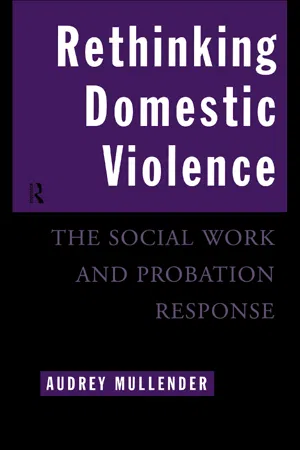
This book explodes the myths concerning domestic violence and explores how the responses of social workers and probation officers to the people involved need to be far better coordinated and more effective.
Information
Chapter 1
The terms of the debate
In recent years there has been a growing intolerance in Britain of the abuse by men of their wives, girlfriends, partners and ex-partners. This can be measured by increased media coverage as well as by changes in policing policy to recognise much of the abuse as criminal behaviour, a rise in the number of domestic violence inter-agency forums intended to co-ordinate practical responses, and belated Government attention—though, at the present time, the latter has yet to be backed up by serious resourcing or legislative change.
These developments have been surprisingly slow to come, as a result of which, although Britain began to originate a nationwide refuge movement as early as 1972 (Dobash and Dobash, 1992, pp.63–7), we currently lag behind parts of the USA, Canada and Australia in giving women and children real hope for safety through adequate public funding of services. The intentions and philosophy of the early feminist campaigners have held firm (pp.87–90), despite public neglect, and the results are there to be turned to: by women experiencing abuse for life-saving assistance, and by statutory professionals for guidance and example. The four Women’s Aid federations of England, Scotland, Wales and Northern Ireland hold the nation’s expertise on men’s abuse of women. They are well-established voluntary organisations which undertake campaigning and offer support to independent, collectively run local refuges1 and related services which conceptualise their committed work for women’s safety within broader goals of personal and social empowerment. There are no bureaucratised refuges run by or employing professional social workers or psychologists in this network as one finds in North America; women living in Women’s Aid refuges make their own decisions, continue to look after their own families, and are supported by workers, still normally in collective structures, who have often been through similar experiences themselves. This keeps UK refuges highly woman-centred.
Women’s organisations in Britain, in a second wave of feminism with roots in the nineteenth and early twentieth centuries, have fought for over twenty years for a national funding base for refuges, for effective rehousing policies, economic and social support for women forced to leave their homes, legislative protection, and effective law enforcement. None of these battles has yet been fully won. It has always been an uphill struggle to get women’s danger and distress taken seriously. In particular, Government has lacked or resisted a comprehensive understanding of the problem that could underpin action across a range of fronts. The Children Act of 1989 (implemented in 1991) makes no mention of domestic violence, for example, yet contact orders made under the Act (see Chapter 7, this volume) can involve men being given details of their ex-partners’ whereabouts. Furthermore, the lack of comprehensive national planning means that gains for women in one area are frequently accompanied by losses in another. Recent research by Malos and Hague (1993), for instance, indicates that proposed improvements in legislation on homelessness have been accompanied by cutbacks in funding for local government housing departments that make rehousing harder than ever. There is also an interplay (or perhaps a vacuum) between agency responses that is counterproductive for women. Many housing departments now expect women to obtain injunctions through the courts, for example (ibid., pp.36–7).
In the mid-1990s, however, Britain does at last appear to be in the midst of a wave of serious attention to the issues at national level,2 however sceptical one may remain about the political motivation underlying some of the moves or the extent of real change they have achieved (Morley, 1993). The police were amongst the first public bodies to set the trend towards change. In 1987, the Metropolitan Police introduced a force order on domestic violence, advising all officers to utilise their existing powers of arrest, since ‘an assault which occurs within the home is as much a criminal act as one which may occur in the street’, followed in 1990 by a set of best practice guidelines. The Home Office (Circular 60/1990) and Scottish Office advised similar improvements for the whole of Britain, based on ‘showing the victim that she is entitled to, and will receive, society’s protection and support [by always considering t]he arrest and detention of an alleged assailant’. Most local police forces (now police services) responded, and the publicity received by such moves, together with pressure on women to report assaults (see Chapter 10, this volume, on public education campaigns aimed at women), increased the numbers of women calling the police and the number of assaults recorded as crimes (see Chapter 2, this volume). Other positive measures mooted in the Home Office Circular that have been widely implemented are police involvement in inter-agency forums, and the establishment of designated Domestic Violence Units (DVUs) or of specialist units combining responses to domestic violence and child sexual abuse. Informal feedback from Women’s Aid does seem to reflect some overall improvement in police responses to women reporting abuse, though remaining problems include inconsistencies between individual officers and continuing feelings on the part of many Black3 women that the police use domestic violence to keep them and their communities under surveillance (Mama, 1993, p.135). Prosecution of abusive men, and for sufficiently serious offences, remains difficult to achieve (e.g. Kennedy, 1992, pp.84–5), and pressure on the police and the Crown Prosecution Service (or equivalent; Procurators Fiscal in Scotland) in this regard continues. Current concerns are that charges are more, rather than less, often being reduced to common assault; that women’s behaviour is too often seen as an aggravating factor, and men’s apparent contrition as a mitigating factor in the situation; and that arrests, charges and imprisonment have all failed to increase as one might have expected (Glass, 1995) despite the changes in policing policy.
The police have not been alone in giving domestic violence greater prominence and, gradually it has come to public attention. Three Appeal Court decisions in 1992, for example, which resulted in the release of women imprisoned for killing violent partners, gained widespread media coverage.
Nineteen ninety-two, in fact, was arguably the pivotal year. It also saw the beginning of inter-ministerial co-operation administered by the Home Office (House of Commons, 1992a, para. 132; see Chapter 10, this volume), and the commencement of a Home Affairs Committee enquiry (which reported in House of Commons, 1992a and 1992b) focusing largely on policing and civil remedies. Lest we were becoming too confident in the likelihood of the establishment setting the pace, however, the Government’s reply to the Home Affairs Committee report (Home Department et al., 1993) was cautious and disappointing. But, before the end of 1992, the issue had become unstoppable. A national inter-agency working party from a voluntary organisation had issued a much cited report which set the probation service, amongst others, on the path towards change (Victim Support, 1992), and Southall Black Sisters—the group that campaigned for the release of Kiranjit Ahluwalia, one of the women driven to kill her abusive husband—had achieved their aim and been awarded a civil liberties prize by a national charity. The issue of women who kill their abusers later went on to occupy a major storyline in a soap opera (Channel 4’s Brookside) for several months—culminating in a trial and a not untypical life sentence for the fictional wife in May 1995—and was picked up throughout the media. All these developments, over a period of several years, combined to rekindle general interest in the issue of domestic violence in national news and current affairs reporting and were accompanied, at local level, by a growing interest in establishing multi-agency forums to co-ordinate existing statutory and voluntary responses (see Chapter 10) and to identify what else needed to be done.
Most recently, the Labour Party’s (1995) ‘Peace at Home’ initiative (which proposes a national strategy on domestic and sexual violence, including strengthened legislation, a funding framework for refuges, improved police practice and housing provision, and more effective public education) has placed domestic abuse more firmly on the national political map. In Europe, Ministerial conferences have drawn up plans of action to combat violence against women. Globally, the Beijing World Conference on Women in 1995, also included this matter as a critical area of concern, with the abuse of women increasingly now being seen around the world as an issue of basic human rights (Bunch and Carrillo, 1992).
As 1995 and 1996 have seen the release from prison of Emma Humphreys (following an appeal) and Sara Thornton (after a retrial led to a conviction for manslaughter rather than murder), it does seem that the tide of popular opinion may be turning towards justice for women who experience abuse, even those who kill as a result. Certainly, the media are becoming more willing to report cases from the perspective of the domestic violence involved, rather than glossing over this. There is still a long way to go, however, both in achieving changes in the law so that it is less punitive towards women (making manslaughter pleas and provocation defences easier, lessening the emphasis on women’s mental health and ending mandatory life sentences for murder) and in switching the focus from women who kill to the far larger number of women who are themselves killed.
THE RECORD OF SOCIAL WORK
Social work has not been at the forefront of any of the positive moves for change, though probation and social services are represented on most of the local inter-agency forums which are springing up. Probation services have begun to respond to the need to work with abusive men through special programmes (see Chapter 9, this volume), but neither probation officers nor social workers have routinely re-examined their workloads to consider how they might use their role and influence to hold abusive men to account for their actions in other ways or—crucially—to help women achieve safety and a greater possibility of caring for their children as they would wish. Furthermore, though probation has a national position statement (Association of Chief Officers of Probation [ACOP], 1992, under revision in 1996), only relatively few local probation services, social services departments, and social-work based voluntary organisations have tackled the issue at a policy level, leaving it to individual practitioners to be more or less concerned—as their personal awareness, their life experience, or their training dictate.
Social workers and social work agencies urgently need to learn more about domestic violence, to understand its seriousness, and to rethink their typical responses in order to achieve greater consistency and a more helpful approach. They need to do this in a context that perceives power and control as exercised not only through gender oppression but also through racism, homophobia and heterosexism, as well as unequal treatment on the grounds of class, disability and age. At the same time, they need to find ways to project a more positive image—so that women subjected to abuse do not simply avoid statutory help for fear of having their children taken into care, their ex-partners enabled to recommence their harassment, or their own experiences discounted.
Social workers and probation officers come into contact with very large numbers of abused women and abusive men, and arguably they are in a better position than many other professionals to take constructive action because they are trained to look for concealed problems, to understand issues in a wider social context, to offer interpersonal support or challenge to achieve personal change over time, and to harness a range of forms of practical and emotional help. Too often, they fail to use the opportunities available to them to identify or respond adequately to women experiencing abuse or to confront abusive men. At the same time, the role of the social worker remains blurred—is it to promote family life, to protect children, to help women and children reach safety or, if a little of all of these, then where is the cut-off point and who decides? Contact with abusive fathers is just one area in which these possible roles can come into conflict. Probation officers, too, are being required to be more concerned with the safety and interests of the victims of crime and the nature of offending behaviour but without effective guidance as to their precise role in relation to abuse. Both groups, social workers and probation officers, have commented to researchers and at conferences that they lack skill and confidence in this area of work owing to lack of essential knowledge (see Chapter 3). They need to know what research can tell us about the realities and causes of abuse, what statutory and community-based resources provide the most appropriate answers, whether particular ways of intervening may increase the dangers and what their own involvement should be. Policy makers need to support their staff with adequate training, resources and information, clear guidelines, and systematic co-operation with other agencies right across the statutory health and welfare, criminal justice, and independent sectors. Where these improvements have been made, there has been a noticeable increase in attempts to tackle men’s abuse of women consistently and effectively.
This book will attempt to engage with all these issues and to help practitioners meet their practical and moral responsibilities in ways which put women and their children at less risk and leave abusive men less likely to continue inflicting harm. It is addressed to all social workers, care managers, probation officers and related professionals, as well as to their managers and those who make the policies and laws that they implement. The term ‘social services’ will be used to embrace social services departments in England and Wales, social work departments in Scotland, and health and social services boards or trusts in Northern Ireland. The text is seen as relevant, not only in these settings, but in the far wider context of health and welfare provision in this country.
TERMINOLOGY
The term ‘domestic violence’ has been used in the title of this book because it is in common everyday and professional use and was judged most likely to alert readers to the book’s content. This is of particular importance in respect of a topic that has been widely neglected in social work and that could not, therefore, afford to lose attention through misunderstanding. Nevertheless, the term has been criticised on several grounds and the author shares all of the following concerns about its inadequacies.
The word ‘domestic’ is challenged for its links with the trivialisation of abuse in the past when, for example, the police would not respond on the same level to an assault if it was ‘just a domestic’ as they would to an assault in a public place. The problem has been a private trouble for too long; it now needs to become a public issue. Today’s ‘domestic’ is too frequently tomorrow’s murder.
The word ‘domestic’ is also inaccurate in the context of domestic violence for three reasons. Firstly, there are other crimes in domestic settings, such as child abuse, that are not encompassed by it. This book will not deal with defining or responding to other forms of family violence such as child abuse and elder abuse, except to explore the overlaps—for example where the same men abuse partners and children, or where women continue to be abused into later years. Secondly, the abuser and the woman he subjects to abuse may have had a relationship but need not actually have lived together. The Victim Support national report (1992, p.6) gives an example of ‘Jolita’, whose long-standing boyfriend had keys to her flat and often stayed there although they had never cohabited. He was jealous and violent; she became depressed. She did not dare to confront him about his behaviour or know where to obtain help. A conceptualisation of domestic violence as relating to husbands and wives or live-in partners would not help women like Jolita to know where to turn. Thirdly, harassment and violence often continue after the woman has attempted to end the relationship and either she or her partner has left. Many murders are committed by ex-partners.
The word ‘violence’ conveys an incomplete impression, since men’s ill-treatment of women takes many forms which combine together into a pattern of intimidation, humiliation and control. It encompasses physical violence, psychological terrorisation, sexual abuse of all kinds including rape, and actual or virtual imprisonment. Economic domination and abuse of male privilege also feature strongly, as does using the children against the woman and abusing them or harming pets to frighten or threaten her. In this book, the term ‘abuse’ will tend to be preferred to ‘violence’ or ‘battering’ since it covers both the physical and sexual assaults and the emotional and mental torment to which many women are subjected by their male partners, including the threats of repeat incidents. Many accounts by women tell of physical attacks interspersed with gestures or glares, for example in public when the man feels he cannot actually hit his partner, which contain the threat of renewed violence and are enough to elicit submission; as a social work student said in a women-only discussion in class: ‘How could I go to anyone for help and tell them “He looked at me”?—that’s not a crime and no one else would even notice it, but it was enough.’
We should beware of working within male definitions which outlaw only the grossest and most public forms of abuse. Even though prosecutions and breaches of court orders, for example, must remain for the time being couched within legal language constructed by men, social workers and probation officers have opportunities for professional conversations with women which, with sensitivity and support, could work from women’s understandings. We know, for example, that marital rape has been recognised by the courts in England and Wales as a criminal offence only since an Appeal Court ruling in March 1991 (previously a woman was ‘deemed to have consented to sexual intercourse on marriage’: Maynard, 1993, p.102). Kelly (1988a and 1988b) broadens our understanding of sexual abuse in intimate relationships beyond the purely legalistic by listening to women’s own accounts. Sex can be coerced, unwanted, or consented to under the pressure of continual fear without satisfying legal definitions of rape; the woman feels sullied and demeaned but may be aware that no crime has been committed, may see herself as performing her wifely duty or fulfilling her female destiny, or may lack the language to conceptualise her experiences as abusive (as indeed we all did until Kelly’s and related groundbreaking work). The social expectation upon her to regard behaviour that feels abusive as normal and inevitable will contribute to the feelings of worthlessness and isolation and the suspicion of going crazy engendered by all the other abuses and taunts. The social work, police or health professional who understands abuse as part of a continuum of unwanted, coercive, cruel and gendered b...
Table of contents
- COVER PAGE
- TITLE PAGE
- COPYRIGHT PAGE
- PREFACE
- ACKNOWLEDGEMENTS
- INTRODUCTION
- CHAPTER 1: THE TERMS OF THE DEBATE
- CHAPTER 2: WHAT DO WE KNOW ABOUT DOMESTIC VIOLENCE?
- CHAPTER 3: SOCIAL WORK AS PART OF THE PROBLEM
- CHAPTER 4: DEVELOPING GOOD PRACTICE IN SOCIAL SERVICES DEPARTMENTS
- CHAPTER 5: RESPONSES TO DOMESTIC ABUSE IN HEALTH AND ADULT CARE SETTINGS
- CHAPTER 6: THE NEEDS OF CHILDREN LIVING WITH DOMESTIC ABUSE
- CHAPTER 7: SOCIAL WORK AND PROBATION PRACTICE WITH FAMILIES
- CHAPTER 8: THE PROBATION SERVICE AND DOMESTIC VIOLENCE
- CHAPTER 9: THE MEN WHO ABUSE: WHAT KIND OF INTERVENTION IN GROUPS?
- CHAPTER 10: WORKING TOGETHER FOR CHANGE: THE WIDER CONTEXT AND THE EMPOWERMENT OF WOMEN
- NOTES
- REFERENCES
Trusted by 375,005 students
Access to over 1.5 million titles for a fair monthly price.
Study more efficiently using our study tools.
Frequently asked questions
Yes, you can cancel anytime from the Subscription tab in your account settings on the Perlego website. Your subscription will stay active until the end of your current billing period. Learn how to cancel your subscription
No, books cannot be downloaded as external files, such as PDFs, for use outside of Perlego. However, you can download books within the Perlego app for offline reading on mobile or tablet. Learn how to download books offline
Perlego offers two plans: Essential and Complete
- Essential is ideal for learners and professionals who enjoy exploring a wide range of subjects. Access the Essential Library with 800,000+ trusted titles and best-sellers across business, personal growth, and the humanities. Includes unlimited reading time and Standard Read Aloud voice.
- Complete: Perfect for advanced learners and researchers needing full, unrestricted access. Unlock 1.5M+ books across hundreds of subjects, including academic and specialized titles. The Complete Plan also includes advanced features like Premium Read Aloud and Research Assistant.
We are an online textbook subscription service, where you can get access to an entire online library for less than the price of a single book per month. With over 1.5 million books across 990+ topics, we’ve got you covered! Learn about our mission
Look out for the read-aloud symbol on your next book to see if you can listen to it. The read-aloud tool reads text aloud for you, highlighting the text as it is being read. You can pause it, speed it up and slow it down. Learn more about Read Aloud
Yes! You can use the Perlego app on both iOS and Android devices to read anytime, anywhere — even offline. Perfect for commutes or when you’re on the go.
Please note we cannot support devices running on iOS 13 and Android 7 or earlier. Learn more about using the app
Please note we cannot support devices running on iOS 13 and Android 7 or earlier. Learn more about using the app
Yes, you can access Rethinking Domestic Violence by Audrey Mullender in PDF and/or ePUB format, as well as other popular books in Medicine & Health Care Delivery. We have over 1.5 million books available in our catalogue for you to explore.