In this new paperback edition of Early Civilizations of the Old World, Charles Keith Maisels traces the development of some of the earliest and key civilizations in history. In each case the ecological and economic background to growth, geographical factors, cross-cultural intersection and the rise of urbanism are examined, explaining how particular forms of social structure and cultural interaction developed from before the Neolithic period to the time of the first civilizations in each area.
This volume challenges the traditional assumption of a band-tribe-chiefdom-state sequence and instead demonstrates that large complex societies can flourish without social classes and the state, as dramatically shown by the Indus civilization. Such features as the use of Childe's urban revolution theory as a means of comparison for each emerging civilization and the discussion of the emergence of archaeology as a scientific discipline, make Early Civilizations of the Old World a valuable, innovative and stimulating work.
eBook - ePub
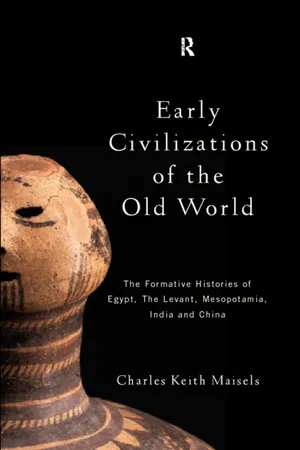
Early Civilizations of the Old World
The Formative Histories of Egypt, The Levant, Mesopotamia, India and China
- 504 pages
- English
- ePUB (mobile friendly)
- Available on iOS & Android
eBook - ePub
Early Civilizations of the Old World
The Formative Histories of Egypt, The Levant, Mesopotamia, India and China
About this book
1
HOW DOES THE PAST ILLUMINATE THE PRESENT?1
time by itself does not exist; but from things themselves there results a sense of what has already taken place, what is now going on and what is to ensue. It must not be claimed that anyone can sense time by itself apart from the movement of things or their restful immobility.
(Lucretius De Rerum Natura, trans. R.Latham, 1951)
What are the operating principles upon which the world is based? How do things in nature and society work and how do they inter-react? We need to know this to make some sense of our lives. For consciousness itself has a double aspect: self-awareness and awareness of environment: the inside and the outside world. The comprehension of each is of course highly problematic and answers can be wrung only from their interrelation.
It is easy to see the relevance of anthropology to answering the question of why the world is the way it is: anthropologists study other societies by participating in them, so what is learned from one, or better still, several, helps us to understand others.
But why bother with ancient societies if it is present and near-future society you want to understand? For this it is surely politics and economics you need, anthropology, plus a close watch on emerging technologies? What have long-gone societies got to do with the here-and-now and the Internet? A lot more than you might think.
In the first place, ancient societies are interesting as a form of anthropology. If we can get a fairly full picture of what any ancient society was like and what went on there, from that we can learn the same sorts of things about social organization and human motivation as we can from the study of living societies: what forces shape them and what ongoing effects those particular patterns have. In the second place, there is the role of ancient societies in chains of cause and effect. Science consists of establishing chains of cause and effect—that is, of specifying mechanisms.
In Western Europe we are all at least vaguely aware that the modern period was preceded by the medieval (‘feudal’) period, which was separated by a Dark Age from the previous period of the Roman Empire. Most people also know that the Roman Empire existed for several centuries before and after the time of Christ, which, from the calendar, was obviously about 2,000 years ago. But we know too that ‘the glory that was Greece’ was a bit earlier than Rome and that one of the major glories of Greece was its remarkably broad breakthrough into rational science, philosophy and drama. But did it not do this on the basis of the newly acquired alphabetic script, and did this not come from the ‘Phoenicians’ who inhabited the Mediterranean’s eastern shoreline (the Levant)? The Levant is halfway between the earlier civilizations on the Nile and the Tigris and Euphrates rivers (Mesopotamia). Egyptians and Mesopotamians had different ways of writing, with the Egyptian more or less pictorial, the Mesopotamian formed by marking wedges in wet clay using a stylus. Could it not be, therefore, that the alphabetic writing that has been so important in shaping the modern world was the outcome of the interaction of Mesopotamian and Egyptian civilizations?
Well, it is; archaeology tells us so. And if this is true of writing, what of other forms of culture, with culture defined as the cumulative intergenerational transmission of techniques (technology), beliefs and institutions?2 This results in shared conceptions and perceptions of reality and the standards which flow from that. In terms of formative beliefs and institutions, the Near East is the region in which the Old Testament, the New Testament and the Koran were written. This is something that could not have taken place without the prior existence of thousands of years of complex society and the state,3 and indeed of recorded theological thinking (cf. Malamat 1989).
Archaeology shows us that recording and calculation techniques, which are essential for the progress of complex thought, have their origins around 3000 BC in Egypt and Sumer (Iraq). But this period is also the one when states had just recently come into existence in Egypt and Mesopotamia, so where did the state come from? It arose on the basis of a relatively dense population numerous enough to fill towns and cities. So how did that come about?
The basis was successful farming villages multiplying and expanding over previous millennia. But humankind had only quite recently become farmers - well within the last 10,000 years—before that all were hunter-gatherers. How did this transition occur and, more important, why? After all, farming marks a whole new way of life, employing new technologies and forms of organization, so it could not be a matter of chance discoveries. And anyway farming is both risky and hard, so why bother? What really happened? Did all the game animals die out, or what? The general answer lies in ‘process’, while the specific answer turns upon the way in which initially small human choices have cumulatively large and unintended consequences. In other words, it is all down to chains of cause and effect!
As we look about us it is clear that we are embedded within everlengthening chains of cause and effect. The origins of mathematics lie between 3000 BC and 2000 BC, and those of astronomy and physics too. The Sumerians developed the positional or place value notation, and, well beyond Pythagorean ‘triples’, knew the value of root-two accurate to six decimal places. Does this matter for where we are today as I type this into my PC?
It matters for several reasons, one of which is sheer intellectual curiosity concerning origins. A second, and related, reason is that to comprehend the world and our place in it we need to have an integrated mental map situating us in time and space. The spatial map has, of course, to be a good representation of what the surface of the earth looks like in terms of landmasses, oceans, mountain chains, rivers, forests and deserts. This tells us what is where. The time-map is, of course, about what went on, when and where. And without an integrated spacetime grid relating events and processes to places, we are left wandering in the kaleidoscope world of myth where we are prey to all kinds of vapourings and fairy-stories. The twentieth century has, after all, been the century of hallucinatory fairy-stories for the masses—in other words of totalitarian political ideologies—intended, after a period of mass mobilization and war, to result in a closed society with a ‘final’ end to real, evolutionary change.
From a broad understanding of the past, by tracing linkages, we can learn about the processes of evolution, natural and social, to which we are all individually and collectively subject. And then maybe we can do something about it in the here and now. At the very least we will have satisfied our need to know how things came to be the way they are.
For this archaeology is essential. Historical accounts rely on texts and inscriptions. Writing is only 5,000 years old, and even where it survives (and can be read) it is so fragmentary that it cannot possibly answer the range of questions we need answered about the constitution of societies, their origins and dynamics. By going straight to the physical evidence of what nature has provided and what people have actually done—material remains of tools fashioned, earth dug, animals killed, structures built, pottery shaped and painted, meals eaten, and so forth—archaeology both circumvents and complements the partiality of texts. Those anyhow could never deal with early formative processes, such as the origins of farming, or, way back beyond this, to the very origins of culture itself (Knight and Maisels 1994; Knight et al. 1995).
It is, then, the task of this book, by employing archaeology, anthropology and some textual material, to try to answer those questions concerning the formative processes of the four originating civilizations of the Old World: Egypt, Levant/Mesopotamia, India and China.
First we must know how archaeology emerged and why only so comparatively recently.
THE EMERGENCE OF ARCHAEOLOGY AS A SCIENTIFIC DISCIPLINE
There are three basic requirements for a discipline to come into being: the social basis, the intellectual basis and the specific theoretical apparatus of the discipline (the latter is a set of linked operational concepts and methodology).
This set of requirements runs from the broadest and most encompassing—the social order—through the intellectual, to the most particular or technical, and of course back again to the social, changing as a consequence of new inputs from technical advances. Nonetheless, the major factor in social change is economic activity, and it is economic expansiveness which, if sustained, provides the social conditions for a broad cultural, intellectual and technical dynamic which are the pre-requisites of science.
The social basis
The technological package put together in northwestern Europe by the sixteenth century under expanding mercantile conditions meant that technology could expand in scope and develop in depth at an accelerating rate. As it did so, transforming not only the economy but the social order, ideas necessarily underwent sustained development. Empirical and technical information became sounder and denser. As the new knowledge was systematized, old disciplines were transformed and new ones emerged. So the broad cultural basis for archaeology was not just widespread literacy and numeracy, but the whole mind-and indeed universe-expanding enterprise of the post-Renaissance period, culminating in the Enlightenment of the eighteenth century.
The socio-political characteristics of the Georgian period in Britain are, of course, those of the ruling Whig aristocracy, themselves a product of trade (and closely allied to the London ‘money interest’, or financiers), in opposition to the ‘country party’ of traditional lesser gentry or ‘squirearchy’, who supported the Tory Party. A working and liberal aristocracy (Baugh 1975:8–13), Whig self-confidence and therefore openness to new ideas, were a consequence of ‘the concentration of wealth and both political and social authority in the hands of one small, unchallenged class, sophisticated, civilised and, except for purposes of sport, urban in its inclinations’ (Steegman 1986:xv).
Writing generally of ‘the rule of taste’ in the eighteenth century, Steegman observes that by the middle of the century antiquarianism had already become the fashion.
Not that every squire or wealthy nabob who Gothicised his country seat during the 1750’s and 1760’s was a mediaeval scholar; but there was certainly, after about 1740, a widespread interest among educated people in archaeology, and an interest in the past became a fashionable affectation.
(ibid.: 80–1)
Like the seventeenth century the eighteenth tended to think of itself as old in time. Only a few scientists and philosophers were beginning to think in terms of a time-scale so vast that the few millennia of recorded history became insignificant. But age now signified maturity rather than decay. Men compared their civilization with historical Greece and Rome, rather than with classical legend and the Old Testament and its uncompromising story of the Fall.
(Hampson 1968:147)
Although the likes of Samuel Johnson regarded contemporary writers as pale reflections of classical authors,
the fire had gone out of the controversy between ‘ancients’ and ‘moderns’. Where civilizations, rather than individual authors, were concerned, most people—for the first time perhaps in modern history—preferred their own age to any that had gone before. Johnson himself could pontificate, in a different mood “I am always angry when I hear ancient times praised at the expense of modern times. There is now a great deal more learning in the world than there was formerly, and it is universally diffused”.
(ibid.)
Thus classicism was used in a new unslavish way which had stimulating effects on the built, as well as the mental and natural landscapes. Ancient Greece and Rome, the latter championed against the former by the Venetian architect Piranesi (whose Antiquita Romane was published in 1748), provided architectural, artistic and political models for the Age of Enlightenment. One of the Enlightenment’s political monuments was the United States Constitution. Logically, neo-classicism became the dominant architectural style.
The elegant neo-classical style and the buildings of Robert and James Adam are well known, especially to graduates of Edinburgh University. Less well known perhaps is that theirs was not a ‘bookish’ style drawn from Vitruvius and Palladio (or even Piranesi, whom Robert Adam greatly admired), but was developed from Robert’s own studies in Rome and on the Dalmatian coast at Split. He made hundreds of drawings in Rome, where he also studied and was greatly influenced by the public baths of Caracalla and Diocletian (Bryant 1992: 6). Working with assistants, Robert measured and drew Diocletian’s enormous palace at Split (currently occupied by private dwellings) in July and August of 1757. This was published in 1764 as The Ruins of the Palace of the Emperor Diocletian at Spalatro, in Dalmatia, with engravings supervised by the French architect Charles-Louis Clerisseau (ibid.: 14).
The pre-Christian Graeco-Roman world was thus no longer filtered through Renaissance rediscovery. In addition to knowledge of Latin and Greek, first-hand experience of its monuments was expected, and was a prime purpose of the Grand Tour undertaken by gentlemen and aristocrats. Such travellers tended just to visit; scholars and artists stayed and recorded, as, for example, James ‘Athenian’ Stuart and Nicholas Revett, who spent the years 1751–1754 in Athens measuring, drawing and recording (Daniel 1975:21). Their first volume of the Antiquities of Athens was published in 1762, financed by the Society of Dilettanti. Formed in 1732, the Dilettanti also paid for the ‘first Ionic expedition’ of 1764 by Revett, Richard Chandler and William Pars, published as the Antiquities of Ionia between 1769 and 1797. In 1766, Chandler identified the site of ancient Olympia. Earlier, in 1753 and 1757, Robert Wood published scholarly accounts of his travels with James Dawkins through Greece, Asia Minor, Syria and Palestine. His Ruins of Palmyra (1753) and the Ruins of Baalbek (1757) by Wood and Dawkins was followed in 1758 by Le Roy’s Ruines des plus Beaux Monuments de la Grèce.
As the Industrial Revolution flowed from the Mercantile Revolution over the following hundred years, all manner of things became possible, most importantly the nineteenth-century scientific revolution in which Charles Lyell and Charles Darwin are pre-eminent. In turn they helped provide further intellectual space for the emergence of archaeology by pushing back the time-span during which the earth and mankind had existed (‘deep time’) and which therefore made an evolutionary ‘prehistory’ of man inevitable. However, the term ‘prehistory’ was not even used in English until 1851, when Daniel Wilson published his work on The Archaeology and Prehistoric Annals of Scotland, though in French it had been used by d’Eichthal in a paper published in 1845 (Clermont and Smith 1990: 98–9). Wilson also seems to have been the first to use the term ‘archaeology’ in its modern form and fully modern reference.
The intellectual basis
From the Renaissance to the Enlightenment, Europe contained a class of scholar peculiar to it, and those were the antiquarians, people who had an abiding curiosity about artefacts as such: who wanted to know who had made them, when, why and how (see Evans 1956). Those artefacts could be anything from henge monuments to barrows, other earthworks, worked stones—anything in fact for which the origins and use were not apparent. Now the usual approach of their time was to scan the ancient authors, preferably classical, for ‘answers’. Since, however, few if any of the above remains were actually mentioned in any text, these artefacts were simply assigned to peoples and periods ‘known’ from ancient authors or the Bible, or, worse still, were assigned to mythical kings and conquests by ‘inference’, for which read ignorance.
But the antiquarians were not content with this literary-speculative approach. Though they were often ultimately reduced to such modes of explanation, they got out and interrogated the monuments by measurement and comparative survey, and by the collection and association of artefacts. In other words, they provided wholly new and independent sources for the writing of history, and rationalist history at that. For antiquarianism was an aspect of the post-Renaissance enquiry into the world at large, which, associated centrally with map making, came to change qualitatively the mediaeval world-picture amongst the educated.
During the sixteenth century
triangulation by means of compass, plane table and sight rule (the alidade), became commonplace, with numerous illustrated handbooks to enable amateurs to do it themselves. From hilltops and church towers, or towing measuring wheels along the roads, the recording of Europe’s surface passed into the hands of hundreds of surveyors, highly skilled or merely ...
Table of contents
- Cover
- Halftitle
- Dedication
- Title
- Copyright
- Contents
- List of figures
- List of tables
- Preface and acknowledgements
- Glossary
- 1 How Does the Past Illuminate the Present?
- 2 Sema-Tawy: The Land of the Papyrus and Lotus
- 3 The Levant and Mesopotamia
- 4 The Indus/‘Harappan’/Sarasvati Civilization
- 5 The Central Kingdom, Zhong-Guo
- 6 Conclusion: The Emergence of Social Complexity
- Appendices
- Notes
- Bibliography
- Index
Trusted by 375,005 students
Access to over 1.5 million titles for a fair monthly price.
Study more efficiently using our study tools.
Frequently asked questions
Yes, you can cancel anytime from the Subscription tab in your account settings on the Perlego website. Your subscription will stay active until the end of your current billing period. Learn how to cancel your subscription
No, books cannot be downloaded as external files, such as PDFs, for use outside of Perlego. However, you can download books within the Perlego app for offline reading on mobile or tablet. Learn how to download books offline
Perlego offers two plans: Essential and Complete
- Essential is ideal for learners and professionals who enjoy exploring a wide range of subjects. Access the Essential Library with 800,000+ trusted titles and best-sellers across business, personal growth, and the humanities. Includes unlimited reading time and Standard Read Aloud voice.
- Complete: Perfect for advanced learners and researchers needing full, unrestricted access. Unlock 1.5M+ books across hundreds of subjects, including academic and specialized titles. The Complete Plan also includes advanced features like Premium Read Aloud and Research Assistant.
We are an online textbook subscription service, where you can get access to an entire online library for less than the price of a single book per month. With over 1.5 million books across 990+ topics, we’ve got you covered! Learn about our mission
Look out for the read-aloud symbol on your next book to see if you can listen to it. The read-aloud tool reads text aloud for you, highlighting the text as it is being read. You can pause it, speed it up and slow it down. Learn more about Read Aloud
Yes! You can use the Perlego app on both iOS and Android devices to read anytime, anywhere — even offline. Perfect for commutes or when you’re on the go.
Please note we cannot support devices running on iOS 13 and Android 7 or earlier. Learn more about using the app
Please note we cannot support devices running on iOS 13 and Android 7 or earlier. Learn more about using the app
Yes, you can access Early Civilizations of the Old World by Charles Keith Maisels in PDF and/or ePUB format, as well as other popular books in History & Historical Geography. We have over 1.5 million books available in our catalogue for you to explore.