eBook - ePub
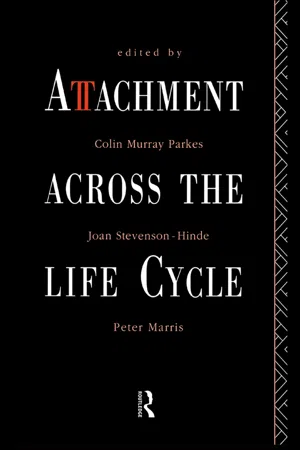
Attachment Across the Life Cycle
- 320 pages
- English
- ePUB (mobile friendly)
- Available on iOS & Android
eBook - ePub
Attachment Across the Life Cycle
About this book
To explain and understand the patterns that attachment play in psychiatric and social problems a body of knowledge has sprung up which owes much to the pioneering work of the late John Bowlby. This book draws together recent theoretical contributions, research findings and clinical data from psychiatrists, psychologists, sociologists and ethologists from Britain, America and Europe.
Information
Part I
The Nature of Attachment
Chapter 1
The roots and growing points of attachment theory 1
Inge Bretherton
Attachment theory in its current form is the joint work of John Bowlby and Mary Ainsworth. John Bowlby, using concepts from ethology, cybernetics, and psychoanalysis, formulated the basic outlines of the theory. We owe to him a new way of thinking about the infant’s tie to the mother, and its disruption through separation and deprivation. Mary Ainsworth not only translated the basic tenets of attachment theory into empirical findings, but also helped us to expand the theory itself. Her two major theoretical contributions were the explanation of individual differences in attachment relations and the concept of the caregiver as secure base.
This paper delineates the historical development of attachment theory. It is divided into four parts. First, I show that the basic ideas guiding both protagonists’ later contributions have roots in their early professional career. I then go on to discuss the development of the theory, laying out the sequence in which Bowlby proposed its basic postulates at the same time as Mary Ainsworth began to test and expand them in her empirical studies. The third part of the paper is devoted to a brief review of work on the validation and consolidation of attachment theory. Finally, I discuss future directions of attachment theory and research.
ROOTS
John Bowlby
John Bowlby was born in 1907. I am sure that experiences in his childhood must have played a role in directing his interest toward the study of attachment. However, Bowlby himself begins his intellectual autobiography with studies at the University of Cambridge where he read medicine, upon the advice of his surgeon father (see interviews with Senn (1977a) and Smuts (1977)). In his third year of study, John Bowlby became drawn to what would later be known as developmental psychology, and he temporarily gave up plans for a medical career.
After graduation he pursued his newfound interest through volunteer work at two progressive schools, the second a small analytically oriented residential institution that served about 24 maladjusted children, aged 4–18 years. Bowlby is modest about his actual work at the school: ‘I don’t think I would like to describe what I did – I did my best’. Two children there had an enormous impact on him. One was a very isolated, remote, and affectionless teenager with no experience of a stable mother figure. This child had been expelled from his previous school for stealing. The second child was an anxious boy of 7 or 8 who trailed Bowlby around, and was known as his shadow (Ainsworth 1974). An additional major influence on Bowlby’s development was John Alford, one of the other volunteer staff at the school (later a professor of art at Toronto). It was with him that Bowlby spent many hours discussing the effect of early family experience, or lack of it, upon character development (see Senn (1977a)).
By the time Bowlby’s volunteer service came to an end, John Alford had successfully persuaded him to resume his medical studies in order to pursue training in child psychiatry and psychotherapy so that he might further pursue his ideas about family influences upon children’s development. Bowlby had accepted Alford’s advice reluctantly because he did not look forward to the medical training which was required as the passport to psychiatry. A saving grace was his immediate acceptance into the British Psychoanalytic Society as a student-candidate. His analyst there was Joan Riviere who was a friend of and much influenced by Melanie Klein.
Interestingly, training in psychiatry and psychoanalysis provided Bowlby with a reasonably tolerant environment in which to develop his own ideas, but the direct impact on his thinking was relatively small. Much more influential than the analysts and psychiatrists who had been his teachers were two social workers whom he encountered during his stint as a fellow at the London Child Guidance Clinic upon completion of his training. These two individuals shared his ideas about the importance for healthy development of a child’s early family experience.
Throughout this period, Bowlby felt very strongly that psychoanalysis was putting far too much emphasis on the child’s fantasy world and far too little on actual events. He expressed this view in an interesting paper which already contains many of the ideas which were later to become central to attachment theory (Bowlby 1940). In emphasizing the influence of early family environment on the development of neurosis, he claims (p. 2) that ‘psychoanalysts like the nurseryman should study intensively, rigorously, and at first hand (1) the nature of the organism, (2) the properties of the soil and (3) the interaction of the two’. Bowlby dwells on the adverse effects of early separation, advising mothers to visit their young children in hospitals. He suggests that for mothers with parenting difficulties
a weekly interview in which their problems are approached analytically and traced back to childhood has sometimes been remarkably effective. Having once been helped to recognize and recapture the feelings which she herself had as a child and to find that they are accepted tolerantly and understandingly, a mother will become increasingly sympathetic and tolerant toward the same things in her child.
(Bowlby 1940:23)
This quotation demonstrates that Bowlby’s interest in the intergenerational transmission of attachment relations dates from the very beginning of his professional career. The psychoanalytic object relations theories that were later put forth by Fairbairn (1952) and Winnicott (1965) were congenial to Bowlby in a number of ways, but his thinking about parent–child relationships developed independently of them.
Following his own injunction for more rigorous studies, Bowlby used case-notes from his work at the child guidance clinic to prepare the classic paper on ‘Forty-four juvenile thieves, their characters and home lives’ (published in revised form in 1944). A significant minority of the children turned out to have affectionless characters, a phenomenon Bowlby linked to their histories of maternal deprivation and separation.
During these early years in child psychiatry, Bowlby was also strongly influenced by two economists with whom he shared a house. These academic friends engaged him in frequent debates about the scientific status of psychoanalysis. Bowlby feels that he owes his academic orientation to their searching questions. With one of these friends, Evan Durbin, he wrote a book entitled Personal Aggressiveness and War which interestingly (in light of later attachment theory) contains a long section on aggression and social bonds in nonhuman primates (Durbin and Bowlby 1939). Moreover, in seeking corroboration for his ideas from outside psychoanalysis, Bowlby was already using an approach which stood him in good stead when he began to formulate attachment theory.
World War II led to an interruption in Bowlby’s budding career as a child psychiatrist, but his development as a scientist continued. The army brought him in contact with several people who later formed the core of the post-war Tavistock Clinic and Institute of Human Relations. The group included psychiatrists, analysts, and psychologists, among them Henry Dicks, Ronald Hargreaves, Wilfred Bion, Adrian Stephen, Jock Sutherland, John Rickman, and Eric Trist. Some of them worked on officer selection procedures. Bowlby’s special responsibility was the validation of these procedures, using large-scale survey techniques. As he put it, this experience was ‘like doing a Ph.D. thesis in psychology under the guidance of Eric Trist and Jock Sutherland’. In response to their influence he began to rewrite the paper on the 44 juvenile thieves ‘in a good deal better form than it had been before’ (Senn 1977a). Indeed, the revised paper is noticeably different from Bowlby’s earlier work: all the evidence on which his conclusions are based is presented in detail and statistically, not just intuitively, evaluated. Bowlby summarizes the findings thus:
The result has been that certain specifically adverse circumstances have been identified and their significance demonstrated both statistically in the whole group and clinically in a few individual cases. The conclusion has been drawn that, had it not been for certain factors inimical to the healthy development of the capacity for object-love, certain children would not have become offenders.... These findings thus not only confirm the general psychoanalytic thesis that it is the early years which count in character development, but demonstrate beyond doubt that the elucidation of the problem of juvenile delinquency is dependent upon psychoanalytic investigation.
(Bowlby 1944:53)
Upon returning from army service in 1945, Bowlby became head of the Children’s Department at the Tavistock Clinic. In order to highlight the importance of the parent-child relationship, he promptly renamed it the Department for Children and Parents. Unlike most psychoanalysts of his time, Bowlby was deeply interested in finding out the actual patterns of family interaction involved in both healthy and pathological development.
Directing the Department for Children and Parents meant running a clinic, undertaking training, and doing research. To Bowlby’s chagrin, much of the clinical work in the Department was done by people with a Kleinian orientation who regarded his emphasis on actual family interaction patterns as not very relevant. Because of this theoretical rift, Bowlby could not use the Department’s clinical cases for the research he wanted to pursue. This led him to found his own research unit, not connected to the clinical work going on at the Tavistock.
Mary Ainsworth
Let us now turn to Mary Ainsworth, née Salter. She was born in 1913 in Ohio, but her family soon moved to Toronto where she later attended the University, specializing in psychology. In the course of her early graduate studies, she came under the influence of William Blatz who had developed security theory (Blatz 1940). Blatz subsequently asked her to pursue her doctoral studies with him, helping to further extend Blatz’s theory. The resulting dissertation was entitled: ‘An Evaluation of Adjustment Based on the Concept of Security’. Mary Salter obtained her Ph.D. in 1939 (the published version appeared in 1940). The collaboration with Blatz was to have a major impact on her future contribution to attachment theory.
Although security theory owed much to Freud, Blatz did not openly acknowledge this link, because of the strong anti-psychoanalytic bias that prevailed at the University of Toronto during this time (Ainsworth 1983). One of the major tenets of security theory is that infants and young children need to develop a secure dependence on parents before launching out into unfamiliar situations where they must cope on their own. Secure dependence provides a basis for learning the skills and developing the knowledge that make it possible to depend confidently on self and gain secure emancipation from parents. Indeed, secure dependence on parents should gradually become supplanted by mature secure dependence on peers, and eventually on a heterosexual partner. Blatz felt that secure independence is an impossibility. In her dissertation, Mary Salter states it this way:
Familial security in the early stages is of a dependent type and forms a basis from which the individual can work out gradually, forming new skills and interests in other fields. Where familial security is lacking, the individual is handicapped by the lack of what might be called a secure base from which to work.
(Salter 1940:45; italics mine)
Her dissertation research involved the construction of two self-report paper and pencil scales to assess college students’ familial and extrafamilial security, validated against the same students’ autobiographical narratives. A classification procedure was used on these scales and related to the narratives, already foreshadowing procedures later used in attachment research.
Upon completion of her dissertation in 1939, Mary Salter became a lecturer at the University of Toronto. The war began shortly thereafter, causing her colleague Blatz to leave Toronto to set up war-time nurseries in Britain. Three years later she decided to join the Canadian Women’s Army Corps where, for a short period of time, her work as an army examiner included counseling, testing, interviewing, and history-taking which gave her a taste for clinical work. However, all too soon she was ‘dragged to Headquarters for an administrative job’ (personal communication, 1989). After post-war work with rehabilitation services, she returned to the University of Toronto where she was asked to teach a course on personality assessment. To prepare for this assignment she volunteered her services in the Veterans Hospital and took workshops with Bruno Klopfer. This training with Klopfer ultimately led to a book on the Rorschach Test with Klopfer (Klopfer et al. 1954) which is still in print. In addition, she renewed her collaboration with Bill Blatz to refine the security scales originally devised for her dissertation. Her extensive experience in diagnostics and instrument development was to be important later in the development of attachment classifications.
In 1950 Mary Salter married Leonard Ainsworth, a World War II veteran and graduate student in psychology at Toronto. The Ainsworths decided that Leonard would continue his Ph.D. studies in London rather than Toronto where his wife was on the faculty. Upon arriving in London Mary Ainsworth was without an appointment, but a friend from her army days drew her attention to an advertisement in the London Times Educational Supplement for a position at the Tavistock Clinic. The position happened to involve research, under the direction of John Bowlby, into the effect on personality development of separation from the mother in early childhood. Joining Bowlby’s research unit reset the whole direction of Mary Ainsworth’s professional career (Ainsworth 1983).
THE DEVELOPMENT OF ATTACHMENT THEORY
Phase 1
Bowlby had chosen to focus the efforts of his research team on a well-circumscribed area: mother–child separation. He did so because separation is a clearcut event that either happens or does not happen. He felt that it would have been too difficult to demonstrate environmental influences on the parent–child relationship by studying its subtler aspects (a task later tackled by Mary Ainsworth).
In 1948, after obtaining his first research funds, Bowlby hired James Robertson to do observations of young children who were hospitalized, institutionalized, or otherwise separated from their parents. During the war years Robertson, a conscientious objector, had been employed in Anna Freud’s Hampstead residential nursery as a boilerman. In a moving interview with Milton Senn (1977b), Robertson explained that everyone on the staff at the nursery, regardless of the nature of their work and background, was required by Anna Freud to write up observations about the nursery children on cards that were then used in weekly teaching sessions. As a result of these sessions, Robertson came out of the Hampstead Nurseries with a much more thorough training in child observation than many people get in academic settings. After the war, he became a psychiatric social worker and began psychoanalysis.
At this point I would like to digress for a moment to discuss Bowlby’s views regarding the sometimes incompatible attitudes held by researchers and clinical workers (Smuts 1977). Clinicians, says Bowlby, feel that researchers are remote from everyday life, whilst researchers believe that clinicians are fuzzy-headed, inclined to engage in leaps in the dark, hunches, and guesswork. The underlying cause for this difference in attitude is that clinicians have to take action, whereas researchers are able to reflect on a narrow area of study to unravel ‘do-able’ problems. Clinicians apply a theory, whereas researchers try to test it. Not many people find it congenial to w...
Table of contents
- COVER PAGE
- TITLE PAGE
- COPYRIGHT PAGE
- CONTRIBUTORS
- INTRODUCTION
- PART I THE NATURE OF ATTACHMENT
- PART II PATTERNS OF ATTACHMENT
- PART III CLINICAL APPLICATIONS
- POSTSCRIPT
Trusted by 375,005 students
Access to over 1.5 million titles for a fair monthly price.
Study more efficiently using our study tools.
Frequently asked questions
Yes, you can cancel anytime from the Subscription tab in your account settings on the Perlego website. Your subscription will stay active until the end of your current billing period. Learn how to cancel your subscription
No, books cannot be downloaded as external files, such as PDFs, for use outside of Perlego. However, you can download books within the Perlego app for offline reading on mobile or tablet. Learn how to download books offline
Perlego offers two plans: Essential and Complete
- Essential is ideal for learners and professionals who enjoy exploring a wide range of subjects. Access the Essential Library with 800,000+ trusted titles and best-sellers across business, personal growth, and the humanities. Includes unlimited reading time and Standard Read Aloud voice.
- Complete: Perfect for advanced learners and researchers needing full, unrestricted access. Unlock 1.5M+ books across hundreds of subjects, including academic and specialized titles. The Complete Plan also includes advanced features like Premium Read Aloud and Research Assistant.
We are an online textbook subscription service, where you can get access to an entire online library for less than the price of a single book per month. With over 1.5 million books across 990+ topics, we’ve got you covered! Learn about our mission
Look out for the read-aloud symbol on your next book to see if you can listen to it. The read-aloud tool reads text aloud for you, highlighting the text as it is being read. You can pause it, speed it up and slow it down. Learn more about Read Aloud
Yes! You can use the Perlego app on both iOS and Android devices to read anytime, anywhere — even offline. Perfect for commutes or when you’re on the go.
Please note we cannot support devices running on iOS 13 and Android 7 or earlier. Learn more about using the app
Please note we cannot support devices running on iOS 13 and Android 7 or earlier. Learn more about using the app
Yes, you can access Attachment Across the Life Cycle by Colin Murray Parkes, Joan Stevenson-Hinde, Peter Marris, Colin Murray Parkes,Joan Stevenson-Hinde,Peter Marris in PDF and/or ePUB format, as well as other popular books in Psychology & Developmental Psychology. We have over 1.5 million books available in our catalogue for you to explore.