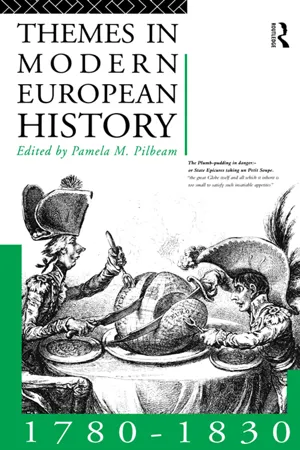
Themes in Modern European History 1780-1830 is an authoritative and lively exploration of a period dominated by events which have shaped modern Europe. In a series of articles, six leading academics present some controversial conclusions:
* the east/west contrast in Europe today has more to do with responses to the French Revolution of 1789 than the Russian Revolution of 1917
* the conservative Europe of 1814 was the product of the Romantic imagnation, not a `Restoration' of the old regime
Spanning political, social, economic and demographic facets of revolutions, this is an indispensable textbook for all students of the nineteenth century, and for all those interested in understanding the nature of Europe today.
- 280 pages
- English
- ePUB (mobile friendly)
- Available on iOS & Android
eBook - ePub
Themes in Modern European History 1780-1830
About this book
Chapter 1
Introducing Europe in revolution and war
‘Men are born free and remain free and equal in their rights. Social distinctions can only be founded on public utility.’1 In the socially privileged Europe of the 1780s this confidently optimistic claim of the French Declaration of the Rights of Man and of the Citizen of 1789 was indeed revolutionary. Much of this volume will concern itself with the ways in which the Declaration was interpreted – and neglected. The themes we shall consider include why the attempt to reform the French state led to cataclysmic revolution and military dictatorship, the impact of the 1789 Revolution and Bonapartist Empire, the expanding role of the state, the emergence of liberal, national and conservative ideas, and the significance of economic change and population growth.
The purpose of this volume, like the series to which it belongs, is to allow a number of specialists, who enjoy discussing broad themes, to offer a guide through the compelling issues of the period to those who want an outline of the main problems and points of contention among historians. Our contributors hope to have captured the style of a good lecture course and have a debt to undergraduate audiences (on two continents) whose tutorial comments have helped to clarify these themes – certainly for the editor! We hope that the overviews which follow will be an encouragement to try the original sources or delve into the historical controversies in more depth. France is dramatically, inescapably centre-stage in this period and we make no apologies for our emphasis on her role.
Historians cannot escape time. The significance of the dates they emphasize is often a mystery to their readers. The contributors to this volume make no claims that the precise dates 1780 and 1830 indicate any more of a specific and tidy beginning and ending than time itself. But they do believe that they signify a broad period of revolutionary upheaval in ideas, politics, society and economic life, and that they serve to cover an era that constituted a major turning point in European history.
Until roughly the middle of the twentieth century historians approached the French Revolution believing that it was an enormously significant epoch, either in the progress of mankind, or in its doom, depending on their political sympathies. Those who believed in the perfectibility of man were again divided into liberals who thought that individual freedom and parliamentary democracy held the key to progress, and socialists who argued that progress was determined by economic development. For both of the latter groups 1789 was a key event. For liberals it was a stage in the struggle for political freedom which was continued by subsequent revolutionary upheaval in France and elsewhere in the nineteenth century. For socialists 1789 marked the first stage in the decline of a feudal, landed, aristocratic elite and the transfer of economic and political power to a commercial and industrial middle class. The revolutions which followed, climaxing within Russia in 1917 and China in 1949, were part of the inevitable narrowing of the capitalist class and its overthrow by proletarian revolution.
Until a generation ago any account of the French Revolution and the years which followed would have had either a liberal or a socialist agenda. A cursory glance at the essays which follow will reveal the absence of such rather optimistic explanations of history. Julian Swann, Robert Alexander and Pam Pilbeam all resist any whiff of determinism in their explanations of the incidence of revolution. While noting the existence of serious socio-economic problems due to demographic and economic change, revolution is seen more as the product of the coincidence of a number of issues, in which the ideals and decisions of individuals or groups, and the problems of containing mass violence in large and crowded cities are significant.
Much ink has been spilled, to the torment of undergraduates anxious to grasp ‘significant’ dates, to try to determine when the French Revolution began and ended; 1780 is a conveniently unspecific date to launch the debate on causation. Julian Swann, in common with other present-day historians, naturally focuses on the immediate and political factors in the downfall of the Bourbon Monarchy. The final act is more problematic. Some writers might even claim that the Revolution is still in progress. When Professor Alfred Cobban taught a Special Subject on the French Revolution at the University of London, he, like Julian Swann, ended with the fall of Robespierre and the demise of the radical Revolution in 1794. The Directory (1795–9) is nearly always the Cinderella of Revolutionary studies, depicted as the rule of a self-interested middle class keen to curb both popular unrest and popular power. These years are shrouded in failure as well as selfishness, the last oligarchical act of a tragedy which ended with the military dictatorship of Napoleon.2 The byzantine Directorial structure of indirect elections barely concealed a desire to emasculate the electoral principle itself. A very narrow, virtually self-selected oligarchy of anti-Jacobins ruled a France where counterrevolutionary movements posed a threat to the survival of the Revolution.3 But it must be remembered that it suited Bonapartist propaganda to compare the glories of the Napoleonic edifice with an anarchic and chaotic predecessor. There have been attempts to resuscitate the image of the Directory. Its unexciting but not inefficient administrators did much to construct the institutions and codes for which the Revolution and Empire are famed4 and its military record in exporting the Revolution was not inconsiderable.5 The Directory is often scored as a prelude to the Napoleonic era and it is appropriate that Robert Alexander, in tracing the links between Bonaparte and the Revolution, has far more to say about its history than does Julian Swann.
The raw material of history is the surviving record, written or artifact. Yet much remains hidden. Apart from government documents and the accounts of educated contemporaries, we have very little direct evidence of the motivation of artisans and peasants who formed the shock-troops of revolutionary unrest. We know very little about the ideas of half the adult population, women, apart from the writing of exceptional individuals such as Mary Wollstonecraft6 and Madame de Staël.7 The work of historians such as Maurice Agulhon,8 Olwen Hufton,9 Alan Forrest10and Peter Jones11 has begun to offer some insights into the concerns of the vast majority of the population of all countries who were virtually invisible to most historians until relatively recently.
This half-century was dominated by French ideas and institutions and by French military expansion on a scale unmatched by any state since the days of Charlemagne. The victories of the French armies led to the further decline of the Ottoman Empire and the break-up of the already barely sustainable Holy Roman Empire. Nearly four hundred separate components in the territories we would call Germany were turned into the Confederation of the Rhine. The Italian peninsula was reorganized, a large part being absorbed into France, while the rest was ruled by puppets appointed by Napoleon. The Austrian Emperor, former head of the Holy Roman Empire, was confined to a much smaller domain, as was the king of Prussia. The Polish provinces, which Russia, Austria and Prussia had divided among themselves in the later eighteenth century, were welded by Napoleon into the Grand Duchy of Warsaw. Driven back to Moscow by invading French troops in 1812, the Tsar was able to hold out mainly because of the winter. In 1814 the new French Empire was destroyed by a coalition of Great Britain, Russia, Prussia and Austria. She was stripped of all her conquests, leading to a second major reorganization of frontiers. Thus twenty-five years of this half-century were dominated by war and its effects. During them France rose to her peak of influence, although by 1830 the permanence of the eventual downturn was not perceived by her nervous neighbours.
The impact of France extended well beyond the shunting of frontier-posts and the redrawing of maps. Enlightened writers such as Rousseau demanded a new approach to politics and society, while the decisions of politicians and the popular violence of the 1789 Revolution made institutional changes an urgent necessity. Contemporaries believed that institutions and education could remake society and the individual for the better. The educated prosperous elite elected to successive revolutionary assemblies in France tried to legislate for a measure of liberty and equality which would favour the better-off, while not ignoring the needs of the poor. Their limited altruism was snuffed out by escalating popular expectations and violence, the pressures of virtual famine plus civil and foreign war. Naive optimism tended to be replaced by fear of the revolutionary process. For the wealthy elites in France and the rest of Europe the experience of the 1790s left a profound fear of popular unrest, which underlay the attempts to restore monarchies and conservative attitudes in post-1814 Europe.
Despite the alarm and disillusion, the institutional legacy of the Revolutionary and Imperial years ultimately rendered French institutions uniform, rational and (in principle at least) egalitarian. Notwithstanding the initial decentralizing euphoria of 1789, they were also highly centralized. This blueprint was transferred to the Italian peninsula, the Low Countries and the Confederation of the Rhine, often to be retained, particularly in the Rhineland and the Italian states, after Napoleonic troops had been repelled. Out of revolution came new state structures, making government more effective and more interventionist. However, it did not always take revolution to commence such rationalization. The pressures of war and defeat obliged other states, especially Prussia, but to some degree Russia also, to continue a process of remodelling and centralization begun in the second half of the eighteenth century. Thus by 1830 not only were frontiers much altered, but the scope of government itself was often very different from the beginning of the period.
The urge for change came not only from French philosophers, armies and bureaucrats. These were years of an unprecedented population explosion which, as Colin Heywood explains, was by no means limited to areas which were also experiencing accelerated economic change. Although, as Heywood emphasizes, only very isolated pockets of territory were directly affected by fundamental structural economic change such as the introduction of large-scale factory production in the cotton industry, contemporaries were as much alarmed by the potential social consequences of industrialization and urbanism as by the effects of the French Revolution. The economies and peoples of Europe seemed to be, willy-nilly, victims of cyclical depressions which governments were helpless to control. At roughly ten-year intervals (on the eve of the meeting of the Estates General of 1789 until the mid-1790s, 1810–11, 1816–18, 1827–32) communities were thrown into disarray when harvest failure coincided with financial, commercial and industrial recession. High food prices and actual shortages were exacerbated by the traditional reluctance of rural communities to permit the free passage of food stuffs. Nervousness on the money markets of Europe led to reduced rates of pay for manufactured goods and to short-time working. The situation was made worse by war and the deliberate attempts of the British and the French to ‘adjust’ international commerce to their own taste. Cyclical depression, in association with the beginnings of long-term structural change, made violent protest endemic in both rural and urban areas as the poor not only blamed government policies for causing their misery but also expected official intervention to alleviate their problems.
Educated contemporaries were divided in their view of the social misery which many were beginning to explain as the consequence of capitalist competition. Some observers were convinced that the disequilibrium was temporary, and were prepared to change the law and to use soldiers to bully the less well-off to accept structural changes in the economy such as the abandonment of communal and artisan traditions.12 Some, like Saint-Simon and Fourier, argued that industrialization must invoke new forms of government to alleviate the effects of the growing disparities of wealth and the social cleavages endemic in capitalism. Others retreated into an idealized, often artificially constructed past. The culture of the Romantic Movement offered historical novels (Walter Scott was the darling of Europe in the 1820s) and re-created a safe and orderly past in verse, on canvas, in music, historical writing and even by building new ‘ruins’.
How terrifyingly different was post-Napoleonic Europe? What had changed by 1830? A comparison of the essays in this volume dealing with western and eastern Europe reveals a dramatic contrast. In the west the French Revolution was inescapable and its structural institutional changes were not questioned when old monarchies were ‘restored’ in 1814. In the east, even in lands conquered by French armies, its impact appeared to be limited to the need for top level diplomatic and military deals to expel invading armies. Most major states, particularly the east European empires of Russia, Prussia and Austria, were still absolute monarchies, unchecked by formal, written constitutional arrangements and still justified principally by the military successes of their ruling dynasties. Brendan Simms stresses the primacy of foreign policy in their approach to government. During the French Wars disaster rather than triumph became the norm for the Romanovs, Hohenzollerns and Habsburg families. In this half-century rulers and their governing servants were keen to centralize, eliminating the power of intermediate bodies such as municipal and guild corporations and the remnants of estates and corporate judicial bodies. The centralizing impetus was grounded in the need for money to fight wars to reverse French conquests; for attempts at setting up viable tax structures; for efforts to rationalize government so that similar institutions operated in different provinces, a tricky problem because some states, such as Prussia, were an amalgam of provinces gathered through war and marriage and physically widely scattered. Rulers were dependent on doing deals with local elites, as in Hungary, to secure the compliance of the wealthy both to pay for war and to lead the armies, even though such arrangements might detract from centralization.
In 1830 the enlargement of the authority of the state was far from complete, but rulers had made further progress in the refinement of two vital props for centralized authority, the army and the bureaucracy. Armies were no longer merely dynastic. Conscription meant that they were beginning to represent the interests of the whole community. The concept of the army of the ‘nation’ was beginning to emerge. Moreover the growth in the size and in the central...
Table of contents
- Cover
- Halftitle
- Title
- Copyright
- Contents
- List of Maps
- List of Figures
- List of Tables
- Notes on contributors
- 1. Introducing Europe in revolution and war
- 2. The French Revolution
- 3. Napoleon Bonaparte and the French Revolution
- 4. The eastern empires from the ancien regime to the challenge of the French wars, 1780–c.1806
- 5. The eastern empires from the challenge of Napoleon to the Restoration, c. 1806–30
- 6. The ‘Restoration’ of western Europe, 1814–15
- 7. Revolutionary movements in western Europe, 1814–30
- 8. The challenge of Industrialization
- 9. The growth of population
- 10. European society in revolution
- 11. Reason and romanticism: currents of social and political thought
- Conclusion: Liberty – and order?
- Chronology of main events
- Index
Trusted by 375,005 students
Access to over 1.5 million titles for a fair monthly price.
Study more efficiently using our study tools.
Frequently asked questions
Yes, you can cancel anytime from the Subscription tab in your account settings on the Perlego website. Your subscription will stay active until the end of your current billing period. Learn how to cancel your subscription
No, books cannot be downloaded as external files, such as PDFs, for use outside of Perlego. However, you can download books within the Perlego app for offline reading on mobile or tablet. Learn how to download books offline
Perlego offers two plans: Essential and Complete
- Essential is ideal for learners and professionals who enjoy exploring a wide range of subjects. Access the Essential Library with 800,000+ trusted titles and best-sellers across business, personal growth, and the humanities. Includes unlimited reading time and Standard Read Aloud voice.
- Complete: Perfect for advanced learners and researchers needing full, unrestricted access. Unlock 1.5M+ books across hundreds of subjects, including academic and specialized titles. The Complete Plan also includes advanced features like Premium Read Aloud and Research Assistant.
We are an online textbook subscription service, where you can get access to an entire online library for less than the price of a single book per month. With over 1.5 million books across 990+ topics, we’ve got you covered! Learn about our mission
Look out for the read-aloud symbol on your next book to see if you can listen to it. The read-aloud tool reads text aloud for you, highlighting the text as it is being read. You can pause it, speed it up and slow it down. Learn more about Read Aloud
Yes! You can use the Perlego app on both iOS and Android devices to read anytime, anywhere — even offline. Perfect for commutes or when you’re on the go.
Please note we cannot support devices running on iOS 13 and Android 7 or earlier. Learn more about using the app
Please note we cannot support devices running on iOS 13 and Android 7 or earlier. Learn more about using the app
Yes, you can access Themes in Modern European History 1780-1830 by Pamela Pilbeam in PDF and/or ePUB format, as well as other popular books in History & 19th Century History. We have over 1.5 million books available in our catalogue for you to explore.