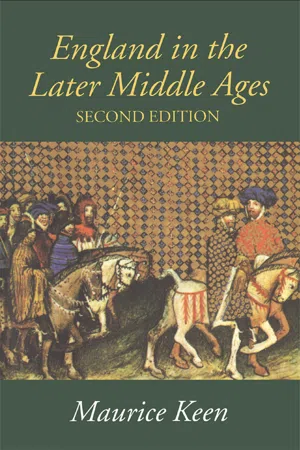
First published to wide critical acclaim in 1973, England in the Later Middle Ages has become a seminal text for students studying this diverse, complex period. This spirited work surveys the period from Edward I to the death of Richard III at the Battle of Bosworth, which heralded in the Tudor Age.
The second edition of this book, while maintaining the character of the original, brings the study up to date. Each chapter includes a discussion of the historiographical developments of the last decade and the author takes a fresh look at the changing world of the Later Middle Ages, particularly the plague and the economy. Also included is a rewritten introduction.
- 504 pages
- English
- ePUB (mobile friendly)
- Available on iOS & Android
eBook - ePub
About this book
1
Introduction
The structure of government and politics
The year 1290 may seem a strange date at which to commence a political history of the late Middle Ages in England. It marks neither the beginning nor the end of a reign: in fact it was the eighteenth year of King Edward I, who had another seventeen years of authority ahead of him. All the same, it is an important date. It was in that year that the death of the Maid of Norway, titular queen of Scotland, started a chain of events which were to lead in 1296 to the outbreak of a great war of the English against the Scots. Two years before that, in 1294, another major war had commenced, with France; this is why the ‘auld alliance’, of France and Scotland against England, came into being at this point in the 1290s. From then onwards, with only short intervals, England was to remain at war with Scotland, or France, or both, until the end of the medieval period. These prolonged hostilities exposed her government and its resources to unprecedented strains. The consequences, both of the wars directly and of the strains and pressures that they engendered, were only beginning to work themselves out when the first Tudor, Henry VII, came to the throne in 1485.
The course of the great wars of the late Middle Ages shaped England’s gradual achievement of self-conscious, insular identity as a nation-state. The period from 1290 to 1485 is therefore a very important one in her political history. It is also a confused and troubled period (though not more troubled, probably, than that which preceded it). As Shakespeare’s plays remind us, this was a violent age, in the course of which no less than five kings lost their thrones and in whose civil wars a long and sorry list of noblemen lost their lives in the field or on the block. This aspect of the late Middle Ages in England is what made their history unpalatable to the scholars of the nineteenth century, with their confidence in constitutional principles and progress. The trouble was not, however, as Stubbs and his generation believed, that the great men of the late Middle Ages were the moral and intellectual inferiors of their ancestors and their descendants. The difficulties of the period arose rather because its recurrent warfare exposed the system of government which had been developed earlier, and the balance of political forces in the kingdom, to new stresses. These stresses generated for the kingdom’s rulers a greater need for cooperation, on the one hand from those who controlled the purse strings for the financing of large scale campaigns, and on the other from their greater subjects, who had their own views on policies and governance and who were too powerful to manage on the basis of authority alone. That cooperation was not always forthcoming, and when it broke down problems easily became acute.
Since so much of the history with which this book will be concerned revolves about these two matters, taxation and magnate power, and about the wars which made them crucial factors in political and social development, it will be prudent to take a closer look at both at the outset. But before we do that we must first say something very briefly about the structure of royal government at the beginning of the period—about the system on which the wars imposed new strains.
According to the legal theory of the late thirteenth century, all secular authority in the kingdom stemmed ultimately from the crown. In reality, however, royal government was neither all powerful, nor legally omnicompetent. Its scope was limited by its objectives: it was not designed to foster the public welfare by providing direction and essential services, as in a modern state, but to uphold the dignity of the king as a great hereditary lord, and to protect his legal rights and those of his subjects. The law which the king’s courts enforced was not based in royal command; it was the common inheritance of the people, founded in the custom of time past. The king might, with the assent and advice of his council, amend the law in detail, as Edward I did in the early part of his reign through a series of famous statues, but it was not, strictly speaking, his law. Moreover, the common law of the king’s courts was not the only law that ran in England, nor his the only authority that enforced it. The church, an international community, had its own law, and its own courts enforced its rules on all men in spiritual matters (which included all matrimonial and testamentary causes). There were great franchises, such as that of the Bishop of Durham, within whose limits their lords exercised the rights that pertained to the king elsewhere. A host of lords of lesser franchises and the citizens of chartered boroughs enjoyed privileges which entitled them to enforce law and local custom with varying degrees of independence, and which gave them, as it were, a private share in the business of governing. At the fringes of the realm, in Wales and its marches and on the northern border with Scotland, the king’s government shaded off into remote control. The king’s duchy of Aquitaine and his lordship of Ireland were administered separately from England, and his authority there was exercised over societies whose customs and outlook were foreign, pure southern French in the one case, and in the other deeply affected by the clan life of the native Irish. For all these limitations on its range, competence and initiative, the English royal administrative system was, at the end of the thirteenth century, precociously developed by contemporary European standards, especially in its central bureaucracy. This bureaucracy was organized around a series of departments, each equipped with one of the royal seals which, as formal authenticating instruments, made it possible to coordinate the private decisions of the king and his trusted advisers into public action, executive, legal, or administrative. The king’s household, which travelled about with him, was his personal business head-quarters, and included a staff of trained clerks. These clerks were able and experienced men, well capable in emergencies of turning the expertise that they had acquired in supervising the king’s everyday expenses in the chamber and wardrobe to tackle such formidable tasks as the victualling and payment of an armed host, and of managing, at a pinch, the whole of his correspondence, official and private. In his household the king kept his privy seal, to authenticate the letters that he sent out from his itinerant court— diplomatic correspondence, summonses to appear before him, instructions to the chancellor to draw up official documents in accordance with his and his counsellors’ decisions. Quite early in the fourteenth century the business passing under this privy seal—especially diplomatic and conciliar business—became so considerable that it developed into a separate office, and its keeper became the third officer of state, after the chancellor and the treasurer. When this happened, the signet seal kept by the king’s secretary became the seal used to authenticate his private letters, and warrants under the signet were from time to time accepted as authority by the chancery for the issue of letters under the great seal of England. The great seal, kept by the chancellor, was the most important of the king’s seals. The use of the great seal for all purposes except routine business required to be warranted (usually by a letter under the privy seal). It was used to give authority to all important acts of state, to public treaties, statutes, and letters patent appointing men to official posts or commissioning them to discharge essential administrative and judicial duties. There were also many regular writs instituting proceedings in the courts, which had to be sued from the chancery and sealed there. In short, the chancery was the lynchpin of general administration, and the chancellor, who was usually a bishop, was in consequence always a man of influence. He was automatically a member of the royal council, and came to be often the chief spokesman who explained the king’s need for fiscal aid to parliaments. He had a substantial staff of clerks to help him in his business, clerics who could expect a benefice (indeed probably more than one benefice) to provide them with a stipend, and for whom, if they made their mark, there were rosy prospects of ecclesiastical promotion.
The third office of state, beside the privy seal office and the chancery, was also the oldest and the most professional, the exchequer. It had acquired early a seal of its own, the seal of the exchequer. Responsible for supervising and accounting for the collection, audit and expenditure of the king’s revenue in accordance with its own strict rules of procedure, it was also a court dealing with cases in which the king’s fiscal rights were involved. The treasurer (like the chancellor, often a bishop) presided over it, aided by the barons of the exchequer, men learned in the law and in the exchequer’s own complicated processes. Every item of the king’s revenue, and every payment made at his order, was entered on its massive rolls. The accounts, both of local officials (as the sheriff) and of the royal household, were audited by it. Its task was more formidable than that of either of the other departments, and in many ways even more vital. The exchequer alone, through the treasurer, could give the king and his councillors any idea of how far his resources really would stretch. Needless to say, it did not manage to keep the kings of England’s royal accounts in balance; it would have needed much more than clerical efficiency to achieve that.
The normal home of the exchequer and the chancery was at Westminster: it was there too that the king’s central courts held their sessions. The King’s Bench was the highest court in the land, aside from the king’s own council and parliament, and was so called because of its concern with all matters that affected the crown. The Court of Common Pleas (often called the ‘bench’ simply) dealt with cases between parties and corrected the errors of lower courts. The judges of these courts, appointed by the crown, were men of great influence, often called to council, who gave important assistance in the drafting of royal statutes. After 1290, few of these judges were clerks, as so many of their predecessors had been, and few had had a clerical education. They were recruited now usually from among the serjeants (senior barristers, who had a monopoly of pleading in the central courts). The law was becoming a professional lay occupation, and these men had trained in their business of pleading by attending the courts and watching their procedures as ‘apprentices’ in the law. On account of the multiplication of the statutes (a notable feature of the late thirteenth century), and of the number and variety of writs instituting proceedings, mastery of the common law and its intricacies had become a branch of learning in its own right. In spite of its long delays and the expense incidental to litigation, the common law was highly prized by the king’s subjects, and the law courts were always busy.
The great offices of state and the central courts were the essential links between the king’s council, the heart and the centre of government where executive decisions were taken and legal remedies framed, and the local administration. The most important figure in local government at the end of the thirteenth century was still, as it had long been, the king’s sheriff. It was he who, in the county court that met once a month, published royal statutes; he who supervised (in this same county court) the election of representatives when these were summoned to parliaments. He was responsible for the pursuit and custody of criminals, for empanelling juries to try cases, and in general for having all things ready when the king’s justices visited his shire. Most judicial work was carried out by justices appointed from time to time to take the assizes, deliver the gaols, or to hear and determine cases between parties: more rarely the counties were visited by justices in eyre, appointed in the exchequer, with power to hear all pleas and to undertake a general review of the administration of the king’s rights (these eyres were unpopular, and lapsed in the course of the fourteenth century). It was the sheriff’s task to see that the decisions of these judges were implemented, and to levy the fines that they imposed. In his fiscal capacity the sheriff was responsible to the exchequer. Twice a year he had to appear there and account for all the moneys that he had received, the farm of his county, fines imposed by the courts, and any other dues to the crown that he had collected— less what he had spent in the county at the king’s orders, in wages, for victualling the king’s castles and repairing his buildings, and so on.
The sheriff was the maid of all work in the county, but by the 1290s he was no longer by any means the omnicompetent royal servant that he had once been, and the late Middle Ages were to witness the further decline of his office. A series of other officials, most of them like the sheriff recruited from among the substantial county gentry, discharged specialized duties in the localities. There was the coroner, who kept the record of the pleas of the crown, and held inquests into matters in which the king had a customary legal interest, such as murders and wrecks. There were the escheators who looked after the king’s rights as a feudal landlord, to wardships, marriages, and reliefs. There were the keepers appointed to look after estates which for one reason or another were in the king’s hand, as for instance those of a bishopric during a vacancy, the collectors of customs at the ports, the keepers of the royal forests. In all financial matters the exchequer supervised the activities of this host of officials. The outbreak of wars, in the 1290s and after, multiplied the tasks and enhanced further the importance of the crown’s local servants. Taxes had to be collected, and men arrayed for military service, and the assistance of men of local substance was called for in the discharge of such offices as collectors of subsidies and commissioners of array. At the same time, concern over the maintenance of public order (whose deterioration was seen by many as a by-product of the strains of war) contributed to an increasing reliance on the same sort of people in the pursuit of crime and law enforcement, first as keepers of the peace in the counties, and later as justices of the peace. The overall effect of this proliferation of local offices was to give the sector of society that historians broadly call ‘the gentry’ a newly significant part to play in the governance of the kingdom regionally and in the service of the crown.
The system of administration that was in operation before the wars began to generate new stresses was sufficient to its foremost intended task, the enforcement of the king’s hereditary rights. Those rights were however not wide enough, and above all were not productive enough financially to enable him to cope with such an emergency as a major war without further assistance. From his private and prerogative resources the king drew an income in the region of £20, 000. Besides this he had the regular revenue brought in by the customs, the levy on wool (6s. 8d. a sack) and certain other exports, payable at the ports, and originally granted to Edward I in the parliament of 1275. In his day this brought in something like £12,000 a year. The income from these combined sources was just about enough to meet the king’s regular expenditure on his household, his works, his administration, and the keeping of his castles. There was nothing left over for emergencies, let alone for such a costly emergency as a campaign.
We shall have to look in later Chapters at the detailed problems of raising hosts for campaigning and paying for them. It was a very expensive business. There was no standing army. Though there was a general obligation on all men between the ages of sixteen and sixty to serve in defence of the realm, troops who served in a host expected to be paid wages. The cavalry of armoured knights carried expensive equipment, a costly coat of mail with plate at the joints, and they were mounted on great warhorses which could be worth as much as £40 or even £80 (the cavalry soldier supplied his own equipment, but the king paid for horses lost in his service). A man had to be wealthy to support the estate of knighthood, and the knights were a military aristocracy; in 1301 Edward I was able to summon about 900 from all over his kingdom to serve in the Caerlaverock campaign. To every mounted cavalryman in the host there might be ten or even twenty footmen, mostly archers, an increasing proportion of them usually being mounted for purposes of mobility. In the fourteenth century archers became more important than before with the development of the longbow, the great English six-foot bow of oak or yew which could penetrate armour up to a range of nearly 400 yards and had a rapid rate of fire. The service of archers was cheap compared with that of cavalrymen (in Edward III’s time a knight bachelor was paid two shillings a day, a foot archer two pence), but they had to be paid, fed, and increasingly often mounted as well. Over and above these forces, the king needed for a major campaign to recruit expert miners and engineers, to build siege engines, and, if he intended to cross the sea, to hire and impound ships. Here already is an onerous tale of the outlay necessary for a single expedition. As long as hostilities were active a king needed three or four times his ordinary annual revenue if he was to pay his way.
The expense of campaigning meant that, if war broke out, the king had inevitably to look to his subjects for grants of taxation. There was no real question of their refusing to aid him: it was an acknowledged principle that subjects were bound to aid their ruler when necessity and the common interest demanded. But because the king had no automatic right to a stipulated contribution by way of tax, some form of communal assent was required to legitimize the collection of any levy that would be classed as ‘extra-ordinary’, that is to say, not due to the crown by established customary right. That spelt a need for the king to negotiate with some body or assembly that could be held to represent the ‘community of the realm’ and therefore empowered to assent to taxation on his behalf. Within the course of the half century following 1290, the assembly called parliament came to be identified as the proper forum in which such assent should be given, and a parliament, moreover, that included the ‘commons’, the representatives of the shires and boroughs of the kingdom. Before the outbreak of the great wars, the role of parliaments had been perceived as principally advisory and judicial (and as by no means necessarily involving the presence of representatives of the local communities). ‘The king has his court in his council in his parliaments, where judicial doubts are determined and new remedies are approved for new wrongs’, wrote the author of the law book Fleta.1 The recurrent need for financial aid to meet military expenditure was the key factor, over the years from 1290 to 1340, in parliament’s development into an institution, the primary significance of whose meetings was fiscal and political, rather than judicial. The regular attendance, at parliaments, of the representatives of the shires and of the boroughs, in the same time, brought the crown into direct, negotiatory contact with leading men in local society. As with the contemporaneous proliferation of local offices, the effect was to involve more closely with the counsels of the realm and in its political life the sector of society from among whom representatives (especially those of the shire) were chosen.
The grants that the king’s subjects made to him were normally of two kinds. One was an extra levy on exports, in particular on wool (such were the maltoltes that Edward I and Edward III negotiated with assemblies of merchants, and the subsidies on wool which later monarchs were granted by parliaments). The other was a ‘lay subsidy’, the payment by the king’s secular subjects of a given fraction of their movable property and their income, by way of a tax. Early in Edward III’s reign the fraction became stereotyped at a fifteenth in the shires and a tenth in the boroughs; and in 1334 the assessments for such subsidies were standardized for future purposes in all localities—so that henceforward a...
Table of contents
- Cover Page
- Title Page
- Copyright Page
- Preface
- Preface to the revised edition
- Abbreviations
- 1: Introduction: The structure of government and politics
- Section I: Edward I and Edward II 1290–1330
- Section II: The age of Edward III 1330–1360
- Section III: The changing world of the later Middle Ages
- Section IV: The uncertain years 1360–1415
- Section V: The rise and fall of the Lancastrian empire
- Section VI: The Yorkists
- Epilogue
- Bibliography
- Genealogical tables
Trusted by 375,005 students
Access to over 1.5 million titles for a fair monthly price.
Study more efficiently using our study tools.
Frequently asked questions
Yes, you can cancel anytime from the Subscription tab in your account settings on the Perlego website. Your subscription will stay active until the end of your current billing period. Learn how to cancel your subscription
No, books cannot be downloaded as external files, such as PDFs, for use outside of Perlego. However, you can download books within the Perlego app for offline reading on mobile or tablet. Learn how to download books offline
We are an online textbook subscription service, where you can get access to an entire online library for less than the price of a single book per month. With over 1.5 million books across 990+ topics, we’ve got you covered! Learn about our mission
Look out for the read-aloud symbol on your next book to see if you can listen to it. The read-aloud tool reads text aloud for you, highlighting the text as it is being read. You can pause it, speed it up and slow it down. Learn more about Read Aloud
Yes! You can use the Perlego app on both iOS and Android devices to read anytime, anywhere — even offline. Perfect for commutes or when you’re on the go.
Please note we cannot support devices running on iOS 13 and Android 7 or earlier. Learn more about using the app
Please note we cannot support devices running on iOS 13 and Android 7 or earlier. Learn more about using the app
Yes, you can access England in the Later Middle Ages by M.H. Keen in PDF and/or ePUB format, as well as other popular books in History & British History. We have over 1.5 million books available in our catalogue for you to explore.