- 264 pages
- English
- ePUB (mobile friendly)
- Available on iOS & Android
eBook - ePub
About this book
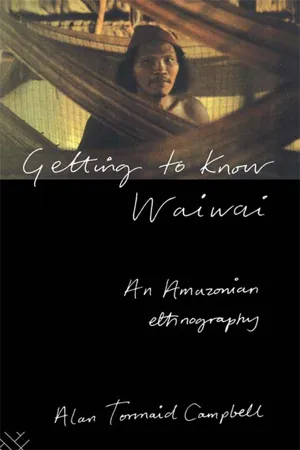
Living with the Wayapi, and their charismatic leader Waiwai, is a serious adventure. It is demanding, and can turn dangerous in a moment. The environment is a difficult one, but beautiful and baffling in its richness. And the job of learning about the people is like a journey without end.
Alan Campbell tells the story of these people, and of the time he spent with them, in an imaginative, beautifully written account which looks back from a century into the future to relate a way of life that is being destroyed. In doing so, he addresses important and complex issues in current anthroplogical theory in a way which makes them accessible without sacrificing any of their subtlety.
Trusted by 375,005 students
Access to over 1.5 million titles for a fair monthly price.
Study more efficiently using our study tools.
Information
1
TELLING NAMES
Over a spell of two years I lived in a remote area of the Amazon Forest with a people called Wayapí. They had bows and arrows; they wore loincloths; they walked barefoot; they spoke a language of their own. For five centuries people like that have been called ‘Indians’, and for five centuries people like that have been on the run.
Going to live with them is a serious adventure. It's demanding in the long term and it can turn dangerous in a moment. The environment is a difficult one in some ways, insects and disease for example, but it's beautiful and baffling in its richness. And the job of learning about the people is like a journey without end. There never is a point where you can pack up and say ‘That's it done’. All you can ask is: ‘How far will I get in the time?’ Even learning the language is like that, although to this day I hope that with some more time I could really get to a stage where I felt at ease hearing it and using it.
I found there was always an uncertainty about the venture. I don't mean surprises, insecurities, loss of nerve. I mean that in spite of an overwhelming conviction that this was the most fascinating enterprise that it was possible to undertake on this planet, who was going to pay any heed to anything I learned? Who would share the interest? Who would want to know?
The language effort reflected that uneasiness particularly well. When I first arrived there were 150 Wayapí left. I had then to plunge in to the desperate and painful struggle of learning an unwritten language from scratch in the sure and certain belief that, apart from 150 Indians, there would be no one else in the world that I'd ever be able to converse with in this tongue. But that simply didn't matter. Rather, it didn't matter then. It was only an uncertainty when I looked back over my shoulder.
There were other facets too. As I was drawn into their lives it became increasingly improbable to see the enterprise fitting in to a set of scientific or ethnographic expectations where, as if in botany or zoology, you take off into the woods and emerge again after your explorations with new discoveries that you can present to the world outside—reports of findings; comptes rendus. It was bizarre to think that I should eventually have to return home and deliver explanatory accounts of these people I knew so well, showing slides of them in seminar and lecture rooms. I would find myself addressing strangers about my friends as if I was addressing friends about strangers. How could I talk about them in that way—as patients etherized upon a table?
That was perhaps just a matter of interfering with a few conventions. I thought I'd sort that out when the time came. But whatever I tried I could never get rid of that uneasiness about just who was the real reader over my shoulder. I couldn't possibly write for the Wayapí themselves, at least not for these generations.
I got a shadowy sense one day of Wayapí survivors a hundred years on, looking back at these times and trying to make sense of them. It happened when I was in the Scottish hills looking down on the remains of what they still call the ‘Old Caledonian forest’, as if it never had been in a real time nor in a real country; a matter of myths and mysteries, maybe. So little of it was left there; just a defiant band of pine trees, gloomy and dark, straggling across the hillside, hunched against the wind, looking over their shoulders at the empty slopes all round them.
You can't get a real feel for a vanished forest like that. The loss is like a bereavement, like a yearning to know which will never be satisfied. I was sitting at some small ruins, a shieling most likely, from a time when Gaelic was spoken in these areas—a dialect of Gaelic that is now extinct. I'll never know that wood just as I'll never hear the words of those who have gone. All I can do is let my fantasy wander amongst whatever mythy fragments my memory might be able to make images out of.
Old Caledonia turned into Old Amazônia. One forest seemed to be the other. There are, today, destroyed areas of the Amazon forests that are left just like the remnants of the Scottish woods, sometimes just raggedy clumps, sometimes long slender islands of trees amongst vast spaces of weeds and prickly grass that cattle are supposed to graze on. Seeing these areas, once the dismay recedes a bit, I feel a defiant sense of relief. I've seen it; I've seen it before they did this. I know what it was like and they can't leave me suspended in ignorance. I was in it. I got lost in it (once or twice). And above all, I met them. I got to know these people, the ancestors of those shadowy presences.
During the closing years of the twentieth century that I'm living through, the destruction of the Amazon forests has become a dominant image of the anguish felt by millions of people in the industrialized world when they realize that the relationship between human beings and their natural surroundings has gone badly wrong. People who have never been near a tropical rain forest are profoundly dismayed by the pictures they see and by the reports they hear. School children with next to no awareness of the history and politics of the countries concerned know the names of the animals and birds that are threatened and can describe how the indigenous peoples traditionally carried on their lives. It's an accurate anguish; and to it has to be added the anger, the bewilderment, and the despair of the indigenous peoples themselves as they face the violence of invasion. It is their lands that are taken. It is they who are dislocated. When that has been done the forests are cleared for logging profit, burnt for cattle grazing, polluted by schemes for mineral extraction, flooded by the building of monstrous dams.
I knew the Wayapí during those decades of destruction. I thought, at one point in the 1970s, that they were doomed, that they would simply vanish, but they survived the major onslaught that took place then, and they can now dig in for a century of struggle as a tiny minority people within the colossal country of Brazil. It was in Old Caledonia that I got a sense of a small, intense group of them, a hundred years on, still calling themselves ‘Wayapí’, still aware of their past. How did the struggle go? How did it turn out?
I'll never know, and it's impossible to guess. But I think they will understand my thwarted curiosity about the future, just as I understand theirs about the past. I can get a sense of them, in their ruined Amazônia, looking back a century to our time, and I know how curious they will feel and how urgently they will want to grasp what's vanished. They do have certain advantages that I don't have since they can find so much themselves as they look back. If they've lost the language, not only will the grammar and vocabulary be in scholarly books, but they'll be able to see their people on film and hear on recordings the language, the songs, and the sound of the musical instruments. (They had tiny three-holed flutes made from the bone of a deer on which they played tunes like bird-song. They had another huge thing, 6 or 7 feet long, made out of a hollow palm, that made a noise like a tuba.)
Since that first glimmer, those presences a hundred years on fluctuate like weathery moods. Sometimes they make me get on to things like love, and wonder, and heartbreak, and at other times they get severe and I hear them say: ‘Cut the cackle, and get the details down.’ It's the particulars they need after all. What about names, to begin with? They'd want to know the names.
Names to start the spirits
Names are the weightiest nouns we know. Their meanings can swing unpredictably. I was looking at lists of their personal names and their place names, wondering what these would mean to the survivors next century. That made another place and time boundary slip and disengage. I remembered names from precisely a century ago, not from the empty areas of Scotland, nor from Amazônia, but from the North American plains. I had to hand at that time an account of the events at Wounded Knee in South Dakota on 29 December 1890, and part of it went like this:
Suddenly Yellow Bird stooped down and threw a handful of dust into the air, when, as if this were the signal, a young Indian, said to have been Black Fox from Cheyenne river, drew a rifle from under his blanket and fired at the soldiers, who instantly replied with a volley directly into the crowd of warriors…. At the first volley the Hotchkiss guns trained on the camp opened fire and sent a storm of shells and bullets among the women and children, who had gathered in front of the tipis to watch the unusual spectacle of military display. The guns poured in 2-pound explosive shells at the rate of nearly fifty per minute, mowing down everything alive. The terrible effect may be judged from the fact that one woman survivor, Blue Whirlwind, with whom the author conversed, received fourteen wounds, while each of her two little boys was also wounded by her side. In a few minutes 200 Indian men, women, and children, with 60 soldiers, were lying dead and wounded on the ground, the tipis had been torn down by the shells and some of them were burning above the helpless wounded…
The incident was called ‘the battle’ of Wounded Knee as if it was just another in the list of those violent struggles between opposed ambitions, like Agincourt, or like The Somme. But the names declare that it was not a ‘battle’ like that at all. Listen to the names. You can hear in them both the echoes of something being finally destroyed, something disappearing from the earth forever, and also the power that's doing it.
Colonel Forsyth was the officer in command, along with Major Whitside; and those Hotchkiss guns were under Captain Capron and Lieutenant Hawthorne. Present amongst the other officers of the Seventh Cavalry were Lieutenants Robinson, Nicholson, McCormick, Tompkins, and Gresham. A list like that is so reassuringly familiar to the people of the English-speaking world that they can all just about hear the twang of the men's accents. The soldiers did battle against Yellow Bird, Black Fox, Blue Whirlwind, and chief Big Foot, ill with pneumonia. It is a mark of how comprehensively the world of Forsyth and Whitside took over Dakota and all the many thousands of miles around it that two baby girls found alive on the battlefield were adopted by army officers and christened (not just named) ‘Marguerite’ and ‘Jennie’. Yellow Bird's infant son survived. He remembered having seen his father shot through the head and the blood coming out of his mouth. The boy was adopted by a teacher and called ‘Herbert’.
Well, they are all dead now; Forsyth, and Blue Whirlwind's sons, and Jennie and Marguerite, and Herbert Zitkalazi. (The teacher had known the boy's father and left him the Sioux form of his father's name ‘Yellow Bird’ as a surname.) All the sorry circumstances that led to Wounded Knee lingered on for many years, but 1890 was the end of a way of life for the Indians on the North American Plains. And I think now of those Wayapí survivors, looking back at our times, only for them it's not the North American Plains but the South American Forests, not the Missouri but the Amazon. And the names of the peoples who lived there seem more outlandish to the dominant culture: not the Sioux, the Cheyenne, the Apache, made familiar to my world by cowboy movies and adventure yarns for small boys, but more mysterious forest names: Yanomami, Txukahamae, Uru Eu Wau Wau, and the name that means so much to me and to the survivors I think of: Wayapí. The survivors may well look back to the 1990s as marking a significant end for the Tropical Forest peoples, not in the sense of final extinction, but in the sense of a watershed in the possibilities of their existence.
In 1990 that northern extremity of Brazil where they'll still be living was called Amapá. It hadn't even been a full state of the federal union until that time; still a Territory, as if it had not been properly taken over. Brazilians in the big cities away to the south thought of Amapá as one of those impossibly remote places in ‘Amazonas’ which, in general, they associated with a kind of threatening backwardness.
But the eastern side of the Territory was not typical of Amazonian Brazil. There was a huge manganese mine there called Serra do Navio, sitting on the banks of the Rio Amaparí. The mine had been developed since the 1940s by the vigour of United States capital, and for thirty years or so was owned by Bethlehem Steel Inc.. They had built a railway from the mine down to the port at Santana on the mouth of the River Amazon and administered pretty well everything in between. As you rode up the railway towards the mine you looked over expanses of undulating country, stripped of the original forest, and replanted with geometrically perfect lines of dende palm, grown for the oil that the tree produces. Later massive acreages went under quick-growing pine. But beyond the mine, to the west and to the north, the rivers went on up to their headwaters through miles and miles of the old woods. And away up, where the main courses of the rivers broke into smaller streams, that's where the Wayapí lived when I got to know them.
A hundred years of devastation. What on earth will be left? I try to imagine the immediate surroundings of the future as I see those hundreds of little prosperous towns all over the Dakotas and the Midwest in the USA—peaceful, trim, and affluent, with lawns, flowering trees, and tarmacked roads, except that people on the equator won't have the cold winters to put up with. Those pretty clapboard houses of the United States are so much nicer than the flimsy brick and cement things they throw up in Brazil at present.
The forest is bound to go, just as the Great Plains were put under cultivation and concrete. But I can't imagine a credible pattern of towns and roads at all. I can't envisage the maps of the future, even though the rivers will still be there. Perhaps the Brazilians will keep an Indian name or two as they move in. Perhaps there will be towns called Aramirán and Mariry. The Brazilians won't like the sound of ‘Nipukú’ if they've settled it and made a town there. When they were first building the road into Wayapí lands in the 1970s the surveyors had the name marked on their maps, and although they never saw the place, they enjoyed turning the word into a smutty pun: ‘limpo cu’, ‘clean bum’. Not the nicest name for My Home Town. I'm glad their damned road never got as far as Nipukú in my day.
Nipukú or ini-poko means ‘long hammock’. When the Wayapí lived in the woods they were good at making hammocks. They gathered cotton from their garden clearings. The women would card it and spin the thread by twirling small hand spindles for days on end until they wound up a large ball of white thread. Then they'd thump two posts into the earth floor of a hut, about a couple of yards apart, and wind the thread back and forth between them. In the old days they made two kinds of hammocks: a net one, and a closely woven one called an ini. But an ini used up so much thread and took so long to do, that they stopped making them when they were able to get the more brightly coloured factorymade equivalents from the Brazilians. Wounded Knee and Long Hammock. They're good names, aren't they?
Will the survivors keep their Wayapí names? Or will the Brazilians give them names like ‘Maria’ and ‘Helena’? That's not really fair. Brazilians have always shown a carefree imagination in their naming habits, not just in their nicknaming but in their proper naming too, and they easily accept Indian names into the repertoire in a much more generous way than the staid habits of white English-speakers would ever allow. So perhaps the survivors can still call their children Kuyuri and Apeyawar and Waimisí without it counting as an eccentricity or a stigma.
I never really got the hang of how they used their names. There were a number of different little games going on simultaneously. And even when people were playing the same game they might play it with different intensities. To some it mattered. To others not. And of course more and more contact with Brazilians was always changing the stakes. The basic rule was that proper names were private—never to be used in public when you were addressing someone. You had to use the correct relationship term for that: ‘Hello Mother's Brother’, ‘Hello Sister's Daughter’ sort of thing. But of course since children's names were not hidden like this, by the time you grew up and by the time your name had become private, all your contemporaries knew it anyway.
‘The Grandfather-People didn't use names,’ they'd explain. ‘To call someone by their name gives that person shame.’ I might be going through genealogies and, on stating a name, get a really excited question: ‘Who told you that name?’, or I might ask the name of a person from another settlement that I'd visited and be asked: ‘Didn't he tell you when you were there? What did he say his name was?’
There were three common ways of getting round the naming difficulty. It was easy to use a child's name when addressing its close relative, for example, a child called Koropi might allow you to say ‘Hello, Koropi's big sister’ to the appropriate grown-up woman. Second, among close friends, they might use nicknames for one another: ‘just being playful’. People would be more comfortable using nicknames when talking with me of others. Finally, Portuguese names, given by the Brazilians, solved the problem. These were freely admitted; and I suppose I could reveal a longterm secret right now: ‘Waiwai’, Our Big One, the ‘chief’ at the Nipukú, is not Waiwai's real name. I think I know what his real name is, but shouldn't say. I hope the survivors have other ways of finding out.
These three solutions, then, children's names (‘teknonyms’ as they are known in the anthropology trade), nicknames, and Brazilian names were really just useful stop-gaps when there were outsiders around. Amongst themselves name privacy was just taken for granted. Although they said that naming in public caused ‘shame’, it was never used as a deliberate technique for shaming, say during a violent quarrel. Waiwai might get furious with his daughters’ husbands and say: ‘They are not real daughters’ husbands any more. They're no good. I'm going to stop calling them “daughter's husband”!’ He'd shame them by changing the relationship term, but however angry people got they wouldn't start naming one another. Perhaps it would so obviously defeat the purpose since the person who did it could so easily be shamed in return. Names were just private.
It was a privacy that then found itself flagrantly invaded by the arrival of Brazilian frontiersmen who were inordinately garrulous in their use of names, constantly naming each other in open conversation, even shouting out names to attract one another's attention. Imagine what the Indians had to put up with in these initial boisterous encounters with the Brazilians: loud aggressive greetings, and a habit which they found so odd of being expected to stick out your hand and have it roughly grasped and waggled by the intruder. (I found handshakes odd in those early days when I too thought it was an appropriate gesture, and I'd find myself trying to tighten my grip on the limp hand of a fierce looking man.)
So imagine if you were an Indian in one of those encounters. You have your hand waggled, then the guy grabs your shoulder at the same time and shakes you, and all the time he's shouting in your face as if he was drunk: ‘Hey, amigo, tudo bem, everything fine, OK, WHAT'S YOUR NAME? EH? WHAT'S YOUR NAME? My name's PAULO. And this is my pal ALGIMIRO. So WHAT'S YOUR NAME?’ And while he's doing this all your folk are standing around giggling. Everybody's face is broken open in great smiles, although nobody's feeling at all at ease. So what do you do? Do you tell your name out loud, there and then, to these rough looking creatures with bristles all over their faces, or do you make up a name on the spot? And whether you do it one way or the other, your relatives will snigger about it later on and make fun of you across the hammocks in the dark.
1974: The arrival topos
This is how I first met them, in June 1974. The government department responsible for Indian affairs (known by its acronym FUNAI, ‘National Indian Foundation’) had arranged for me to get to the Indian Post that they had set up in Wayapí lands. I was to travel with a medical team: a doctor, a dentist, a lab technician, and a nurse, who were visiting the post as part of an immunization programme. It was a jolly group; everyone kindly and straightforward. From the moment we got off the plane in Amapá we were in the hands of the people from Bethlehem Steel's manganese mine, known by its acronym ICOMI. (Bureaucratic Brazil pours forth acronyms. People would never say ‘Eff Bee Eye’ or ‘See Eye Ay’. They'd make a word out of it.) ICOMI vans took us to ICOMI quarters then on to the personnel carriage attached to a long train of empty wagons on their way up the line to the mining town at Serra do Navio. There we...
Table of contents
- Front cover
- Getting to Know Waiwai
- Title Page
- Copyright
- Dedication
- Contents
- 1 TELLING NAMES
- 2 AT LONG HAMMOCK
- 3 OTHER VOICES
- 4 ROMANCE
- 5 FOUR, FIRE, AND GIVING
- 6 REMEMBERING
- 7 SUBMITTING
- 8 AIMA
- REFERENCES
- INDEX
Frequently asked questions
Yes, you can cancel anytime from the Subscription tab in your account settings on the Perlego website. Your subscription will stay active until the end of your current billing period. Learn how to cancel your subscription
No, books cannot be downloaded as external files, such as PDFs, for use outside of Perlego. However, you can download books within the Perlego app for offline reading on mobile or tablet. Learn how to download books offline
Perlego offers two plans: Essential and Complete
- Essential is ideal for learners and professionals who enjoy exploring a wide range of subjects. Access the Essential Library with 800,000+ trusted titles and best-sellers across business, personal growth, and the humanities. Includes unlimited reading time and Standard Read Aloud voice.
- Complete: Perfect for advanced learners and researchers needing full, unrestricted access. Unlock 1.5M+ books across hundreds of subjects, including academic and specialized titles. The Complete Plan also includes advanced features like Premium Read Aloud and Research Assistant.
We are an online textbook subscription service, where you can get access to an entire online library for less than the price of a single book per month. With over 1.5 million books across 990+ topics, we’ve got you covered! Learn about our mission
Look out for the read-aloud symbol on your next book to see if you can listen to it. The read-aloud tool reads text aloud for you, highlighting the text as it is being read. You can pause it, speed it up and slow it down. Learn more about Read Aloud
Yes! You can use the Perlego app on both iOS and Android devices to read anytime, anywhere — even offline. Perfect for commutes or when you’re on the go.
Please note we cannot support devices running on iOS 13 and Android 7 or earlier. Learn more about using the app
Please note we cannot support devices running on iOS 13 and Android 7 or earlier. Learn more about using the app
Yes, you can access Getting to Know Waiwai by Alan Campbell in PDF and/or ePUB format, as well as other popular books in Social Sciences & Anthropology. We have over 1.5 million books available in our catalogue for you to explore.