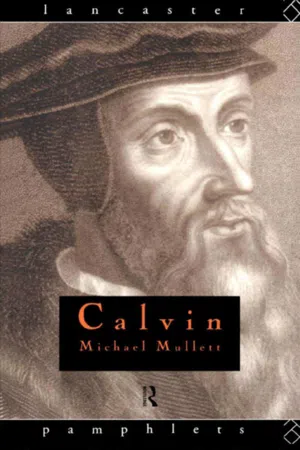
In this lucid and readable study, Michael Mullet explains the historical importance of a man and a movement whose influence are still felt in the modern world. The pamphlet locates John Calvin in the context of early 16th-century France and then charts his emergence as an influential theologian and civic religious leader in the 'second generation' of reformers following Luther. After exploring the main lines of Calvin's theology, set out in the Institutes, the central section deals with the difficult process by which his authority was imposed on, or accepted by, Geneva. Finally, the long-term impact of John Calvin is evaluated, including the hypothesis that Calvinism has assisted the economic development of Europe.
eBook - ePub
Calvin
About this book
Information
1
Religion and the Church in early sixteenth-century France
John Calvin’s early religious upbringing took place within the Catholic Church of early sixteenth-century France, a Church desperately in need of the reform that became the theme of Calvin’s life. Looked at first of all from the institutional point of view, the Church in France reflected the key importance of the monarchy in national life. Indeed, in common with other western European states such as England, France was showing a marked tendency to wrest ecclesiastical control out of the hands of the papacy and to nationalize the Church as a royal institution in one kingdom. This process, in France as elsewhere, was particularly to the fore in the vital areas of finance and of senior ecclesiastical appointments, the latter being especially important since kings felt they needed reliable and serviceable men to staff a kingdom’s bishoprics. Under the terms of the 1516 Concordat of Bologna, an agreement negotiated with the papacy, the French Crown nominated ten archbishops and eighty-two bishops in France’s numerous episcopate.
The Crown did not, however, exercise complete freedom of choice over ecclesiastical appointments. France was an aristocratic society as well as a monarchical polity and the composition of the episcopate partly reflected the predominance of the nobility in French life. Certain noble families exercised effective monopolies over appointments to bishoprics and other lucrative ecclesiastical benefices within their areas of influence and they regularly inserted younger sons into those positions. Thus leaders of the French Church were recruited on the basis of a spoils system that took account primarily of financial priorities, of aristocratic privilege and of the political needs of the Crown, especially its need to reward loyal supporters and state servants with ecclesiastical revenues. Such a system, obviously, could not be guaranteed to produce dedicated pastoral clergy having spiritual vocations. That said, this rickety system did, perhaps surprisingly, produce some clerics of holy lives and high ideals. Such a one was Bishop Guillaume Briçonnet of Meaux (1470–1533). With regard to his background, Briçonnet’s appointment was not a promising one in terms of the increasingly urgent tasks of Church reform. Son of a Crown servant and a former royal ambassador, Briçonnet was a pluralist – a collector of Church benefices – and a classic product of the spoils system. Yet Briçonnet set in motion an ambitious and partially successful plan of preaching and reform in his Meaux diocese. The Concordat system was not necessarily inimical to Church reform.
Yet there was pressing need for such reform. Much of the malaise stemmed from the ingrained habit of regarding an ecclesiastical appointment not as a vocation to service but more as a bundle of personal rights, privileges and receipts. From this arose resistance to all change, fierce defence of one’s existing status and constant appeals to precedent against reform. In 1501, for instance, the Cardinal d’Amboise, backed by the Crown and the papacy, attempted to make the Cordelier monks of Paris observe their own rule. He was checked not only by the monks’ no doubt infuriating habit of chanting psalms whenever he tried to talk to them, but also by their even more effective tactic of quoting their ancient charters as a bar to any reform whatsoever.
There seemed to be also a pervasive and debilitating disputatiousness about the French Church. Calvin’s own father provides us with one very typical example, becoming involved in a protracted financial quarrel with the cathedral chapter of his home city of Noyon, a dispute which led to his excommunication. This rift may have had some influence on John Calvin’s own alientation from the Catholic Church. The way in which institutional religion confirmed the habits of a quarrelsome society was deeply unsettling because of the function which Christian religion was supposed to exercise of instilling social peace.
Peacemaking was certainly regarded in French popular culture and in popular mentalities as an important social function of religion and its rituals. On the major feast of Christ in the Eucharist, Corpus Christi, to take one example, neighbours were expected to entertain and regale one another and in the process extinguish a year’s disputes in this annual festival of communion. Indeed, ordinary French men and women seem to have regarded religion as at least in part a system for ordering and controlling their environment and regulating their communities. They needed patrons and protectors to see them through this life’s vicissitudes and these they found in the myriad saints of the Church. Most of these were held to have specialist functions which qualified them as patrons of particular groups, especially occupational groups, or alternatively their specialisms were invoked in particular emergencies such as loss of money. All this was part of a magical or miraculous apparatus for controlling the material environment in this life as well as for ensuring salvation in the world to come: it meant using super-nature to influence nature. It could lead to some quite bizarre manifestations: in the Dombes region of southeast France, women with sick children would invoke the aid of a folk saint, Guinefort, whom they assimilated to a mythic figure of a childprotecting dog.
That was, though, only an exaggerated development of a tendency still strongly evident in popular piety throughout Europe on the eve of the Reformation, a tendency to use religion to get things done in the material world. This impulse had traditionally been sanctioned by the official Church, with its prayers, masses and rituals to protect crops, ensure good weather, cure sickness, and in general effect a permanent cycle of miracles. However, in the period we are considering we can detect a trend, not always consciously articulated or even consciously present, whereby educated elites were moving towards the greater spiritualisation and dematerialisation of religion, making it much more a matter of personal salvation in an after-life – the issue that haunted the theology of Luther and of Calvin. This salvation of souls was, of course, earned for man by Christ alone, and the saints, dear as they were to popular religion as agents of material assistance in this life, played no part in winning eternal life. They were to be relentlessly eliminated from Calvin’s scheme of essentially spiritual salvation, but even before that enlightened reformists were pouring scorn on the superstitions associated with the saint-cult – ‘superstition’ here meaning belief in daily beneficial miracles performed by invoked saints. A less superstitious Christianity was beginning to make headway, partly associated with Calvin’s mentor, Erasmus.
2
Christian humanism
John Calvin’s education took place against the background of a long-term intellectual revolution. The prevailing academic system of theology in medieval Europe and its universities is known as scholasticism. Classic scholasticism twinned the methods of the ancient Greek philosopher Aristotle with the Christian Scriptures so as to produce a synthesis of revealed Christian faith and human reason. This scholasticism flourished in the hands of such masters as St. Thomas Aquinas (1225–74). In the fourteenth century the scholastic synthesis broke down. A new movement within scholasticism, known as Nominalism, undermined the reliance on reason that had been the hallmark of classic scholasticism. In place of reason, the Nominalists placed emphasis on ecclesiastical authority and on Scripture as the primary means of attaining the knowledge of God – a stress on Scripture which reached a high point in the movement known as Christian humanism. In the fifteenth and early sixteenth centuries, the alleged sterilities of scholasticism came to be widely discredited and indeed ridiculed, amongst humanist intellectuals.
Initially, humanism was a trend originating in later medieval Italy concerned with the rediscovery, editing, and publication of the main texts of ancient Greek and Latin literature. There was even a paganistic tinge to this literary humanism, which was, after all, a movement of deference to the norms of the ancient, pagan world. Even when they were not overtly neo-paganistic, humanist scholars could be harshly critical of accepted Catholic values and assumptions. Thus the archetypal fifteenth-century Italian humanist scholar, Lorenzo Valla, through his work in the field of literary editing of early documents, undermined the textual legitimation of the pope’s temporal rule.
With all this criticism of corruption and of debased intellectual methods, many Italian humanist scholars of the Renaissance were aiming at a new synthesis, one between Christianity and pre-Christian philosophies such as that of Plato. Humanism – love of the classics – linked to Christianity produced the most exciting new intellectual development in Europe on the eve of the Reformation, Christian humanism. The acknowledged leader of this movement was the Dutchman Desiderius Erasmus (1466–1536), the scourge of scholastic traditionalists, of obscurantist monks and of all those who traded in the lucrative superstitions of popular piety. An outstanding Latin scholar, Erasmus made it his business to recover the earliest sources of Christianity – the early Church fathers of theology, and, beyond them, the Scripture, especially the New Testament, to whose study Erasmus was passionately dedicated. The outcome of his scriptural scholarship was his 1516 edition, along with a new Latin translation, of the New Testament in its original Greek. Although Erasmus remained essentially a Catholic – a critical one – the tendency of his New Testament edition was to undermine many features of current Catholicism. To cite just one example, Erasmus’s disclosure of the Greek basic text of the New Testament revealed that the original meaning of a key New Testament concept, repentance, was not the formal Catholic practice of doing penance for sins but rather an interior change of heart.
As part of the Christian humanist recourse to Scripture of which Erasmus was the leading light there was a re-awakening of interest in the seminal Christian theologian, St. Paul (d. a.d. 69). Paul’s letters to various local churches form an extended commentary on Christ as saviour. In one of these letters, that to the Christians in Rome, Paul explained that men and women are made acceptable to God not through any efforts or merits of their own but solely through Christ’s death on the Cross which atoned for human sin. Here was the root, in Scripture, of the theology of the Reformation, first in Luther, then in Calvin.
An important feature of Christian humanism was a Pauline renaissance which was strongly evident in France and which gave rise to the evangelical reformist, Jacques Lefèvre d’Étaples (c. 1455– 1536), who was in many ways Calvin’s guide, especially in his appreciation of the centrality of Scripture. As France’s leading exponent of the Pauline movement, Lefèvre moved away from a theology of human good works towards one that placed the emphasis on God’s grace for the attainment of salvation.
In 1516 Lefèvre’s fellow reformist, Guillaume Briçonnet, was made Bishop of Meaux, east of Paris, and the opportunity arose to turn the idea of reform into practical reality. A campaign was set in motion to create a laity well instructed in Christian doctrine, with the Bible freely available in French. A team of dedicated preachers of reform was recruited, including Calvin’s later associate, Guillaume Farel. The eventual collapse of the Meaux experiment exposed the inherent difficulties, especially in the tense 1520s, of the kind of moderate, centrist reformism espoused by Briçonnet and Lefèvre. Traditional Catholicism was inextricably bound up with France’s social and political structure and there was fear of the spread of the socially corrosive Lutheran infection from neighbouring Germany. Therefore, even moderate criticism and cautious reformism seemed dangerous and out of place. The University of Paris, known as the Sorbonne, Europe’s leading Catholic centre of higher education and the self-appointed watchdog of orthodoxy, in 1521 condemned Lefèvre for unorthodoxy. Meanwhile, to the left of Lefèvre and Briçonnet more radical reformers were attracted by direct action, including the destruction of Catholic images, which only deepened the suspicions of conservatives about what was going on in Meaux. By the mid-1520s the Meaux group had broken up, Lefèvre had fled from the diocese and this hopeful experiment in Catholic diocesan reform had come to an end.
All was not lost for the reformists. They had friends in high places, notably the French king’s sister, Marguerite of Angoulême, later Queen of Navarre, whose court at Nérac became a refuge for suspect reformists, including Lefèvre. However, the squeezing out of the liberal Christian humanists meant that during the formative period of Calvin’s life moderate options were being reduced and stark choices presented between orthodoxy, assent, and tradition on the one hand and open dissent, protest, and repudiation of authority on the other. It is important to real...
Table of contents
- Cover Page
- IN THE SAME SERIES
- Title Page
- Copyright Page
- Foreword
- Introduction: the importance of Calvin and Calvinism
- 1: Religion and the Church in early sixteenth-century France
- 2: Christian humanism
- 3: John Calvin: the early years
- 4: The Institutes of the Christian Religion
- 5: Geneva
- 6: Strassburg
- 7: Return to Geneva
- 8: The years of opposition
- 9: The road to victory
- 10: Calvin’s leadership: foreign policy
- 11: The Genevan Academy
- 12: Calvin: scholar, writer, organizer
- 13: Finale
- 14: The expansion of Calvinism
- Suggested further reading
Trusted by 375,005 students
Access to over 1.5 million titles for a fair monthly price.
Study more efficiently using our study tools.
Frequently asked questions
Yes, you can cancel anytime from the Subscription tab in your account settings on the Perlego website. Your subscription will stay active until the end of your current billing period. Learn how to cancel your subscription
No, books cannot be downloaded as external files, such as PDFs, for use outside of Perlego. However, you can download books within the Perlego app for offline reading on mobile or tablet. Learn how to download books offline
Perlego offers two plans: Essential and Complete
- Essential is ideal for learners and professionals who enjoy exploring a wide range of subjects. Access the Essential Library with 800,000+ trusted titles and best-sellers across business, personal growth, and the humanities. Includes unlimited reading time and Standard Read Aloud voice.
- Complete: Perfect for advanced learners and researchers needing full, unrestricted access. Unlock 1.5M+ books across hundreds of subjects, including academic and specialized titles. The Complete Plan also includes advanced features like Premium Read Aloud and Research Assistant.
We are an online textbook subscription service, where you can get access to an entire online library for less than the price of a single book per month. With over 1.5 million books across 990+ topics, we’ve got you covered! Learn about our mission
Look out for the read-aloud symbol on your next book to see if you can listen to it. The read-aloud tool reads text aloud for you, highlighting the text as it is being read. You can pause it, speed it up and slow it down. Learn more about Read Aloud
Yes! You can use the Perlego app on both iOS and Android devices to read anytime, anywhere — even offline. Perfect for commutes or when you’re on the go.
Please note we cannot support devices running on iOS 13 and Android 7 or earlier. Learn more about using the app
Please note we cannot support devices running on iOS 13 and Android 7 or earlier. Learn more about using the app
Yes, you can access Calvin by Michael Mullett in PDF and/or ePUB format, as well as other popular books in Theology & Religion & Religious Biographies. We have over 1.5 million books available in our catalogue for you to explore.