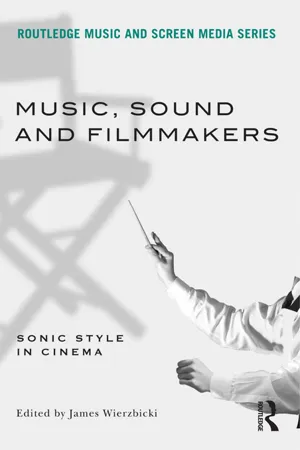
Music, Sound and Filmmakers: Sonic Style in Cinema is a collection of essays that examine the work of filmmakers whose concern is not just for the eye, but also for the ear. The bulk of the text focuses on the work of directors Wes Anderson, Ingmar Bergman, the Coen brothers, Peter Greenaway, Krzysztof Kie?lowski, Stanley Kubrick, David Lynch, Quentin Tarantino, Andrey Tarkovsky and Gus Van Sant. Significantly, the anthology includes a discussion of films administratively controlled by such famously sound-conscious producers as David O. Selznick and Val Lewton. Written by the leading film music scholars from Europe, North America, and Australia, Music, Sound and Filmmakers: Sonic Style in Cinema will complement other volumes in Film Music coursework, or stand on its own among a body of research.
- 216 pages
- English
- ePUB (mobile friendly)
- Available on iOS & Android
eBook - ePub
About this book
Information
Chapter 1
Sonic Style in Cinema
The word ‘sonic’ is, I think, self-explanatory: it is simply an adjective that refers to sound. ‘Style,’ on the other hand, is a more slippery word. The large and weather-beaten Webster’s Ninth New Collegiate Dictionary that has long been my trusted companion gives a six-point definition that runs to twenty lines; the much smaller American Heritage Dictionary gives only fourteen lines divided into eight definitions for nouns and three for verbs, and the Penguin Macquarie Dictionary that has lately helped my efforts to understand Australian English has a definition of twenty-one lines divided into no less than thirteen definitions.
Discounting those that are obviously irrelevant here (the seed-delivering part of a flower, the bit of a sundial that makes the time-telling shadow, a sharp-pointed instrument used for engraving, a bristly hair on the back of a wild boar), we are left with a large collection of definitions that all describe ‘a way of doing something’ but which nevertheless fall into a pair of very differently flavored groups.
On the one hand is a group of definitions that suggest a ‘general’ way of doing something, a way that is shared by many persons, or strata of society, or entire nations, who are somehow linked by a common locale, time period, or ideological agenda. Back in the late 1960s, bell-bottoms and beads were often ostentatiously worn by persons whom journalists dubbed hippies; even if someone were not really a hippie, he or she could nevertheless pose as one, perhaps at a costume party, by wearing hippie-style garb. In ancient Greece, monumental edifices were built according to principles espoused not just by the sculptor Phidias (who supposedly designed the Parthenon) but by numerous of his contemporaries; two and a half millennia later, we certainly recognize authentic examples of Greek-style architecture when we see them, and we likewise recognize Greek-style efforts in the facades of modern banks and town halls.
On the other hand is a group of definitions of ‘style’ that suggest a way of doing something that is not at all generalized but, rather, limited to a particular person or entity.
Within this second group are definitions that refer to what in effect are typographical rules. Scholars who nowadays work in music, film studies, and other areas of the humanities are typically instructed by book publishers and editors of academic journals to follow the guidelines spelled out in the aptly titled Chicago Manual of Style.1 Yet individual publishers often have ‘rules’ of their own that differ slightly from those of the CMS. Should the second sentence of this paragraph have a comma after ‘film studies’ or should it not? Should the date of Christmas be offered as ‘25 December 2011’ or as ‘December 25, 2011’? In an endnote or footnote, should the second edition of a cited work be indicated as ‘2nd ed.’ or as ‘2nd ed.’? Should the abbreviation of the Latin word ‘ibidem’ be in roman or italic type? There are no right or wrong answers to any of these questions; what matters is that different publishers have different sets of rules about such matters, and copy editors dutifully enforce their employers’ rules of ‘style.’
More to the point of this collection of chapters, the second group of dictionary definitions of ‘style’ includes a few that refer not at all to sets of rules that distinguish the products of one publisher from those of another but, rather, to sets of characteristics unique to the output of creative individuals. “A distinctive manner of expression” is the first definition offered by Webster’s Ninth New Collegiate Dictionary; “individuality expressed in one’s actions and tastes” is the third definition (after “the way in which something is said, done, expressed, or performed” and “sort; type”) in the American Heritage Dictionary; “a particular, distinctive, or characteristic mode of action” is the second definition (after “a particular kind, sort, or type, as with reference to form, appearance, or character”) in the Penguin Macquarie Dictionary. It is in the sense of these last-cited definitions—which focus on “distinctive manner[s]” and expressions of “individuality” and “characteristic mode[s] of action”—that the word ‘style’ figures into this book.
Scholars of literature would likely agree that there is indeed such a thing as ‘Elizabethan-style’ drama, but probably they would be quick to point out the differences between the literary-theatrical styles of such Elizabethan playwrights as, say, William Shakespeare and Ben Jonson. Art historians might well concur on the overall style of painters who nowadays are lumped together in the category of French Impressionism, but many of them have staked entire careers on demonstrating precisely the ways in which the ‘Impressionistic’ style of Édouard Manet, for example, differs from the equally ‘Impressionistic’ style of Claude Monet. Indeed, some scholars have dug deeply into the matter of style, identifying and analyzing not just Shakespeare’s and Jonson’s literary style in general, for example, but in particular their stylish uses of iambic pentameter.
It is in this last-mentioned sense that the word ‘style’ is employed throughout this book. Broadly speaking, all the filmmakers under consideration have ‘a way of doing something’—that is, a way of making films—that is distinctly their own. But the deliberately narrow focus here is on the filmmakers’ stylish use of sound.
Filmmakers
Film production is a collective exercise, not necessarily a collaboration in the most idealistic sense of that word but certainly a joint effort whose final result involves the input of numerous creative minds. The obviousness of this fact has long been apparent to persons even tangentially involved with the film industry, and probably it did not go unnoticed by the serious thinkers who fifty years ago laid the foundations for what in anglophone academia is now known as ‘film studies.’2 Only in recent years, however, has the idea of film as the product of teamwork emerged from the background and come to the fore of film scholarship, and thus only in recent years has there been a generally accepted debunking of what British writer Richard Dyer in 1998 dubbed “film studies’ greatest hit.”3 Dyer was referring, of course, to the pretentiously misnamed ‘auteur theory.’
The seeds for what in the English-speaking world has come to be known as ‘auteur theory’ were planted, innocently enough, by the critics who in the 1950s wrote for the monthly Paris-based magazine Cahiers du Cinéma. For these film critics, the word ‘auteur’ was nothing more than the French equivalent of the English ‘author,’ and they meant it precisely that way when they announced their group decision to shift the focus of their writing. Whereas their commentaries since the magazine’s founding in 1951 had centered for the most part on the authors of screenplays, after the 1954 publication of François Truffaut’s landmark essay “Un certaine tendence du cinéma Français” their commentaries tended to center on those French filmmakers “who often write their dialogue and [in some cases] invent themselves the stories that they direct.”4
Filmmakers who exemplified this “certain tendency in French cinema,” Truffaut wrote, included such directors as Jacques Becker, Robert Bresson, Jean Cocteau, Abel Gance, Max Ophüls, Jean Renoir, and Jacques Tati. Because they actually penned so much of their films’ content, Truffaut suggested, these filmmakers were in certain ways comparable to playwrights and the authors of novels. And thus Cahiers du Cinéma’s boldly proclaimed new policy—to take seriously the contributions of such filmmakers—was called the “Politique des auteurs.”
André Bazin, one of the founders of Cahiers du Cinéma, expanded on the policy in a 1957 article titled “De la politique des auteurs.” Paying close attention to a film director who might also be the author—literally speaking—of the film’s screenplay and dialogue, Bazin wrote, was just a logical application to the cinema of an idea that had long been applied in serious criticism of literature, music, and painting. Cahiers du Cinéma’s new “politique des auteurs,” he wrote, behooved critics to take notice of whatever elements a number of films ‘authored’ by a particular filmmaker might have in common. The Cahiers’ new author-based policy fairly mandated that film critics adopt as a “criterion of reference” what Bazin called a filmmaker’s “personal factor.” The policy also mandated, Bazin strongly suggested, that critics seeking to identify whatever “personal factor” marks the work of an arguably ‘authorial’ filmmaker should engage not just in “postulating [the] permanence” of this “personal factor” from one film to another but also in exploring the “progress [of this factor] from one work to the following.”5
As articulated by Bazin, in other words, the French critics’ author-based policy called not only for attention to be paid to a filmmaker’s style as demonstrated in a particular film; it also called for identification of that style, and for comparisons of evidence of that style as exhibited in any number of films. To act on the policy indeed required close observation of a film’s content, but it did not require making value judgments. The “politique des auteurs” simply outlined an approach to film criticism that focused on a certain filmmaker’s characteristic traits; aptly named, it was a policy, and there was nothing theoretical about it.
The policy morphed into something called a ‘theory’ in the early 1960s, when critics in England and the United States self-consciously began writing about film as an art form. The theory’s main champion, expressing his opinions in Film Culture, the New York Film Bulletin, and the UK-based journal Movie, was Andrew Sarris; its chief opponent was Pauline Kael, at that time (that is, before the 1968 start of her long tenure as film critic for The New Yorker) a writer for such publications as City Lights, McCall’s, and The New Republic. In 1963 Kael and Sarris squared off famously in the pages of Film Quarterly. Kael struck the first blow, in particular targeting the second of three premises that Sarris had spelled out the year before in an article in Film Culture. The first premise of what Sarris clearly labeled “the auteur theory” involved consideration of a director’s technical competence, and the third premise involved consideration of a film’s “interior meaning”; the second premise—the one that Kael found so galling—involved consideration of “the distinguishable personality of the director as a criterion of value.”6
“The smell of a skunk is more distinguishable than the perfume of a rose,” Kael noted, and then she asked: “Does that make it better?”7 Sarris hit back by arguing that his 1962 article had been grossly misread by Kael; he...
Table of contents
- Cover
- Title
- Copyright
- Dedication
- Contents
- Series Foreword
- Preface
- Acknowledgements
- 1 Sonic Style in Cinema
- 2 Music, Sound, and Silence in the Films of Ingmar Bergman*
- 3 Andrey Tarkovsky: The Refrain of the Sonic Fingerprint
- 4 “It’s All Really Happening”: Sonic Shaping in the Films of Wes Anderson
- 5 Kieślowski’s Musique concrète
- 6 Gus Van Sant’s Soundwalks and Audio-visual Musique concrète
- 7 Blowin’ in the Wind
- 8 Sound and Uncertainty in the Horror Films of the Lewton Unit
- 9 Conducting the Composer: David O. Selznick and the Hollywood Film Score
- 10 The Stanley Kubrick Experience: Music, Firecrackers, Disorientation, and You
- 11 The Filmmaker’s Contract: Controlling Sonic Space in the Films of Peter Greenaway
- 12 The Attractions of Repetition: Tarantino’s Sonic Style
- 13 Dream Timbre: Notes on Lynchian Sound Design
- List of Contributors
- Bibliography
- Index
Trusted by 375,005 students
Access to over 1.5 million titles for a fair monthly price.
Study more efficiently using our study tools.
Frequently asked questions
Yes, you can cancel anytime from the Subscription tab in your account settings on the Perlego website. Your subscription will stay active until the end of your current billing period. Learn how to cancel your subscription
No, books cannot be downloaded as external files, such as PDFs, for use outside of Perlego. However, you can download books within the Perlego app for offline reading on mobile or tablet. Learn how to download books offline
Perlego offers two plans: Essential and Complete
- Essential is ideal for learners and professionals who enjoy exploring a wide range of subjects. Access the Essential Library with 800,000+ trusted titles and best-sellers across business, personal growth, and the humanities. Includes unlimited reading time and Standard Read Aloud voice.
- Complete: Perfect for advanced learners and researchers needing full, unrestricted access. Unlock 1.5M+ books across hundreds of subjects, including academic and specialized titles. The Complete Plan also includes advanced features like Premium Read Aloud and Research Assistant.
We are an online textbook subscription service, where you can get access to an entire online library for less than the price of a single book per month. With over 1.5 million books across 990+ topics, we’ve got you covered! Learn about our mission
Look out for the read-aloud symbol on your next book to see if you can listen to it. The read-aloud tool reads text aloud for you, highlighting the text as it is being read. You can pause it, speed it up and slow it down. Learn more about Read Aloud
Yes! You can use the Perlego app on both iOS and Android devices to read anytime, anywhere — even offline. Perfect for commutes or when you’re on the go.
Please note we cannot support devices running on iOS 13 and Android 7 or earlier. Learn more about using the app
Please note we cannot support devices running on iOS 13 and Android 7 or earlier. Learn more about using the app
Yes, you can access Music, Sound and Filmmakers by James Wierzbicki in PDF and/or ePUB format, as well as other popular books in Media & Performing Arts & Music. We have over 1.5 million books available in our catalogue for you to explore.