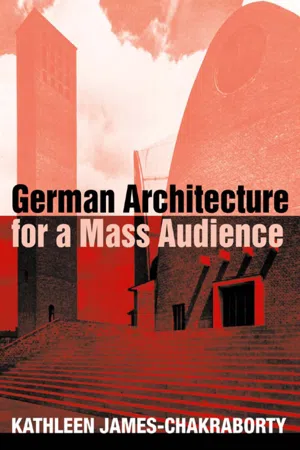
This book vividly illustrates the ways in which buildings designed by many of Germany's most celebrated twentieth century architects were embedded in widely held beliefs about the power of architecture to influence society. German Architecture for a Mass Audience also demonstrates the way in which these modernist ideas have been challenged and transformed, most recently in the rebuilding of central Berlin.
- 184 pages
- English
- ePUB (mobile friendly)
- Available on iOS & Android
eBook - ePub
German Architecture for a Mass Audience
About this book
Information
1 Space
In 1938 the German architect Rudolf Schwarz described the way in which the experience of standing in a ring affects those who participate in it:
In the closed form of the ring the arcing movement which originated it circles incessantly ahead, an inner stream of power which constantly renews and unifies the figure, just as the warmly circulating blood sustains and enlivens the human body. The inner stream, dark and hidden, turns the people into a community and unites their bodies into the higher body. This genuine growth befalls the individual who links himself into the common form. The forms of human community are alive. They are exceedingly potent realities which, standing the test of time, prove true. And of them all, the ring is the strongest.1
In this statement Schwarz makes a number of assumptions about the power of form. First, he assumes that all people experience it in the same way, that is, he assumes a universal subject. Second, he takes for granted that form generates emotions in both individuals and, because these experiences are universal, in groups. Schwarz uses organic metaphors (‘warmly circulating blood’) to explain how the group, or community, can thus be understood as ‘alive’. Finally, these are, Schwarz tells us, timeless truths, located outside the shifts in fashion that had done so much within his own lifetime to change the appearance of architecture.
Schwarz wrote during the Nazi dictatorship and described techniques that its supporters relied upon in their own attempts to use architecture to promote community. Nonetheless there is nothing specifically Nazi about these beliefs, nor were they unique to Schwarz. Indeed, they had already been widely held by German architects for a quarter of a century, and they would prove to have enormous consequences for the modern religious architecture of which Schwarz was such an important exponent before and after as well as during the Nazi dictatorship.2 Schwarz’s assumptions had their roots in two interlocking discourses: the explanation German sociologists offered for understanding the social dislocations wrought by modernization, and the aesthetic theories of philosophers and art historians who, at times inadvertently, offered architects a means for addressing and perhaps resolving those dislocations. Writing in the final decades of the nineteenth century, these thinkers articulated ideas which by the 1910s tended to be taken for granted by the architects who are the subject of this study.
Architecture and politics have been intertwined since the first ruler erected a palace magnificent enough to leave his subjects and foreign guests awestruck. Two aspects of this relationship in Germany between 1910 and 1940 are nonetheless unusual. First, rulers and their audiences alike assumed that style was political.3 Second, architects like Schwarz believed that the quality of the space of their buildings could resolve social problems that seemed intractable to all but the most extremist politicians. What were these problems and why had they resisted more conventional solutions?
The political background
Between the outbreak of the French Revolution and World War I the public engaged in German politics expanded to include first the bourgeoisie and eventually the lower middle class and the working-class masses.4 This process, which was exacerbated by the social and economic transformations that accompanied modernization, did not result in empowerment for all those who had gained a voice in German politics, however. While the bourgeoisie eventually became largely integrated into the late nineteenth- and early twentieth-century economic and political establishment, the votes that working-class and lower middle-class men cast for the Social Democrats did not produce the political changes they had hoped for until the revolution of November 1918.5 The strategies developed by the country’s elite in order to court the expanding number of participants in the political arena were seldom successful in curtailing the radical aspirations of working-class voters, but their attempts to develop a sense of community which would transcend class divisions did dramatically change the practice of both politics and architecture.
Between 1815 and 1871, the German states that survived Napoleon’s reorganization of Central Europe accommodated bourgeois demands for political representation in a variety of ways. While prerevolutionary systems that favored the aristocracy, or at least the traditional urban elites, were restored in many northern states, including both Mecklenburgs, Brunswick, Hamburg, Bremen, and Lübeck, new constitutions in Bavaria and Baden provided for more representative legislatures. The powers of these bodies remained severely restricted, however, as did the extent of the electorate.6
Following the unification of Germany in 1871, the situation became more complex, as the country’s first chancellor, Otto von Bismarck, initially relied upon the enfranchisement of the entire male populace to check the power of bourgeois liberals, at least at the national level. Elections for the Reichstag (the German parliament), unlike those for the parliament of Prussia, the country’s largest state, did not weight votes according to the economic status of those casting them. At first universal manhood suffrage produced comfortable majorities for Bismarck’s government. Despite Bismarck’s creation of what was then Europe’s most highly developed system of state-sponsored social welfare, his success in reaching over the head of bourgeois liberals to appeal to the masses eventually waned. The new nation’s rapid industrialization and urbanization, which moved many peasants off the land and into the proletariat, also encouraged them to turn to socialism. Although at the beginning of Wilhelm II’s reign Bismarck’s successor, Leo von Caprivi, courted popular support through relatively enlightened social policies, no imperial German government included or was sympathetic to the Social Democrats. The Center Party reflected the interests of its Roman Catholic working-class as well as bourgeois supporters, but it, too, remained on the periphery of national governments. Meanwhile, by the 1890s the rising popularity of the Social Democrats encouraged a bourgeois retreat from liberalism, which in any case was never identical with representative government.7
By 1912 the situation had reached crisis proportions. In that year the Social Democratic Party became the single largest party in the Reichstag. The socialists garnered 35 per cent of the vote in an election in which every adult German male was qualified to participate. No longer could aristocrats command the loyalty of the people against the bourgeoisie. The danger was twofold. First and most simply the electorate’s turn to the left called into question the structure of the Reichstag, a popularly elected body whose leadership was nonetheless appointed by the Kaiser. Germany threatened to become ungovernable. Second, the yawning class divisions exposed by the socialists’ strong showing revealed the weak foundations upon which the myths of German unity had been built.8 What if speaking the same language and inhabiting the same territory did not ensure that people of different social classes shared the same interests? Even if one sympathized with the socialists, one might envision an ideal community in which the many issues which divided Germans were eclipsed by social harmony.
Furthermore, while the emergence of a mass public attracted the attention of German elites primarily because it threatened their control of the nation’s political and economic system, it had other important implications. Although they were relatively impoverished in comparison to their employers, German workers still made enough money in the first four decades of this century to be important consumers of mass-produced goods, including such new and ephemeral forms of entertainment as film, radio, and sporting events. The extension of the public realm to include the commercial as well as the civic, indeed, the challenge the former increasingly posed to the latter, was one of the developments that most disturbed cultural commentators from across the political spectrum.9
Efforts to reach out to a mass public were largely diverted from partisan politics after Bismarck’s system was swept aside by the revolution which broke out in November 1918, following Germany’s defeat in World War I. The uprising, which prompted the abdication of the emperor, resulted in a Social Democratic government whose own integrity was in its earliest months most threatened by those further to the left. The communist-backed Sparticist uprising that took place in Berlin in January 1919 was the most serious of the many continuing revolts which were suppressed only by an alliance between the socialists and the notorious Freikorps, nationalist remnants of the imperial army. The republican constitution approved in 1919 in Weimar (hence the name Weimar Republic), brought a measure of political stability, but parliamentary politics never enjoyed the support of a convincing majority. In the absence of popular support for the government, other institutions tried to fill the void. Industry and the church were among those who realized the importance of reaching out to the working and lower classes. Their attempts to stabilize the system from within were quite distinct from more dynamic efforts to build a better society upon the more equitable distribution of consumer goods, including entertainment. Aborted when the collapse of the American stock market in October 1929 triggered a devastating economic crisis in Germany, the rise of mass culture was accompanied in many cases by an alliance with avant-garde artists and architects. The fragile republic endured for just three more years. Nazis and Communists battled in the streets, as well as at the ballot boxes, before Adolf Hitler finally assumed power in January 1933.10
Although Hitler governed as a dictator, he eagerly courted the German public, on whose behalf he claimed to rule. Plebiscites, for instance, were a prominent feature of his efforts to demonstrate that the country was united behind him. Equally compelling were events like the annual party rallies held in Nuremberg, in which hundreds of thousands gathered as participants and spectators. Such opportunities for apparently direct political participation masked the degree to which the apparent Nazi unification of German society depended upon statesponsored violence, but not that the Nazi definition of those to be united was in fact exclusive, barring Jews in particular from a public now defined in racial and religious terms.
The stalemates that characterized German politics during the first four decades of the twentieth century ensured that efforts to promote cultural solutions to political problems had enormous appeal. The approaches already developed before World War I were refined in the following two decades by those from across the political spectrum who saw in them the hope of reconstituting a vision of ideal communities, one whose slim basis in fact in no way hindered its popularity among cultural critics and other intellectuals who agreed about little else. All hoped that ostensibly nonpolitical solutions might heal an increasingly obviously fractured society. Their attempts to enlist architecture and theater in this project were to be shaped as well by long-standing German presuppositions about the relation of art to the society in which it was produced and by new sociological analyses of the process of modernization.
Organic communities: a sociological construct
Contemporaries attributed the political crises spawned by the failed alliance between Bismarck and the masses to what they saw as the socially corrosive forces of modernization. Led by Ferdinand Tönnies, German sociologists explained the alienation of the working class in terms of the unraveling of pre-industrial communities, which Tönnies described as ‘organic’. The issue was, quite simply, how one could restore the premodern social organization Tönnies romanticized without compromising the industrial development upon which the country’s new economic and political power depended. Beginning in the 1890s, generations of Germans from all across the political spectrum attempted to exploit the new technology they both feared and cherished to transcend through culture what they understood to be the most destructive effects of modernization, that is, to redeem industrialization without sacrificing what was seen as the nation’s fundamental (and hence pre-industrial) character.
First published in 1887, and reissued in 1912 to widespread acclaim, Tönnies’s Community and Society posited that there were two forms of social organization: communities and societies.11 Based on the patriarchal family, but extending outwards to encompass village and town society, the community was, according to Tönnies, a unified, inwardly focused form of organization encompassing ties of blood, of place, and of mind. Even when they did not themselves farm, as was for instance the case for those who instead practiced a craft, the participants in this social structure were, according to Tönnies, closely tied to the land. Furthermore, in Tönnies’s highly romanticized view, chains of communal authority, although feudal, remained ‘natural’:
Within kinship, all natural authority is concentrated in paternal authority; where the social grouping is based on neighborhood, this paternal authority is transformed into the authority of the prince and as such retains its importance. Under this form it is based more upon power than upon age and fatherhood. It is more clearly evident in the influence of a master over his people, of the landlord over his copyholders, of the feudal lord over his serfs. When friendship is based on common devotion to the same calling or the same craft, such dignity and authority expresses itself as the authority of the master toward his disciples, pupils, apprentices.12
To community, Tönnies opposed society, the mechanical organization of modern, urban life and – by extension – the nation-state. This he labeled an ‘artificial construction of an aggregate of human beings which superficially resembles the Gemeinschaft [community] in so far as the individuals live and dwell together peacefully’.13 Society, in Tönnies’s view, lacked the social unity that created meaningful communal bonds. Instead it was based upon a rationalism derived from the exchange of money and commodities. Borrowing from Karl Marx, Tönnies voiced a critique of modern capitalism that established his appeal to generations of leftwing intellectuals:
To the extent that free workers become deprived of property – as the possession of working tools and consumption goods – the natural rule of free merchants and capitalists over workers in the Gesellschaft [society] is realized and becomes actual domination, in spite of the latter’s freedom.14
Ironically, his claim that the merchant class was ‘international’ in outlook hinted at a possible anti-semitism, but did not diminish the popularity of his schema among Jewish cultural critics such as Siegfried Kracauer and Theodor Adorno. Similarly difficult to position politically was Tönnies’s postulation that in this form of social organization, the vagaries of public opinion replaced timeless religious truths.
The abstractness of Tönnies’s theory, derived from German circumstances but intended to be universally valid, obscured uncomfortable historical facts. Tönnies ignored the very real poverty and social disorder that had always existed in such settings.15 That he nonetheless had an enormous impact upon both the emerging discipline of sociology and upon German intellectual life more generally demonstrates the nearly universal nostalgia for pre-industrial life on the land and in small cities, if often on the part of those fully embedded in metropolitan culture, and the enormity of the desire to believe social harmony possible. For many Germans on the left and right from the 1890s through to the 1930s, clergymen as well as politicians, merchants as well as artists, the possibility of recreating these mythical communities offered the promise of eliminating social divisions they, like Tönnies, attributed almost exclusively to the processes of modernization. Yet the overriding goal was not turning back the clock, but defusing social tensions without necessarily changing either the country’s economic or political system. This could, depending on one’s point of view, be accomplished by overlaying past forms on present conditions or – more radically – by inventing new versions of what were understood as timeless ideals.16
Art as a path to social harmony
These attempts deployed newly invented symbols of the community in lieu of structural political or economic change. This was especially true in the arts. Critical to the substitution of cultural for political reform was the idea espoused since the end of the eighteenth century by German Romantics and their successors that art was a reflection of the society that produced it. If this were true, then perhaps one could change society by changing its artistic manifestations. Furthermore, before Germany’s political unification, a national culture had first been established by intellectuals. The preservation of pre-industrial culture thus assumed unusual political importance to those in nineteenth- and early twentieth-century Germany who located within it the core of national identity. At the same time, the Romantic emphasis upon art’s expressive, anti-rational characteristics was expanded upon following unification by aestheticians and art historians who increasingly emphasized abstract form rather than the stylistic and iconographic associations integral to Romanticism.
In architecture, art’s new responsibility to transcend rather than express the processes of modernization resulted in a shift away from tectonics, that is, theories which emphasized the methods and materials used to construct a building, towards the psychological effect of space.17 During the middle decades of the nineteenth century two important architectural theorists, Carl Gottlieb Wilhelm Bötticher and Gottfried Semper, had confronted the implications of new construction materials, above all iron, by emphasizing the relationship of architectural form to construction techniques and materials. Semper also stressed the symbolic qualities of architecture, which he believed to be enmeshed in its social role.18 By the 1870s, however, art historians and aestheticians...
Table of contents
- Cover Page
- Title Page
- Copyright Page
- List of figures
- Acknowledgements
- Introduction
- 1 Space
- 2 Simplicity
- 3 Spirituality
- 4 Spectacle
- 5 Postwar legacy
- 6 The new Berlin
- 7 Conclusion
- Notes
- Select bibliography
Trusted by 375,005 students
Access to over 1.5 million titles for a fair monthly price.
Study more efficiently using our study tools.
Frequently asked questions
Yes, you can cancel anytime from the Subscription tab in your account settings on the Perlego website. Your subscription will stay active until the end of your current billing period. Learn how to cancel your subscription
No, books cannot be downloaded as external files, such as PDFs, for use outside of Perlego. However, you can download books within the Perlego app for offline reading on mobile or tablet. Learn how to download books offline
Perlego offers two plans: Essential and Complete
- Essential is ideal for learners and professionals who enjoy exploring a wide range of subjects. Access the Essential Library with 800,000+ trusted titles and best-sellers across business, personal growth, and the humanities. Includes unlimited reading time and Standard Read Aloud voice.
- Complete: Perfect for advanced learners and researchers needing full, unrestricted access. Unlock 1.5M+ books across hundreds of subjects, including academic and specialized titles. The Complete Plan also includes advanced features like Premium Read Aloud and Research Assistant.
We are an online textbook subscription service, where you can get access to an entire online library for less than the price of a single book per month. With over 1.5 million books across 990+ topics, we’ve got you covered! Learn about our mission
Look out for the read-aloud symbol on your next book to see if you can listen to it. The read-aloud tool reads text aloud for you, highlighting the text as it is being read. You can pause it, speed it up and slow it down. Learn more about Read Aloud
Yes! You can use the Perlego app on both iOS and Android devices to read anytime, anywhere — even offline. Perfect for commutes or when you’re on the go.
Please note we cannot support devices running on iOS 13 and Android 7 or earlier. Learn more about using the app
Please note we cannot support devices running on iOS 13 and Android 7 or earlier. Learn more about using the app
Yes, you can access German Architecture for a Mass Audience by Kathleen James-Chakraborty in PDF and/or ePUB format, as well as other popular books in Architecture & Architecture General. We have over 1.5 million books available in our catalogue for you to explore.