- 304 pages
- English
- ePUB (mobile friendly)
- Available on iOS & Android
eBook - ePub
Cultural Revolution?
About this book
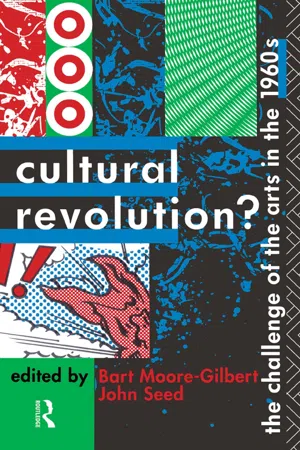
Are the cultural upheavals of the sixties just a media myth? The Summer of Love with its ambience of marijuana and sitar music, the glitterati of Swinging London, and student protesters battling with the police evoke a period of material prosperity, cultural innovation and youthful rebellion. But how significant were the radical aspirations and utopian ideals of the sixties? And what is the legacy of the social, political and cultural transformations which characterized the decade? In an interdisciplinary collection of specially commissioned essays, the contributors to Cultural Revolution uncover the complex economic and political contexts in which these changes took place. Covering a wide variety of art forms - drama, television, film, poetry, the novel, popular music, dance, cinema and the visual arts - they investigate how sixties' culture became politicized, and how its inherent contradictions still have repercussions for the arts today.
Trusted by 375,005 students
Access to over 1.5 million titles for a fair monthly price.
Study more efficiently using our study tools.
Information
Chapter 1
Introduction
Bart Moore-Gilbert and John Seed
The sixties’ in Britain is a construct with varied and contested meanings. The earliest and perhaps most persistent derives from a composite of media-constructed images evoking material prosperity, cultural innovation and youthful rebellion: the ‘Swinging London’ of Time magazine’s special April 1966 issue, with its King’s Road boutiques, Mayfair art galleries and fashionable glitterati; the enamelled butterflies of the summer of love; the hippie cult with its vocabulary of love and peace, its ambience of marijuana and sitar music; or protesting students battling with police outside the US Embassy in Grosvenor Square.
The central aim of this collection of essays is to penetrate beyond the conventional emblems of the sixties and to begin to elaborate a much more complex and precise history of what occurred in some of the central spheres of cultural life in Britain during these years. In this introduction we will, necessarily, be talking at an over-generalized level about ‘the cultural opposition’, ‘cultural radicals’, the ‘counter-culture’. But the thrust of the volume as a whole is towards recognizing differences and contradictions within the cultural practices of the 1960s. Thus it needs to be stressed at the very beginning, and this too is part of the work of demythologizing, that there was in these years no single monolithic counter-culture or cultural opposition with a coherent programme. There were diverse attacks on official culture (and that too was a more fissured and de-centred formation than the very term suggests), but in myriad locations—not only within the academy, within arts institutions of all kinds, within publishing, but also within more dispersed spaces around issues of gender, class, race and generation. Greater specificity about the chronology, location and often problematic interrelationship of these engagements is crucial to any adequate interpretation of the changes, the incorporations and the marginalizations of the cultural politics of the 1960s.
This is particularly important in the context of the New Right’s attempt in recent years to establish its own politically charged reading of the 1960s. For Mary Whitehouse, for instance, the 1960s was ‘an illiberal decade’ in which all but a minority of unrepresentative voices were silenced: ‘The avant garde flooded our culture and our society with its dirty water, churning up foundations, over-turning standards, confusing thought and leaving in its wake an all too obvious trail of insecurity and misery’ (quoted in Tracy and Morrison 1979:152). Concern about the alleged damage done to Britain’s cultural institutions by the infiltration of counter-cultural values and personnel into the BBC, the education system, even the Church of England, has provided a rallying point for the New Right. Whitehouse’s obsessive harrying of the BBC throughout the 1960s was an augury of what was to become in the 1980s a much more pervasive and statesponsored kulturkampf (see Whitehouse 1972). Norman Tebbit, former cabinet minister and from 1985 to 1987 chairman of the Conservative Party, has frequently pronounced his anathemas upon ‘the insufferable, smug, sanctimonious, naive, guilt-ridden, wet, pink orthodoxy of that sunset home of the third-rate minds of that third-rate decade, the Sixties’. His 1985 Disraeli Lecture blamed what he perceived as the current ills of Britain—violence, crime, above all ‘personal irresponsibility’—on the ‘Permissive Society’ that overturned traditional values in the 1960s:
The permissives scorned intellectual standards. Bad art was as good as good art. Grammar and spelling were no longer important. To be clean was no better than to be filthy. Family life was an outdated bourgeois concept. Criminals deserved as much sympathy as their victims. Many homes and classrooms became disorderly—if there was neither right nor wrong there could be no basis for punishment or reward. Violence and soft pornography became accepted in the media.
(quoted in Eccleshall 1990:247)
Mrs Thatcher herself contrasted—‘Sixties culture’ with ‘the old-fashioned…clean and orderly’ 1950s:
Pennissiveness, selfish and uncaring, proliferated under the guise of the new sexual freedom. Aggressive verbal hostility, presented as a refreshing lack of subservience, replaced courtesy and good manners. Instant gratification became the philosophy of the young and the youth cultists.
(quoted in Sinfield 1989:2961)
Malcolm Bradbury’s The History Man, first published in 1975 and then shown twice as a television series in the early 1980s, provided a powerful and influential picture of the sixties as destructive of intellectual and educational values by popularizing negative images of a new university sociology department at the end of the decade. The novel’s anti-hero, Howard Kirk, is cynical and meretricious in every aspect of his life. His intellectual work is superficial, carefully tailored to the fashionable market for radical chic. As a teacher he is demagogic, self-indulgent and biased. In his personal life he is manipulative and devious, sexually predatory, emotionally cold, devoid of personal loyalties or principles. Kirk’s colleagues and students are simply two-dimensional caricatures. Nevertheless Bradbury’s novel has been taken as an authoritative representation of the state of at least some parts of higher education in Britain in the late 1960s. According to a reviewer in the Sunday Express it was ‘horribly accurate’ and the Financial Times thought it was ‘possibly the most effective picture of academic life since Mary McCarthy’s The Groves of Academe’ . In many ways this picture of the 1960s as a phase of cultural trivialization, of superficial but sinister radicalisms, ‘trendy lefties’, selfindulgent and immature psyches, gratuitously destructive of order and tradition, devoid of any meaningful project for constructively transforming the real structures of social life, has become part of contemporary ‘common sense’.
The success of the New Right in generating an influential political orthodoxy about the sixties has been reinforced by disillusioned reaction to the decade from very different cultural and political perspectives. John Lennon’s 1970 interview with Rolling Stone, for instance, was forthrightly negative:
The people who are in control and in power and the class system and the whole bullshit bourgeois scene is exactly the same except that there is a lot of middleclass kids with long hair walking around London in trendy clothes and Kenneth Tynan’s made a fortune out of the word ‘fuck’. But apart from that, nothing happened except that we all dressed up. The same bastards are in control, the same people are running everything, it’s exactly the same. They hyped the kids and the generation…there has been a change and we are a bit freer and all that, but it’s the same game, nothing’s really changed.
(quoted in Wenner 1972:11–12)
Disillusion and antipathy also pervade several of the most substantial academic studies of the cultural politics of the decade. Daniel Bell’s The Cultural Contradictions of Capitalism, first published in 1976, provides a sophisticated sociological account of the failure of the counter-culture. For Bell—who describes himself as ‘a socialist in economics, a liberal in politics, and a conservative in ‘culture’ (1978: xi)—the ultimate exhaustion of the modernist dream is evidenced in the emptiness and nihilism of much of the art, the cultural values and the radical politics of the 1960s: ‘All that there was, was the pathetic celebration of the self—a self that had been emptied of content and which masqueraded as being vital through the playacting of Revolution’ (144). Or, as he put it in the foreword to the second edition:
The so-called counter-culture was a children’s crusade that sought to eliminate the line between fantasy and reality and act out in life its impulses under a banner of liberation. It claimed to mock bourgeois prudishness, when it was only flaunting the closet behaviour of its liberal parents. It claimed to be new and daring when it was only repeating in more raucous form—its rock noise amplified in the electronic echo-chamber of the mass media—the youthful japes of a half-century before. It was less a counter-culture than a counterfeit culture.
(Bell 1978: xxvii)
Bell’s focus is primarily on the United States, though its ramifications are considerably wider. In A Sociology of Contemporary Cultural Change, Bernice Martin develops often parallel kinds of arguments about Britain. She argues that the radical movements of the 1960s were particular instances of a long-term historical conflict between the individual and social order, which she terms ‘the expressive revolution’ developing out of romanticism. The late 1960s counter-culture, she argues, ‘was always an impossible Utopian dream’ (Martin 1981:235). Its ideals were impossible to realize as a total way of life and, as a consequence, ‘that missionary generation’ suffered major casualties. Martin does acknowledge that the 1960s brought significant change. An older culture of control was decisively undermined: ‘much that was only “lurking irreality”, or unspeakable in the 1950s is now the stuff of daily cultural consumption’ (237). Out of the cultural contests of the 1960s there emerged a new synthesis of structure and anti-structure–a widening, in other words, of the whole cultural repertoire. But the essential thrust of her argument is that such transformations indicate the ease with which the challenges of the cultural opposition were absorbed and contained.
Martin’s overall thesis, and especially her stress on the subsequent incorporation of the radicalisms of the 1960s, converges with Regis Debray’s sardonic comments on the significance of May 1968 in France.‘A modest contribution to the rites and ceremonies of the tenth anniversary’ deflates radical nostalgia. ‘May ’68 was the cradle of a new bourgeois society. It may not yet realize this, but it is time someone told it so’ (Debray 1978:46). Or, as he puts it later, ‘The sincerity of the actors of May was accompanied, and overtaken, by a cunning of which they knew nothing…they accomplished the opposite of what they intended’ (48). For Debray the May events brought about the transformation of a regime and a culture that were increasingly incompatible with a dynamic capitalism; the superstructure was brought back into line with the base, the relations of production with the forces of production. The targets of French radicals—the cult of work, the patriarchal family, a narrow patriotism, the dead weight of tradition—were increasingly obsolete. ‘Capital’s development strategy required the cultural revolution of May’ (49). These three critics of the cultural significance of the 1960s, despite differences of emphasis, share a sense of the cultural opposition as naive, dupes of history, unconscious of their real effects and comfortably assimilated into the dominant formations.
In Britain, disillusionment with the sixties has been particularly marked in relation to the decade’s impact on the arts. Amongst the earliest voices to dissent from the counter-culture’s own estimation of its significance in this respect was Bernard Bergonzi. He commented that Britain had ‘few cultural achievements to offer the world apart from the strident trivialities of the pop scene’ (Bergonzi: 1970:57). Triviality and an obsession with the private sphere are charges commonly laid against much artistic practice in Britain in the 1960s. Thus Martin laments the period’s ‘penchant for the exploration of essentially private states…and the relative neglect of (and even contempt for) issues and experiences which involve public behaviour’ (Martin 1981:98). Yet others hostile to the decade accuse it of the very opposite. Swinden caustically compares the vogue for Patrick White with the neglect of Barbara Pym, whom Cape ceased to publish in 1961. This, he opines, reveals the characteristic pretentiousness of the cultural values of the time: ‘Obviously a novel about a crucified Jew [The Riders in the Chariot] was bound to be ten times better than one about two old ladies who don’t know what to do with a milk bottle’ (Swinden 1989:267). Several commentators have argued that just as the most revolutionary political initiatives occurred elsewhere—in the United States, in France, in Germany, in Italy, in Czechoslovakia—so too Britain was largely untouched by, or merely parasitic on, the most challenging cultural innovations being developed elsewhere. In his book on experimental fiction, for example, Robert Alter (1975) found only one British novelist—John Fowles—worthy of comparison with continental and American writers engaged in revolutionizing the genre.
A recurrent charge against the 1960s avant-garde is that it attempted to destroy the very categories of art and culture. Symptomatic of this vandalism were: the erosion of the status of the individual artist, for instance by stressing group collaboration or the obliteration of the distinction between performer and audience, whether in theatre, poetry readings or ‘happenings’; the blurring of the status of the artwork by the use of ‘found objects’ and collage in the visual arts, found texts and cut-ups in writing, or the use of everyday gestures in dance; the instrumental use of art in agit-prop; and, at the other end of the spectrum, the interest shown in chance and random occurrence as constitutive elements in composition; and finally, at its most extreme, the exploration of autodestructive art. Swinden has been particularly critical of two of the most striking directions taken by the avant-garde: the erosion of distinctions between politics and art, and between ‘high’ and ‘popular’ culture. The former tendency, he argues, led to a vast overrating of new dramatic voices like Mercer, Bond and Potter, whose ‘combination of theatrical sensation and political naivety failed to produce plays that merited more than passing attention’ (Swinden 1989:271). ‘Cultural decline’, as he calls it, was also apparent in the widespread interest in the uses of ‘popular’ forms. He complains of the ‘frightful philosophical vacuity that is typical of the popular culture of the period’ and alleges that its influences on traditional ‘high’ cultural practices simply ‘exerted a pressure towards the juvenile, the irresponsible’ (264). Bernice Martin, by comparison, locates the threat to the distinctive identity of art in the avant-garde’s increasing subordination of practice to theory. The latter, she says, ‘becomes almost more a work of art than the art works themselves. The Word is thus infiltrating arts whose essential codes are not verbal at all’ (Martin 1981:91—though, paradoxically, she dismisses rock music as a serious art form precisely because of its failure to theorize itself).
This book does not casually dismiss the force of some of the critical views surveyed above. Nevertheless the 12 essays gathered here do provide a critique of some of the emerging orthodoxies about the 1960s in Britain. Four recurrent areas of debate can be briefly noted. In the first place these essays suggest that the question of the alleged selfabsorption or provincialism of British culture in these years needs to be reconsidered. In a range of cultural practices, from fiction and poetry to dance and pop music, foreign influences—especially American—were marked. Equally, however, in pop music, the visual arts, theatre and cinema at least, Britain’s international reputation was high. A number of foreign figures were attracted to Britain in these years, precisely because of the vitality and cosmopolitanism of its cultural scene—in cinema, to take one example, Polanski, Losey and Antonioni. In any case, the capacity to respond to foreign influences indicates a decisive shift away from the cultural introversion that characterized much of the British cultural establishment in the 1950s.
A second emerging orthodoxy about the 1960s, which this volume questions, concerns the apparent ease and speed with which the decade’s cultural radicalisms were absorbed into the Establishment they so vociferously opposed. First, that assimilation did not occur without a good deal of political counter-pressure. The state intervened directly to contain a range of challenges. Bookshops and galleries were prosecuted for the promotion of ‘obscene’ material—including work by Aubrey Beardsley. Publishers such as John Calder were involved in lengthy court cases over the publication of books like Trocchi’s Cain’s Book and Selby’s Last Exit to Brooklyn. The underground press was harried by the police, contributing to the closure of Oz and International Times in 1970. Particular pop songs were excluded from television and radio. Peter Watkins’ important film The War Game was banned. More subtle pressures—selective distribution of government subsidy by the Arts Council, for lack of which projects such as Arnold Wesker’s Centre 42 withered away—also served to deflect or undermine elements of the cultural opposition, filtering out what was deemed disruptive. This trend was already in evidence during the 1960s, but became much more marked after the accession to power of Heath’s Tory government in 1970. The new minister of the arts expressed in parliament his unhappiness at the Arts Council’s use of public money to support ‘works which affront the religious beliefs or outrage the sense of decency of a large body of tax-payers’. The Council’s clients were subsequently sent a ‘reminder’ (Hewison 1986:227). It would, of course, be absurd to exaggerate or over-dramatize the subtle repressions experienced in Britain in the 1960s; nevertheless it is shortsighted not to see the real political antagonisms that were in play in the field of culture.
It is also careless to forget the values and the work of many oppositional figures and groups who continued to remain outside, and opposed to, the mainstream after 1970—whether poets, musicians, dramatists, artists or academics. Indeed, Perry Anderson (1990) has recently noted the paradox that in Britain in the 1980s ‘a regime of the radical right part confronted, part created an overall cultural drift to the left’. Since the 1950s successive waves of radicalized intellectuals have preserved an oppositional culture crystallized in a range of journal...
Table of contents
- Cover Page
- Title Page
- Copyright Page
- Notes on Contributors
- Acknowledgements
- Chapter 1 Introduction
- Chapter 2 Hegemony postponed: the unravelling of the culture of consensus in Britain in the 1960s
- Chapter 3 The new radicalism: the politics of culture in Britain, America and France, 1956–73
- Chapter 4 The politics of culture: institutional change
- Chapter 5 From equality toliberation contextualizing the emergence of the Women’s Liberation Movement
- Chapter 6 A critical stage: drama in the 1960s
- Chapter 7 Inside the liberal heartland: television and the popular imagination in the 1960s
- Chapter 8 British poetry and its discontents
- Chapter 9 The return of the repressed: Gothic and the 1960s novel
- Chapter 10 Step by step: the cautious revolution in dance
- Chapter 11 New waves and old myths: British cinema in the 1960s
- Chapter 12 Still crazy after all these years: what was popular music in the 1960s?
- Chapter 13 Caro verbum factus est: British art in the 1960s
Frequently asked questions
Yes, you can cancel anytime from the Subscription tab in your account settings on the Perlego website. Your subscription will stay active until the end of your current billing period. Learn how to cancel your subscription
No, books cannot be downloaded as external files, such as PDFs, for use outside of Perlego. However, you can download books within the Perlego app for offline reading on mobile or tablet. Learn how to download books offline
Perlego offers two plans: Essential and Complete
- Essential is ideal for learners and professionals who enjoy exploring a wide range of subjects. Access the Essential Library with 800,000+ trusted titles and best-sellers across business, personal growth, and the humanities. Includes unlimited reading time and Standard Read Aloud voice.
- Complete: Perfect for advanced learners and researchers needing full, unrestricted access. Unlock 1.5M+ books across hundreds of subjects, including academic and specialized titles. The Complete Plan also includes advanced features like Premium Read Aloud and Research Assistant.
We are an online textbook subscription service, where you can get access to an entire online library for less than the price of a single book per month. With over 1.5 million books across 990+ topics, we’ve got you covered! Learn about our mission
Look out for the read-aloud symbol on your next book to see if you can listen to it. The read-aloud tool reads text aloud for you, highlighting the text as it is being read. You can pause it, speed it up and slow it down. Learn more about Read Aloud
Yes! You can use the Perlego app on both iOS and Android devices to read anytime, anywhere — even offline. Perfect for commutes or when you’re on the go.
Please note we cannot support devices running on iOS 13 and Android 7 or earlier. Learn more about using the app
Please note we cannot support devices running on iOS 13 and Android 7 or earlier. Learn more about using the app
Yes, you can access Cultural Revolution? by Bart Moore-Gilbert,Dr Bart Moore-Gilbert,John Seed in PDF and/or ePUB format, as well as other popular books in Art & Art & Politics. We have over 1.5 million books available in our catalogue for you to explore.