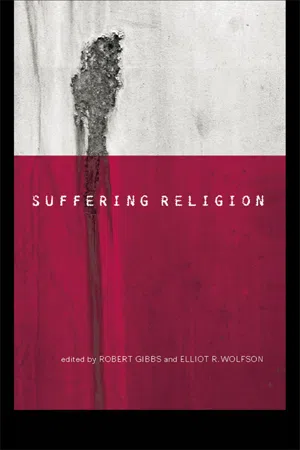
In a diverse and innovative selection of new essays by cutting-edge theologians and philosophers, Suffering Religion examines one of the most primitive but challenging questions to define human experience - why do we suffer? As a theme uniting very different religious and cultural traditions, the problem of suffering addresses issues of passivity, the vulnerability of embodiment, the generosity of love and the complexity of gendered desire. Interdisciplinary studies bring different kinds of interpretations to meet and enrich each other. Can the notion of goodness retain meaning in the face of real affliction, or is pain itself in conflict with meaning?
Themes covered include:
*philosophy's own failure to treat suffering seriously, with special reference to the Jewish tradition
*Martin Buber's celebrated interpretations of scriptural suffering
*suffering in Kristevan psychoanalysis, focusing on the Christian theology of the cross
*the pain of childbirth in a home setting as a religiously significant choice
*Gods primal suffering in the kabbalistic tradition
*Incarnation as a gracious willingness to suffer.
- 208 pages
- English
- ePUB (mobile friendly)
- Available on iOS & Android
eBook - ePub
Suffering Religion
About this book
Information
1 Unjustifiable suffering
Robert Gibbs
I wish to occupy a dangerous place, the place of accuser of philosophy and defender of sufferers. I wish to defend those who suffer from philo-sophical justification of their suffering. The task, however, must reach beyond that defense to relief and consolation of the sufferer. Such a task disturbs the practice of an academic essay, but accentuates the question of why we write and think.
In a cursory comparison of Hermann Cohen (1842–1918), Franz Rosenzweig (1886–1929), and Emmanuel Levinas (1905–95), we will find each of them positioning themselves against philosophy, in the honor of sufferers. In the first part of this essay, I will articulate the nature of each one’s objection against thought, in particular philosophical thought. But in the second part, I will return to the risks in their writings and their disparate calls to actions. That we can discern a tradition of modern Jewish thought on suffering is a central claim that I and others have raised. Indeed, we have argued that postmodern Jewish thought must make suffering the primary concern for thinking. This tradition, however, stands in ambiguous relation to philosophy and to the possibility of philosophy.
I must also pause to explain the composition of this text. This paper was delivered orally three years ago, and at that presentation I handed out a photocopied sheet with the short passages I examined. For the written format, I use a commentary composition. On the left side of the page you will see passages by the various authors, retranslated by me and broken up into chunks. These passages are numbered consecutively (1, 2, 3 . . . ) and the chunks of a given passage are lettered consecutively (a, b, c . . . ). I call these passages the pretexts of the paper. My commentary surrounds the pretexts. At the bottom of the page are citations to secondary sources and also some parallel passages from the authors, creating a kind of hypertext or, for the talmudically minded, masoret ha-shas.1
The compositional tradition for the page I am drawing on is talmudic (but also shared with medieval and early modern Christian texts). My argument is not simply a history of ideas, but is rather a thematic set of claims about suffering and thought. Thus the commentary (and not the integrity of a larger pretext) governs the essay—and in this I break with what one might have expected from premodern commentary. Rabbinic texts themselves, however, follow principles of argument and discourse that prize anachronism and discontinuity for the sake of a logic that refuses treatise format. Those texts inspire me and have charged me to compose articles, chapters, and recently a whole book in this compositional style. One of the central themes of my work is that the reader becomes responsible for the text while the writer must hold open the vulnerability of a text for its reader, and thus I display the practices of my own reading in order to write in such a way that I can set my readers free to read for themselves, against my reading. The pretexts themselves solicit interpretation, but my commentary is meant to allow my readers to be solicited by the pretexts. Both Peter Ochs and Elliot R. Wolfson, colleagues of mine in quite different fields of Jewish Studies, have explored how a text suffers, and how our interpretations are attempts to address the suffering of the text.2The performance of this essay itself reflects responsibilities for relieving that suffering and for consoling the texts and by commenting even though those responsibilities are only tacit in the essay. While the essay can develop the indexicality of discourse about suffering, the esthetics of such discourse and the cultural critique involved, it stops short of the place of its own commentary composition.
I Justified suffering
I begin with Franz Rosenzweig, in his The Star of Redemption. Begun in the trenches of the First World War and written after it, The Star accuses old philosophy of a blindness to the human suffering in the fear of death. There is a recourse to the soldier’s experience of anxiety, discovering that I want to live and that my own death is really something. Philosophy chose to divert us from facing that fear by denying that death was
real. His book begins:
(1a) Rosenzweig (3/3) From death, from the fear of death all knowledge of the All arises. Philosophy dares to jettison the anxiety of the earthly, to take from death its poison thorn, from Hades its pestilential stench. Everything mortal lives in this anxiety of death, each new birth adds to the anxiety for one new reason, because it adds to the mortal. Without ceasing, the womb of the indefatigable earth bears a new mortal and each is bound to die, and each waits with fear and trembling for the day of its journey into the dark.
Philosophy appears here as the knowledge of the all, as a totality. Rosenzweig’s discovery is that the desire to know-it-all is a flight from death, or more significantly from the fear of death. This etiology could be compared with Freud’s war writings and scoops Heidegger by over five years—anxiety, or rather, the evasion of anxiety, instigates not merely a distractive interest in knowing (so as not to be in angst), but further, a drive for totalizing knowledge. Philosophy arises in order to jettison the anxiety of the earthly—to denature death, or at least, to help remove the sting of death, which is not the decay of the corpse after death, nor even the moment of death itself, but—of course—the anxiety, the fear of death. We would be rid of the suffering that precedes death, the suffering of anxiety about our death. The passion of death is not in the moment of becoming dead, but is the way of living with this anxiety. For a mortal, to be alive is to live in this anxiety. Rosenzweig gives his account of the continuous upsurge of anxiety. Each new birth brings the promise of another death, and so adds to the anxiety, because a mortal lives in the fear of its coming death. For each new mortal is under a death sentence (bound to die) and must live in fear and trembling for the death.
Philosophy arises to give the lie to this anxiety by positing that death is nothing: or at least nothing to fear. It offered the myth of the immortal soul that will survive the death of the body. Rosenzweig’s images of the earthly, opening the grave with every step, dreading the moment of burial, of returning to dirt, echo the Hebrew Adam, the earthling. To walk on the earth is to walk in the anxiety of death. Philosophy’s “solution” is to deny the dirty, to drop the body into the abyss and leave the self as soul to float away. But the anxiety resides not in the part that is dirt, but in me: I will die, not just my body. Philosophy’s ruse is to deny my death—including the death of the philosopher. By denying death, it removes the anxiety. But even that ruse would fail, if only philosophy listened to the anxiety of the mortals. Rosenzweig continues in this passage to discuss the men become mud in the trenches of World War I, but even as they are inserted into the dirt, their anxiety does not concern their bodies alone—rather it screams out for the “I,” who fears to die, who wants to live. The extreme corporeality of their war deaths unmasked the diversion of separating body and soul.
(1b) But philosophy belies these anxieties of the earth. It snatches over the grave which the foot discloses with every step. It lets the body fall into the abyss but the free soul float away over it. That the anxiety of death knows nothing of such a separation of body and soul, that it bellows I, I . . . and wants to hear nothing of this diversion of anxiety onto a mere “body”—why should that bother philosophy?
While Rosenzweig will later open the door to a non-totalizing reasoning, to a thinking that can accommodate the particularity of death, he does interpret the whole history of Western philosophy as emerging from this fundamental avoidance of this profound anxiety of death and the desire to live in the world. Compelled by a fear it could not dignify or interpret Philosophy chose totalizing thought.
(2a) Rosenzweig (5/5) In so far as philosophy denied the dark presupposition of every living thing, namely that it would not allow death to count as something, but made it into nothing, it constructed for itself the appearance of presuppositionlessness. Because now all knowledge of totality has as its presupposition—nothing. Prior to the one and universal knowledge of totality is only the one and universal nothing.
The logical move is so simple that it was plausible. Make death into a one and universal nothing, and then one can know everything (because death is not part of that). What you know you need not fear, and if you know everything, then you need not fear what you know and you need not fear what you don’t know (because it is not). But what strikes a philosopher here is the transposition of clear values in the philosophical tradition (presuppositionlessness, universality, knowledge of totality), in a narrative where they serve as ways of denying the dark presupposition of every living thing. To flee from the anxiety of death, philosophy undertook a slight diversion: to know everything. The grand systems of philosophy arise in flight from anxiety.
The thirst for rising beyond presuppositions (Plato’s anhupotheton) is itself a repression formation of the most difficult and basic passion: the passion of anxiety for death. But that anxiety in Rosenzweig singles me out, and to deny it only required a bait and switch: that death became an empty, universal nothing, a death that no one need be anxious of.
(2b) If philosophy did not want to stop its ears from the scream of anxious humanity, then it would have had to proceed—and consciously proceed thus—: that the nothing of death is a something, that each new death-nothing is a new, an ever new fearful something that neither talking nor keeping silent can do away with. And in place of this one and universal nothing, that sticks its head in the sand before the scream of the death anxiety, that would proceed only from the one and universal cognition, it would have had to have the courage to listen to each scream and to not close its eyes before the gruesome actuality. The nothing is not nothing, it is something.
Philosophy runs from anxiety, or sticks its head in the sand. That is, it pretends that death is not plural and that anxiety is not real, refusing to listen, refusing to think about anxiety. But like the ostrich, pretending cannot remove the danger—and perhaps this in the sand is the image of the head (the thinker) returning to the ground, the burial of philosophy. But more important than its failure is the task that Rosenzweig sets. Anxiety has a discourse: the scream. The scream cannot be resolved into speech or silence. To listen to it is to find thought delivered over to the individual person in dread of death. Each has anxiety for itself. Death itself is thousands of deaths. But universality obscures the suffering of each in the suffering of all—which is not even suffering for all because it is linked to that denial of death.
Rosenzweig understands post-Hegelian philosophy to struggle to heed this scream of anxiety. It bears the task of recognizing this extra-totality of the self, whether Kierkegaard’s or Nietzsche’s. In an interesting presage of Heidegger, Rosenzweig constructs a defiant self who is authentic precisely in relation to his own death. But the limitations of Idealism and its totality recur throughoutThe Star, always deaf to the cries of people, blind to their suffering in the face of death.
Having set forth the motive for thinking the all, Rosenzweig later sets out its logic, with its necessary emanations and necessary sublimations, its generation of what is and its demand to surrender one’s particularity in ever higher rationalization. Philosophy thus deals with suffering by disregarding the particularity of the sufferer, whose suffering arises not merely through her circumstance, but also through anxiety, ultimately mortal anxiety. To think in this totalizing way is to protect oneself from that anxiety, but also to disavow responsibility for one’s own thinking. The turning away from anxiety is, therefore, a turning away from the responsibility of the one who thinks.
If we now turn to Hermann Cohen, Rosenzweig’s teacher, we find a remarkably parallel and different account of suffering and of the philosophical blindness to it. Cohen, the founder of the Marburg Neo-Kantian school, was a champion of rationality, especially of rational ethics. In his last work, however, he turns to Jewish religious sources to make good some incompleteness of rational ethics. The integration of this new material is extremely complex, and Cohen insists that it still preserves the rationality of both ethics and religion. Hence, whatever the limitations of philosophy to pay attention to suffering, the excess from Jewish sources will neither contradict nor even compromise the purity of rational ethics. Still, like his student, Cohen had found that there is a kind of human suffering that philosophy did not know. For Cohen that is the suffering of poverty.
Our interest is the limitation of philosophy itself to recognize the poor person as my responsibility. In ethics the individual appears under the categories of the state and the universality of a world federation of states. It assigns responsibilities to the individual through locating the individual within a totality. But the particularity that rational religion seeks allows for a plurality and a difference between I and you. In his introduction to the Religion of Reasonwe find a problem that fore-shadows Rosenzweig’s Star:
(3a) Cohen RR (17/15) Does it lie in the competence of ethics, is it within its method, to make the discovery of the “you”? Can it enter into this classification of individuals according to its concepts of the human, of humanity? Does it have the methodical means to establish it, even if its end point is only the totality (Allheit), which is fulfilled only in humanity? Mustn’t it suppose in the task of such a division and gradation, and generally in the problem of plurality of human beings, an aberration from its unifying goal of totality?3
The logical problem is the recognition of the specificity of the other person, the “you.” In his Ethics of the Pure Will, Cohen had produced a “you.” Indeed, Buber’s account of I–you owes most of its logic to that account. Thus the rhetorical questions does it, can it, mustn’t it are not as foreclosed as one might expect. Ethics had indeed discovered the you. But which “you”? The logic of Cohen’s system pursued an all-ness (Allheit) that was constructed toward unity. The plurality of people was subordinated to a unity, not merely logically but also ethically: a vision of world peace and universal justice. The “you” of that totality was determined through the state and its specificity was generated from the all-inclusive categories above it. It recognized the “you” of legal contracts and of co-operation, but not as bearing the other’s specificity. Indeed, from the perspective of the Ethics, any interest in the specificity of other people would seem to be an aberration from its unifying goal of totality. The logic of philosophical ethics must suspect a fascination with specificity, even of the other person.
(3b) One cannot object that ethics, in so far as it has human beings in the history of the human race as its task, ineluctably also must make the plurality of human beings and their classification its task. Because this objection would be settled in that the task is indeed acknowledged, but its solution first follows from totality, and thus also only in conformity with this totality. The question always remains if the plurality of human beings does not nonetheless raise questions that cannot at all be solved on the grounding concept of totality. And this question becomes pressing in relation to the problem of the “you,” even if it would have liked to remain veiled in that of the “he.”
Cohen then restates the logical problem for ethics. Of course ethics is concerned to account for the plurality and distinctions among human beings. It bears this task because its pursuit of totality requires an account of the history of the human race: it is not merely a description of binding norms, but also needs an historiography in relation to the goal of human unity— humanity. But just because the task is determined from the totality, the specificity of others can be had only in conformity with this totality. In the Ethics, Cohen had accepted the interpretation of a totality produced through a rational generation by means of ideas. But now beyond that project of classification through totality, there is a further concern. Are there not questions that cannot be approached, cannot at all be solved, from this concept of totality? Totality acts as the grounding concept for ethics. The specificity of the other person, who now will shed the cloak of “he” to appear as the problematic “you,” exceeds the reach of this philosophical concept of totality. In the Ethics, Cohen had moved from “he” to “you”—from an objective other to a companion or co-worker, to whom one addresses oneself. But now specificity gains a deeper impulse, as once again the other becomes the one I address and face—and as such eludes not only the objectivizing discourse about “him,” but also raises problems beyond the power of the concept of totality.
Rosenzweig (158/142) . . . the self surrenders to a universal. In the concept of surrender we have the counterpart to the concept of generation. The latter governs the way from universal to particular, the way down; the former governs the way from particular to universal, the way up. The two together, generation and surrender, close the idealistic world as a whole. The way up begins with that original surrender of the “maxim” of one’s own will—and what else is that than B=B!—to the principle of a universal legislation—and what else is that than B=A! This now goes on and on, because as soon as the final principle of a universal legislation is reached, and is admitted again into the “maxim of one’s own will,” the power of the idealistic surrender must again prove itself by again becoming the principle of a universal legislation. In this way the surrender to ever higher communities, ever more inclusive universality of life renders itself the universal . . .
The complexity of Cohen’s position requires a bit more explanation. Because both the religion and the ethics under consideration are rational, he fears that concern with the “you” will import something irrational, something unintelligible and perhaps fanatical into the system. Hence the recourse to an alternative relation to plurality has to be justified as still rational and not preferential nor particularistic. Now Cohen wants to say that the “you” of Ethics is not “you” enough, not the “you” with whom I am obliged to suffer. That near-one from the Ethics can become an underling, someone who is inferior to me. The new “you” is to be a co-human, someone who is with me, not just near me. To be with-me requires that I suffer with him, or have compassion (Mitleid). For Cohen, this is not simply a passive experience of pity but is rather an active, rational process of recognizing him as my responsibility. Indeed, I become a person myself only in relation to this other person. The relation between me and the other is structured around overcoming a discrepancy: the other suffers, and I have to learn how to suffer with her.
For Cohen the essential form of human suffering is poverty. This suffering, moreover, is not merely my anxiety about death. Rather, it is physical, too. Poverty arises through an economic discrepancy between me and the other, but that gap also signals the crisis of the community and of the totalizing concepts that arise in ethics itself.
(4a) Cohen RR (157–8/135–6) The objectification of evil in poverty has led us to suffering. . . . Suffering is an actual feeling, that is, not only a social fact, that is reflected in poverty; rather it is laid hold of and must be grasped as a prevalent fact of consciousness, as one that fills the whole human consciousness and has a ro...
Table of contents
- Cover Page
- Title Page
- Copyright Page
- Suffering Religion
- Contributors
- Introduction: The study of religion
- 1 Unjustifiable suffering
- 2 Rereading Job as textual theodicy
- 3 Suffering in theory
- 4 The scandal of pain in childbirth
- 5 Divine suffering and the hermeneutics of reading Philosophical reflections on Lurianic mythology
- 6 Suffering and incarnation
- Epilogue
Trusted by 375,005 students
Access to over 1.5 million titles for a fair monthly price.
Study more efficiently using our study tools.
Frequently asked questions
Yes, you can cancel anytime from the Subscription tab in your account settings on the Perlego website. Your subscription will stay active until the end of your current billing period. Learn how to cancel your subscription
No, books cannot be downloaded as external files, such as PDFs, for use outside of Perlego. However, you can download books within the Perlego app for offline reading on mobile or tablet. Learn how to download books offline
Perlego offers two plans: Essential and Complete
- Essential is ideal for learners and professionals who enjoy exploring a wide range of subjects. Access the Essential Library with 800,000+ trusted titles and best-sellers across business, personal growth, and the humanities. Includes unlimited reading time and Standard Read Aloud voice.
- Complete: Perfect for advanced learners and researchers needing full, unrestricted access. Unlock 1.5M+ books across hundreds of subjects, including academic and specialized titles. The Complete Plan also includes advanced features like Premium Read Aloud and Research Assistant.
We are an online textbook subscription service, where you can get access to an entire online library for less than the price of a single book per month. With over 1.5 million books across 990+ topics, we’ve got you covered! Learn about our mission
Look out for the read-aloud symbol on your next book to see if you can listen to it. The read-aloud tool reads text aloud for you, highlighting the text as it is being read. You can pause it, speed it up and slow it down. Learn more about Read Aloud
Yes! You can use the Perlego app on both iOS and Android devices to read anytime, anywhere — even offline. Perfect for commutes or when you’re on the go.
Please note we cannot support devices running on iOS 13 and Android 7 or earlier. Learn more about using the app
Please note we cannot support devices running on iOS 13 and Android 7 or earlier. Learn more about using the app
Yes, you can access Suffering Religion by Robert Gibbs,Elliot R. Wolfson in PDF and/or ePUB format, as well as other popular books in Theology & Religion & Comparative Religion. We have over 1.5 million books available in our catalogue for you to explore.