- 256 pages
- English
- ePUB (mobile friendly)
- Available on iOS & Android
eBook - ePub
About this book
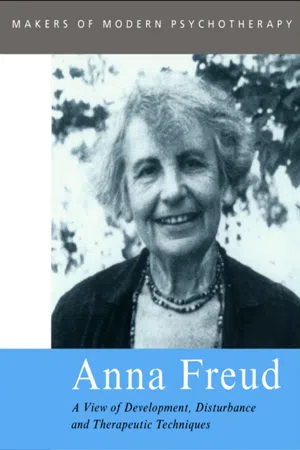
Anna Freud, daughter of Sigmund, made many original contributions to psychoanalytic theory and child development, and yet much of her work remains relatively unknown.
In this book, Rose Edgcumbe seeks to redress the situation. Taking a fresh look at Anna Freud's theories and techniques from a clinical and critical viewpoint, and the controversy they caused, she highlights how Anna Freud's work is still relevant and important to the problems of today's society, such as dysfunctional families, child delinquency and violence. It also plays a vital role in recent developments in therapeutic techniques.
Written by a former student and co-worker of Anna Freud, this book will make useful reading for clinicians and students of child development.
Rose Edgcumbe is a member of the Association of Child Psychotherapists and the British Psychoanalytic Society. Since training with Anna Freud at the Hampstead Clinic she has worked there in many capacities in treatment, training and reseach, and in other clinics. She has published numerous papers on child analysis, including a memorial paper: Anna Freud: Child Analyst.
Information
Chapter 1: Introduction: Three questions about Anna Freud's work
Anna Freud's work is a mine of information and insight for anyone interested in understanding the vagaries of human development. It is of special value to all who have care of children, whether as parents or professionals. Anna Freud combined a powerful intellect and questioning mind with a keen capacity for observation.
My aim in this book is to describe Anna Freud's innovative and still relevant work in the observation, upbringing and care of children, as well as in child psychoanalysis. I especially want to stress the interaction between her clinical observation and her interest in developing the structural theory of her father. She was an adult analyst who maintained a large practice in addition to her other work throughout her life; and she played an important role in psychoanalytic training for work with adults first in Vienna and then in London. But her earliest papers concerned her work with children, and she was one of the first people to explore the possibilities of psychoanalysing children. It was from children that she gained many of the insights which she incorporated into her contributions to psychoanalytic theory. Her major influence on the theory and technique of clinical work with adults also derives from the understanding of human development which grew out of her immense experience with children. Yet the extent of her influence is not always recognised; and in trying to understand this, I wish to consider three questions.
Question 1 : Why did she not accept ‘developmental help’ – her own innovative approach to deficiency disorders – as a legitimate part of psychoanalytic technique?
Her developmental theories gave rise to innovations in technique for work with children suffering from developmental deficiencies. She modestly called these techniques ‘developmental help’, and they were elaborated by generations of her students in the Hampstead Child Psychotherapy Course. Many of us who were her students would now consider this developmental help to be an essential part of child analytic technique in many of the cases we treat today. Further, similar considerations of developmental deficiencies have given rise to modifications of technique in psychoanalytic work with adults suffering from borderline, psychotic and some narcissistic disorders, and Anna Freud's ideas have certainly had some influence in this area. Yet she herself seemed, to many of us who worked with her, doubtful whether these innovations could be considered a legitimate part of the main body of psychoanalytic technique. Instead, she considered them to be a useful extra tool for patients not suited to ‘proper’ psychoanalysis.
Question 2 : Why is she still thought of as a drive theorist only, in spite of her excellent theory of object relations?
In the debate about what motivates human behaviour, Anna Freud continues to be labelled as a ‘drive theorist’, although it is evident that she also placed great emphasis on object relations as sources of motivation for development. Her work on development contains a very clear and detailed theory of the development of object relations. It is to be found in her ‘developmental lines’; and in many papers her formulations about the development of ego and superego, of impulse control, of thinking, and of the management of emotions, all stress the central importance of the child's relationships, as does her theory of technique. If forced to choose she would no doubt have opted to be counted among those who take drives rather than object relations as the primary motivating force in human behaviour. But she would, I believe, have seen no reason to make such a choice, given that both are important.
I do not claim to have complete answers to these two questions, which are not merely of historical interest, although part of the answer may be historical, and links with the third question.
Question 3 : Why is she not better known?
Her work is not commonly recognised in Britain, and is more widely accepted among analysts in the USA as well as Europe. Yet Anna Freud's work is as relevant today as it ever was, since it offers avenues of approach to understanding and managing the children whose difficult behaviour can create havoc in schools, who become violent, murderous, delinquent or promiscuous, vandalise schools and the areas where they live, or turn to substance abuse. It also offers understanding and ways of treating those who create trouble not for others but for themselves, through crippling anxieties, failure in their schoolwork, inability to cope with social relationships and situations, or incapacity for work. Both groups of children may suffer difficulties in their sexual partnerships and in parenting in later life, because of their anxieties, inadequacies or immaturities, and her work offers ways of helping such individuals as parents, too.
I believe we can go some way towards answering my three questions by examining Anna Freud's relationship with her father's work, and her way of handling controversies within the British Psychoanalytic Society. To put it in a vastly oversimplified way: Anna Freud's loyalty to Sigmund Freud's drive and structural theories, in which instinctual drives are seen as the motivating force for all human behaviour, meant that when writing or speaking theoretically she formulated all her ideas about relationships in terms of drive theory and ego functioning. She believed that those who propounded new theories of object relations were in danger of abandoning drive theory, which she regarded as the bedrock of psychoanalysis. Her own object relationships theory was essentially an attachment theory, similar to Bowlby's in many ways. She recognised this, but also clarified the differences in a discussion of Bowlby's work (Freud, A. 1969a). Her stress is not merely on the importance of the child's external attachments but on the effect of these real external relationships on the child's inner world of self–object relations. She was among those in the analytic community who for many years regarded Bowlby's work with suspicion, feeling that he had abandoned psychoanalysis. Time has softened such extreme positions, and Bowlby's work is now better valued in the psychoanalytic community.
I do not think it was simply fear of appearing to side with those who abandoned drive theory which motivated her. Rather, she genuinely thought that the development of relationships could be adequately explained by taking drives as the primary motivating forces, and aspects of ego and superego functioning as the modifiers of relationships. Her own formulations in these terms are elegant and clear. Moreover, in her later works there does seem to be a gradual shift in the relative importance she accorded to object relations and drives. But her overall adherence to theories which have come to be considered, rightly or wrongly, as outmoded is one reason for her lack of prominence among the psychoanalytic writers of today in this country.
By the time Anna Freud formulated her later theoretical conceptualisations she was doing so very succinctly, often without illustrative material. Her writings are often deceptively simple, but actually so densely packed that they can be difficult to unravel without the experience of observation and clinical work on which she based them. The illustrations of some of this experience are to be found in her early writings, for example, on the war nurseries and on defence, but relatively little in her later writings. Here she differed from Melanie Klein, who continued to publish many case histories. Other reasons include her withdrawal from arguments in the British Psychoanalytic Society, and the fact that she was probably not by nature given to proselytising. Her biographer, Elizabeth Young-Bruehl, also suggests possible political and class differences between Anna Freud and the British Society into which Melanie Klein had become integrated, which would have influenced their scientific style (Young-Bruehl 1988, p. 178).
Biographical note
This book is not a biography of Anna Freud; it is a book about her work, especially as a child analyst, especially in Britain, and especially those aspects of it which are most innovative. It is my personal attempt to evaluate her work, which spans six decades, and to understand and try to reconcile some of the contradictory elements in it. I became her student at the Hampstead Clinic in 1959, and a member of her staff in 1963, so I know the major part of her work only from reading and being taught by those already familiar with it. But I was more directly involved in the last two decades of her work as it developed. It has been an illuminating and sometimes surprising experience to re-evaluate work I thought I knew well.
For those who wish to read about Anna Freud's life there is a good biography by Elisabeth Young-Bruehl (1988). For those who want more information about her work in Vienna there is a detailed study by Uwe Henrik Peters (1985). Peter Heller (1990) gives an account of his experience as one of her child patients in Vienna. For those interested in the relationship of her work to that of her father, there is Raymond Dyer's (1983) book. For those wishing to place her pioneering work with children in the historical context of the development of child analysis, there is now an English-language translation of a history by two French analysts, Claudine and Pierre Geissman (1998). There is a short introduction to her work by Clifford Yorke (1997) published only in French. A useful study guide to a selection of some of her main papers, with editorial introductions which help to guide the reader through each paper, has recently been produced by Ekins and Freeman (1998).
Here, I give only enough detail to place Anna Freud in her professional and cultural context. Born in Vienna in 1895, the youngest of Martha and Sigmund Freud's six children, she was the only one to become a psychoanalyst. In clinical discussions she would occasionally joke about the ambitiousness of youngest children. Her first training and work was as a teacher, and she soon became involved in attempts to improve the lives of socially and economically deprived children, especially in the aftermath of the First World War. She began psychoanalytic work in the early 1920s. As well as working with adults she joined the very small band of those developing ways of working with children. Her father's illness with cancer precipitated her into taking unexpected administrative responsibilities in the Vienna Psychoanalytic Institute. Her first book on child analysis was published in German in 1927, but was fiercely attacked by Klein and other British analysts (Peters 1985, pp. 94–100), and rejected for publication in Britain by the International Psycho-analytical Library, where Melanie Klein's influence was great enough to suppress rival theories at that time. Klein, together with other Berlin analysts, had been invited to come to England in the 1920s and had been integrated into the British Society.
The rise of the Nazis made life increasingly difficult for the Viennese analysts. The Freud family fled to England in 1938 following the Nazi anschluss into Vienna. Ernest Jones, President of the British Psychoanalytic Society, was instrumental in assisting the escape of the Freuds and other Viennese analysts, who were welcomed into the British Society. When, subsequently, theoretical and clinical disagreements arose between the groups of analysts led by Anna Freud and Melanie Klein, they led to the ‘Controversial Discussions’ (King and Steiner 1991), a series of meetings in which views were expounded and discussed. But differences were not resolved, and led to the creation of different streams of training to reflect the differing views. Because Anna Freud was grateful to the British Society for helping her family and others to escape and find homes and work in this country, she felt it would have been improper to respond to such kindness with further overt quarrelling (Freud, A. 1979a). So although she remained an important member of the British Society, to some extent she withdrew from it, preferring to become less prominent. She continued to live and work in London until her death in 1982.
Views on theory and technique
Anna Freud was also extremely aware of the dangers of ‘wild analysis’: the application of imperfectly understood theory by insufficiently trained people who might misunderstand or misuse classical technique, thereby doing their patients more harm than good. She believed, further, that any departure from classical technique must be based on a careful assessment of the clinical state of the patient, and used only after scrutiny of existing techniques had revealed a gap which needed to be filled by a modified or new technique. She was also aware that throughout the history of psychoanalysis there had been those who found it difficult to accept the full depth of psychoanalytic understanding of unconscious conflict, and were therefore eager to find more superficial ways of understanding and treating emotional disturbances, especially in children. I believe that all these considerations went into her rationale for her careful distinction between the interpretative techniques of psychoanalysis and the more educative techniques of developmental help. The latter seemed to come perilously close to the ‘corrective emotional experience’ proposed by Alexander (1948) and disapproved of by mainstream psychoanalysts.
In the chapters which follow I will begin by discussing Anna Freud's first major contribution to psychoanalytic theory, her book on defences, which was for years the definitive text on defences, and remains a standard text even today (Freud, A. 1936). This book signalled Anna Freud's focus on Sigmund Freud's structural theory (Freud, S. 1923). Her interest in developing this theory, and in particular her elaboration of the development and structuralisation of the ego can be traced through all her subsequent work, reaching another high point in her diagnostic profile (Freud, A. 1962a), and leading into her work on the developmental lines, which examined the myriad small strands of intertwining maturation and development which contribute to the growth of the human personality.
I will then describe her early work as a teacher and director of nursery schools and residential nurseries. The systematic observations made by all staff became the basis for her first formulations about the developmental needs of children, including the need for stable relationships with parents, and for her formulations on the way in which the effects of relationships become built into the child's psyche (Freud and Burlingham 1944).
The clarity and power of theoretical conceptualisation and the careful, detailed and open-minded observation of children are the two bases on which is founded all Anna Freud's subsequent work on the internal world of the child.
The early work influenced her ideas on how child analysis could be conducted, one of the areas which led her into disagreements with the Kleinian school of thought. One of the issues I particularly wish to examine is Anna Freud's view of the importance of the child's experience with his parents, and the importance of involving them in the child's therapy. This view was based on her awareness of the complex development of the child's relationships and the myriad developments in other areas of the child's functioning which depend on the child's relationships with his parents. This was one of the areas of contrast with Klein's theory and practice of child analysis which Anna Freud felt to be insufficiently respectful of the role of parents, concentrating as it did on the child's internal world of fantasy to the exclusion of external factors.
Subsequent chapters will describe how these early ideas were developed largely through the research and study groups of the Hampstead Child Therapy Course and Clinic, a charitable centre with the threefold aims of supporting psychoanalytic training for child psychotherapists, psychoanalytic treatment for children and adolescents, and research into childhood development and disorders. This institution was founded following Anna Freud's partial withdrawal from the British Psychoanalytic Society, to meet the needs of workers in the war nurseries who wished to continue the training they had begun there. This training has produced therapists capable of working with children suffering from a wide range of emotional disorders extending far beyond the neuroses for which child psychoanalysis was originally deemed appropriate. Anna Freud encouraged her colleagues and students to devise techniques for working with children who could not respond to ‘classical’ psychoanalytic techniques, and needed ‘developmental help’ in order to progress. For much of her lifetime she doubted that these techniques could be considered truly analytic, seeing them, rather, as ‘educational’. Yet she did not think that developmental help, as she envisioned it, could be provided by people without analytic training.
Her developmental profile, a diagnostic tool for the thorough assessment of childhood disturbances (Freud, A. 1962a, 1965a), emerged from the research work of the Hampstead Clinic, as did the developmental lines, which describe the stages a child passes through in a number of key areas of development, and which can be used for assessing the child's readiness for such life events as entry to school or nursery school, separation from parents, or coping with hospitalisation.
Further chapters will cover the later developments in her theories and the results of clinical research, and how these influenced her later views on technique. I will also consider the many ways in which her thinking was applied to professions other than psychoanalysis, since she never lost her more general interest in the well-being of children, or her wish to improve the ways they were looked after by all who had care of them.
After her death, The Hampstead Clinic was renamed the Anna Freud Centre. Her work is continued there. Recent years have seen the drawing together of research work by developmental psychologists and paediatricians with psychoanalytic observations. Followers of Melanie Klein and Anna Freud have been able to exchange ideas and work together. Bowlby's work is used in a major study on attachment in progress at the Centre. The wealth of clinical material collected because of Anna Freud's insistence on the importance of thorough recording is the subject of a retrospective study using over eight hundred cases, studying the efficacy of psychoanalytic treatment with different age groups and types of disturbance. Further studies on the technique of child analysis give due weight to what has eventually been renamed ‘developmental therapy’. This current work is discussed in a final chapter which considers Anna Freud's legacy to those who work in many capacities with both normal and disturbed children.
Chapter 2: The basic theory
The richness of Anna Freud's contributions to psychoanalytic thought derives from the fertile interaction between the clarity of her theoretical conceptualisation and her capacity for penetrating observation. Like her father, she was aware of the extreme complexity of human development and functioning. While apparently simple ‘rules of thumb’ can be derived from the theories of both Sigmund and Anna Freud, a more complete understanding of theory is required for real clinical competence. Many therapists, however, find it hard to grasp the need for extensive theory, preferring to think of clinical work as somehow separate from theory. This may be another reason for the lack of popularity of Anna Freud's work among those who prefer a simpler approach. But her work makes clear the inadequacies of the simpler approach. Her 1936 book The Ego and the Mechanisms of Defence and her 1965 book on Normality and Pathology in Childhood in particular demonstrate how important it is to make a careful, all-round assessment of all factors involved in an individual's disturbance.
ELABORATION OF SIGMUND FREUD'S CONCEPT OF THE EGO
This chapter sets out the early theoretical views which formed one of the two bases for Anna Freud's life work in psychoanalysis. In 1936 she published her first major contribution to psychoanalytic theory, The Ego and the Mechanisms of Defence. Some of the ideas it contains had already made an appearance in earlier (and controversial) works on the technique of child analysis, to which I will return in Chapter 4. But this book pulled together all the main strands of her thinking at that time. It set out a general theory of technique which remains a valid approach today, and became a classic text on defence. It also introduced her knowledge of child development derived from direct observation and work with children. This was a valuable addition to psychoanalytic theories of human development which, until the advent of child analysis, had been based on reconstruction from the analyses of adults.
The book served many co-workers as a basis for subsequent elaboration of their thinking about defence. In particular it was used to develop the Manual on Defence in the Hampstead Index. This was a project set up by Dorothy Burlingham and Anna Freud, and chaired for many years by P...
Table of contents
- Cover Page
- Anna Freud
- The Makers of Modern Psychotherapy
- Title Page
- Copyright Page
- Acknowledgements
- Chapter 1: Introduction: Three questions about Anna Freud's work
- Chapter 2: The basic theory
- Chapter 3: Observation
- Chapter 4: Theories and techniques: Controversies and repercussions
- Chapter 5: Frameworks, institutional, informational and theoretical: The developmental point of view
- Chapter 6: The developmental lines, further elaboration of developmental theory and later applications
- Chapter 7: Psychopathology and therapeutic technique
- Chapter 8: Conclusions: The legacy
- Glossary
- Chronology
- Bibliography
Trusted by 375,005 students
Access to over 1.5 million titles for a fair monthly price.
Study more efficiently using our study tools.
Frequently asked questions
Yes, you can cancel anytime from the Subscription tab in your account settings on the Perlego website. Your subscription will stay active until the end of your current billing period. Learn how to cancel your subscription
No, books cannot be downloaded as external files, such as PDFs, for use outside of Perlego. However, you can download books within the Perlego app for offline reading on mobile or tablet. Learn how to download books offline
Perlego offers two plans: Essential and Complete
- Essential is ideal for learners and professionals who enjoy exploring a wide range of subjects. Access the Essential Library with 800,000+ trusted titles and best-sellers across business, personal growth, and the humanities. Includes unlimited reading time and Standard Read Aloud voice.
- Complete: Perfect for advanced learners and researchers needing full, unrestricted access. Unlock 1.5M+ books across hundreds of subjects, including academic and specialized titles. The Complete Plan also includes advanced features like Premium Read Aloud and Research Assistant.
We are an online textbook subscription service, where you can get access to an entire online library for less than the price of a single book per month. With over 1.5 million books across 990+ topics, we’ve got you covered! Learn about our mission
Look out for the read-aloud symbol on your next book to see if you can listen to it. The read-aloud tool reads text aloud for you, highlighting the text as it is being read. You can pause it, speed it up and slow it down. Learn more about Read Aloud
Yes! You can use the Perlego app on both iOS and Android devices to read anytime, anywhere — even offline. Perfect for commutes or when you’re on the go.
Please note we cannot support devices running on iOS 13 and Android 7 or earlier. Learn more about using the app
Please note we cannot support devices running on iOS 13 and Android 7 or earlier. Learn more about using the app
Yes, you can access Anna Freud by Rose Edgcumbe in PDF and/or ePUB format, as well as other popular books in Psychology & Developmental Psychology. We have over 1.5 million books available in our catalogue for you to explore.