In Unmaking Mimesis Elin Diamond interrogates the concept of mimesis in relation to feminism, theatre and performance. She combines psychoanalytic, semiotic and materialist strategies with readings of selected plays by writers as diverse as Ibsen, Brecht, Aphra Behn, Caryl Churchill and Peggy Shaw.
Through a series of provocative readings of theatre, theory and feminist performance she demonstrates the continuing force of feminism and mimesis in critical thinking today.
Unmaking Mimesis will interest theatre scholars and performance and cultural theorists, for all of whom issues of text, representation and embodiment are of compelling concern.
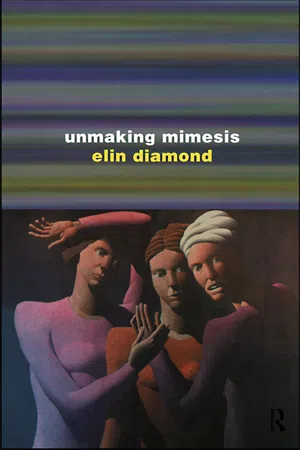
- 256 pages
- English
- ePUB (mobile friendly)
- Available on iOS & Android
eBook - ePub
About this book
Information
Part I
Unmaking mimesis
1 Realism’s hysteria
Disruption in the theater of knowledge
DOLEFUL REFERENTS
Morbid pessimism, subdued or paroxysmal, is the dominant role of the …new psychological drama…. The ideal writer of the neurotic school is a sort of literary mosquito, probing greater depths of agonised human nature than anybody else…. And this same process of needless self-torture is at work in some women’s minds now. It is difficult to explain on any other hypothesis their craving for the literature of hysteria…the doleful squalor of Ibsen.
H.E.M.Stutfield
Noticeable immediately in this statement is the ease with which the writer identifies not only a genre, ‘the literature of hysteria,’ and its characteristic strategies and tone, but also its characteristic audience/reader: women whose minds are engaged in ‘needless self-torture,’ who perversely indulge their ‘craving’ for unhappiness—who exhibit, in other words, the very symptoms of hysteria they were seeing enacted on stage.1 To this late Victorian critic, the hysteric was alarmingly on stage and in the audience, responding mimetically with ‘sobs and tears’ to the titillating and tearful revelations of Rita Allmers during the first London performances of Ibsen’s Little Eyolf. As he sat surrounded by women at a matinée in the Avenue Theatre, November 1896, H.E.M. Stutfield was no doubt reacting to more than an unseemly adoration for Ibsen and other ‘semi-insane’ writers. The ‘new woman’s’ demands for suffrage, better education, employment, and more sexual freedom, accompanied by major changes in late Victorian law and culture, were, Stutfield believed, connected to the very disease he was witnessing at the Avenue Theatre: hysterical ego-mania.2 In his Blackwood’s article, authoritatively entitled ‘The Psychology of Feminism,’ Stutfield borrows the inflammatory medico-ethical terminology of Max Nordau’s Degeneration (1895) to denounce those ‘self-centered, neurotic, and egotistical’ women both on and off the stage who have fallen prey to ‘the Ibsenite theory of female individualism’ (108). In fact the enormously popular Degeneration substantiated Stutfield’s claim for theatrical influence: Nordau’s long chapter on hysteria contains the subheading ‘Ibsenism.’
The year 1895 marks the appearance of another analysis of neuropathology in women, Freud and Breuer’s Studies on Hysteria (translated into English in 1909 but discussed in British medical journals as early as 1896), and from 1889 to the end of the century a rash of English translations and productions of Ibsen’s ‘literature of hysteria’ appeared (six Ibsen performances in 1893 alone), infecting indigenous imitators who broke out with their own versions of the ‘new drama.’3 What I am pointing to is a discursive formation whose fields of enunciation are the new science of psychoanalysis and the new ‘sex-problem play,’ both at the end of the nineteenth century, both targeting the ‘women with a past’ My first thesis is that Ibsenite realism guarantees its legitimacy by endowing the fallen woman of popular melodrama with the symptoms and etiology of the hysteric. In deciphering the hysteric’s enigma realism celebrates positivist inquiry, thus buttressing its claims for ‘truth to life.’ In effect, hysteria provides stage realism with one of its richest and, ideologically, one of its most satisfying plots.
My second thesis, that realism is itself a form of hysteria, needs a wider preface especially in relation to feminist theory. Realism’s putative object, the truthful representation of social experience within a recognizable, usually contemporary, moment remains a problematic issue for feminism, not least because theatrical realism, rooted in part in domestic melodrama, retains the oedipal family focus even as it tries to undermine the scenarios that Victorian culture had mythified—the angel in the house, the lost child, the poor but faithful husband, among others. In line with Diderot’s tragedy for the common man, late nineteenth-century social realism establishes its authenticity against, on the one hand, the ‘artificiality’ of neoclassical rules, and, on the other, episodic, histrionical, visually excessive melodrama. With the box-set and picture-frame stage that came to dominate theater design in the latter half of the century, realism could carve out a ‘natural’ present; the walls of the family drawing room and later the family living room, particularly the fourth wall, create the only space for breathing what Zola calls ‘the free air of reality.’4 The notion that realism offers, as Shaw puts it, ‘ourselves in our situations,’5 follows the curve of Plato’s condemnation of mimesis but inverts the valuation. The lifelike stage sign is not only validated by, it reinforces the epistemology of an ‘objective world,’ for the referent does not simply exist (the historical drawing room on which Hedda Gabler’s is modeled), it is reaffirmed in the activity of reception. Realism is more than an interpretation of reality passing as reality; it produces ‘reality’ by positioning its spectator to recognize and verify its truths: this escritoire, this spirit lamp affirms the typicality, the universality of this and all late Victorian bourgeois drawing rooms. Human signification is no less teleological. The actor/signifier, laminated to her character/signified, strenuously seeks admission to the right class of referents.
With Brechtian hindsight we know that realism, more than any other form of theater representation, mystifies the process of theatrical signification. Because it naturalizes the relation between character and actor, setting and world, realism operates in concert with ideology. And because it depends on, insists on a stability of reference, an objective world that is the source and guarantor of knowledge, realism surreptitiously reinforces (even if it argues with) the arrangements of that world. Indeed ‘arrangement’ is a crucial concept in realism. The picture-frame or proscenium stage (which still dominates theater design) reinforces the pleasures of perspectival space, in which each object has a measured and appropriate position within the whole—a ‘whole’ produced by a ‘single and immobile eye [I],’ positioned to see/know the relations between, and meanings of, the objects in view.6 For nineteenth-century middle-class audiences duly impressed by the authority and methods of positivism, theatrical realism fed a hunger for objects that supplied evidence, characters who supplied testimony, plots that cried out for interpretive acuity and, pleasurably, judgment. Realism as literature and as mode of production urged and satisfied the pursuit of knowledge, the production of truth.
Hysteria, on the other hand, has become the trope par excellence for the ruination of truth-making. Whether we situate the hysteric empirically, as a historico-medical object, whose unreadable symptoms derive in part from the material and gender constraints of bourgeois life (particularly, as Breuer noted, the Victorian tendency to channel young women into jobs as governesses or nurses to the dying),7 or discursively, as a ‘speaking body’ that defies the grammar of the patriarchal symbolic, hysteria in feminist discourse has become meaningful precisely as a disruption of traditional epistemological methods of seeing/knowing.8 Cixous and Clément’s The Newly Born Woman remains one of the best feminist readings of hysteria because it interweaves empirical and figural explorations, Clément drawing on anthropology and psychoanalytic history, Cixous mythmaking and deconstructing through a spiraling series of fantasmatic (hysterical) identifications.9 In both authors’ sections, Freud’s theory of bisexuality, a prominent feature of his formulations on hysteria, is rewritten as a refusal of correct gender positions, although for Clément such refusal is efficacious only in the short term (‘Every hysteric ends up inuring others to her symptoms, and the family closes round her again,’5), while for Cixous, hysterical discourse explodes the binary logic of logocentrism (‘It is you, Dora, you who cannot be tamed…your words will…write themselves against the other and against men’s grammar,’ 95). If the female subject is the ‘repressed that ensures the system’s functioning’ (67), hysteria throws a wrench into the system, upsetting its socio-linguistic and gender arrangements.
Sarah Kofman’s The Enigma of Woman explores Freud’s need to criminalize the hysteric in order to break through her narcissistic self-sufficiency and reveal her secret (her sexuality). As early as Studies on Hysteria Freud understands, through his interpretation of hysterical symptoms, the sexual origin of all neurosis. But according to Kofman, psychoanalysis cannot penetrate woman’s ‘enigma’; by Freud’s own account, female sexuality is double, undecidable.10 When Freud attempts to fix a position for the instability of female sexuality, he is led to theorize (illogically, defensively) the binary of gender (active/male versus passive/female) and, more outrageously, to posit penis envy, as the only result of the girl’s passage through the oedipus. In effect Kofman, like Irigaray, rejects the castration complex, female sexuality as lack, as the inevitable scenario of female identity. Elizabeth Berg, in her reading of The Enigma of Woman, draws out three positions in Kofman’s argument. The first is the sick hysteric who, ignorant of her own truth, ‘enter[s] into complicity with the doctor in order that he may reveal it.’11 Second is the narcissistic woman who knows the truth and will not tell. Her most salient feature is her muteness; embodying the truth, she cannot speak it: ‘the narcissistic woman silently grounds the discourse of the philosopher or psychoanalyst who verbally interprets the truth that she bears’ (19). The second hardly improves on the first; to be inscribed in the economy of truth is always to reinscribe the very phallic oppositions that feminism attempts to undermine. The third woman is ‘both masculine and feminine, [thus] no longer the incarnation of truth’ (19). Berg elaborates: ‘the third woman is not a syndiesis of masculinity and femininity …it is not that there is no sexual difference; rather sexual difference is seen as undecidable, producing an irresolvable oscillation between masculine and feminine’ (19). Nietzsche emerges here. The third woman is ‘affirmative,’ dionysian, like the god of mythology whose contradictions (god/(wo)man; masculine/feminine) dissolve the have/have not binary of penis envy and gender opposition, those truths of phallic structuration. The third woman has no referent, except in feminist theory. Of course Berg’s one-two-three schema sets out its own truth, but it will be useful in our account of a dramatic form that legitimizes itself through its ability to know, to respect, to reflect the truth—‘an undistorting and unexaggerating mirror of real life.’12
I have said that the new realism, like the new science of psychoanalysis, establishes its truth by reading of the enigma of hysterical symptoms. Freud found an exemplary psychoanalytic dynamic in Ibsen’s Rosmersholm, in which the interrogation of Rebecca West (a ‘new woman’) glorifies the pursuit of knowledge as Rector Kroll peels off layers of repressed material about her past. Figures of male authority, however ironized, read the enigmas of two other Ibsen hysterics, Ellida Wangel and Hedda Gabler; and a similar if cruder dynamic occurs in plays by English Ibsenites, A.W. Pinero’s The Second Mrs. Tanqueray and Henry Arthur Jones’s Mrs. Dane’s Defence. But if hysteria is signified and narrativized, has it been cured? Or is it possible that even as realism contains and puts closure to the hysteric’s symptoms, it catches her disease?
The first English audience of Ibsen’s Hedda Gabler disgusted the Stutfields but endthralled middle-class women. In her memoir of her Ibsen years, Elizabeth Robins, an American who first acted Hedda and other major Ibsen roles in London in the 1890s, confirms Stutfield’s impressions of the imaginary identifications and the gender divisions that Ibsenism produces:
How should men understand Hedda on the stage when they didn’t understand her in the person of their wives, their daughters, their woman friends. One lady of our acquaintance, married and not noticeably unhappy, said laughing, Hedda is all of us.13
What should be our response to such confident projection—such absolute identification of self with group, group with a fictional imago?14 On the one hand this one-to-one mirroring, so typical of the Lacanian imaginary, offers yet another example of both the pleasure and the ideological distortions of realism. Hedda Gabler produces a subject who sees, and reproduces, a real relation between signifier-signified-referent Hedda is all of us, says the spectator, and the pleasure of participating in that group reference is the self-gratifying sense that one’s knowledge of the world and the text has been confirmed. Robins’s spectator is merely the flip-side of Stutfield, using Ibsen as empirical evidence to validate her own ‘truth’. If the early texts of realism seem to gender its spectators, dividing men who snigger (according to Stutfield) and fail to understand Ibsen, from women who weep and do understand, realism is just doing its job, mirroring and reproducing society’s most conservative ideological positions. On the other hand, there is something volatile in this woman’s statement: a narcissism that deconstructs the mimetic referent upon which it is insisting. If Ibsenism empowers women to recognize themselves as the referent for Hedda, the truth of referentiality passes through the signifier of hysteria. The question, then, is this: can feminist theory make use of the observation that realism, at its inception, can be construed as a form of hysteria?
By historicizing the relation between hysteria and realism, by recovering an early connection between the thematics and semiotics of medical and popular theaters, between Freud’s well-padded couch and the ottoman upon which so many heroines of early realism collapse, we might discover some informing contradictions. The drama of ‘ourselves in our situations’ exists only by repressing other selves, other situations. In Archer’s simple narrative, ‘new drama’ replaces ‘old’; ‘logical’ realism separates off from the false, illogical melodrama. But traces of melodrama’s irrationality and its hallucinatory effects still cling to the teacups and upholstered divans. Melodrama provides in fact a crucial link between popular and psychoanalytic theaters. By historicizing Stutfield’s particular example we uncover one of realism’s most common features, the erasure of the apparatus of representation. For Stutfield, the Avenue Theater production of Little Eyolf represented only the delusions of a group of well-meaning Ibsenites, unaware of their own disease.15 Stutfield was, in fact, an excellent audience for the new realism, for he thought he was seeing all. He did not see, or did not choose to mention, the attack on the hegemony of actor-managers of which this independent production, through the impetus of Elizabeth Robins and William Archer, was a notable contribution.16 Robins, too, needs to be historicized. Her importance in popularizing Ibsen, the fact that to Shaw, Archer, Henry James, Oscar Wilde, and many suffragette colleagues, her life and work seemed exemplary of Ibsenite individualism, has been only recently noted.17 My immediate interest lies in her contribution to the hystericizing of realism. In May 1893, the highly praised The Second Mrs. Tanqueray by A.W. Pinero and the controversial Alan’s Wife by Elizabeth Robins and Florence Bell were performed within weeks of each other in very different venues, to very different responses, and with very different relations to the referent. In order to appreciate this odd juxtaposition of theater events, it will be helpful to look at realism’s past, to ‘excavate,’ as Freud would say, the theatrical secrets it represses.
FALLEN WOMEN: THE MEDICAL MELODRAMA
Semiotically, discursively, the hysteric has always been a fallen woman. Since ancient Greek physicians named the ‘disease’ for the female womb (hysteron), the hysterical woman has been guilty, not only of sexual aberrations that undermine her proper role in family and culture, but also of symptoms whose etiology could not be explained. No medical narrative could contain the sheer diversity of symptoms—depression, withdrawal, bouts of uncontrollable laughter and crying, muscular tics, shortness of breath, nervous cough, attacks of blindness, mutism, vomiting, cutaneous...
Table of contents
- Cover Page
- Title Page
- Copyright Page
- Acknowledgments
- Introduction
- Part I: Unmaking mimesis
- Part II: Gestic feminist criticism
- Part: III Toward a feminist postmodern
- Notes
Trusted by 375,005 students
Access to over 1.5 million titles for a fair monthly price.
Study more efficiently using our study tools.
Frequently asked questions
Yes, you can cancel anytime from the Subscription tab in your account settings on the Perlego website. Your subscription will stay active until the end of your current billing period. Learn how to cancel your subscription
No, books cannot be downloaded as external files, such as PDFs, for use outside of Perlego. However, you can download books within the Perlego app for offline reading on mobile or tablet. Learn how to download books offline
Perlego offers two plans: Essential and Complete
- Essential is ideal for learners and professionals who enjoy exploring a wide range of subjects. Access the Essential Library with 800,000+ trusted titles and best-sellers across business, personal growth, and the humanities. Includes unlimited reading time and Standard Read Aloud voice.
- Complete: Perfect for advanced learners and researchers needing full, unrestricted access. Unlock 1.5M+ books across hundreds of subjects, including academic and specialized titles. The Complete Plan also includes advanced features like Premium Read Aloud and Research Assistant.
We are an online textbook subscription service, where you can get access to an entire online library for less than the price of a single book per month. With over 1.5 million books across 990+ topics, we’ve got you covered! Learn about our mission
Look out for the read-aloud symbol on your next book to see if you can listen to it. The read-aloud tool reads text aloud for you, highlighting the text as it is being read. You can pause it, speed it up and slow it down. Learn more about Read Aloud
Yes! You can use the Perlego app on both iOS and Android devices to read anytime, anywhere — even offline. Perfect for commutes or when you’re on the go.
Please note we cannot support devices running on iOS 13 and Android 7 or earlier. Learn more about using the app
Please note we cannot support devices running on iOS 13 and Android 7 or earlier. Learn more about using the app
Yes, you can access Unmaking Mimesis by Elin Diamond in PDF and/or ePUB format, as well as other popular books in Literature & Feminist Literary Criticism. We have over 1.5 million books available in our catalogue for you to explore.