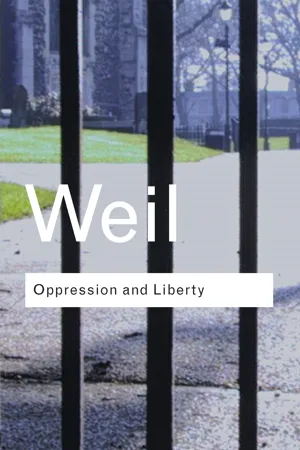
The remarkable French thinker Simone Weil is one of the leading intellectual and spiritual figures of the twentieth century. A legendary essayist, political philosopher and member of the French resistance, her literary output belied her tragically short life. Most of her work was published posthumously, to widespread acclaim. Always concerned with the nature of individual freedom, Weil explores in Oppression and Liberty its political and social implications. Analyzing the causes of oppression, its mechanisms and forms, she questions revolutionary responses and presents a prophetic view of a way forward. If, as she noted elsewhere, 'the future is made of the same stuff as the present', then there will always be a need to continue to listen to Simone Weil.
- 192 pages
- English
- ePUB (mobile friendly)
- Available on iOS & Android
eBook - ePub
Oppression and Liberty
About this book
Information
REFLECTIONS CONCERNING
THE CAUSES OF LIBERTY AND
SOCIAL OPPRESSION
THE CAUSES OF LIBERTY AND
SOCIAL OPPRESSION
With regard to human affairs, not to laugh, not to cry, not to become indignant, but to understand.
Spinoza
The being gifted with reason can make every obstacle serve as material for his work, and turn it to account.
Marcus Aurelius
The present period is one of those when everything that seems normally to constitute a reason for living dwindles away, when one must, on pain of sinking into confusion or apathy, call everything in question again. That the triumph of authoritarian and nationalist movements should blast almost everywhere the hopes that well-meaning people had placed in democracy and in pacifism is only a part of the evil from which we are suffering; it is far deeper and far more widespread. One may well ask oneself if there exists a single sphere of public or private life where the very spring-heads of activity and of hope have not been poisoned by the conditions under which we live. Work is no longer done with the proud consciousness that one is being useful, but with the humiliating and agonizing feeling of enjoying a privilege bestowed by a temporary stroke of fortune, a privilege from which one excludes several human beings by the mere fact that one enjoys, in short, a job. The leaders of industry themselves have lost that naïve belief in unlimited economic progress which made them imagine that they had a mission. Technical progress seems to have gone bankrupt, since instead of happiness it has only brought the masses that physical and moral wretchedness in which we see them floundering; moreover, technical innovations are now banned everywhere, or very nearly so, except in industries connected with war. As for scientific progress, it is difficult to see what can be the use of piling up still more knowledge on to a heap already much too vast to be able to be embraced by the minds even of specialists; and experience has shown that our forefathers were mistaken in believing in the spread of enlightenment, since all that can be revealed to the masses is a miserable caricature of modern scientific culture, a caricature which, far from forming their judgment, accustoms them to be credulous. Art itself suffers the backlash of the general confusion, which partly deprives it of its public, and by that very fact impairs inspiration. Finally, family life has become nothing but anxiety, now that society is closed to the young. The very generation for whom a feverish expectation of the future is the whole of life, vegetates, all over the world, with the feeling that it has no future, that there is no room for it in our world. But if this evil is felt more sharply by youth, it remains common to the whole of humanity today. We are living through a period bereft of a future. Waiting for that which is to come is no longer a matter of hope, but of anguish.
However, ever since 1789, there has been one magic word which contains within itself all imaginable futures, and is never so full of hope as in desperate situations—that word is revolution. That is why, for some time now, we have often been hearing it uttered. We ought, so it seems, to be in a period of full revolution; but in fact everything goes on as if the revolutionary movement were falling into decay with the very system it aspires to destroy. For more than a century, each new generation of revolutionaries has, in turn, placed its hopes in an impending revolution; today, these hopes have lost everything which was able to serve them as buttresses. Neither in the régime that emerged from the October Revolution, nor in the two Internationals, nor in the independent socialist or communist parties, nor in the trade unions, nor in the anarchist organizations, nor in the small youth groups that have sprung up in such profusion in recent times, can one find anything vigorous, healthy or pure; for a long time now the working class has shown no sign of that spontaneity on which Rosa Luxemburg counted, and which, moreover, has never manifested itself without being promptly drowned in blood; the middle classes are only attracted by revolution when it is conjured up for demagogic purposes by apprentice dictators. It is often said that the situation is objectively revolutionary, and that all that is lacking is the “subjective factor”; as if the complete absence of that very force which alone could transform the system were not an objective characteristic of the present situation, whose origins must be sought in the structure of our society! That is why the first duty the present period imposes on us is to have enough intellectual courage to ask ourselves if the term “revolution” is anything else but a name, if it has any precise content, if it is not simply one of the numerous lies produced by the capitalist system in its rise to power which the present crisis is doing us the service of dissipating. This question seems impious, in view of all the pure and noble human beings who have sacrificed everything, their life included, in the service of this word. But only priests can claim to measure the value of an idea by the amount of blood it has caused to be shed. Who knows whether the revolutionaries have not shed their blood as vainly as those Greeks and Trojans of the poet, who, cheated by a false semblance, fought each other for ten years around the shade of Helen?
CRITIQUE OF MARXISM
Up to now all those who have experienced the need to buttress their revolutionary feelings with precise concepts have found or thought they found these concepts in Marx. It is accepted once and for all that Marx, thanks to his general theory of history and to his analysis of bourgeois society, demonstrated the ineluctable necessity of an early upheaval, in which the oppression we suffer under capitalism would be abolished; and indeed, by dint of being persuaded of the fact, we generally dispense with examining. the demonstration more closely. “Scientific socialism” has attained the status of a dogma, exactly in the same way as have all the results obtained by modern science, results in which each one thinks it is his duty to believe, without ever dreaming of enquiring into the method employed. As far as Marx is concerned, if one tries really to grasp his demonstration intellectually, one at once perceives that it contains very many more difficulties than the advocates of “scientific socialism” lead one to suppose.
Actually, Marx gives a first-rate account of the mechanism of capitalist oppression; but so good is it that one finds it hard to visualize how this mechanism could cease to function. As a rule, it is only the economic aspect of this oppression that holds our attention, that is to say the extortion of surplus value; and, if we confine ourselves to this point of view, it is certainly easy to explain to the masses that this extortion is bound up with competition, which latter is in turn bound up with private property, and that the day when property becomes collective all will be well. Nevertheless, even within the limits of this apparently simple reasoning, a thousand difficulties present themselves on careful examination. For Marx showed clearly that the true reason for the exploitation of the workers is not any desire on the part of the capitalists to enjoy and consume, but the need to expand the undertaking as rapidly as possible so as to make it more powerful than its rivals. Now not only a business undertaking, but any sort of working collectivity, no matter what it may be, has to exercise the maximum restraint on the consumption of its members so as to devote as much time as possible to forging weapons for use against rival collectivities; so that as long as there is, on the surface of the globe, a struggle for power, and as long as the decisive factor in victory is industrial production, the workers will be exploited. As a matter of fact, what Marx assumed, without, however, proving it, was that every kind of struggle for power will disappear on the day socialism is established in all industrial countries; the only trouble is that, as Marx himself recognized, revolution cannot take place everywhere at once; and when it does take place in one country, it does not for that country do away with the need for exploiting and oppressing the mass of workers, but on the contrary accentuates the need, lest it be found weaker than the other nations. The history of the Russian Revolution furnishes a painful illustration of this.
If we consider other aspects of capitalist oppression, other still more formidable difficulties appear, or rather the same difficulty under a more glaring light. The power which the bourgeoisie has to exploit and oppress the workers lies at the very foundations of our social life, and cannot be destroyed by any political and juridical transformation. This power consists in the first place and essentially in the modern system of production itself, that is to say big industry. Pungent dicta abound in Marx’s writings on this subject of living labour being enslaved to dead labour, “the reversal of the relationship between subject and object”, “the subordination of the worker to the material conditions of work”. “In the factory”, he writes in Capital, “there exists a mechanism independent of the workers, which incorporates them as living cogs…. The separation of the spiritual forces that play a part in production from manual labour, and the transformation of the former into power exercised by capital over labour, attain their fulfilment in big industry founded on mechanization. The detail of the individual destiny of the machine-worker fades into insignificance before the science, the tremendous natural forces and the collective labour which are incorporated in the machines as a whole and constitute with them the employer’s power.” Thus the worker’s complete subordination to the undertaking and to those who run it is founded on the factory organization and not on the system of property. Similarly, “the separation of the spiritual forces that play a part in production from manual labour”, or, according to another formula, “the degrading division of labour into manual and intellectual labour”, is the very foundation of our culture, which is a culture of specialists. Science is a monopoly, not because public education is badly organized, but by its very nature; non-scientists have access only to the results, not to the methods, that is to say they can only believe, not assimilate. “Scientific socialism” has itself remained the monopoly of a select few, and the “intellectuals” possess, unfortunately, the same privileges in the working-class movement as they do in bourgeois society. And the same applies, furthermore, on the political plane.
Marx had clearly perceived that State oppression is founded on the existence of organs of government that are permanent and distinct from the population, namely, the bureaucratic, military and police machines; but these permanent organs are the inevitable result of the radical distinction existing, in fact, between the managerial and executive functions. In this respect again, the working-class movement reproduces in full the vices of bourgeois society. At all levels we are brought up against the same obstacle. The whole of our civilization is founded on specialization, which implies the enslavement of those who execute to those who co-ordinate; and on such a basis one can only organize and perfect oppression, not lighten it. Far from capitalist society having developed within itself the material conditions for a régime of liberty and equality, the establishment of such a régime presupposes a preliminary transformation in the realm of production and that of culture.
We can only understand how Marx and his disciples could still believe in the possibility of a real democracy based on our present civilization if we take into account their theory of the development of productive forces. It is well known that, in Marx’s eyes, this development constitutes, in the last analysis, the true motive power of history, and that it is practically unlimited. Every social system, every dominant class has the “task”, the “historic mission”, of carrying the productive forces to an ever higher level, until the day when all further progress is arrested by the social cadres; at that moment the productive forces rebel, break up these cadres, and a new class takes over power. The recognition of the fact that the capitalist system grinds down millions of men only enables one to condemn it morally; what constitutes the historic condemnation of the system is the fact that, after having made productive progress possible, it is now an obstacle in its way. The essential task of revolutions consists in the emancipation not of men but of productive forces. As a matter of fact, it is clear that, as soon as these have reached a level of development high enough for production to be carried out at the cost of little effort, the two tasks coincide; and Marx assumed that such was the case in our time. It was this assumption that enabled him to establish a harmony, indispensable to his moral tranquillity, between his idealistic aspirations and his materialistic conception of history. In his view, modern technique, once freed from capitalist forms of economy, can give men, here and now, sufficient leisure to enable them to develop their faculties harmoniously, and consequently bring about the disappearance, to a certain extent, of the degrading specialization created by capitalism; and above all the further development of technique must lighten more and more, day by day, the burden of material necessity, and as an immediate consequence that of social constraint, until humanity reaches at last a truly paradisal state in which the most abundant production would be at the cost of a trifling expenditure of effort and the ancient curse of work would be lifted; in short, in which the happiness of Adam and Eve before the fall would be regained.
One can understand very well, starting from this conception, the attitude of the Bolsheviks, and why all of them, including Trotsky, treat democratic ideas with supreme disdain. They have found themselves powerless to bring about the workers’ democracy foreshadowed by Marx; but such a minor detail does not worry them, convinced as they are, on the one hand, that all attempts at social action which do not consist of developing productive forces are doomed to failure, on the other hand, that all progress in productive forces causes humanity to advance along the road leading to emancipation, even if it is at the cost of a temporary oppression. It is not surprising that, backed up by such moral certainty as this, they have astonished the world by their strength.
It is seldom, however, that comforting beliefs are at the same time rational. Before even examining the Marxist conception of productive forces, one is struck by the mythological character it presents in all socialist literature, where it is assumed as a postulate. Marx never explains why productive forces should tend to increase; by accepting without proof this mysterious tendency, he allies himself not with Darwin, as he liked to think, but with Lamarck, who in similar fashion founded his biological system on an inexplicable tendency of living creatures to adapt themselves. In the same way, why is it that, when social institutions are in opposition to the development of productive forces, victory should necessarily belong beforehand to the latter rather than the former? Marx evidently does not assume that men consciously transform their social conditions in order to improve their economic conditions; he knows perfectly well that up to the present social transformations have never been accompanied by any clear realization of their real long-term consequences; he therefore implicitly assumes that productive forces possess a secret virtue enabling them to overcome obstacles. Finally, why does he assert without demonstration, and as a self-evident truth, that the productive forces are capable of unlimited development?
The whole of this doctrine, on which the Marxist conception of revolution entirely rests, is absolutely devoid of any scientific basis. In order to understand it, we must remember the Hegelian origins of Marxist thought. Hegel believed in a hidden mind at work in the universe, and that the history of the world is simply the history of this world mind, which, as in the case of everything spiritual, tends indefinitely towards perfection. Marx claimed to “put back on its feet” the Hegelian dialectic, which he accused of being “upside down”, by substituting matter for mind as the motive power of history; but by an extraordinary paradox, he conceived history, starting from this rectification, as though he attributed to matter what is the very essence of mind—an unceasing aspiration towards the best. In this he was profoundly in keeping, moreover, with the general current of capitalist thought; to transfer the principle of progress from mind to things is to give a philosophical expression to that “reversal of the relationship between subject and object” in which Marx discerned the very essence of capitalism. The rise of big industry made of productive forces the divinity of a kind of religion whose influence Marx came under, despite himself, when formulating his conception of history. The term religion may seem surprising in connection with Marx; but to believe that our will coincides with a mysterious will which is at work in the universe and helps us to conquer is to think religiously, to believe in Providence. Besides, Marx’s vocabulary itself testifies to this since it contains quasi-mystical expressions such as “the historic mission of the proletariat”.
This religion of productive forces, in whose name generations of industrial employers have ground down the labouring masses without the slightest qualm, also constitutes a factor making for oppression within the socialist movement. All religions make man into a mere instrument of Providence, and socialism, too, puts men at the service of historical progress, that is to say of productive progress. That is why, whatever may be the insult inflicted on Marx’s memory by the cult which the Russian oppressors of our time entertain for him, it is not altogether undeserved. Marx, it is true, never had any other motive except a generous yearning after liberty and equality; but this yearning, once separated from the materialistic religion with which it was merged in his mind, no longer belongs to anything except what Marx contemptuously called utopian socialism. If Marx’s writings contained nothing more valuable than this, they might without loss be forgotten, at any rate except for his economic analyses.
But such is not the case; we find in Marx a different conception from that Hegelian doctrine turned inside out, namely, a materialism which no longer has anything religious about it and forms not a doctrine but a method of understanding and of action. It is no uncommon thing to find thus in quite great minds two distinct and even incompatible conceptions mingling together under cover of the inevitable looseness of language; absorbed as they are in formulating new ideas, such minds have not the time to make a critical examination of what they have discovered. Marx’s truly great idea is that in human society as well as in nature nothing takes place otherwise than through material transformations. “Men make their own history, but within certain fixed conditions.” To desire is nothing; we have got to know the material conditions which determine our possibilities of action; and in the social sphere these conditions are defined by the way in which man obeys material necessities in supplying his own needs, in other words, by the method of production. A methodical improvement in social organization presupposes a detailed study of the method of production, in order to try to find out on the one hand what we may expect from it, in the immediate or distant future, from the point of view of output, and on the other hand what forms of social and cultural organization are compatible with it, and, finally, how it may itself be transformed. Only irresponsible human beings can neglect such a study and yet claim the right to domineer over society; and, unfortunately, such is the case everywhere, as much in revolutionary circles as among the ruling classes. The materialistic method—that instrument which Marx bequeathed us—is an untried instrument; no Marxist has ever really used it, beginning with Marx himself. The only really valuable idea to be found in Marx’s writings is also the only one that has been completely neglected. It is not surprising that the social movements springing from Marx have failed.
The first question to consider is that concerning output. Are there any reasons for supposing that modern technique, at its present level, is capable—always supposing a fair distribution—of guaranteeing to everyone sufficient welfare and leisure so that the development of the individual may cease to be hampered by modern working conditions? It seems that on this subject there are many illusions, purposely kept alive by demagogic interests. It is not profits which have to be calculated; those of them that are reinvested in production would for the most part be taken away from the workers under any system. We should have to be able to calculate the total amount of labour that could be dispensed with at the cost of a transformation of the property system. Even that would not solve the problem; we must bear in mind the labour involved in the complete reorganization of the productive machine, a reorganization necessary for production to be adapted to its new end, namely, the welfare of the masses; we must not forget that the manufacture of armaments would not be abandoned before the capitalist system had been everywhere destroyed; above all, we must provide for the fact that the abolition of individual profit, while causing certain forms of waste to disappear, would at the same time necessarily create others. It is impossible, of course, to make exact calculations; but they are not indispensable for discerning that the abolition of private property would be far from sufficient in itself to prevent work in the mines and in the factories from continuing to weigh as a servitude on those who are subjected to it.
But if the present state of technique is insufficient to liberate the workers, is there at any rate a reasonable hope that an unlimited development lies before it, which would imply an unlimited increase in productivity? This is what everybody assumes, both among capitalists and socialists, without the smallest preliminary study of the question; it is enough that the productivity of human effort should have increased in an unheard of manner for the last three centuries for it to be expected that this increase will continue at the same rate. Our so-called scientific culture has given us this fatal habit of generalizing, of arbitrarily extrapolating, instead of studying the conditions of a given phenomenon and the limits implied by them; and Marx, whose dialectical method should have saved him from such an error, fell into it on this point just like other people.
The problem is fundamental, and of a kind to determine all our future prospects; it must be formulated with the utmost precision. To this end, the first thing is to know in what technical progress consists, what factors play a part in it, and to examine each factor separately; for we mix up under the name of technical progress entirely different procedures that offer different possibilities of development.
The first procedure that offers itself to man for producing more with less effort is the utilization of natural sources of energy; and it is true, in a sense, that it is impossible to assign a precise limit to the benefits of this procedure, because we do not know what new sources of energy we shall one day be able to use; but this does not mean to say that there can be prospects of unlimited progress in this direction, nor that progress in it is, generally speaking, assured. For nature does not give us this energy, whatever may be the fo...
Table of contents
- Cover Page
- Title Page
- Copyright Page
- Contents
- Prospects: Are we Headed for the Proletarian Revolution?
- Reflections Concerning Technocracy, National-Socialism, the U.S.S.R. and Certain Other Matters
- Reflections Concerning the Causes of Liberty and Social Oppression
- Fragments, 1933–1938
- Fragments, London 1943
- Is There a Marxist Doctrine?
Trusted by 375,005 students
Access to over 1.5 million titles for a fair monthly price.
Study more efficiently using our study tools.
Frequently asked questions
Yes, you can cancel anytime from the Subscription tab in your account settings on the Perlego website. Your subscription will stay active until the end of your current billing period. Learn how to cancel your subscription
No, books cannot be downloaded as external files, such as PDFs, for use outside of Perlego. However, you can download books within the Perlego app for offline reading on mobile or tablet. Learn how to download books offline
Perlego offers two plans: Essential and Complete
- Essential is ideal for learners and professionals who enjoy exploring a wide range of subjects. Access the Essential Library with 800,000+ trusted titles and best-sellers across business, personal growth, and the humanities. Includes unlimited reading time and Standard Read Aloud voice.
- Complete: Perfect for advanced learners and researchers needing full, unrestricted access. Unlock 1.5M+ books across hundreds of subjects, including academic and specialized titles. The Complete Plan also includes advanced features like Premium Read Aloud and Research Assistant.
We are an online textbook subscription service, where you can get access to an entire online library for less than the price of a single book per month. With over 1.5 million books across 990+ topics, we’ve got you covered! Learn about our mission
Look out for the read-aloud symbol on your next book to see if you can listen to it. The read-aloud tool reads text aloud for you, highlighting the text as it is being read. You can pause it, speed it up and slow it down. Learn more about Read Aloud
Yes! You can use the Perlego app on both iOS and Android devices to read anytime, anywhere — even offline. Perfect for commutes or when you’re on the go.
Please note we cannot support devices running on iOS 13 and Android 7 or earlier. Learn more about using the app
Please note we cannot support devices running on iOS 13 and Android 7 or earlier. Learn more about using the app
Yes, you can access Oppression and Liberty by Simone Weil in PDF and/or ePUB format, as well as other popular books in Philosophy & Philosophy History & Theory. We have over 1.5 million books available in our catalogue for you to explore.