- 284 pages
- English
- ePUB (mobile friendly)
- Available on iOS & Android
eBook - ePub
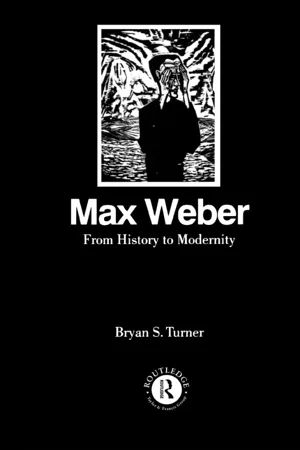
Max Weber: From History to Modernity
About this book
This wide-ranging and assured book, written by one of the leading Weber scholars in the English-speaking world, shows us the many sides of Max Weber. The book provides an authoritative guide to the current burning issues in social theory, religion, rationalization, the body, modernization and capitalism. It will be essential reading for anyone interested in Weber's claim that the aim of sociology must be to explain what is distinctive about the times in which we live.
Information
1
Max Weber and the Panic Culture of Postmodernism
Introduction
Max Weber has long been regarded as a major figure in historical sociology. Indeed, Weber’s sociology can be taken as a paradigm of how to undertake comparative and historical research in the social sciences. In specific terms, The Protestant Ethic and the Spirit of Capitalism (1930), Ancient Judaism (1952), The City (1958a), The Religion of China (1951), The Religion of India (1958b) and General Economic History (1927) have made a major contribution to the debate about the relationship between history and sociology. The scale of Weber’s contribution to the development of historical sociology is explored in Chapters 2 and 6 in this volume. Although Weber’s stature as a historical sociologist is not in dispute, his influence has unfortunately often been confined either to debates about methodology—in terms of The Methodology of the Social Sciences (Weber 1949)—or to the origins of rational capitalism.
It is increasingly clear that these two loci of debate—methods and capitalism—are not only too narrow, they have also somewhat distorted the reception of Weber’s historical sociology. Following Wilhelm Hennis’s interpretation (1988) of Weber’s Fragstellung, it is clear that Weber’s sociology was driven by clear philosophical and ethical concerns, which were to understand the nature of Man and life-orders, that is, how specific social conditions gave rise to personality. I have retained the use of ‘Man’ throughout this volume, because it is not appropriate to modernize and transform Weber’s own language. While much attention has been given to Marx’s ontology in his view of Man, labour and nature, insufficient interest has been focused on Weber’s implicit ontological presuppositions. Thus, Weber’s analysis of the Protestant, the bureaucrat or the aristocratic warrior was a consequence of wider concerns with the problem of character in the context of what he called life-orders. Weber’s historical sociology reflected a German philosophical tradition which divided human inquiry into the understanding of mind, body and soul. To understand Weber’s comparative sociology of civilizations we need to turn not to a set of antecedents in Marxism, but to the critical philosophy of Nietzsche and his followers such as Stefan George and Ludwig Klages (Stauth and Turner 1988). Some aspects of Weber’s relationship to Nietzsche are considered in Chapter 10. Weber’s historical sociology was very different, therefore, from the tradition of English empiricism; we could more safely describe Weber’s purpose as the production of a moral characterology of modern times.
The Modern Revolution
Two major changes—one sudden and immediate, the other slow and persistent—are gradually transforming the theoretical paradigms and perspectives of the social sciences as a whole, and of sociology in particular. The first is the collapse of communism in eastern Europe and in the Soviet Union, and the second is the corrosive critique of modernism by postmodernism. These two developments, although dissimilar in many ways, are also closely tied together. They represent an attack on grand narratives, and thereby a challenge to more traditional strategies in social theory, and at the same time they embody an assertion of the importance of difference (Turner 1990a). In this commentary on Max Weber in modern sociology, I want to reflect on the fact that both developments (political and cultural) are to some extent anticipated in Weber’s sociology. They are present in Weberian sociology, because he remained highly ambiguous about the content and consequences of modernization and rationalization. I explore these ambiguities in this collection with respect to Weber’s views on science in Chapter 5, on the body in Chapter 7 and on the reification of value in money in Chapter 9.
Weber’s ambiguities over capitalism were also expressed in his ambivalent attitudes to socialism as a rational planning of the market. His critique of Soviet socialism (and his more enduring fear of the threat of Cossacks on the plains of Europe) is well known, and does not concern me here (Runciman 1978). For Weber, socialism was another step in the growth of rational management of resources; socialism represented a further development of the second serfdom—to calculation, planning, and instrumental rationalism. These rational systems would eventually destroy the entrepreneur who is essential to dynamic capitalism (Mommsen 1974). Various features of Weber’s political sociology are examined in Chapters 6, 8 and 9. The main issue in Weber’s political sociology is the absence of any analysis of the processes of democratization, about which Weber remained sceptical, if not dismissive. In this respect, Weber was significantly influenced by Robert Michels’s theory of ‘the iron law of oligarchy’, which suggested that all mass-party organization would come to depend on an élite (Mommsen 1989).
My aim at this stage, however, is simply to draw attention to some respects in which Weber’s ambiguous evaluation of modern rational capitalism provides a curious parallel to modern ‘panics’ over postmodernism (Holton and Turner 1989). The intention is not to suggest naively that all aspects of postmodernism were foreshadowed in Weber’s complex, uncertain and unstable endorsement of modernization. However, there is a tension in Weber between a Nietzschian celebration of life against systemrationality, which at least prefigures more contemporary uncertainties about the end of history, the end of philosophy and the end of the social. Weber’s uncertain and somewhat reluctant acceptance of modernization has been the subject of much recent debate (Sayer 1990; Sica 1988), but so far, few sociologists have made the link between his ambiguities over modernity and the postmodern scene.
A minor theme of this introduction therefore, is that, if we look at the history of sociology—and possibly at the social sciences as a whole—then we can see that certain crucial debates appear to be repeated by each new generation of scholars, albeit with a new terminology and often for rather different reasons. If the debates are not exactly repeated, at least the same problematics seem to recur with alarming uniformity. The obvious examples are the nature/nurture controversy, the methodological struggle around positivism, the intellectual contest over methodological individualism, and the definition of the social. More interestingly, it can be argued that the current controversy surrounding sociology as a global or national science is a repeat of the debate in Saint-Simon about the necessity for a European parliament and the plea for a global sociology as the science of humanity rather than of national social systems (Turner 1990b). One can also speculate that the current condemnation of the negative effects of centralized planning in terms of its preclusion of democratic cultures in socialist Europe and the Soviet Union will almost certainly rehearse arguments which were fully developed in Karl Wittfogel’s Oriental Despotism (1963). Even the ghost of Evgeny Preobrazhensky, whose The New Economics (1965) caused Stalin such displeasure, may be resurrected.
The issue I wish to raise here is posed on a broader scale: to what extent is the contemporary modern/postmodern debate a repeat of earlier battles inside sociology, and in particular how does this debate relate to Max Weber? It is worth noting that Weber has already been drawn into this debate. Because Nietzsche’s philosophy has proved fundamental to both poststructuralism and postmodernism, the revival of interest in Nietzsche has inevitably linked Weber with the critique of modernist rationalization (Lassman and Velody 1989). In order to understand Weber’s introduction into the debate about postmodernism, we will have to look more closely at the history of postmodernism, and confront the problem of defining terms. A number of recent interpretations of Weberian sociology have paved the way for the inclusion of Weber into the postmodernist debate. I shall briefly mention four of these developments in Weberian scholarship;
Redirecting Weberian Scholarship
The first reorientation is that the traditional (and possibly sterile) debates about Marx versus Weber (Antonio and Glassman 1985) have largely collapsed. (Some features of the recent developments in the interpretation of Weber’s historical sociology with reference to the Marx/Weber issue are considered in Chapters 2 and 6.) These issues with Marxism have been partly replaced with a new emphasis on Weber’s relationship to Nietzsche and to the romantic critique of capitalism in Germany. Although many early comments on this relationship drew attention to possible connections between Weber’s concept of charisma in relation to Nietzsche’s Übermensch; between Weber’s methodological notions of valuerelevance and Nietzsche’s perspectivism; between Weber’s analysis of the ethics of the world religions and Nietzsche’s alleged psychologization of morals in the idea of ressentiment; or between Weber’s views on politics as endless struggle and Nietzsche’s will-to-power philosophy, the complexity and depth of Weber’s relationship to Nietzsche has probably yet to be fully explored. However, two areas of inquiry appear to be especially important. The first is the implications of Nietzsche’s death-of-God prophecy for Weber’s analysis of polytheism in the ‘science as a vocation’ lecture (Lassman and Velody 1989) and the second, as I have just argued, is Wilhelm Hennis’s development of what might be called ‘characterology’ from Weber in his studies of personality and lifeorders as part of Weber’s underlying philosophical anthropology (Hennis 1988). At this stage the validity or otherwise of these intepretations is not especially relevant. The point is that the revival of interest in Nietzsche (especially, and paradoxically, in France) for the development of poststructuralism and postmodernism in Michel Foucault (Bernauer and Rasmussen 1988), Giles Deleuze, Jean Baudrillard (Gane forthcoming), and Jacques Derrida (Norris 1987) has been parallel to the revival of interest in the shaping of Weberian sociology by Nietzsche.
These issues—Weber’s relationship to Nietzsche, his controversial but rather hidden connections with the George Circle, his moral interest in character and life-order—are important for understanding Weber’s interest in the sociology of religion. On the one hand, the Judaeo-Christian faith was the source, in Weber’s view, of western civilization. On the other hand, religion is the great fountain of irrationality. It was the historical transformation of this irrationality into rationality which constituted the essence of the civilizational process. Weber, however, retained the residual view that a religious framework was essential for social, especially moral, order. Charisma was ultimately the driving force in the historical ruptures of social processes. This view of religion informed much of Weber’s general sociology, and in this volume Weber’s sociology of religion is discussed in Chapters 3, 4, and 6.1 have concentrated on the issue of Islam, because Weber’s faulty treatment of Islamic civilization raises a number of general problems in his sociology as a whole. I consider these issues in Chapters 3, 4 and 5.
A second and related reorientation is that seeing Weber as a major theorist of capitalism (alongside Marx, Veblen, Schumpeter, and Spencer) has given way to interpreting Weber as the theorist of rational modernity and modernization. While in the 1960s and 1970s radical sociologists in the sociology of development and underdevelopment condemned concepts like ‘modernity’ and ‘modernization’ as pseudo-concepts in functionalism which really meant ‘western’ and ‘westernization’, it is interesting to note how thoroughly in the 1980s modernity and modernization have been revived and restored as explanatory paradigms. First, we can note that Marx has been restored as an interpreter of the modern by Marshall Berman in All that is Solid melts into Air (1983). More recently, Derek Sayer in Capitalism and Modernity (1990) regards both Marx and Weber as developing a theory of modernity of which capitalism is a sub-text. Anthony Giddens, in the collection by Christopher Bryant and David Jary (1990), argues that he (Giddens) has all along been concerned with modernity rather than with the narrow debate over capitalism. The majority of the authors who contributed to the collection by Lash and Whimster (1987) adopted a similar stance, namely seeing Weber as a theorist or even interpreter of modernity rather than as a sociologist of capitalism. The title Max Weber, Rationality and Modernity was indicative of this orientation. There appears to be a broad if gradual turning away from traditional debates about the structure of capitalism to interpretations of the culture of modernism and postmodernism. Indeed ‘culture’ as such has somewhat replaced the original hegemony of ‘structure’ in the sociological canon (Archer 1988; Robertson 1990; Wuthnow 1989). Since Weber devoted much of his intellectual endeavour to the problems of cultural sociology, we may expect Weberian ideas to play a major part in the revival of a culturalist perspective. These orientations towards Weber as a theorist of modernity have also redirected the exegesis of Weber’s work, away from limited debates with Marx to include other theorists of modernity, notably Georg Simmel. In this volume, Weber’s view of rationalization is compared in Chapter 9 with Simmel’s analysis of the reification of money as a specific illustration of the ‘tragedy of culture’. It is already evident that Weber and Simmel will be connected in these contemporary debates about culture, fin-de-siècle capitalism, postmodernism and the end of organized capitalism (Weinstein and Weinstein 1990).
A third theme in current views of Weber is possibly not new, but it is closely related to the postmodern question. A number of commentators on Weber have recently drawn attention to the problem of sensibility and sympathy not only in Weber’s sociology, but also in relation to his own life. This contextualization of Weber has referred again to the question of Weber’s own relationship to sexuality with regard to his commitments to the educational and moral virtues of a calling or vocation in life. For many years, of course, writers have drawn attention to the tensions in Weber’s biography between (in Nietzsche’s terms) Dionysus and Apollo, between the ecstatic sexual energies and the rational form-giving intellect, and between yes-saying and no-saying philosophies. The work of Arthur Mitzman is an obvious case in point; in The Iron Cage, a Historical Interpretation of Max Weber (1971) he attempted to analyse Weber’s ‘illness’ in psychoanalytic terms as a solution to the conflicts within the domestic sphere between the secular authoritarian father and the pious sympathetic mother. A similar view of the complex relationship between Weber’s personal sexual mores and his relationship to the nascent women’s movement was analysed in Green’s study (1974) of the von Richthofen sisters. More recently, W.Lepenies in his Die drei Kulturen, Soziologie zwischen Literatur und Wissenschaft (1988) has drawn parallels between the psychic crises of major figures in social sciences in relation to the theoretical development of their work, including J.S.Mill and Max Weber. These tensions in his biography may also exhibit an aspect of the general problem of masculinity in Weberian sociology (Bologh 1990). Some aspects of this issue in Weber’s sociology are raised in Chapter 7, where I consider the implications of the sociology of the body for Weber’s notion of rationalization.
In a related fashion, there has been increasing interest in Weber’s relationship to romantic criticisms of capitalism which look towards life, love and sexuality as an alternative to work, labour and productivity as the raisons d’être of the contemporary world. I shall refer to work on Weber’s connection with Otto Gross in the Mommsen and Osterhammel collection Max Weber and his Contemporaries (1987). Here once more it is difficult to get away from the more general influence of Nietzsche. To my mind, we do not as yet have a very clear picture of how deeply the Nietzschean philosophers and poets around Stefan George at Heidelberg influenced Weber. It appears that Weber admired much of the visionary poetry of Stefan George while rejecting his romanticism as inappropriate for modern times. Ernest Troeltsch tells us in ‘The Revolution in Science’ from Schmollers Jahrbuch of 1921 that Weber said that George’s romanticism would smash on the hard rocks of economic necessity and social reality (Lassman and Velody 1989:64).
However, we may suggest in addition a rather closer relationship between Weber and the so-called Romantics. Writers like George, Klages and Gundolf were specifically adopting a Nietzschean critique of modern rational, industrial culture which accepted the idea that this form of modernization would produce a standardization of social and cultural reality. Only a new breed or a new creation (a Nietzschean Übermensch) could overcome this debasement. In this respect they appear to have followed Nietzsche’s critique of Social Darwinism, not the survival of the fittest but the survival of the herd. The goal of the George Circle was to foster a new character or personality which could transcend the vulgar standardization and uniformity imposed on Germany by mass technology, bureaucratization and the civilization of the capitalists. George in particular had a metatheory which drew a distinction between spirit, intellect and embodiment (or between soul, mind and body). In the modern world, the rational intellect was threatening to destroy both the soul (Geist) and the body. This idea was basic to Klages’ major work Der Geist als Widersacher der Seele (1929–32)—the consciousness as the adversary of the soul. Is not this perspective reproduced in Weber’s famous lament against the technocrats without a soul, the bureaucrats without a spirit, and, we might add, the intellectuals without bodies? Is not this philosophical anthropology of characterology and life-orders in Weber also a legacy of Nietzsche which is parallel to, or even derived from, the Romanticism of the George Circle? The Romantics around George have been neglected, probably because of their overt connection with anti-Semitism and their alleged, but probably mistaken, association with the Nazi regime.
This interpretation draws attention to a contradiction in Weber’s life between the overt commitment to an ascetic vocation in science and the covert empathy for a life-philosophy embracing romanticism and mysticism. There is an undercurrent of sympathy for more transcendental values, for the Other in a world of standardized Sameness, for prophecy against science. This split in Weber is surely connected with a lesson which he took from Nietzsche, namely that all rational thought is necessarily tragic because it must constantly explore its own horizons, that is its limit. For Weber, this tragedy is represented by the contradiction between scientific rationality and meaning. While science can make the world understandable by making the world predictable, science cannot make the world meaningful. In fact, quite the contrary. As science advances, meaning retreats, leaving the world disenchanted.
The Debate on Modernity and Postmodernity
These four interpretations—Nietzsche, modernization, sensibility and the romantic critique of rationalism—suggest parallel relationships to the debate on modernity and postmodernity. In his account of architecture, urban space and humanism, Scott Lash (1990) has argued that some versions of postmodernism are humanist in the classical sense that they are anthropomorphic in rejecting the formalism, rationalism and structuralism of high modernism (as represented, for example, by Corbusier). In this perspective, postmodernism celebrates the intimate, the affective and the sympathetic over and against the public, large-scale, instrumental rationalism of modernism. If this version of postmodernism has any validity, then it suggests a critique of modernism which has much in common with the romantic anticapitalist critique of the George Circle. It also suggests a relationship with Weber as a critic of the standardization and insensitivity of bureaucratized capitalism, with Weber as a cultural interpreter of the soulless characterology of the modern state, and with Weber as a Dionysian character protesting against the Apollonian requirements of academic professionalism.
Defining Concepts
In these opening remarks, I have drawn attention to the ways in which reinterpretations of Weber have suggested possible lines of development between Weberian sociology and postmodernism. Of course, in suggesting these relationships it has been necessary to take for granted the meaning of a range of concepts. In order to proceed any further, we need to confront the question: what is postmodernism? In this discussion I shall take the view that a postmodern sociology is impossible for the reasons outlined in Habermas’s critique of postmodernity, namely that a postmodern critique of sociological reason is forced to depend on and presuppose the logical criteria of modernity (Habermas 1987). In short, to establish the credentials of a postmodern sociology would require a modernist criticism of the grounds of reason. By contrast, a sociology of postmodernity would seek to understand postmodernity (as a stage in the development of a modern system), postmodernism (as a particular form of culture) and postmodernist sensibility (as an aesthetic paradigm for contemporary experiential fragmentation) via an analysis of the development of modernization. Thus, a sociology of postmodernism would analyse postmodernity and postmodernism as the consequence of developments in production and consumerism in late capitalism (Featherstone 1990). I take this position to be present in Featherstone’s analysis of social classes and postmodernism (Featherstone 1988), Jameson on late capitalism (1984) and Lash and Urry on the end of organized capitalism (1987).
Modernization may, within this approach, be treated very much from within a Weberian conceptualization of modern social change. Modernity is an effect of the processes of social rationalization which had their origins in the asceticism of the Protestant sects, in the ethic of world mastery of the seventeenth century, in the evolution of positivistic experimental sciences (especially in English and Dutch experimental medicine), in Enlightenment rationalism and in the slow and uneven formation of a general ...
Table of contents
- Cover Page
- Title Page
- Copyright Page
- Preface
- Introduction
- 1
- 2
- PART I: Religion and Tradition
- 3
- 4
- 5
- 6
- PART II: Rational Bodies
- 7
- 8
- PART III: Modernization and Capitalism
- 9
- 10
- Conclusion
- 11
- References
Trusted by 375,005 students
Access to over 1.5 million titles for a fair monthly price.
Study more efficiently using our study tools.
Frequently asked questions
Yes, you can cancel anytime from the Subscription tab in your account settings on the Perlego website. Your subscription will stay active until the end of your current billing period. Learn how to cancel your subscription
No, books cannot be downloaded as external files, such as PDFs, for use outside of Perlego. However, you can download books within the Perlego app for offline reading on mobile or tablet. Learn how to download books offline
Perlego offers two plans: Essential and Complete
- Essential is ideal for learners and professionals who enjoy exploring a wide range of subjects. Access the Essential Library with 800,000+ trusted titles and best-sellers across business, personal growth, and the humanities. Includes unlimited reading time and Standard Read Aloud voice.
- Complete: Perfect for advanced learners and researchers needing full, unrestricted access. Unlock 1.5M+ books across hundreds of subjects, including academic and specialized titles. The Complete Plan also includes advanced features like Premium Read Aloud and Research Assistant.
We are an online textbook subscription service, where you can get access to an entire online library for less than the price of a single book per month. With over 1.5 million books across 990+ topics, we’ve got you covered! Learn about our mission
Look out for the read-aloud symbol on your next book to see if you can listen to it. The read-aloud tool reads text aloud for you, highlighting the text as it is being read. You can pause it, speed it up and slow it down. Learn more about Read Aloud
Yes! You can use the Perlego app on both iOS and Android devices to read anytime, anywhere — even offline. Perfect for commutes or when you’re on the go.
Please note we cannot support devices running on iOS 13 and Android 7 or earlier. Learn more about using the app
Please note we cannot support devices running on iOS 13 and Android 7 or earlier. Learn more about using the app
Yes, you can access Max Weber: From History to Modernity by Profesor Bryan S Turner in PDF and/or ePUB format, as well as other popular books in Social Sciences & Social Theory. We have over 1.5 million books available in our catalogue for you to explore.