The Industrial Heritage is the first integrated approach to the assessment, conservation, interpretation, financing and management of the complex heritage of industrial cultures. It breaks new ground, as the authors (both active workers in the field) suggest that concepts of heritage defined to deal with pre-industrial cultures must be modified to deal with the very different demands presented by industrial objects and the societies which produced them.
The essence of this book is practicality, offering examples of the real issues which confront those concerned with preserving and managing the industrial heritage.
- 340 pages
- English
- ePUB (mobile friendly)
- Available on iOS & Android
eBook - ePub
About this book
Information
1
Industrial culture as heritage
Introduction
What is the industrial heritage? What does managing the industrial heritage involve? We have put this question to many people in several countries and received diverse answers:
 | piecing together the remnants of long-lost (or not so long-lost) industry to understand how it functioned; |
| protecting and caring for buildings, sites and machinery because of their technical, historical or aesthetic interest; |
| finding new uses for redundant but irreplaceable elements of the industrial landscape; |
| restoring disused machinery and working practices to use; |
| recording the knowledge, skills and experience of industrial populations; |
| using the results of the above to show how past generations lived and worked. |
Each of these activities involves constituting a resource (selected traces and remains of previous activity) for one or more uses (study, care, representation). Making the industrial heritage involves managing the relationship between a range of such potential resources and their possible uses.
The range of potential resources is very broad—potentially the whole life and works of industrial civilisation. (In speaking of industrial civilisation we mean simply one which, however diverse and complex its course and contents, has industrial culture at its heart and as its constant presupposition.) The scope of this culture takes in medieval mineworkings or the musical consumption of a modern adolescent. Selection is inevitable: effective selection requires a well thought-out set of objectives to guide a programme of work (research, conservation, interpretation) that constitutes a resource of enduring value and usefulness.
This book is concerned with how potentially significant resources deposited by industrial civilisation can be identified and how they can best be exploited. Words like exploitation and use may sound strange in a discussion of heritage, where one is more accustomed to hear about protection for posterity. This is not as much of a contradiction as it might seem. The special cultural value which all heritage-making accords to its chosen resource is justified by, and specifies or implies a programme for, future use. While heritage management is often concerned with determining appropriate kinds and levels of use, its ultimate objective is to enrich the cultural resources which are available.
Those who have succeeded in extending the boundary of heritage concern to include the remains of industrial civilisation have had to demonstrate the cultural benefits of this ‘new’ heritage and have often been innovative in developing new programmes or cultivating new constituencies. They have accomplished some quite extraordinary things: a generation ago industrial heritage was virtually unknown, even in the academy; now it has become something to conjure with—even an element in the regeneration of areas devastated by the decline of key industries.
The concept of an industrial heritage can still seem contradictory, even nonsensical; many assumptions about heritage, and the institutions based on them, were formed in a period when an awesome industrialisation transformed familiar landscapes, disrupted habits and challenged established values. Most of what is today protected or celebrated as heritage has been chosen within industrialised societies as pre-industrial or nonindustrial, as older, more rare, more beautiful, more traditional, more natural, more spiritual. Industrial culture has itself idealised archetypes of what it is not which can get in the way of recognising its own character, problems and achievements.
A civilisation unable to recognise itself would be a frightening thing. The demand for representations of all aspects of our common world is, however, voracious, and works to expand the heritage resource and extend its uses. Established ‘treasures’ are extensively reproduced while previously ‘hidden’ histories are ferreted out for public consumption. Heritage managers have to satisfy the demand for access while maintaining the integrity of the resource. This can only be done if we realise that our heritage is all around us and that the responsibility for recognising it, caring for it, and sharing it with others is ours, too.
In this sense industrial civilisation is coming to take possession of its own heritage.
Industrial civilisation, its characteristics and residues
Thanks to the work of a generation of enthusiasts, who have won increasing official and popular support, we now have windows into the industrial past. But it would be foolish to believe that we do more than catch glimpses through these windows—and then only of scenes which have been framed to suit present-day preoccupations and pastimes. The resource which is available as industrial heritage today may be voluminous, but it is still fragmentary. A prime task in its management is to understand the reasons for this and to be able to overcome their effects.
The first reason for the fragmentary record is to be found in the capacity of industrial civilisation to transform itself. In 1987 the ecomuseum of the community Le Creusot-Montceau-Les-Mines mounted an exhibition about the vast empty space overlooked by the main museum building. This ‘Plaine des Riaux’, already built and rebuilt several times in the course of the growth of the giant Schneider metallurgical company, was being flattened and rebuilt again. Fragments of industrial archaeology survived on a less eligible slope and the outlines of an early engine shed justified their survival by a twin reference to classical architectural rhetoric and the avantgarde status of the works at the dawn of the railway age. But the main theme of the industrial history of the Plaine des Riaux was to be found not in monuments, but in the array of photographs, plans and drawings to be seen in the exhibition. Its successive and continuing re-occupation spoke not only of the intensive development of the Schneider company and of the now worldwide industry in which it has been a protagonist, but also of the continual reassessment of resources essential to an industrial culture.
Not every piece of industrial landscape has been as intensively developed as the Plaine des Riaux. In the extensive northern forests of Scandinavia it is more usual to find the older works simply abandoned, perhaps surviving alongside the new. Yet the image of the Plaine des Riaux deserves a place at the head of any consideration of the industrial heritage resource. It reminds us that renewal and transformation are more characteristic, more emblematic, of industrial history than any monument. And, consequently, the fragments that survive are seldom representative of what went before.
The progress of industry produces a scrapheap: of redundant products, machinery, building materials and ‘waste’ certainly, but also of projects, performances and ways of life. What is abandoned though is seldom without value; much finds a new use, often in an unrecognisable form. What is left over becomes the raw material of the industrial heritage.
When managing the industrial history of today, or of the recent past, an active strategy which casts an eye over the entire scrapheap is possible—it can salvage much of cultural value which would otherwise be wasted, and record the overall shape and direction of industrial progress. The remains of the not so recent past, however, present a different challenge: their relative rarity value as artefacts is shrouded in doubts about their status as evidence—what, exactly, are they monuments of? and what of the histories for which the monuments are missing?
An important feature of the industrial heritage movement in several countries has been the emergence of a sort of historian intrigued by this challenge. As often amateur as professional, these historians have been relatively uninfluenced by academic fashionability, or the priorities of research councils. They have their own agenda—the material culture of the modern period and its modes of life.
Those academic disciplines that do study industrial culture have an important contribution to make in the development of proper understandings of heritage resources, whether their perspective is historical—embracing economic, social, cultural and political histories—or ethnological, or design study. But the directions of academic study will not always coincide with the prescriptions of heritage resources.
Historical studies have not been as much use in heritage management as might have been expected: whether their subject is defined as economic or social history, business or labour history, their discipline has concentrated on narrative order and causal relations. Selective focus and organisation of study, whether dealing with institutions, with people or with such apparently objective phenomena as national economies, has imposed an order which, concerned with stories and results, and with no place for particularity, may overlook the complexity and contradictions of heritage resources. Historical study which has attempted to embrace a total history containing the structures of everyday life, as the French Annales school has done, may offer a richer agenda to the heritage manager in locating and contextualising resources, but its broad perspectives may be impossible to represent in interpretation (for example Braudel 1981).
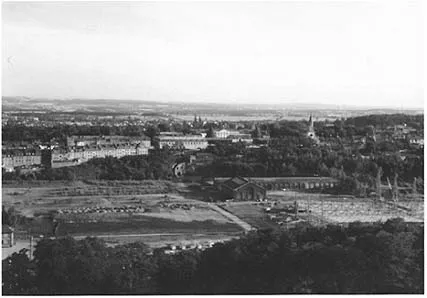
1 Cycles of use and re-use in the industrial landscape: Plaine des Riaux, Le Creusor, France
Industrial heritage has not been well served by any branch of historical study, not least because these disciplines have been heavily dominated by a nationalist perspective. This emphasis has spilt over into heritage management where resources may be identified only in so far as they illustrate particular themes relevant to certain periods or phases of development: monuments and machines become symbols of technological innovation; buildings appear on the historical stage newly built—the stubborn fact of their survival and continuing history conveniently overlooked. It is this very survival which is a starting point for the identification and study of heritage resources.
In the theatre of national economic development, images of what is and is not industry have also shaped perceptions of what industrial heritage can and cannot be. In Britain and the United States, for example, emphasis on heavy industry and technological innovation has encouraged definitions of resources focused on the factory, the machine and the technical monument. This heroic representation of industry as a largely male preserve has only recently been challenged by ‘histories from below’ bringing consideration of minor industries, the experience of work, the experience of industrial change for women and their participation in it.
Many branches of historical study have also tended to be ignorant, even contemptuous, of material culture. Ethnology, ethnography and archaeology are among the only disciplines that take as their starting point a concept of a whole culture. Having as their subject the integrity of a culture, and recognising the importance of material culture in that matrix, they have developed procedures for dealing specifically with material traces. These techniques have been developed to deal with unfamiliar societies, or those where documentary evidence is scanty, applying systematic rules for looking for and examining all sorts of traces and artefacts for a whole site or social system. Unlike historical studies, they must perforce engage with particularities, while seeking to contextualise them. Their disciplines are vital in heritage management.
In this connection, the work of amateur historians also comes to the fore. Although amateurs may have a weak grip on the general contexts and perspectives adopted in academic study, they may bring an energy to the pursuit of detailed investigation or documentary work, even sometimes saving artefacts as evidence.
Industrial archaeology has developed as an attempt to remedy the deficiencies both of academic study, and of amateur his-tories. Its programme suggests an alliance of particular histories based on artefacts, and a grand conceptual dimension—as the archaeology of the industrial period. In bringing these two things together, industrial archaeology is at once indispensable in curatorship and a key science for understanding contemporary society. However, industrial archaeology has tended to neglect one of the primary tenets of traditional archaeology, which takes a society and its people as its proper object of study; industrial archaeology has developed procedures for the investigation and analysis of technical monuments and machinery, but has had little to say about the experience and organisation of working life.
With its starting point in material or experiential traces of past activity, heritage management requires an interdisciplinary approach with a common agenda which may make use of the perspectives provided by these disciplines in generating awareness, understandings of and contexts for its resources. In turn, the prerequisites of industrial heritage may be able to influence the academic agenda.
Heritage resources refuse to be marshalled in the orderly narratives of historical study, and remain full of complexity and contradiction. Fragmentation of the resource is partly created by industrial progress itself and compounded by the absence of an integrated management strategy. Historical and other studies have only begun to establish a perspective using the new insights that greater involvement in industrial heritage is turning up—we do not yet have an integrated understanding of the varieties of industrial culture, so have to hold this out as a heuristic device.
For the present, what has been recognised as industrial heritage still faces inadequate appraisal of material and cultural resources on the one hand, and stereotyped ideas of industry on the other. Even so, we can already observe tensions between the outlines of an industrial heritage which are emerging and established ways of treating the heritage resource. These form the subject of this chapter.
Instruments of heritage thinking: planning for landscapes and sites
There are several institutional structures which have contained and shaped heritage values. The structures of planning and conservation have exercised a powerful influence on the direction and subject matter of heritage, encouraging a definition of resources heavily dependent on landscape features, and defining value according to particular criteria. Typically, conservation was introduced as one component of the larger agenda of land-use planning, and this context has served to shape the development of ideas about what heritage could and should be.
Conservation has typically been defined as the safeguarding of cultural assets, themselves more often seen as relics of a pre-ind...
Table of contents
- Cover Page
- Title Page
- Copyright Page
- Contents
- Acknowledgements
- List of illustrations
- 1 Industrial culture as heritage
- 2 What industrial heritage can do
- 3 Creating constituencies
- 4 Defining heritage resources: protection, collection and documentation
- 5 Interpretation: linking resources and uses
- 6 Bringing projects to fruition
- Bibliography
- Index
Trusted by 375,005 students
Access to over 1.5 million titles for a fair monthly price.
Study more efficiently using our study tools.
Frequently asked questions
Yes, you can cancel anytime from the Subscription tab in your account settings on the Perlego website. Your subscription will stay active until the end of your current billing period. Learn how to cancel your subscription
No, books cannot be downloaded as external files, such as PDFs, for use outside of Perlego. However, you can download books within the Perlego app for offline reading on mobile or tablet. Learn how to download books offline
We are an online textbook subscription service, where you can get access to an entire online library for less than the price of a single book per month. With over 1.5 million books across 990+ topics, we’ve got you covered! Learn about our mission
Look out for the read-aloud symbol on your next book to see if you can listen to it. The read-aloud tool reads text aloud for you, highlighting the text as it is being read. You can pause it, speed it up and slow it down. Learn more about Read Aloud
Yes! You can use the Perlego app on both iOS and Android devices to read anytime, anywhere — even offline. Perfect for commutes or when you’re on the go.
Please note we cannot support devices running on iOS 13 and Android 7 or earlier. Learn more about using the app
Please note we cannot support devices running on iOS 13 and Android 7 or earlier. Learn more about using the app
Yes, you can access The Industrial Heritage by Judith Alfrey,Tim Putnam in PDF and/or ePUB format, as well as other popular books in Architecture & Historic Preservation in Architecture. We have over 1.5 million books available in our catalogue for you to explore.