- 208 pages
- English
- ePUB (mobile friendly)
- Available on iOS & Android
eBook - ePub
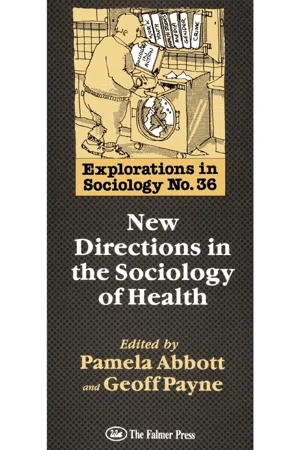
New Directions In The Sociology Of Health
About this book
The sociology of medicine has come a long way from its origins in epidemiology and clinical practice. Like all specialist areas of study it has developed its own internal debates, over the years there has been a shift from a sociology in medicine to a sociology of medicine, and from a sociolgy of medicine, towards a sociology of health and illness. It is to the development of this latter perspective that this volume is addressed.
Information
Chapter 1
Introduction: Developing the Sociology of Health
Pamela Abbott and Geoff Payne
The sociology of medicine has come a long way from its origins in epidemiology and clinical practice. Like all specialist areas of study it has developed its own internal debates, its preferred core of research topics, and its own professional infrastructure for their analysis. Over the years, there has been a shift from a sociology in medicine to a sociology of medicine, and from a sociology of medicine, towards a sociology of health and illness. It is to the development of this latter perspective that the present volume is addressed.
Within what is a large and active field of study there are inevitably several competing paradigms. Medicine and medical science continue to play a substantial part in setting the agenda. This is reflected not only by a concentration on illness and illness behaviour, but also by the relative neglect of paramedical workers such as nurses, or the wider settings in which health behaviour is determined. The narrow focus of much earlier research means that we are still today in the process of discovering more about the ways in which ordinary people act to promote their own, and other people’s, health. The structural and cultural factors that hinder them in so doing have been under-researched, as have the roles played by the State and other agencies in these processes. To take one example, the health promotion work of the non-professional health worker and of the unpaid worker have virtually been ignored.
In selecting papers for this volume, we have therefore looked for those which address these under-researched areas and set a new direction for the sociology of health. The articles were all originally presented at the 1989 Annual Conference of the British Sociological Association, held at Polytechnic South West in Plymouth. The theme for the Conference, ‘Sociology in Action’, was chosen to demonstrate how current work in the discipline was directly related to issues in contemporary society: Health and Illness was one of the main ‘streams’ and provided a rich resource of contributions from among which the contents of this conference volume were chosen.
At first sight, the papers here might seem to be disparate, because they raise a number of wide-ranging issues, and deal with them in rather different ways. However, they share more than just a common concern with the sociological understanding of health and illness for the 1990s. There are two interconnected central themes. First, we wanted to broaden the perspectives, and to connect research in the specialist field of health and illness to developments and approaches in other cognate areas of current sociology. Second, we wish to foster the promotion of a ‘sociology of health’, as distinct from a sociology of medicine, or even of ‘health and illness’. A broader perspective leads us to see the advantages of escaping from the medical model: the rejection of the medical model opens up new perspectives for study.
The first of these themes manifests itself in several ways among the articles. On the one hand, there are papers such as those by Sara Arber (Chapter 3) and by Gary Littlejohn and colleagues (Chapter 2), which take a well established tradition and carry it forward through more sophisticated and systematic analysis. Arber applies to health statistics perspectives on women and social class that have been recently advanced in the context of social mobility, labour markets, and class analysis. Littlejohn et al. use improved standards of empirical research to disentangle individual, household and community level effects in the familiar field of social epidemiology. On the other hand, George Giarchi and Lorna Warren (Chapters 4 and 5) expand the idea of health care by looking at parallel, non-medical services, while Ursula Sharma and Nicki Thorogood (Chapters 9 and 10) offer us insights into the world of alternative therapies. Other papers draw on work in the sociology of deviance and the sociology of the media, to explain public reactions to initiatives aimed at dealing with alcoholism, tranquillizers and AIDS.
The second theme in this selection, a concern with ways that sociology can enhance our understanding of health by placing health maintenance at the centre of things, also presents itself in a number of ways. Warren shows how Home Helps in practice go beyond their formal duties and carry out work with the elderly which could be seen as nursing, and certainly resembles the informal health support which they do in their domestic sphere for their own families. Norma Daykin (Chapter 11) shows how occupational health research has focused on male workers, ignoring many work hazards that affect women. Giarchi, Sharma and Throrogood have already been mentioned as setting the problem of health maintenance in specific cultural contexts, far removed from the world views of the medical practitioner. Thomas Acton and David Chambers (Chapter 12) address questions of public health policy (as do several of the papers), but again, from a new angle.
The papers, then, contain a coherence at a level which reflects recent movements in the field, while equally spanning a range of work that builds bridges to other fields. Our choice of title is deliberate: as editors we see the need to draw attention to new directions, and in particular, we have selected the title ‘the sociology of health’, rather than ‘health and illness’ to emphasize where we believe the focus should lie. It is not our claim that we are being totally original in this; rather it is a case of adding the weight of part of the BSA’s annual conference—an opportunity to report on work in hand—to reinforce a fresh perspective in the field.
The sociology of under-researched groups
It is certainly also not original to add that several groups in our society have not received the research attention that they deserve. This collection includes new work on four of these groups with, most obviously, the health situation of women not only receiving specific attention (Chapters 2, 3 and 11, for example) but being a recurrent element in many of the other papers. Within the conventional boundaries of the sociology of health and illness, the particular health concerns of the elderly, of Black Britons, and of rural dwellers have also largely been marginal, whereas there has been a growing literature on other aspects of their life experience in associated fields of sociology. To a large extent, the earlier narrow perspective that we now wish to replace is a product of a medical model, in which medicine, maleness, metropolitanism and middle class membership have been equally constraining.
The potential of breaking this mould can be seen in Arber’s examination of women’s health in Chapter 3, in which she points out that despite the fact that the Black Report on Health Inequalities was published a decade ago, inequalities in women’s health remains a largely unresearched area, because research in the area has been dominated by male-oriented class analysis. She argues for two kinds of refinement here, drawing on her background as a member of the Stratification and Employment Group at the University of Surrey. On the one hand, Arber is identifying the need for more sophisticated indicators of material deprivation, differentiation and inequality than the conventional catch-all of social class. This takes us away from sterile ‘left versus right’ debates and accusations of political bias; but, more important, it redirects us towards a more informed picture of what we wish to know. Too often in the past, sociologists have tended to see health inequalities only as particular symptoms of class, the latter being their real interest. The way forward must be to take health patterns as an interest in themselves, and to explore them using a larger battery of variables and indicators. (Ironically, this may cause more problems for the medical professions than for sociologists; what often passes for ‘scientific’ research among the former is frequently typified by simplistic statistical analysis, and the new complexity implied in Arber’s paper could be a daunting challenge for many medics!)
On the other hand, Arber is not abandoning the question of class structures and structuration, although she does suggest that the concentration on structural/ materialist explanations has deflected researchers from seeing the ways in which women’s familial and employment roles need to be analyzed within a structural context. She concludes that, as with men, structural factors have a major impact on women’s health status, but that also women’s health status influences women’s roles. This suggests that the material disadvantages of some households may be compound by the poor health of female members as they are unable to take on paid employment in addition to their domestic work. Indeed it could further be suggested that the poor health of women in disadvantaged households may reduce the ‘health promoting’ work that they are able to perform in the household, compounding the disadvantages of children and other household members. Women’s health status is of vital importance in determining their ability to promote the health of other members of the household—including children, and their own parents.
For the elderly who cannot draw on health support from their own families, an alternative may be found in the Home Help, although this is neither the prime function of the service, nor the original motivation of those who start as Home Helps. These are, as Warren’s study shows (Chapter 5), on the whole unqualified women who become Home Helps because the hours are convenient. However, the work that they do as Home Helps is much the same as they perform for their own families. The care they give makes a valuable, often vital, contribution to maintaining the health of the elderly. Furthermore, as Warren points out, they often go beyond their defined duties and carry out work that could be seen as nursing. This echoes Graham’s point (1984) that much of the unpaid work that women routinely undertake in the domestic sphere is health promotion or health monitoring work. Yet it is rarely acknowledged as such, not least where the medical model narrows our focus on to disease per se.
A parallel case of health promotion which is largely invisible to the formal medical world is the use of traditional treatments by West Indian women. Thorogood (Chapter 10) argues that we need to understand the cultural attitudes of Black Britons to health and health care if adequate provision is to be made to meet their needs. She focuses on the health work of West Indian women in London. While she is specifically concerned with the traditional ‘bush’ medication used in the West Indies, she develops her analysis to argue that class, gender and race shape the ways in which West Indian women make use of traditional and western medicine. On the one hand, a decision to use ‘bush’ remedies may be influenced by experience of racism in the NHS, both as patient and as worker. On the other ‘bush’ represents one element within a (largely female) cultural tradition. Thorogood suggests that among West Indian women in her study, ‘bush’ was used in the West Indies (and still is used amongst older West Indian women) to maintain health as well as to cure specific illnesses/diseases. Perhaps it could be seen as akin to the taking of vitamin pills and other ‘health preparations’ as a way of maintaining health, an increasingly common practice in Britain.
In contrast ‘alternative medicine’, also of increasing popularity in contemporary society, is more frequently used when conventional medicine ‘fails’. Sharma (Chapter 9) suggests that when people turn to alternative medicine, it is generally because they are seeking alternative ways to restore and maintain their health when conventional medicine is unable to meet their expectations. Frequently she found this is in respect to chronic illnesses. Thorogood and Sharma both illustrate how the medical model influences wider perceptions of ‘problems’. The medical profession has a claim to the monopoly of skills in the treatment of disease and judgments of successful treatment. This is not always accepted by those suffering from disease, who may choose to consult and follow the treatment prescribed by ‘alternative healers’. Most medical practitioners are critical of ‘alternative medicine’, at once trying to incorporate elements within their own domain, and challenging others to ‘prove’ their efficacy by scientific methods (generally controlled clinical trials). Sharma argues that this lack of scientific ‘proof’ of efficacy may not be seen as problematic by those who use alternative medicines, because they are generally suffering from complaints that conventional medicine cannot cure. There are also alternative measures of ‘satisfactory outcome’ to that of positivist science. For example, Thorogood suggests that ‘bush’ is based on tradition and presumably empirical knowledge, that is knowledge built up through a perceived ‘successful’ experience of use.
Before one can use such remedies, one must be in a position to exercise choice, based on knowledge and availability (or access). George Giarchi (Chapter 4) points to the neglect of rural deprivation in dimensions of health inequalities. He argues that the rural poor ‘suffer’ all the deprivations of the urban poor, plus additional ones because of living in rural areas—making not only access to services difficult, but also adequate knowledge of services difficult to obtain. In his Cornish study, reported in his article, he shows how the problems of the rural poor were also compounded by age and social isolation. Not only are many of the rural poor elderly, but also many have moved to the area after retirement, leaving behind family and long established community ties. This means that many are not integrated into communities and cannot rely on community support. This is an even greater problem for those who live in isolated dwellings or small hamlets where there are few people available to provide ‘community care’.
Giarchi’s article raises two key issues for the sociology of health, knowledge of available services, and provision and access to services. Both are political. In recent years there has been a tendency to centralize services—exemplified in the development of the centralized District General Hospital. Knowledge of the availability of a service is necessary, as is an ability and willingness to travel to use it. Giarchi argues that the further from services people live, the less likely they are to have or to be able to obtain knowledge of them. He identifies ‘knowledge deprivation’ as a new dimension of general social deprivation. This extends Graham’s (1984) argument that the centralization of services may cause severe difficulties for women in carrying out their health maintenance work in the domestic sphere. Problems such as cost, time and transportation may deter women from making use of available services for themselves and their children. Transport may be the greater problem, despite higher levels of car-ownership, because women rarely have access to ‘the family car’ (Graham 1984).
These people are consumers of the available services, even if their ‘choices’ are constrained by availability, knowledge and cost. While Stacey (1976) may be correct to argue that patients are health workers and that the consumer analogy is a misconception, people do make decisions about service utilization. This still applies even in circumstances such as those that Giarchi found in Cornwall, where these choices are heavily constrained.
Research on these four under-researched groups goes beyond providing substantive information about the groups in question. As this brief review demonstrates, the papers are also a rich resource of concepts and approaches—such as the interaction of structures and processes, cultural systems, and individual action on constrained choices—which can fruitfully be brought to bear on health from other fields of sociology. This enrichment follows naturally from the refocusing on health, rather than on illness, as the central issue.
Focus and Framework
The sociology of health is centrally about the ways in which people strive to maintain their health. This is a different model from one that starts with ill health, or that contained within the medical model. It starts from the assumption that people are concerned, in their everyday lives, to maintain their health and that in doing so they carry out health work and make decisions about and choices between the available services. It also recognizes that members are using their own social definitions of health and illness, and their own knowledge of how to promote, maintain and restore health. They do so within a material framework that not only constrains and limits the choices available to them, but is the major factor in shaping their health status. Class, gender, age and ethnicity all play a major role in structuring our abilities to maintain our health.
We would, however, want to distinguish between a structuralist perspective per se, and its application to health and the process of health promotion. This is not to reject structuralist research, but to call for further developments. It is of course true that the sociology of medicine has contributed to the analysis of structures, in the senses of class structures, and of Government policies. Obviously, the Black Report (DHSS, 1980) has prompted considerable research on health inequalities (see e.g. Townsend et al., 1988 (a) and (b); Abbott et al., 1988), some of it undertaken by sociologists. The major conclusion from this work is that health inequalities are structural and that as in the past, future improvement in health will come from improvement in diet, housing and such. Recognition has also been given to cultural factors and particularly the ways in which they articulate with material disadvantage (see, e.g., Graham, 1984). In this way individualistic explanations of health inequalities have been challenged, despite their continuing popularity with Government.
As Acton and Chambers (Chapter 12) demonstrate, such structuralist research has had singularly little impact on Government, while at the same time, this problem has been exacerbated by sociologists’ choice of research topics. For example, public health, and the role of Environmental Health Officers in particular, have been virtually ignored. Yet this is an area where sociologists could make important contributions to the development of public policy. While it has been commonplace to point out that we have an ‘ill-health service’ rather than a ‘health service’, little attention has been paid to the preventative arm. This neglect is, of course, not just one of sociologists: for instance, the recent Government White Paper on the Health Service, Working for Patients (DoH, 1989), made no reference to preventative or public health policies. Government remains not only committed to individualistic explanations for health status, but also to the traditional emphasis on a curative rather than a preventative health policy, and an emphasis on chronic rather than acute illness. In this sense health promotion exists in a framework of public policies oriented to illness.
This does not mean that Government has not played a role in health promotion policies. However, campaigns have generally been directed at the individual, with a view to changing individual behaviour—often with little success. When such campaigns have been successful it has generally been because there are strong motivating factors and individuals are able to make choices. This is probably best illustrated by cigarette smoking. There has been a sustained campaign for a number of years to get people to give up smoking. Middle-class and, to a lesser extent, working-class men have reduced their consumption of cigarettes while the proportion of working-class women smoking has actually increased. Graham (1984) has argued that this suggests that it must have something to do with the situation that these women are in. Her analysis of the budget of poor single-parent women, as compared with those of women in more advantaged households, indicates that the disadvantaged women who smoke see it as an essential item of expenditure. She argues that these women see cigarette smoking as their only pleasure and the thing that enables them to get through the day. For them giving up smoking is not a realistic choice.
A parallel example is the mid-1980s health education campaigns against heroin, which were designed to persuade young people not to try heroin. Graham Hart (Chapter 9) argues that the campaigns had negative as well as positive effects: they were so targeted to heroin that other drugs appeared relatively benign, and the drug-addicted sallow youths appearing in the posters were considered attractive enough to be put up on bedroom walls. The campaigners were concerned when heroin addiction was seen as having a debilitating and dependency-inducing effect on ‘youth’ and the solution was seen as persuading individuals not to take t...
Table of contents
- Cover Page
- Title Page
- Copyright Page
- Chapter 1
- Chapter 2
- Chapter 3
- Chapter 4
- Chapter 5
- Chapter 6
- Chapter 7
- Chapter 8
- Chapter 9
- Chapter 10
- Chapter 11
- Chapter 12
- References
- Notes on Contributors
Trusted by 375,005 students
Access to over 1.5 million titles for a fair monthly price.
Study more efficiently using our study tools.
Frequently asked questions
Yes, you can cancel anytime from the Subscription tab in your account settings on the Perlego website. Your subscription will stay active until the end of your current billing period. Learn how to cancel your subscription
No, books cannot be downloaded as external files, such as PDFs, for use outside of Perlego. However, you can download books within the Perlego app for offline reading on mobile or tablet. Learn how to download books offline
Perlego offers two plans: Essential and Complete
- Essential is ideal for learners and professionals who enjoy exploring a wide range of subjects. Access the Essential Library with 800,000+ trusted titles and best-sellers across business, personal growth, and the humanities. Includes unlimited reading time and Standard Read Aloud voice.
- Complete: Perfect for advanced learners and researchers needing full, unrestricted access. Unlock 1.5M+ books across hundreds of subjects, including academic and specialized titles. The Complete Plan also includes advanced features like Premium Read Aloud and Research Assistant.
We are an online textbook subscription service, where you can get access to an entire online library for less than the price of a single book per month. With over 1.5 million books across 990+ topics, we’ve got you covered! Learn about our mission
Look out for the read-aloud symbol on your next book to see if you can listen to it. The read-aloud tool reads text aloud for you, highlighting the text as it is being read. You can pause it, speed it up and slow it down. Learn more about Read Aloud
Yes! You can use the Perlego app on both iOS and Android devices to read anytime, anywhere — even offline. Perfect for commutes or when you’re on the go.
Please note we cannot support devices running on iOS 13 and Android 7 or earlier. Learn more about using the app
Please note we cannot support devices running on iOS 13 and Android 7 or earlier. Learn more about using the app
Yes, you can access New Directions In The Sociology Of Health by Geoff Payne,Pamela Abbott in PDF and/or ePUB format, as well as other popular books in Education & Education General. We have over 1.5 million books available in our catalogue for you to explore.