eBook - ePub
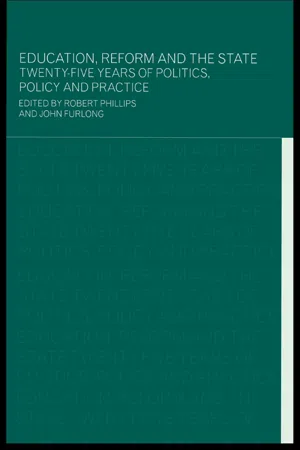
Education, Reform and the State
Twenty Five Years of Politics, Policy and Practice
- 284 pages
- English
- ePUB (mobile friendly)
- Available on iOS & Android
eBook - ePub
Education, Reform and the State
Twenty Five Years of Politics, Policy and Practice
About this book
The last quarter of the twentieth century was a very important period in history of education. Beginning with the so-called 'Great Debate', the period witnessed intense public and political interest in educational issues, culminating in an almost unprecedented amount of education-related legislation, the most symbolic of which was the Education Reform Act of 1988. Some scholars have rightly claimed that the education system was 'transformed' during this period, pointing to major changes in the ways in which schools, further education colleges and universities were organised, managed and controlled. Others have claimed that these changes altered the power relationships which had underpinned the education system since 1944. Given the sheer scale and pace of the education-policy related reforms of this period, this edited collection brings together some of the leading scholars in education to reflect on the major legislative and structural changes in education over the past few decades. Published in the year of the twenty-fifth anniversary of Callaghan's Ruskin College speech in 1976, it provides a definitive contemporary history of education policy in the late twentieth century. The editors bring together some of the leading educationalists to reflect on the major legislative and structural changes in the field over the last twenty five years. The book will be of use to education students on undergraduate and postgraduate courses, as well as students and academics working in social policy.
Information
Part I
Introduction and historical overview
1 Introduction and rationale
John Furlong and Robert Phillips
Setting the scene: Ruskin and beyond
The last quarter of the twentieth century, specifically the period 1976–2001, was profoundly important in the history of education. It witnessed a transformation in the ways in which education in England and Wales was organised, controlled and managed. As with other spheres of social policy, few aspects of education remained unchanged: the period saw fundamental changes in the structure and nature of educational institutions, in the organisation of the curriculum, in the nature of teachers’ work and professionalism, and in the aims and purposes of assessment. It was a period which was characterised by profound and often confrontational debates over the nature and purposes of education in society, particularly those between education, the economy and the nation. The changes initiated during the period altered the power relationships which had underpinned the education system since the 1944 Education Act, which itself had shaped the post-war educational world.
Our starting point is Callaghan’s speech on education given at Ruskin College, Oxford, on 18 October 1976, and we conclude exactly twenty-five years later, near the end of New Labour’s first administration. Although there had already been some well-publicised debates over aspects of education in the 1970s, Callaghan’s speech was significant because it signalled direct interest in education by central government at the highest level. At the beginning of the twenty-first century, we are now very familiar with well-publicised direct interventions in education by prime ministers and other senior ministers, yet in 1976 this was regarded as something of a novelty. This changing context for the conduct of educational policy discourse reveals much about the shifting power structures relating to education itself. The Ruskin speech and the so-called ‘Great Debate’ which followed represented a symbolic indication of central government’s desire to influence the nation’s education in certain ways. A dominant and recurring theme throughout most of the period under investigation is therefore the growth of central influence over educational politics, policy and practice.
There is considerable consensus and agreement amongst contemporary historians of education that 1976 should be regarded as a significant turning point in the history of education. Aldrich (1996: 4) suggests that after 1976, the year 1944 would no longer be seen as the ‘dividing line between past and present’ in education policy. This is because, as Brooks (1991: 4) stresses, not only did it represent a ‘stage in the assertion by central government of its stake in the nation’s education system’, but it also marked the transition between the expansionist period of the 1960s and the retrenchment of the 1980s. The connection here between education and nationhood needs to be stressed, for, as we shall see in Chapter 2, Callaghan made explicit the relationship between education and the nation’s well-being, particularly its economic prosperity. As we shall also see in the other chapters which follow, this was to dominate much governmental thinking on education throughout our period and, at the time of writing, is central to the ‘modernising’ priorities of the present government. Thus, as Esland (1996: 47) suggests:
Even at the time, the 1976 speech was seen as a defining moment; but in retrospect its significance if anything seems greater. For the first time in the history of mass education in Britain, the state set out a clear priority for the economic purpose of education, thereby establishing an explicit connection between education and economic nationalism.
Rationale for the book
The observation above provides a useful justification for this volume; it seems apposite on the twenty-fifth anniversary of Ruskin to publish a book documenting the history of the period which focuses upon the connection between education, reform and the state. Yet the book is not merely a straightforward contemporary history, as it draws upon the rich and wide-ranging literature which also emerged during this period in response to the reforms. This includes scholarly work which analysed education reform at the macro (state) level, and the analytical work which described the impact of reform on, for example, curriculum and assessment, primary and secondary schools, post-compulsory and higher education, educational administration and governance and teacher education and professionalism. It also utilises work which has sought to describe the conceptual ideas which underpinned these reforms, such as equity, ‘choice’, marketisation and accountability.
Each of the contributors to the volume reflects on the major legislative and structural changes in their designated fields over the past twenty-five years. Although the contributors have identified their own specific questions and themes (see below), overarching ones such as the following are appropriate to all the chapters:
- What have been the major legislative reforms and structural changes which have influenced education policies over the past twenty-five years?
- What were the major ideological, political and educational factors which accounted for these changes?
- In what ways have certain areas of education been ‘transformed’ during this period?
- To what extent is there continuity with regard to education policy over the period as a whole?
- What have been the merits and demerits of these changes?
In essence, the book is a contemporary history of education policy, drawing upon some of the ‘illuminative’ approaches associated with that analytical tradition commonly associated with policy sociology. The work of Stephen Ball has been preeminent in this respect, particularly the seminal Politics and Policy Making in Education: Explorations in Policy Sociology (Ball 1990), which did so much to alert us to the ideological context of reform in the late 1980s and early 1990s. It is therefore appropriate that we use a quotation from the historian Barraclough, chosen by Ball himself, to provide a useful rationale and justification for this volume:
In the long run contemporary history can only justify its claim to be a serious intellectual discipline and more than a desultory and superficial review of the contemporary scene if it sets out to clarify the basic structural changes which have shaped the modern world.
(Barraclough 1967: 16, quoted by Ball 1990: 1)
Structure and outline of chapters
Following the above, we very much hope, therefore, that the book will be of utility to students, academics, education professionals and policy makers alike, who wish to understand more clearly the factors which have shaped the contemporary education scene in England and Wales and who wish to ‘continue the debate’ (see Williams et al. 1992) over the nature of educational provision in England and Wales. The book is divided into five sections. Section 1 provides an introductory historical overview; Section 2 analyses the changing institutional contexts for reform; Section 3 focuses upon three key themes which dominated not only the Ruskin speech but most of the subsequent twenty-five years, namely professionalism, accountability and standards; Section 4 evaluates issues relating to equality in education; Section 5 offers an analytical conclusion to the period and also contemplates the future.
In Chapter 2, Robert Phillips provides a retrospective evaluation of the impact of Callaghan’s Ruskin speech by considering continuity and change in educational reform in England and Wales over the whole of the last twenty-five-year period. He suggests that Callaghan did not anticipate the scale and pace of education reform that would be initiated after 1976 and that it would be misconceived to suggest that all subsequent policy reforms had their origins in that particular moment. However, Phillips argues that although each of the subsequent periods had a set of characteristic dynamics of its own, Callaghan’s intervention was profoundly important in that it helped shape the ‘discursive framework’ within which subsequent debates over education policy would take place. This influence, Phillips argues, has been just as apparent under the post-1997 New Labour administration as it was throughout the Conservative administrations of the 1980s and 1990s.
Perhaps the most highly contested area of education during this period was the primary sector, and in Chapter 3 Jim Campbell describes what he calls the ‘colonisation’ of the primary school curriculum over the last twenty-five years with regard to its aims, nature, assessment and modes of delivery. In 1976, he suggests that the metaphor of the curriculum as a secret garden, despite its over-use, did have some resonance with reality as individual teachers were able to experiment with aspects of their curriculum according to local and individual interests. Today, the scene is very different because, according to Campbell, successive governments have sought to take control or, to use Campbell’s term, attempted to ‘colonise’ the curriculum. He describes three strategies that have been utilised in different periods. The first phase, from 1976 to 1986, was characterised by gentle persuasion; the second phase, from 1987 to 1996, involved the imposition of standards and accountability measures by statute; the third phase, which began in 1992/3 and came into full force after the election of the New Labour government of 1997, involves the imposition of a performance culture on primary schools, a concentration on raising standards of literacy and numeracy, and the development of officially sponsored pedagogies.
Geoffrey Walford looks at secondary schools over the same period and considers the changing fate of the ‘comprehensive ideal’. That ideal, he suggests, affirms that children’s education should not be disadvantaged by their background and that the state should provide free, high-quality education for all in comprehensive schools. Walford begins by briefly outlining the development of the comprehensive system which became the dominant model of secondary education in England and Wales during 1970s. He then outlines interlinked policies introduced after 1979 to support and encourage the selection of particular children for unequally funded schools. The development of the Assisted Places Scheme in 1980, grant-maintained schools in 1988 and specialist schools after 1993, all served progressively to undermine the comprehensive principle. As a result of all of these moves, Walford suggests that by 1996 it was estimated that only 40 per cent of all secondary schools were LEA maintained and fully comprehensive. Moreover, he argues that in contrast to what might be expected from a Labour government, many of their polices since 1997 appear to be designed to generate an even greater challenge to the comprehensive ideal, with fragmentation into different types of school, more selection according to a range of different criteria and greater inequality in what schools offer.
As already stated, a fundamental theme of Callaghan’s speech was the notion that the education system was not providing industry and the economy with what it required in terms of a skilled and well-educated work force, a theme which has dominated educational discourse throughout our period. Martin Jephcote and Prue Huddleston analyse a crucial sector of education in this respect, namely further education (FE). They argue that in many respects FE has been blighted by the governmental view that education and training should be seen as an investment in human capital and as a means to economic growth and wealth creation, and also the belief that the prolonged decline of the UK was the result of poor education and training. Consequently, from the 1980s onwards, they argue, post-16 education and training was increasingly regarded by politicians as a key means of responding to the demands of economic restructuring. They conclude by suggesting that despite the often dramatic changes in FE, the challenges facing the sector are not fully resolved.
Gareth Rees and Dean Stroud consider changes in the field of higher education. As they note, during the latter decades of the twentieth century, the place of higher education in British society has been transformed. Until the 1960s, the universities and other higher education institutions impinged relatively little on the lives of most people. The expansion of higher education since then has enormously widened its range of influence. This transition to a mass system of higher education, they argue, embodies a profound if not generally much noticed educational and social transformation. However, there are, suggest Rees and Stroud, important caveats to be noted to this largely positive story, most significantly in the move away from the notion of higher education as a ‘right of citizenship’ to one of ‘market/individual consumer’. Moreover, this social transformation has entailed a fundamental restructuring of the organisation of higher education itself, most crucially the basis upon which universities are funded. These changes, in turn, have required the reformulation of the relationships between central government and the higher education sector. The principal rationale for the expansion of higher education has been the contribution of an enlarged sector to fulfilling the ambitions of successive governments to bring about a long-term improvement in the competitiveness and growth of the British economy. In this regard, the changes which have taken place echo the school reforms in the last twenty-five years.
Robert Phillips and Richard Daugherty explore what has perhaps been one of the unintended consequences of greatly increased centralisation of control over education in the last twenty-five years, namely the move towards educational devolution in Wales. As they say, it is both ironic and remarkable to reflect that, during the period between 1988 and 1998, a time of increasing policy centralisation by Conservative governments, Wales was able to develop a distinctive educational and institutional framework that preceded political and legislative devolution in 1999. The main engine of this restructuring, they suggest, was the Education Reform Act of 1988 that revolutionised the role of the state in education, thereby inadvertently raising questions about the relationship between the Welsh nation and the British state in a new context. Phillips and Daugherty trace the origins of these developments, particularly in relation to the school curriculum; they argue that this period of educational history in Wales provides an opportunity to analyse the ways in which educational reform, cultural politics and political nationalism are interrelated.
Gary McCulloch considers the changing nature of teacher professionalism over the last twenty-five years. In 1976, he argues, the prevailing image of teacher professionalism in England and Wales revolved around an ideal of teachers individually and collectively possessing a high degree of autonomy and control in the curriculum domain. Within this sphere, he suggests that it was widely assumed that their role included the freedom to decide not only how to teach but also what to teach, and that they had a primary responsibility for curriculum development and innovation. As he says, this prerogative was not subject to the fickle demands of parents and the community, still less to the interests of the state or political parties. Rather, it was to be carefully preserved and the province of teachers’ experience, judgement and expertise, which would ensure the gradual evolution of content and methods in line with social and cultural change. In fact, McCulloch suggests that this ideal did not entirely accord with reality. Nevertheless, the desire to challenge teacher autonomy (interpreted by many of those close to government as no more than vested interests) has been a key feature of educational policy in the last twenty-five years, so much so, McCulloch argues, that today teacher autonomy has been fundamentally redefined. What replaced it in the 1990s was first a pragmatic adjustment in the balance between teachers’ rights and responsibilities in the classroom and public accountability. More recently, under New Labour there has been a wholesale recasting of the ideal of teacher professionalism characterised as the ‘New Professionalism’.
John Furlong also considers changes to the nature of teacher professionalism, but within the context of initial teacher education and training. He argues that over the last twenty-fiv...
Table of contents
- Cover Page
- Title Page
- Copyright Page
- Illustrations
- Contributors
- Part I Introduction and Historical Overview
- Part II The Changing Institutional Context
- Part III Professionalism, Accountability and Standards
- Part IV Issues of Equality
- Part V Conclusion
Trusted by 375,005 students
Access to over 1.5 million titles for a fair monthly price.
Study more efficiently using our study tools.
Frequently asked questions
Yes, you can cancel anytime from the Subscription tab in your account settings on the Perlego website. Your subscription will stay active until the end of your current billing period. Learn how to cancel your subscription
No, books cannot be downloaded as external files, such as PDFs, for use outside of Perlego. However, you can download books within the Perlego app for offline reading on mobile or tablet. Learn how to download books offline
Perlego offers two plans: Essential and Complete
- Essential is ideal for learners and professionals who enjoy exploring a wide range of subjects. Access the Essential Library with 800,000+ trusted titles and best-sellers across business, personal growth, and the humanities. Includes unlimited reading time and Standard Read Aloud voice.
- Complete: Perfect for advanced learners and researchers needing full, unrestricted access. Unlock 1.5M+ books across hundreds of subjects, including academic and specialized titles. The Complete Plan also includes advanced features like Premium Read Aloud and Research Assistant.
We are an online textbook subscription service, where you can get access to an entire online library for less than the price of a single book per month. With over 1.5 million books across 990+ topics, we’ve got you covered! Learn about our mission
Look out for the read-aloud symbol on your next book to see if you can listen to it. The read-aloud tool reads text aloud for you, highlighting the text as it is being read. You can pause it, speed it up and slow it down. Learn more about Read Aloud
Yes! You can use the Perlego app on both iOS and Android devices to read anytime, anywhere — even offline. Perfect for commutes or when you’re on the go.
Please note we cannot support devices running on iOS 13 and Android 7 or earlier. Learn more about using the app
Please note we cannot support devices running on iOS 13 and Android 7 or earlier. Learn more about using the app
Yes, you can access Education, Reform and the State by John Furlong, Robert Phillips, John Furlong,Robert Phillips in PDF and/or ePUB format, as well as other popular books in Education & Education General. We have over 1.5 million books available in our catalogue for you to explore.