eBook - ePub
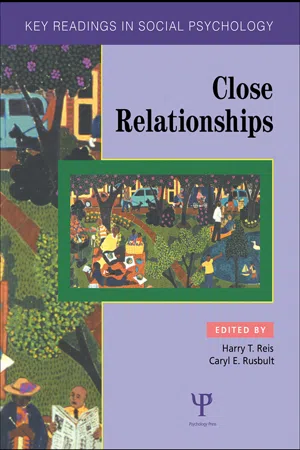
Close Relationships
Key Readings
- 532 pages
- English
- ePUB (mobile friendly)
- Available on iOS & Android
eBook - ePub
About this book
Each of the chapters in this reader is written by leading scholars in the area of relationships, reflecting the diversity of the field and including both contemporary and key historical papers for comprehensive coverage of research.
Information
Publisher
Psychology PressYear
2004Print ISBN
9780863775963
9780863775956
Edition
1eBook ISBN
9781135471323
SECTION 1
Relationships in Our Lives
Never believe that you know the last word about any human heart.
—Henry James
The bird a nest, the spider a web, man friendship.
—William Blake
What role do relationships play in our lives? Although few would deny that people care deeply about their ongoing connections with others, a full appreciation of the impact of relationships involves more than simply declaring that “humans are social animals.” Relationships have been an ever-present theme throughout human history, as evidenced in literature, music, Biblical tales and precepts, anthropological studies of any and all human societies, and the chronicles of kings, queens, emirs, emperors, chiefs, and their nation-states and alliances. As discussed in the introduction to this volume, the social psychological perspective to understanding relationships differs from these and other approaches by its focus on underlying processes, broad theoretical analysis, and rigorous empirical scrutiny.
The articles in this section address several of the many ways in which relationships affect our lives and everyday activities. Berscheid’s article provides a fitting introduction to this volume. In sounding a clarion call for relationship science, Berscheid refers to the empirical study of relationships as an “essential science.” By this she means that relationships—not only between two individuals but also the larger social networks in which dyadic relationships reside—inherently and importantly influence many or most phenomena in the social, behavioral, and biological sciences (Reis, Collins, & Berscheid, 2000). Berscheid further notes that because relationships have profound implications for human health and welfare, researchers in this field have an obligation to contribute to public policy debates and to the design of treatments and interventions. Berscheid’s paper stirringly articulates a fundamental rationale for the field to which many researchers resonate.
Research regarding physical and psychological health powerfully demonstrates the importance of relationships for human welfare—a fact that may account for the ever-growing popularity of this research topic. That these effects can be substantial is evident in House, Landis, and Umberson’s (1988) analysis of five ambitious, long-term prospective epidemiological studies, which concluded that the risk for premature death associated with poor social integration exceeds the risk associated with such well-known health hazards as tobacco use. Similarly, relational circumstances are among the most potent factors affecting mental health, as demonstrated in numerous studies of depression, loneliness, life satisfaction, emotional distress, and happiness (Myers, 1992; Ryff, 1995). Conducting this sort of research—research that spans the social, physical, and medical sciences—often requires collaboration among scientists with diverse specializations. The social psychologist’s contribution is to identify and document the interpersonal mechanisms involved in these dramatic effects on personal well-being.
Collins and her colleagues provide a compelling example of the health effects of relationships in their study of social support among pregnant, low-income women. Their research shows that social support predicts not only lesser postpartum depression among these women, but also the well-being of their babies: Women with more support had healthier babies with higher birth weight. To the medical community, studies such as this highlight the need to consider relationship circumstances when providing health care. To researchers, studies such as this stimulate our desire to more fully understand the mechanisms by which these and many other similar effects come about.
In the final article in this section, Reis and his colleagues explore the role of relationships in our lives by examining how social participation changes during early adulthood. Lifespan developmental theorists—such as Erikson (1950) and Hartup and Stevens (1997)—have a longstanding interest in describing and understanding developmental changes in the form and function of social interaction from infancy to old age. Reis et al.’s research relies on a diary method. Using participants’ brief, structured descriptions of all of their social interactions lasting 10 minutes or longer, these researchers provide a detailed social ecology of the college years and later (around age 30). Their study reveals, for example, that as Dave and Anna move from their college years into adulthood, they come to spend somewhat less time with same-sex friends, spending more time with opposite-sex partners. Moreover, as they proceed into adulthood, Dave’s and Anna’s relationships become increasingly intimate, or personally meaningful to them; this increase in intimacy is evident not only in opposite-sex interactions, but also in same-sex interactions. Importantly, this study reminds us that although social relations matter greatly throughout life, the particular manner in which social needs are manifested and satisfied is likely to change as we mature and age (Hartup & Stevens, 1997).
REFERENCES
Erikson, E. (1950). Childhood and society. New York: Norton.
Hartup, W.W., & Stevens, N. (1997). Friendships and adaptation in the life course. Psychological Bulletin, 121, 355–370.
House, J.S., Landis, K.R., & Umberson, D. (1988). Social relationships and health. Science, 241, 540–545.
Myers, D.G. (1992). The pursuit of happiness: Who is happy—and why. New York: William Morrow & Co.
Reis, H.T., Collins, W.A., & Berscheid,E. (2000). The relationship context of human behavior and development. Psychological Bulletin, 126, 844–872.
Ryff, C.D. (1995). Psychological well-being in adult life. Current Directions in Psychological Science, 4, 99–103.
Suggestions for Further Reading
Baumeister, R.F., & Leary, M.R. (1995). The need to belong: Desire for interpersonal attachments as a fundamental human motivation. Psychological Bulletin, 117, 497–529. This paper reviews evidence from diverse sources in support of the claim that the “need to belong” is an abiding force in shaping human behavior and everyday experience.
Berkman, L.F. (1995). The role of social relations in health promotion. Psychosomatic Medicine, 57, 245–254. A useful overview of research illustrating how relationship factors influence health in diverse ways.
Brown, G.W., & Harris, T. (1978). Social origins of depression: A study of psychiatric disorder in women. London: Tavistock. A classic study in the area, this research was one of the first to link intimate relationships to depression.
Cohen, S., Underwood, L.G., & Gottlieb, B.H. (Eds.). (2000). Social support measurement and intervention. New York: Oxford University Press. How to measure social support and how to design interventions that improve social support.
Collins, W.A., & Laursen, B. (Eds.). (1999). Relationships as developmental contexts: Minnesota Symposia on Child Psychology (Vol. 30). Mahwah, NJ: Erlbaum. A collection of essays by some of the leading scholars who have studied the impact of relationships on development.
Diener, E., Suh, E.M., Lucas, R.E., & Smith, H.L. (1999). Subjective well-being: Three decades of progress. Psychological Bulletin, 125, 276–302. Many studies have examined the correlates of subjective well-being; this comprehensive review summarizes that research, including sections on relationships and social involvement.
Hartup, W.W. (1989). Social relationships and their developmental significance. American Psychologist, 44, 120–126. An insightful review of both changes and continuities in the impact of relationships across the human lifespan from infancy to old age.
Kiecolt-Glaser, J.K., & Newton, T. (2001). Marriage and health: His and hers. Psychological Bulletin, 127, 472–503. A comprehensive review of evidence regarding the impact of marriage on physical health, with an emphasis on behavioral and physiological mechanisms.
Leary, M.R., & Baumeister, R.F. (2000). The nature and function of self-esteem: Sociometer theory. In M.P.Zanna (Ed.), Advances in experimental social psychology (Vol. 32, pp. 1–32). San Diego: Academic Press. Sociometer theory argues that self-esteem is an internal, psychological monitor of social belongingness. This article describes the theory and presents supporting studies.
Stroebe, M.S., & Stroebe, W. (1983). Who suffers more? Sex differences in the health risks of the widowed. Psychological Bulletin, 93, 279–301. This article reviews empirical evidence regarding the consequences of bereavement and discusses why men frequently suffer even more devastating effects than women.
Uchino, B.N., Cacioppo, J.T., & Kiecolt-Glaser, J.K. (1996). The relationship between social support and physiological processes: A review with emphasis on underlying mechanisms and implications for health. Psychological Bulletin, 119, 488–531. This paper discusses three specific physiological processes that appear to underlie social support effects on health and well-being.
Discussion Questions
1. When Berscheid says that relationships are “the foundation and the theme of the human condition,” what does she mean? Give an example of an important human behavior that is influenced by people’s relationships with others.
2. What public programs and policies might our legislatures enact if they took relationship science research to heart? What sort of research should relationship scientists conduct in order to generate a knowledge base tailored to the needs of policymakers?
3. Discuss at least one specific mechanism by which the social support a pregnant woman receives might influence the health of her baby.
4. Discuss the qualities that, in your experience, make a relationship supportive. How might these qualities contribute to your health?
5. What are the advantages and disadvantages of the diary method that Reis and his colleagues used? For what sorts of scientific phenomena is this method best suited?
6. Using concepts and variables discussed by Reis et al., describe ways in which your patterns of social participation have changed over the past few years. What principles might you use to explain these changes?
Why Focus on Social Activity in Everyday Life?
The RIR is a fixed-format diary procedure that requires subjects to complete a short record after every interaction lasting 10 min or longer. These records include standard descriptors and rating scales, from which summary indexes are computed. This approach offers three advantages over standard questionnaire or interview methods. First, the RIR deals with voluntary social activity in its natural, everyday context. Researchers have recently become interested in the nature of daily experience as a complement to traditional paradigms that focus on major life events or global perceptions of relationships (see DeVries, 1992; Tennen, Suls, & Affleck, 1991, for overviews). Rather than focusing solely on primary relationships or highly salient social behavior, the RIR considers all social activity within a given period.
Second, standard questionnaire and interview methods require that subjects first recollect, then evaluate, and finally summarize many events, often over lengthy periods. Such accounts possess substantial possibilities for error attributable to cognitive and motivational processes (Fiske & Taylor, 1991; Nisbett & Ross, 1981; Schwarz, 1990). Although retrospective self-reports of social activity provide useful data about interpretations of social life, they are not as accurate as contemporaneous accounts are. (In fact, the discrepancy between retrospective summaries and contemporaneous diary accounts has been used to study ...
Table of contents
- Key Readings in Social Psychology
- Contents
- About the Editors
- Acknowledgments
- Relationship Science: A Casual and Somewhat Selective Review
- SECTION 1 Relationships in Our Lives
- SECTION 2 First Impressions and Interpersonal Attraction
- SECTION 3 Evolution, Experience, and Later Relationships
- SECTION 4 Developing Relationships
- SECTION 5 Interdependence in Relationships
- SECTION 6 Maintaining Relationships
- SECTION 7 Cognition and Emotion in Ongoing Relationships
- SECTION 8 Deteriorating Relationships
- APPENDIX How to Read a Journal Article in Social Psychology
- Author Index
- Subject Index
Trusted by 375,005 students
Access to over 1.5 million titles for a fair monthly price.
Study more efficiently using our study tools.
Frequently asked questions
Yes, you can cancel anytime from the Subscription tab in your account settings on the Perlego website. Your subscription will stay active until the end of your current billing period. Learn how to cancel your subscription
No, books cannot be downloaded as external files, such as PDFs, for use outside of Perlego. However, you can download books within the Perlego app for offline reading on mobile or tablet. Learn how to download books offline
Perlego offers two plans: Essential and Complete
- Essential is ideal for learners and professionals who enjoy exploring a wide range of subjects. Access the Essential Library with 800,000+ trusted titles and best-sellers across business, personal growth, and the humanities. Includes unlimited reading time and Standard Read Aloud voice.
- Complete: Perfect for advanced learners and researchers needing full, unrestricted access. Unlock 1.5M+ books across hundreds of subjects, including academic and specialized titles. The Complete Plan also includes advanced features like Premium Read Aloud and Research Assistant.
We are an online textbook subscription service, where you can get access to an entire online library for less than the price of a single book per month. With over 1.5 million books across 990+ topics, we’ve got you covered! Learn about our mission
Look out for the read-aloud symbol on your next book to see if you can listen to it. The read-aloud tool reads text aloud for you, highlighting the text as it is being read. You can pause it, speed it up and slow it down. Learn more about Read Aloud
Yes! You can use the Perlego app on both iOS and Android devices to read anytime, anywhere — even offline. Perfect for commutes or when you’re on the go.
Please note we cannot support devices running on iOS 13 and Android 7 or earlier. Learn more about using the app
Please note we cannot support devices running on iOS 13 and Android 7 or earlier. Learn more about using the app
Yes, you can access Close Relationships by Harry T. Reis, Caryl E. Rusbult, Harry T. Reis,Caryl E. Rusbult in PDF and/or ePUB format, as well as other popular books in Psychology & History & Theory in Psychology. We have over 1.5 million books available in our catalogue for you to explore.