![]()
Chapter 1
An explanation of TASC. How does
TASC help to develop the
processes of scientific thinking in
learners?
Making Science a real, hands-on problem-solving learning experience
A Glimpse of Life Poised and Open in Expectancy
The eyes of a newly born child focus gradually on an awareness of a world of colours, shapes and shadows. The dawning and recognition of faces that smile and welcome, and the scent and warmth of supporting arms in the close intimacy of nurturing and caring — the first knowing of the self. The self-parted from the time of preconscious thought yet still linked to it for a brief all-knowing time. A gift to adults — these newly opened eyes — a glimpse into eternity — a glimpse of life poised and open in expectancy.
What experiences then clarify and colour in the outline of the child’s new world of knowing?
What feelings quickly network through the brain’s potential brilliance?
What confirming sense of being in the world confirms the premonition of joy and self as one dimension?
What will the old, worn, gnarled and cynical world of experience offer to the newly born child?
(Wallace 2006)
Designing, Gathering and Creating
All children are born with the gifts of curiosity and creativity — and the potential, usually insatiable, gift for asking questions to find out about the world in which they live. Fostering these questions and developing inquisitive and investigating minds is one of the essential roles of parent and teacher, and scientific enquiry is a wonderful route for nurturing and developing all children’s potential for thoughtful discovery.
The ethos of this book is that ‘Every Child Matters’. The underlying message is one of ‘Inclusion with Differentiation’. The theme flowing throughout is that teachers and learners need to work interactively to construct knowledge and together, through this interaction, deep and sustained learning is promoted. When learners are truly involved in constructing knowledge for themselves, then their motivation is high and both individual and group effort is sustained. We all realise that maintaining learners’ motivation and interest is the route that leads to the raising of the standards of achievement of all learners.
Intelligence is the essential capacity to solve problems — seen most dynamically through practical problem-solving activities involving creative and analytical thinking embedded within real-life topics. All children (and adults) can improve their skills of thinking and problem-solving — ‘intelligence’ is not fixed in any individual — we all have the capacity to improve and to grow throughout the whole of our lifetime.
Investigate with the learners
The Qualifications and Curriculum Authority (QCA) Document (QCA 2005) and The Primary Science Education Report (September 2005) stress the need for practical problem-solving in Science that provides differentiated levels of activities for learners. The document also suggests that when teachers become investigators with learners, then both the scientific processes and the end results are shared between teachers and learners. This means that the teacher does not need to be a science expert knowing all of the answers beforehand, but a co-learner engaging in open-ended problem-solving investigative science.
Personalised learning
Vitally, when children have opportunities to negotiate the topics of their investigative work, they have ownership of their learning which leads to increased motivation and attention. This is personalising learning — encouraging learners to find out possible answers to questions that they have raised as interesting and worth exploring. This, in turn, leads to increased confidence in questioning, a sense of self-esteem and self-worth, and the promotion of a life lived with the posing of questions and the search for possible answers to those questions.
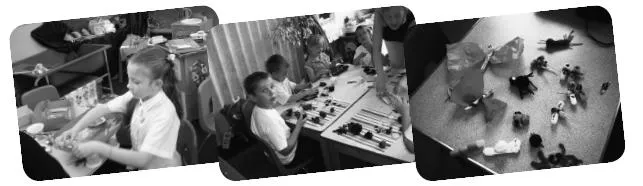
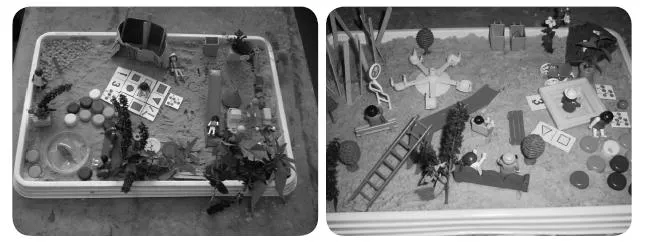
The photographs show the model playgrounds made by children in St. Gwladys Primary School, Caerphilly, who have used the TASC process to create their own environments.
Creating Our Environment
In-depth investigations
Schools are becoming increasingly aware of the amount of repetition of scientific facts and concepts throughout the Foundation Phase and Key Stages 1 and 2. This has prompted schools to plan the science investigative work as a continuum from the Foundation Phase through to the end of Key Stage 2 — not only cutting out unnecessary repetition, but importantly, creating time and space for sustained in-depth science investigations. Of course, this is not to suggest that children do not have to learn basic subject skills, research and recording skills and ICT skills — these skills are the basic skills that underpin all open-ended investigations and explorations at Primary level, and they equip learners with the necessary interest and skills to engage in rigorous investigations and explorations at Key Stages 3, 4 and 5. Ultimately we want learners who persevere, are independent and who are driven by curiosity about the world in which they live.
Differentiated learning
It is ideal and best practice that enables differentiated learning to become a reality in the classroom. Since the TASC Framework provides a structure for learners to work independently or in small groups, then learners can take the topic, investigation or research project into as ...