- 408 pages
- English
- ePUB (mobile friendly)
- Available on iOS & Android
eBook - ePub
About this book
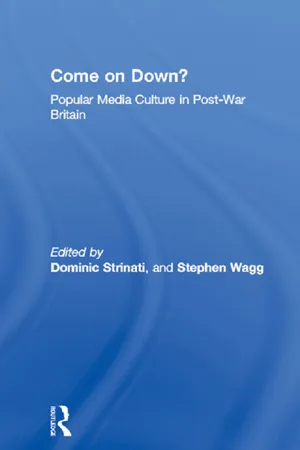
Come on Down represents an introduction to popular media culture in Britain since 1945. It discusses the ways in which popular culture can be studied, understood and appreciated, and covers its key analytical issues and some of its most important forms and processes. The contributors analyse some of popular culture's leading and most representative expressions such as TV soaps, quizzes and game shows, TV for children, media treatment of the monarchy, Pop Music, Comedy, Advertising, Consumerism and Americanization. The diversity of both subject matter and argument is the most distinctive feature of the collection, making it a much-needed and extremely accessible, interdisciplinary introduction to the study of popular media culture. The contributors, many of them leading figures in their respective areas of study, represent a number of different approaches which themselves reflect the diversity and promise of contemporary theoretical debates. Their studies encompass issues such as the economics of popular culture, its textual complexity and its interpretations by audiences, as well as concepts such as ideology, material culture and postmodernism.
Information
Chapter 1
Homeward bound
Leisure, popular culture and consumer capitalism
LEISURE, POPULAR CULTURE AND EVERYDAY LIFE
Just a few years after the global defeat of fascism many aspects of popular culture in Britain continued to exhibit major features of prewar British life. Everyday life in Britain remained class bound and gender specific, despite many dramatic changes set in motion during the war years, and prominent leisure activities of a collective and publicly experienced nature prospered. In the immediate post-war years many aspects of popular culture exuded a sense of stability and traditionalism; people engaged in established leisure activities and rituals in everyday life—the holiday outing, the night out at the dance hall—in ways that would have been instantly recognizable to their pre-war equivalents. Indeed, in the first years after the end of the war some established leisure activities achieved an all-time peak in their level of popularity.
In 1946, 1,635 million cinema admissions were recorded, a figure dwindling to 111 million by the end of the 1970s, on the eve of the home-video boom (Corrigan 1983:30). Attendances rose again during the late 1980s, ‘from fewer than one visit on average per adult in 1984, to 1.5 in 1989, when there were 88 million cinema visits in Britain’ (Hughes 1991:9). New multiplex cinemas, and a flexibility of usage of domestic television, encouraged such a growth. Attendances at top class professional soccer matches in the Football League had also peaked in the immediate post-war period: in the season 1946–7, the first after the war, attendances totalled 35.6 million. Two seasons later the attendance for the 1948–9 season was 41.2 million, a figure never reached again during the subsequent four decades of social and cultural change. The figure for the end of the 1950s was around 33 million; for 1969–70, 29.6 million; for 1979–80, 24.6 million; for 1984–5, 17.8 million; and by 1985–6, in the wake of the Bradford fire and the Heysel tragedy, the figure had slumped to an all-time low of 16.5 million (Mason 1989:165; and figures provided by the Football League). Although the end of the 1980s saw some encouraging trends upwards (with the figure for 1989–90 standing at 19.46 million (HMSO, Social Trends 21)) and the high profile World Cup Finals in Italy in summer 1990 further rekindled enthusiasm for the game, by any comparison with the immediate post-war figures such increases remain marginal. Although the number of clubs affiliated to county football associations increased fourfold between the late 1930s and the mid-1980s—from around 10,000 to more than 40,000 (Mason 1989:149)—the predominantly male public ritual of ‘going to the match’ was no longer the symbol that it had been of a community collectively at play.
By the 1980s, too, a key recurrent political theme had become intertwined with the fate of these two long-established cultural forms. Both became prominent targets for the law and order lobbies during the ascendancy of the New Right during the Thatcher years. Battle cries and rallying calls about the morality of the media and the safety of the streets indicated explicitly what has always been the case: that our everyday activities and popular cultural practices are not autonomous innocent worlds apart, but are constitutive of the social and political order. Just thinking about the movies and the football match, and their developemnt as cultural activities and leisure industries over the last forty years, directs us towards central questions about the nature of contemporary leisure and the conditions of its emergence. How does contemporary leisure represent new forms of consumption and ways of consuming? How has privatized consumerism affected forms of community life? To what extent is leisure a reflection of change, the index of change or a harbinger itself of important changes? If we are to move beyond mere descriptive histories and sociologies of the ‘how many, where and when?’ kind, these are the sorts of question that must be posed. The consideration of selected cases, informed by such questions and organized around key concepts, will provide the basis of an understanding of major influences upon popular culture in the post-war period.
One very important dichotomy becomes impossible to ignore: the public/private dimension. Much of contemporary leisure has inclined towards the expansion of ways of consuming in individualized and privatized forms in the home, and this has matched the rhetoric and ideology of the New Right/Thatcher years, as well as the marketing strategies of the new industrial barons of late twentieth-century Britain, the leisure retailers. In the cases which feature below (see pp. 21–5 and 25–41), the public/private dimensions of the consumption of sport and popular fiction are given some detailed consideration.
Everybody has a view on leisure and popular culture—on their ephemeral nature; or their inherent subjectivity; on their relevance to the realm of the personal; on their potential as expressions of freedom or individual choice; on their implicitly politicized and politicizing nature. Leisure is widely seen—both in the academic analysis and in the expressed views of people—as personal choice and freely chosen activity, and as a sign of widening freedoms. Defendants of liberal capitalism see modern industrial society as a world of golden opportunity for those willing to work, apply themselves and avail themselves of the goodies obtainable in the marketplace. While in previous phases of capitalism the class and status system was characterized by high degrees of rigidity, and conspicuous consumption was, to use Thorstein Veblen's term, the prerogative of the wealthiest classes and a handful of elite groups, modern consumer capitalism has enabled greater numbers to express themselves in the marketplace. In this context, as consumption becomes more and more targeted towards specialist segments of the market, people become encouraged to express their uniqueness and subjectivity as consumers. This, as much as the role that they might have as producers, becomes the source of their identity: consumer capitalism becomes in this sense enabling; people are seen as discriminating punters in the incessant commodity and credit stakes of the modern marketplace.
In the 1950s the combination of new techniques of mass production (of cars, fridges, washing machines, vacuum cleaners, for instance) with newly available forms of credit (hire purchase available at manageable rates of interest), produced an expanded consumer market. Social inhibitions were also breaking down, producing in Arthur Marwick's words ‘the relatively free-wheeling society of the late 1960s and early 1970s (which) differed markedly from the tight and excessively traditionalist society of the late 1940s’ (Marwick 1986:19). In the United Kingdom the Conservative Prime Minister Harold Macmillan captured the spirit of the times with his claim that people had ‘never had it so good’. Released from the austerity of the immediate post-war years, choosing between jobs available in the new and booming industries, encountering new types of domestic and leisure living, many at the time believed that here was the new Nirvana: full employment, lots of credit, affluence all round and a more open morality.
There was sufficient substance to these developments to constitute a real shift, a move into what Harry Braverman (1974) has called the phase of the emergence of the universal marketplace. Paradoxically, it is in this marketplace that the swing towards modes of individualized consuming intensifies; paradoxically because, as it penetrates more universally, everyday life becomes a more fully personalized construct. We are not talking here about a sudden and dramatic transformation from some idyllic collective culture to an individualized array of fragmented cultures: everyday life for some had for some time had been rooted in individualized modes rather than the collective. But the process certainly intensifies, and more and more aspects of everyday life become inextricably linked with new forms of commodity production which in turn generate new ways of consuming. Before looking at some major recent trends in popular culture and leisure, and then focusing upon two cases—the phenomenon of media sport, and images of femininity in post-war women's fiction—it is worth considering a little more fully the implications of this expansion of the universal marketplace.
THE UNIVERSAL MARKET
If there is any single idea that captures the essence of post-war developments in leisure and popular culture it is this notion of the universal market. Modern capitalism, for Braverman, revolves around a principle of monopoly, which extends the reach of the capitalist mode of production to the most private of spheres. All needs—‘the totality of individual, family and social needs’ (Braverman 1974:270)— become subordinated to the market. Such needs are actually reshaped ‘to serve the needs of capital’. Although the social framework itself— capitalism—is here endowed with a sense of determinacy which can no doubt be questioned (in other words, some might accuse Braverman of a rather simplistic form of economic reductionism), the central point is an extremely persuasive one. Consider how much of our everyday life is lived in newly privatized forms in the last decade of this second millennium. Where individuals may have talked to each other in family and community settings in previous eras, they now have the choice of consuming alone in well-equipped consumer playgrounds in their own part of the increasingly fragmented home. Where young children may have played football on the streets, they now watch edited highlights of elite matches starring sponsored superstars whose wages have put the price of a spot or a seat at a live match way out of reach of many potential fans. It is not a question of being evaluative, or nostalgic, about this; rather, it is a matter of cultivating an adequately historicized understanding of the contemporary, one which will help us identify key recent trends, and which will therefore in turn highlight what is specific about the state of things in the here and now. It seems almost old fashioned now, if you are waged, salaried and buffeted against deprivation or hardship, to do anything which costs nothing; our patterns of leisure and the contours of popular culture have been redrawn by what Braverman calls ‘one of the keys to all recent social history’.
This is the transformation by capitalism of ‘all of society into a gigantic marketplace’. The source of our individual status—what we become known for—is not what we do, or what we can make, ‘but simply the ability to purchase’. As modern urban society crams more and more people into less and less space, a central paradox of contemporary living emerges more and more clearly—the ‘atomization of social life’. In such circumstances, life away from dehumanizing work and fragmented family becomes a search for some sociability; in Braverman's view this ‘social artifice’ is now only available in its marketable forms:
Thus the population no longer relies upon social organization in the form of family, friends, neighbours, community, elders, children, but with few exceptions must go to market and only to market, not only for food, clothing and shelter, but also for recreation, amusement, security…the atrophy of community and the sharp division from the natural environment leaves a void when it comes to the ‘free’ hours. Thus the filling of the time away from the job also becomes dependent upon the market, which develops to an enormous degree those passive amusements, entertainments, and spectacles that suit the restricted circumstances of the city and are offered as substitutes for life itself. Since they become the means of filling all the hours of ‘free’ time, they flow profusely from corporate institutions which have transformed every means of entertainment and ‘sport’ into a production process for the enlargement of capital.
(Braverman 1974:276, 277–8)
The embodiment of this form of activity, for Braverman, is an event such as a car-smashing derby which can draw large holiday or spare-time crowds. Some of us might remember, in Britain, similar spectactles in the late 1960s and early 1970s when piano-smashing competitions were held, often in seaside towns on Bank Holiday weekends. Not quite defined as old enough then to have antique value, these pianos were smashed out of existence, a subconscious preparation perhaps for the burgeoning market in home-based leisure goods—the portable television, the ghettoblaster, the videocassette recorder, the personal stereo, the home-computer, the compact disc. All these resources were/are small, individualized, easily portable. The individual could now retreat more and more into privately defined worlds of consumption, where s/he could sample in peace the products of the booming consumer market. It is the central paradox of modern living that much of our subjectivity is constituted in response to the products of a mass market, whose products are often standardized objectively to cater for as large a public as possible. Braverman, admittedly coming close to a form of cultural elitism here, is scathing when talking of such products:
By their very profusion they cannot help but tend to a standard of mediocrity and vulgarity which debases popular taste, a result which is further guaranteed by the fact that the mass market has a powerful lowest-common-denominator effect because of the search for maximum profit. So enterprising is capital that even where the effort is made by one or another section of the population to find a way to nature, sport or art through personal activity and amateur or ‘underground’ innovation, these activities are rapidly incorporated into the market so far as is possible.
(Braverman 1974:279)
Written on the eve of the explosion of punk rock into the consciousness of western youth, with its impact upon the recording industry, this pinpoints the central question about any sphere of popular culture. If the universal market reaches so far into all of our lives—in the third phase of its creation producing ‘a “product cycle” which invents new products and services’ (281)—what is the possibility of cultural initiative, intervention, autonomy? As punk rock became staple fare on the racks of high street fashion stores, and alternative comedians become stars and celebrities in the mainstream media, it is clear that the momentum of the popular does in so many cases give way to the force of the dominant. This looks silly sometimes, in the anachronistic punk styles of country youth in small town market squares—but it is profitable, and that is what counts. Incorporation remains the fate of many cultural challenges and innovations; it would be naive, overidealistic and romantically foolish to deny this.
There is, of course, more to it than Braverman recognizes. The act of consuming can be evaluative, critical, dynamic. Paul Willis's corpus of work on symbolic creativity in schools, leisure and everyday life is eloquent testimony to the capacity of young people to make products their own, or to dispute the taken-for-granted authority of institutional values, and impose upon them their own meanings (Willis 1977; 1990a; 1990b). He argues, for instance, that there is an ‘unexpected life and promise of everyday grounded aesthetics in the ordinary life activities of young people’ which is ‘articulated…for the most part through the popular cultural products of the mainly commercial market’ (Willis 1990a:55). Ruth Finnegan, in a convincingly rigorous anthropological fashion, has demonstrated the deep-rootedness of cultural creativity in everyday life, in her study of music-making in the English new town of Milton Keynes in the early 1980s (Finnegan, 1989). And in the appropriate circumstances people are certainly attracted still to ‘help each other to pleasure’, in ‘communal leisure groups (which) can be considered as organized for...
Table of contents
- Cover
- Haft Title
- Full Title
- Copyright
- Dedication
- Contents
- Notes on contributors
- Introduction: Come on down?—popular culture today
- 1 Homeward Bound: Leisure, popular culture and consumer capitalism
- 2 The taste of America: Americanization and popular culture in Britain
- 3 The impossibility of Best: Enterprise meets domesticity in the practical women's magazines of the 1980s
- 4 From the East End to EastEnders: Representations of the working class, 1890–1990
- 5 British soaps in the 1980s
- 6 ‘One I made earlier’: Media, popular culture and the politics of childhood
- 7 The price is right but the moments are sticky: Television, quiz and game shows, and popular culture
- 8 Embedded persuasions: The fall and rise of integrated advertising
- 9 ‘You're nicked!’: Television police series and the fictional representation of law and order
- 10 You've never had it so silly: The politics of British satirical comedy from Beyond the Fringe to Spitting Image
- 11 A ‘divine gift to inspire’?: Popular cultural representation, nationhood and the British monarchy
- 12 Shock waves: The authoritative response to popular music
- 13 Digging for Britain: An excavation in seven parts
- Digging for Britain: An excavation in seven parts
- Index
Trusted by 375,005 students
Access to over 1.5 million titles for a fair monthly price.
Study more efficiently using our study tools.
Frequently asked questions
Yes, you can cancel anytime from the Subscription tab in your account settings on the Perlego website. Your subscription will stay active until the end of your current billing period. Learn how to cancel your subscription
No, books cannot be downloaded as external files, such as PDFs, for use outside of Perlego. However, you can download books within the Perlego app for offline reading on mobile or tablet. Learn how to download books offline
Perlego offers two plans: Essential and Complete
- Essential is ideal for learners and professionals who enjoy exploring a wide range of subjects. Access the Essential Library with 800,000+ trusted titles and best-sellers across business, personal growth, and the humanities. Includes unlimited reading time and Standard Read Aloud voice.
- Complete: Perfect for advanced learners and researchers needing full, unrestricted access. Unlock 1.5M+ books across hundreds of subjects, including academic and specialized titles. The Complete Plan also includes advanced features like Premium Read Aloud and Research Assistant.
We are an online textbook subscription service, where you can get access to an entire online library for less than the price of a single book per month. With over 1.5 million books across 990+ topics, we’ve got you covered! Learn about our mission
Look out for the read-aloud symbol on your next book to see if you can listen to it. The read-aloud tool reads text aloud for you, highlighting the text as it is being read. You can pause it, speed it up and slow it down. Learn more about Read Aloud
Yes! You can use the Perlego app on both iOS and Android devices to read anytime, anywhere — even offline. Perfect for commutes or when you’re on the go.
Please note we cannot support devices running on iOS 13 and Android 7 or earlier. Learn more about using the app
Please note we cannot support devices running on iOS 13 and Android 7 or earlier. Learn more about using the app
Yes, you can access Come on Down? by Dominic Strinati,Stephen Wagg in PDF and/or ePUB format, as well as other popular books in Social Sciences & Television History & Criticism. We have over 1.5 million books available in our catalogue for you to explore.