- 216 pages
- English
- ePUB (mobile friendly)
- Available on iOS & Android
eBook - ePub
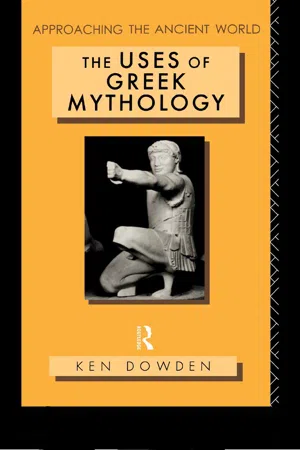
The Uses of Greek Mythology
About this book
In an innovative sequence of topics, Ken Dowden explores the uses Greeks made of myth and the uses to which we can put myth in recovering the richness of their culture. Most aspects of Greek life and history - including war, religion and sexuality - which are discernable through myth, as well as most modern approaches, are given a context in a book which is designed to be useful, accessible and stimulating.
Information
Part I
Attitudesto myth
Chapter 1
Myth and mythology
1.1 WHAT IS MYTH?
It says here: ‘Peppino is a myth in the world of Italian song’. He looks
real enough to me. Perhaps they meant a ‘legend’.
(Terry Wogan, commentator on the 1991 Eurovision Song Contest)
real enough to me. Perhaps they meant a ‘legend’.
(Terry Wogan, commentator on the 1991 Eurovision Song Contest)
A lie?
If it’s a myth, it’s untrue. That is what we mean today – or part of what we mean. But a myth is also enticing: it lures not just a stray, mistaken individual, but whole groups and societies into believing it. Perhaps superior courage or skill was the key to the defeat of the Luftwaffe by the Royal Air Force in the Battle of Britain. Or is that just the myth of Britain’s ‘most glorious hour’? Was it in fact more about intelligence derived from the breaking of enemy codes (the ‘Ultra’ intelligence – Cave Brown 1976:36–38). If so, the ‘myth’ brought great satisfaction to the (undeniably courageous) participants in the battle, to a nation on the brink of defeat, and to the post-war nation adjusting to a reduced position in the world. Few would welcome the rejection of this myth, if myth it is.
This is the paradox of myths. They are not factually exact: they are false, not wholly true, or not true in that form. But they have a power which transcends their inaccuracy, even depends on it. I do not think this is just a fact about modern use of the word ‘myth’. It lies at the heart of all myths and in particular of ancient myths: myths are believed, but not in the same way that history is. Those who, let us say, ‘subscribe to’ a myth may well express their acceptance of it by asserting its ‘truth’. Certainly they will not wish to call it ‘false’. A Christian who denies that the virgin birth actually happened will not say that it is ‘false’, but rather that it has some valuable meaning, that it has its own ‘truth’. As we follow myth in Greek history, we should be sensitive to the variable meaning of ‘truth’. Language is an approximate tool.
A Greek word
‘Myth’ goes back to the Greek word mythos. Like any other word, its meaning has shifted over the centuries. Back in the days of Homer, at the beginning of Greek literature (c. 725 BC), a mythos was not necessarily false. Here is a servant replying to Hektor’s question about the whereabouts of his wife Andromache: ‘To him then the trusty stewardess spoke her mythos in return: “Hektor, since you really tell me to mytheisthai the truth” ’ (Homer, Iliad 6.381–2). The woman proceeds to give an account, as asked – this is her mythos, a worked out string of ideas expressed in sentences. I suppose it amounts to a ‘speech’ here. So, in Iliad 9, when the delegation has tried to recall Achilles to the battle and he has given devastating expression to his rejection of the request, the three envoys sit silent, ‘in wonderment at his mythos’ (9.431). Only after some time does aged Phoinix reply, referring to Achilles’ father’s instructions that he, Phoinix, should teach Achilles to be effective in war and in assembly, ‘to be a speaker of mythoi and a doer of deeds’ (9.443). These are the twin competences of the Homeric hero: to kill efficiently and to persuade through impressive mythoi.
The earliest Greek literature had been in verse. Prose only arrived in the mid-6th century BC and was part of the deeper penetration of writing into what was still very much an oral culture. Logos, the noun corresponding to the verb legein (‘I speak’), was the word chosen to describe prose. It covered both the verbal expression (‘speech’) and the enhanced possibilities inherent in committing prose to writing (‘rational account’, ‘discourse’). Early writers frequently refer to their book as a logos, including our first historian: ‘I must tell [legein] what people tell, but I am not at all obliged to believe it – and this principle can be taken as applying to my whole logos’. (Herodotos, 7.152.3). Indeed, Thucydides refers to all early historians as logographoi (‘logos-writers’, 1.21), a term which has passed into modern handbooks on these ‘logographers’.
This development of the word logos to cover extended utterances, pushed back the frontiers of the mythos. Though fifth-century tragedians, in their archaic way, might preserve something of its original application, by now mythos was usually applied to fiction – the sort of material associated with the early verse writers. The predominant contrast is no longer between mythoi and battle-action, but between mythoi and logoi, a word now close to the heart of the new enlightenment. Thucydides, implicitly distinguishing himself from his predecessor Herodotos, asserts the scientific value of his work at the cost of lessening its entertainment value: it does not appeal to to mythodes (‘the mythos-quality’). A mythos may have retained its sense of a developed utterance, a whole narrative, but it has become a mere ‘story’, a ‘tale’ (Burkert 1985:312 with 466 n.4).
This was the crucial development in the history of the word. Since then, it has changed less: it has always been able to apply to the inherited stock of Greek traditional stories (‘Greek myths’). This view of mythos is, for instance, passed on in the mid-80s BC by a Latin rhetorical author: ‘fabula [“story”, Latin for mythos] is defined as including matters which are neither true nor probable, for instance those handed down in the tragedies’ (Anon. (‘Cicero’), Rhetorica ad Herennium 1.13). Changes in its meaning since antiquity have only reflected our changes in attitude to that stock of stories – and all stories which are told and enjoyed in spite of the fact that they are ‘false’.
‘Myth’, ‘history’ and other terms
History is what myth isn’t. What history tells is true or else it would not be history, only failed history. What myth tells is in some way false or else it would be history. Yet within mythology there are gradations of credibility. To take an example: there is a myth that Athene was born from Zeus’ head. It is wholly false: Zeus never existed, neither did Athene, and no one has ever been born from anyone else’s head. On the other hand, many believe that history underlies the myth of Agamemnon’s expedition against Troy (though see chapter 4.3). On that view the ‘Trojan War’ is partly historical, if not in the form we have it (if Homer’s Iliad were literally true, it would be an historical record and not a version of myth). To many writers it is important if there is an historical dimension, and they like to reflect this in their choice of terminology, distinguishing between various types of traditional story: saga and legend, on the one hand, and myth and folk-tale on the other. Broadly, these terms have the following implications:
Saga, is applied to myths supposed to have a basis in history. So, for instance, Rose (1928:13) thought that ‘The Homeric account of the Trojan War is one of the best possible examples.’ ‘Saga’ is an Icelandic term and was originally applied to supposedly true histories of families/clans or of kings. Perhaps it is best restricted to myths which tell the history of a family.
Legend: originally traditional stories about saints that were ‘worth reading’ (Latin:
legenda). As stories about saints rarely have much historical value, the term is applied to any myth with only a kernel of truth or historicity.
legenda). As stories about saints rarely have much historical value, the term is applied to any myth with only a kernel of truth or historicity.
Folk-tale: this term was invented during the early nineteenth century (like ‘folklore’ and ‘folk-song’), to serve as a translation of the German word Märchen. This was when scholars such as Jacob and Wilhelm Grimm (1785–1863, 1786–1859) imagined, and persuaded their readers, that they were collecting traditional tales which ordinary folk used as a sort of moralising entertainment. Some think their motifs derive from long lost myths (as the Brothers Grimm did).1 Others think that all nations have always had folk-tales for their entertainment. In any case, European literary sources have been found for some of these supposedly oral tales.
In content the tales of the Brothers Grimm are not always easy to distinguish from what people class in other societies as myths. Maybe they tend to contain types rather than individuals. Bettelheim (1976:39–41) accounts for this psychoanalytically by distinguishing the roles of myth and folk-tale: folk-tales are about everyman, ‘facilitating projections and identifications’ and resolving anxieties, whereas myths ‘offer excellent images for the development of the superego’. You may believe this if you like, but folk-tales can be just as vague about locations. Perhaps, too, there is some delight in the magical and rather an obsession with princely courts – as one might expect from that period in German history. But in any case the unthinking application of the term ‘folk-tale’ to the oral traditions of other nations has obscured the difference (if there is one) between myth and folk-tale and trivialised those traditions. Merely to register a tradition as folk-tale too easily evades their specific social and historical context and leaves only their motifs to be classified. We will be looking at analysis of heromyths by motif in chapter 8.3.
Fairy story is often used as a variant for ‘folk-tale’, but is rather useless for Greek culture (low on fairies). Interestingly, however, when used in a derogatory sense, it captures something of the contempt which Greek thinkers could occasionally feel for ‘myth’.
Myth is often reserved for tales which do not fall into the above categories, which perhaps have a clear involvement of gods or a clear religious or philosophical purpose.2
I have tried to be less discriminatory. It seems to me that attempts to distinguish between these terms have failed and that it is best simply to allow all Greek non-historical narratives to be ‘myths’. Otherwise we will suffer from terminological difficulties of our own invention and prejudge the nature of each of these narratives, with its own identity and its own history. However, I should mention that there is a school of thought which recognises a regular pattern of ‘degeneration’ of myth:
stage 1: the myth is associated with religious ritual and that is its function;
stage 2: the myth has become ‘history’;
stage 3: the ‘history’ has turned into folklore;
stage 4: the folklore is turned to literary purposes.3
There are some problems of detail in the application of this scheme to Greek mythology: it is not clear (and most scholars will refuse to believe) that all myths began as partners for ritual. In classical Greece, as we shall see, the myth has indeed largely turned to history, but it also has something of the entertainment value of folklore about it and most certainly the literary artists are busy with it. Nevertheless, the reader may find this a useful pattern to hold against the shifting role of Greek mythology from prehistoric to Roman and modern times.
1.2 GREEK MYTHOLOGY
Greek Mythology, a total system
It is one thing to decide what will count as Greek myths, another to know what ‘Greek Mythology’ is. ‘It is a matter above all of written material, of texts’ (Brelich 1977:6). There is no doubt that we access Greek Mythology above all through texts and that even in ancient times texts, read or performed, were instrumental in forming the Greeks’ own sense of mythology. But texts were not the only medium for mythology (unless you have a very broad definition of ‘text’).4 Myths may be told orally, without reproducing a particular author’s account – it is simply ‘how the story goes’. Art too displayed myths and in both senses offered a view of them. We think of the surviving remnants of sculpture and vase-painting, but of course there were wall-paintings too—now lost but for their reflection in the humbler art of vase-painting. All of these are media through which Greek Mythology was presented and, by being presented, reinterpreted.
In fact Greek Mythology is a shared fund of motifs and ideas ordered into a shared repertoire of stories. These stories link with, compare and contrast with, and are understood in the light of, other stories in the system. Greek Mythology is an ‘intertext’, because it is constituted by all the representations of myths ever experienced by its audience and because every new representation gains its sense from how it is positioned in relation to this totality of previous presentations. In this book I will use the term Greek Mythology, with capital letters, to denote this (evolving) total system.
Today handbooks play a special part in communicating Greek Mythology. It is their job, sometimes alphabetically, more often chronologically, to lay out before us a tapestry of Greek myths. At the beginning: the origin of the gods (and the world). At the end: the aftermath of the Trojan War. We need collections of stories to help us know them. The Greeks, however, were brought up on their mythology and it is only relatively late that we find a collected Greek Mythology. The first surviving collection, and the best, dates from the first century AD. It is by an ‘Apollodoros’ (so the manuscripts claim, perhaps thinking wrongly of the scholar Apollodoros of Athens), and is headed The Library, to mark its comprehensiveness. The end is missing, but we also possess an abridgement, the Epitome, which is complete. Apollodoros is of great importance to us, and as he is the most useful single source for Greek Mythology I have inclu...
Table of contents
- COVER PAGE
- TITLE PAGE
- COPYRIGHT PAGE
- PREFACE
- ABBREVIATIONS
- PART I: ATTITUDES TO MYTH
- PART II: MYTH AND THE PAST
- PART III: MYTH AND RELIGION
- PART IV: THE WORLD OF MYTH
- CONCLUSION: WHAT GREEK MYTH IS
- NOTES
- TOPIC BIBLIOGRAPHY
- GENERAL BIBLIOGRAPHY
Trusted by 375,005 students
Access to over 1.5 million titles for a fair monthly price.
Study more efficiently using our study tools.
Frequently asked questions
Yes, you can cancel anytime from the Subscription tab in your account settings on the Perlego website. Your subscription will stay active until the end of your current billing period. Learn how to cancel your subscription
No, books cannot be downloaded as external files, such as PDFs, for use outside of Perlego. However, you can download books within the Perlego app for offline reading on mobile or tablet. Learn how to download books offline
Perlego offers two plans: Essential and Complete
- Essential is ideal for learners and professionals who enjoy exploring a wide range of subjects. Access the Essential Library with 800,000+ trusted titles and best-sellers across business, personal growth, and the humanities. Includes unlimited reading time and Standard Read Aloud voice.
- Complete: Perfect for advanced learners and researchers needing full, unrestricted access. Unlock 1.5M+ books across hundreds of subjects, including academic and specialized titles. The Complete Plan also includes advanced features like Premium Read Aloud and Research Assistant.
We are an online textbook subscription service, where you can get access to an entire online library for less than the price of a single book per month. With over 1.5 million books across 990+ topics, we’ve got you covered! Learn about our mission
Look out for the read-aloud symbol on your next book to see if you can listen to it. The read-aloud tool reads text aloud for you, highlighting the text as it is being read. You can pause it, speed it up and slow it down. Learn more about Read Aloud
Yes! You can use the Perlego app on both iOS and Android devices to read anytime, anywhere — even offline. Perfect for commutes or when you’re on the go.
Please note we cannot support devices running on iOS 13 and Android 7 or earlier. Learn more about using the app
Please note we cannot support devices running on iOS 13 and Android 7 or earlier. Learn more about using the app
Yes, you can access The Uses of Greek Mythology by Ken Dowden in PDF and/or ePUB format, as well as other popular books in Social Sciences & Ancient History. We have over 1.5 million books available in our catalogue for you to explore.