Learning Through Storytelling in Higher Education explores ways of using storytelling as a teaching and learning tool. When storytelling is formalized in meaningful ways, it can capture everyday examples of practice and turn them into an opportunity to learn - encouraging both reflection, a deeper understanding of a topic and stimulating critical thinking skills. The technique can accommodate diverse cultural, emotional and experiential incidents, and may be used in many different contexts eg formal/informal; one-on-one/group setting.
The authors outline the different models of storytelling and explain how to make use of this technique and encourage a 'storytelling culture' within the workplace or in tutorial sessions.
Academic yet accessible, this book provides a new perspective on learning techniques and will be a great asset to any educator looking to improve reflective practice.
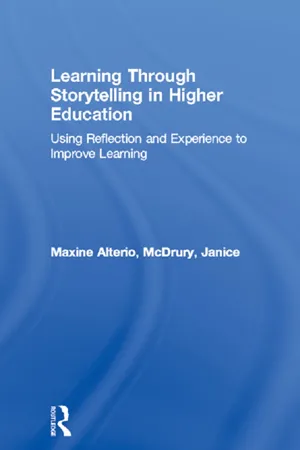
eBook - ePub
Learning Through Storytelling in Higher Education
Using Reflection and Experience to Improve Learning
- 200 pages
- English
- ePUB (mobile friendly)
- Available on iOS & Android
eBook - ePub
Learning Through Storytelling in Higher Education
Using Reflection and Experience to Improve Learning
About this book
Trusted by 375,005 students
Access to over 1.5 million titles for a fair monthly price.
Study more efficiently using our study tools.
Information
Topic
EducationSubtopic
Education General| 1 | Introduction |
There are possibly as many ways of beginning books as there are of starting stories. While storytelling can occur spontaneously, the techniques some writers use to draw readers into text parallel the ways many storytellers engage listeners in the oral process. Words are chosen and arranged on the page or presented verbally in an attempt to capture the attention of a particular group of readers or listeners. How effectively writers and story-tellers manage this endeavour is dependent on many factors, one being the ability to translate knowledge, experience and intuition into words and images that appeal to the intended audience. Ideally each significant word, or cluster of words, serves two purposes: first, it contributes to the meaning of what is being conveyed, and second, it moves the text or story forward in ways that engage the audience. Providing adequate contextual information is another useful technique because it helps readers or listeners connect with aspects that are meaningful to them
The context for this book is higher education and our primary intention is to suggest ways in which storytelling can be used effectively as a learning tool. For this purpose we draw on our experiences as researchers, lecturers and students, and as individuals who have been interested in, and surrounded by, stories from an early age. Throughout our adult years we have enjoyed numerous conversations with friends and colleagues about how storytelling impacts on our personal and professional lives. In recent years we have worked with stories in formalised ways to enhance student learning. During this period we have talked with and gathered feedback from students and colleagues who have used our storytelling processes. These interactions and subsequent feedback helped shape our thinking as we prepared to embark on the writing of this book. Learning Through Storytelling is the result of many such interactions, including the happy coincidence of our own professional journeys coming together in the same place, at the right time.
OUR RATIONALE
Our intention is to link the art of storytelling with reflective learning processes and to demonstrate how educators might use the ideas, strategies and processes we present to prepare students better for the rigours and uncertainties inherent in professional practice. We are convinced that storytelling has enabled us to learn from experience throughout our lives and we have discovered that it can also be used in meaningful, enjoyable and creative ways to facilitate learning in higher education settings.
The more we used storytelling with students the more we realised its application to lifelong learning. Around the same time we also began to pay attention to informal stories. We noticed what stories were told where, what responses were given in particular settings and how the way stories were told influenced the outcomes they achieved. Our enthusiasm to learn more about the nature of storytelling and, in particular, how to use it formally in higher education contexts led us on a journey of inquiry. We examined storytelling characteristics in more detail, developed a storytelling pathway model, and designed, then used, three formalised processes with research participants, undergraduate and postgraduate students and interested colleagues. We presented our findings at conferences, published papers and ran workshops on storytelling. This led to the development and implementation of the five-stage learning-through-storytelling approach we describe in this text. As we formulated our concepts, strategies and processes, we learned about storytelling along with our students and colleagues and we are eternally grateful for their enthusiastic participation.
Our thinking about storytelling took another significant leap when we embarked on this book. We therefore welcome the opportunity to place our ideas about storytelling in a public arena for others to adapt and develop further. Still passionate about the way we relate to, work with and learn from stories, we offer this book as a resource to anyone interested in using storytelling as a learning tool.
OUR STORIES
During the writing of this book we became increasingly aware of the many influences that had contributed to our interest in storytelling. Our families and the way they told or did not tell stories, how we had viewed reading and writing-related activities during childhood, our school experiences, why we chose particular careers and most importantly what place stories had and still have in our lives. In keeping with our theme we now share these influences in story form.
Janice
Sharing of experience through stories was an important part of my early life. The wonder and joy of hearing adventures set in other places and times alerted me to different worlds, different realities. My parents shared snippets of the joys and sorrows that impacted on their childhood in the country. The simple pleasures and ability to create times of relaxation contrasted with the harsh reality of the depression years, limited resources and ailing parents. While most of these stories were contained within the realm of day-to-day activities, there were also the significant events over time where themes and characters were more constant. Dad's experience of being employed by the Ministry of Works to put power lines across the Southern Alps and Mum's experience during the war years became epic adventures.
However, there were also stories that were not told that had a significant impact on my life. In particular, Dad's war stories. His life was, in many ways, shaped by the years in places such as Egypt, Rome and Palestine. Yet he talked little of death and destruction, or of the illnesses he contracted that remained with him throughout life, and only occasionally did he recount humorous events that gave me brief insight into the harshness of his reality.
For me, stories occurred primarily in the oral tradition, through listening and telling. Stories were shared by people who had experienced them first or second-hand and were willing to share the events, the feelings and the outcomes. Most important to me was being able to talk with tellers, to seek clarification, elaboration or expansion. In this way I had opportunities to somehow become part of these stories and gain understanding and insight.
Written stories had little appeal. I struggled to learn to read and had limited interest in the banal school texts I was capable of reading. However, I was happy to have stories read to me as I could then talk about them, wonder what else could have happened or discuss alternative approaches. Stories were a beginning point for dialogue. Predictably the demand during school years for me to write stories held little relevance. I had no academic concept of developing a theme, uncovering a plot, creating suspension or discovering resolution. Most of my school essays were jointly written with my mother, with her attempting to create and extract a story, and me being happy just to write down whatever words were necessary! It wasn't until doing a stage two education paper at Massey University as a mature student that I discovered there were different learning styles. This insight unlocked my ability to write.
So, with little interest in written stories but a strong oral tradition, I entered nursing. I found an immediate match with many other students. Nursing has a strong oral tradition and storytelling became our key debriefing tool. The hours spent sharing the joys, sorrows, embarrassing moments and funny situations enabled us to make sense of our world and also discover how colleagues were dealing with their realities. The nurses' home provided a wonderful storytelling space. There were always tellers and listeners—all hours of the day and night.
Storytelling remained with me over my years of nursing and was carried into the teaching/learning environment in a very natural and spontaneous way. I used stories as a means of sharing experience, enabling others to view the nursing reality, and demonstrating ways of being with patients and their families in their moments of sadness and joy.
Once I embarked on my PhD journey, storytelling began to take on new meaning. I was interested in learning from experience, especially reflective experience. I was challenged to develop tools to enhance reflection, and storytelling seemed obvious as it was the means nurses used spontaneously. I listened to stories that were shared over coffee and lunch breaks. I dialogued on stories from practice with students and colleagues. Gradually I began to wonder about when, where, how and why stories were told. I was also interested in the type of stories told and what outcomes they could achieve. My thinking on storytelling is informed by these experiences and forms the basis of what I share in this book.
Maxine
I have always derived pleasure from, and been challenged by, the power of reflection and, in particular, the forms of reflection associated with reading fiction, engaging in creative writing activities and sharing stories. Encouraged as a child to value ‘daydreaming’ as a worthwhile form of thinking, I created fantasy worlds that stimulated and stretched my imagination. These worlds were often played out in daring and enter-taining ways. Attempting to fly from a henhouse roof, walking a tightrope strung between a shed and garage, and riding a one-wheel bicycle as part of a circus act started as imagined possibilities and ended as thoughtfully choreographed physical adventures.
Active participation in my father's creative interpretations of well-known stories was also very much part of my childhood. He acted out stories such as ‘The Three Billy Goats Gruff’ by becoming the troll and hiding under the kitchen table while encouraging me to run across it saying ‘No, no, don't eat me, wait for my little sisters, they're much juicier’. Original stories were also part of my parents' repertoire. Imaginary characters such as Hairy Fairy accompanied me through childhood and helped nourish my interest in storytelling.
Once I was able to read I devoured books, transporting my mind to countries I had not known existed and to lifestyles that intrigued and mystified me. I became interested in why characters behaved in certain ways, frequently asking myself how I would have acted if placed in the same situation. Immersed in the lives of fictional characters, I shared their adventures and became familiar with the landscapes in which their stories unfolded. At this stage I was convinced that books could provide everything I wanted to know.
Writing my own stories was a natural progression. I wrote scripts for plays, circuses and puppet shows, a consuming and enjoyable activity that helped me survive many long Southland winters. These stories were rarely edited. My focus was on content, not style, grammatical details or spelling.
Attending school seemed like an intrusion because it interrupted my writing and reading life. I considered school regimented, boring and rule-bound. For a while I believed that teachers were harming my brain by requiring me to do mathematics, reading or spelling at certain times. Forty-minute periods for these subjects did not sit well with my natural ‘learn what you want when you want’ approach. I felt compelled to suppress my creative spirit. By the time I reached secondary level I viewed school-based learning as something that had to be endured for legal reasons.
I was in my late twenties, and the mother of three small children, before I considered formal education might have something to offer. With the encouragement of my brother I enrolled in a University Entrance English class at the local polytechnic, where I would later teach for seven years. I loved this class. What made the difference? The time was right for me and I had a teacher who was student-centred. The following year I did Bursary English through the Correspondence School and a year later enrolled in Stage One Education at Massey University.
I was an ideal extramural student, being motivated, able to set my own goals and happy to learn when and how I wanted. I took papers in education, psychology, linguistics and English, eventually completing my undergraduate degree as a part-time student at the University of Otago. A Diploma of Teaching (Tertiary) and a Master of Arts (by thesis only) followed. To fulfil my thesis requirements I explored how practitioners from four professions used journalling and storytelling as tools of reflection, analysis, self-evaluation and as ways of initiating and supporting change to professional practice. Once again my three childhood loves, writing and reading and storytelling, were integral to my life although I did not fully appreciate how this came about until I was thoroughly immersed in my research project.
Prior to and during my research, I was also reading and thinking about reflection. The concept made complete sense to me and provided me with a framework for my teaching practice. By this stage I was employed as a staff development coordinator, having held various roles in the higher education sector.
My interest in exploring storytelling as a professional development tool continued to grow. I began presenting my ideas at conferences and facilitating workshops locally, nationally and internationally. In my personal life, I continued to read widely and write short stories, poems and fragments of novels. Several short stories have been broadcast on radio. Others have been published in literary journals in New Zealand and the United Kingdom. A few have won or been shortlisted for prizes.
Finally, my professional life and my personal interests have intersected. Reading, writing, listening to, telling and working with stories is, for me, integral to the learning proeess. It is from this perspective that I offer some ideas, activities and processes for educators to consider when encouraging students to learn through storytelling.
BOOK OUTLINE
So far in this chapter we have introduced the idea of learning through storytelling, given our rationale for writing the book and described how our interest in the topic came from a range of influences and experiences. In the following two chapters we review the literature which has informed our storytelling approach. In Chapter 2 we focus on reflection and learning while in Chapter 3 we provide an overview of the storytelling literature. In Chapter 4 we position our storytelling approach within a constructivist paradigm, introduce a Reflective Learning through Storytelling Model, present the concept of formalised storytelling through our Pathways Model (McDrury and Alterio, 2001) and describe the interrelationships between storytelling processes and cathartic/reflective learning outcomes.
To demonstrate how students can use stories to bring about constructive learning, we offer a five-stage approach, beginning in Chapter 5 where we suggest how a storytelling culture can be created by introducing students to a range of activities to assist in story finding, the first stage in our model. In Chapter 6, the story telling stage, we outline one way to move students from listening to stories, to telling them, to writing exemplars based on practice experiences. Chapter 7 describes how to introduce students to several theories of reflection for the purpose of managing the third stage of our model, story expanding. In this chapter we also provide an exercise to assist students with meta-analysis of stories and reflection. We develop our ideas about formalised storytelling and introduce the stage of story processing in Chapter 8 with accounts of how focused reflective dialogue, on and around practice stories, can lead to significant learning. We describe how students can share their stories using a formalised storytelling process. Stories emerging from spontaneous drawing activities are also explored as are reflective processes used to bring about change. In Chapter 9 our focus is on story reconstructing, the fifth stage in our Reflective Learning through Storytelling Model. At this stage a group storytelling process, used to gain multiple perspectives on practice events, is outlined.
The purpose of Chapter 5 to Chapter 9 is to provide students with a storytelling approach that gradually moves them through levels of reflective learning. We also provide educators with templates to assist in this process. Our intention is to demonstrate how storytelling can be used as a learning tool at different levels, in different ways, for different purposes.
In Chapter 10, we consider assessment and ethical issues. In this challenging c...
Table of contents
- Cover
- Full Title
- Copyright
- Contents
- Providing a rich
- Foreword
- Preface
- Acknowledgements
- Dedication
- 1 Introduction
- 2 Storytelling Influences
- 3 Storytelling Developments
- 4 Storytelling as a Theory of Learning
- 5 Finding Stories
- 6 Telling Stories about Practice
- 7 Expanding Stories through Reflection
- 8 Processing Practice Stories
- 9 Reconstructing Stories within a Group Setting
- 10 Ethical and Assessment Considerations
- 11 Reflections
- References
- Name Index
- Subject Index
- Biographical Notes
Frequently asked questions
Yes, you can cancel anytime from the Subscription tab in your account settings on the Perlego website. Your subscription will stay active until the end of your current billing period. Learn how to cancel your subscription
No, books cannot be downloaded as external files, such as PDFs, for use outside of Perlego. However, you can download books within the Perlego app for offline reading on mobile or tablet. Learn how to download books offline
Perlego offers two plans: Essential and Complete
- Essential is ideal for learners and professionals who enjoy exploring a wide range of subjects. Access the Essential Library with 800,000+ trusted titles and best-sellers across business, personal growth, and the humanities. Includes unlimited reading time and Standard Read Aloud voice.
- Complete: Perfect for advanced learners and researchers needing full, unrestricted access. Unlock 1.5M+ books across hundreds of subjects, including academic and specialized titles. The Complete Plan also includes advanced features like Premium Read Aloud and Research Assistant.
We are an online textbook subscription service, where you can get access to an entire online library for less than the price of a single book per month. With over 1.5 million books across 990+ topics, we’ve got you covered! Learn about our mission
Look out for the read-aloud symbol on your next book to see if you can listen to it. The read-aloud tool reads text aloud for you, highlighting the text as it is being read. You can pause it, speed it up and slow it down. Learn more about Read Aloud
Yes! You can use the Perlego app on both iOS and Android devices to read anytime, anywhere — even offline. Perfect for commutes or when you’re on the go.
Please note we cannot support devices running on iOS 13 and Android 7 or earlier. Learn more about using the app
Please note we cannot support devices running on iOS 13 and Android 7 or earlier. Learn more about using the app
Yes, you can access Learning Through Storytelling in Higher Education by Maxine Alterio,Janice McDrury in PDF and/or ePUB format, as well as other popular books in Education & Education General. We have over 1.5 million books available in our catalogue for you to explore.