eBook - ePub
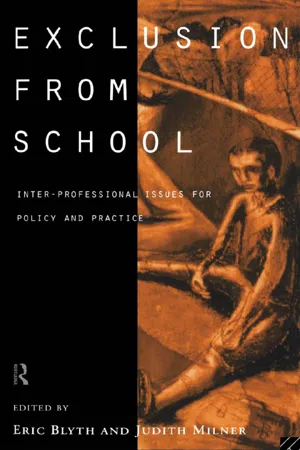
Exclusion From School
Multi-Professional Approaches to Policy and Practice
- 312 pages
- English
- ePUB (mobile friendly)
- Available on iOS & Android
eBook - ePub
About this book
The number of pupils excluded from school has risen sharply over the past few years. To a great extent, this can be directly attributed to the increased competition between schools, following the introduction of the 1988 Education Reform Act. Many schools are concerned that children with behavioural problems will damage the image of the school and so can be reluctant to admit these pupils to the classroom. However, little has been done to follow up what happens to these pupils once they have been excluded from school, or to examine ways in which their exclusion might be prevented.
This collection, written from a range of professional perspectives, examines current trends in exclusion, including the consequences of exclusion. It also gives practical guidance on preventative strategies, based on real life experiences and examines how professionals such as teachers, social workers and other support agencies can work together to help to avoid exclusion.
Information
Topic
DidatticaSubtopic
Didattica generalePart I
Trends and theoretical overview
Chapter 1
Exclusions
Trends and issues
Eric Blyth and Judith Milner
INTRODUCTION
Exclusion is the means by which the headteacher of a school can prevent a child or young person from attending the school, either for a fixed period (not exceeding fifteen days in any single school term) or permanently. It is, therefore, school driven. It does not refer to a child or young person absenting him or herself from school, for example by truancy, although the school can achieve this outcome by excluding a truant.
Despite agreed concern about exclusion from school—from the government, the teaching profession, parents and the media— accurate comprehensive national data concerning exclusion have not been readily available. The Department for Education (DfE) itself undertook a study of permanent exclusions from state schools for the academic years 1990–1 and 1991–2 (DfE, 1992a, 1993), reporting a rise of approximately 32 per cent (from 2,910 to 3,833) over this period, although on the basis of the first year’s data alone the Department had claimed that ‘too many’ children are excluded for ‘too long’ (DfE, 1992a, p. 1). In addition the study revealed that certain groups of children and young people were at greater risk of exclusion than others; that variation in exclusion rates between schools could not simply be explained by differences in intake or the socio-economic characteristics of catchment areas; that existing procedures for the management of exclusions (including legal obligations) were not always adhered to, and that alternative educational provision made for many excluded pupils was subject to ‘unacceptable variations in both quality and quantity’ (DfE, 1992a, p. 1).
These findings are broadly supported by contemporaneous surveys conducted by two professional teaching associations, the Secondary Heads Association (SHA, 1992) and the National Union of Teachers (NUT, 1992). The latter’s conclusion that official figures underestimate the actual number of excluded pupils have received further strong support. For example, a poll of Local Education Authorities undertaken on behalf of the BBC suggested that approximately 66,000 exclusions (of all types) take place annually (BBC, 1993). Extrapolating from the results of the first Office for Standards in Education (OFSTED) inspections, involving 428 English secondary schools, Preston (1994a) suggests that, in 1992–3, the number of permanent exclusions could have doubled from the previous year. However, it needs to be recognised that these particular inspections included those of schools about which the government had particular concerns and are not, therefore, necessarily a representative sample.
Researchers involved in smaller-scale studies have identified various strategies which help to mask the true prevalence of exclusion. Stirling (1992a, and in this volume) provides evidence of the phenomenon of ‘informal’, ‘unofficial’ exclusions although, since these may never be recorded and may never be notified to the Local Education Authority (LEA), the prevalence of such practices remains difficult to quantify, and may sometimes be portrayed as child and parent-friendly strategies. An illustrative example concerns a child who was ‘excluded’ from school for several days following misbehaviour in school. However, in a letter to the parents the point was made that the school was not making the exclusion ‘official’ in light of the child’s previous good behaviour and the parents’ previous cooperation. Further evidence of the existence of ‘informal’ exclusion is confirmed by the observation of the Secondary Heads Association that problems may be ‘resolved’—and the stigma of exclusion avoided—by parents agreeing to withdraw the pupil and trying to place him or her in another school (SHA, 1992). Cohen and Hughes (1994) also note the practice of unofficial ‘internal’ exclusions where the pupil remains on the school premises but is prevented from participating in routine school activities with his or her peers.
Given the sensitive nature of exclusion from school, it is important, therefore, neither to underestimate nor overestimate its prevalence and impact. It remains true that the vast majority of school-age children and young people will not be subject to exclusion from school. Nevertheless, certain groups are at considerably greater risk of exclusion than others, and the educational, social and emotional implications for those who are excluded can be considerable.
PUPILS ‘AT RISK’ OF EXCLUSION
The research evidence indicates that those who are at disproportionate risk of exclusion are: secondary school-age pupils, boys (especially African-Caribbean boys); pupils with special educational needs; and children and young people in local authority care.
There is limited detailed national data concerning the age distribution of excluded pupils, although most attention has been given to pupils at secondary school. In the DfE study (DfE, 1992a, 1993) 87 per cent of permanently excluded pupils were of secondary school age in 1990–1 and 86 per cent in 1991–2. Nevertheless the rising numbers of exclusions from primary schools—described in some areas as ‘dramatic’ and ‘notable’—is giving cause for concern (OFSTED, 1993b; see also Parsons and Hayden in this volume).
There is a notable discrepancy between the numbers of boys and girls excluded from school. In national studies boys are between four and five times more likely than girls to be excluded (DfE, 1992a, 1993; SHA, 1992), although Parsons et al. (1995) note that the gender difference is even greater at primary school age—12:1 in 1993–4 and 21:1 during the autumn term 1994. When gender and ethnicity factors are considered together, however, it is evident that African-Caribbean boys are most at risk of exclusion, although the overall picture is incomplete because not all LEAs record the ethnic background of excluded pupils (Cohen and Hughes, 1994; CRE, 1985; DfE, 1993; Mayet, 1992; Nottinghamshire County Council, 1991; NUT, 1992). In the DfE study, African-Caribbeans made up approximately 2 per cent of the general school population but between 8.1 per cent (1990–1) and 8.5 per cent (1991–2) of all permanently excluded pupils. Similar, if not more extreme, trends are evident from data from individual local authorities (Mayet, 1992; OFSTED, 1993b).
Sivanandan (1994) views this as racism but there is also resistance from within the education system to the notion that high rates of exclusion are the result of racism (see, for example, Varnava, 1995).
The operation of racial discrimination is complex and its relationship to exclusion from school needs to be considered in relation to both masculinity and power issues (Cooper et al., 1991; Blyth and Milner, and Marshall in this volume).
As Booth (in this volume) indicates, the relationship between pupils with special educational needs and exclusion has been little explored to date. Pupils with formal statements of special educational need under the provisions of the Education Act 1981 accounted for between 12.5 per cent and 15 per cent of permanently excluded pupils in the DfE study (DfE, 1993) although only about 2 per cent of the school population had such a statement during this period (DfE, personal communication). Apart from the survey conducted by Parsons et al. (1995) information about exclusion from special schools is not readily available. The latter shows that in the 1993–4 academic year, 4.1 per cent of all permanent exclusions were from special schools, rising to 6.1 per cent of all permanent exclusions during the autumn term 1994. What is perhaps more revealing about the exposure of pupils in special schools to the risk of exclusion is Parsons et al.’s calculation of the rate of exclusions from primary, secondary and special schools for 1993–4:0.031 per cent, 0.35 per cent and 0.46 per cent respectively (Parsons et al., 1995).
However, even though these figures recognise the increased exposure to exclusion of pupils with formal statements of special educational need, they do not acknowledge the risks posed to those children and young people who may have special educational needs but who have not been assessed and whose needs have not been formally identified. Given that the full assessment process can take over a year (ILEA, 1985; Searle, 1994) it is hardly surprising that researchers have found schools increasingly resorting to the speedier exclusion procedures, sometimes using the latter in an attempt to secure additional resources for the child or young person (Cohen and Hughes, 1994; Searle, 1994; Stirling 1992a, b; Todman et al., 1991).
The final group of children and young people considered to be at particular risk of exclusion are those in public care, entry to which has itself been described as an ‘educational hazard’ (Social Services Select Committee, 1984). The educational experiences of these children and young people are likely to be demonstrably worse than those of their peers, whether they remain within mainstream education or are educated within social services establishments, and whether they are accommodated in foster homes or residential establishments (Audit Commission, 1994; Colton and Heath, 1994; DES, 1992; DoH, 1991, 1992; Heath et al., 1989, 1994; Jackson, 1987, 1989, 1994; Sinclair, 1994; SSI and OFSTED, 1995; Stirling, 1992a, b). Changes of placement and returning home, frequently requiring a change of school, erect further educational hurdles in the path of the young person in public care (Bullock et al., 1994; Firth and Horrocks in this volume).
In her study in the Midlands, Stirling found that many children in local authority care (in both residential and foster care) were excluded from school (Stirling, 1992a, b). Maginnis (1993) attempted to quantify the risk of exclusion to which children and young people in residential care in a Scottish local authority were exposed. These children and young people accounted for approximately 0.3 per cent of the total secondary school population in the region but 23 per cent of all permanently excluded pupils. The results of work we have recently undertaken with a number of local authorities show that there are variations between authorities concerning the degree of risk of exclusion to which ‘looked after’ children and young people in residential accommodation may be exposed. In one authority where it was possible to compare the rates of exclusion for children and young people in residential care with those in foster care, the former had almost a 1 in 3 chance of being permanently excluded from school while those in foster care had a 1 in 47 chance of being permanently excluded. In a joint review of the education of ‘looked after’ children, the Department of Health Social Services Inspectorate and OFSTED record their ‘grave concern’ about: ‘the high percentage [25.6 per cent] of the children at [Key Stage] 4 who were excluded from school or who did not attend on a regular basis’ (SSI and OFSTED, 1995, p. 13).
That these are not particularly new phenomena is indicated by the findings of Galloway et al. (1982) that nearly a quarter of the excluded pupils in their Sheffield study had been in local authority care at some stage in their lives. However, the relationship between exclusion and the public-care system has a further dimension since educational disadvantage, especially non-attendance and exclusion from school, increases the risks of a child or young person entering the public-care system (Bennathan, 1992; Parsons in this volume; Parsons et al., 1994; Sinclair et al., 1994).
THE IMPACT OF EXCLUSION
There has been long-standing concern about the adverse effects of children missing school in both the short and longer term (see, for example, Carlen, 1985; DfE, 1992b; Hibbett and Fogelman, 1990; Hibbett et al., 1990) and contemporary research on juve-nile delinquency has made explicit links between delinquency and certain aspects of school behaviour such as truancy, ‘troublesomeness’, dishonesty, aggressiveness and bullying (see, for example, Farrington and West, 1990). Exploration of the relationship between delinquency and exclusion from school is of recent origin (see, for example, Searle, Stirling, and Cullingford and Morrison in this volume), although anecdotal evidence abounds; most dramatically the DfE prediction that excluded children ‘may be drifting into a life of juvenile crime’ (DfE, 1993, p. 1). The National Association for the Care and Resettlement of Offenders (1993) has highlighted the potential crime-prevention role of schools that limit exclusions ‘by holding on to and engaging disaffected pupils’ whilst the Association of Metropolitan Authorities has observed:
LEAs in the cities, in partnership with other departments and agencies, are beginning to be more aware of the social consequences [of exclusion]. Exclusion can represent the last departure point, particularly for boys, before they become entrenched in an alternative culture of crime.(AMA, 1995a, pp. 25–6)
The stakes concerning this relationship were raised considerably following a widely published letter from Sir Paul Condon, Commissioner of the Metropolitan Police, to leaders of the black community expressing concerns about the rise in crimes of violence against people in the context of reductions in crimes reported to the police in London: ‘It is a fact that very many of the perpetrators of muggings are very young black people, who have been excluded from school and/or are unemployed’ (Condon, 1995—our emphasis).
Carlen’s (1985) research tracing the origins of female offenders’ criminal careers to admission to local authority care for nonattendance at school are echoed by Graham’s review of the research evidence that a young person’s delinquent career is ‘at least partly contingent upon rejecting or being rejected by the school’ (Graham, 1988).
The educational futures of many children and young people excluded from school is open to question. Headteachers appear to be increasingly reluctant to accept students excluded from other schools and relatively few permanently excluded pupils are readmitted to another mainstream school (NUT, 1992; Parsons et al., 1995; SHA, 1992; Stirling, 1992a, b)—a practice which may correlate with increasing independence from LEAs (SHA, 1992). So, for some parents at least, the highly vaunted concept of parental choice is little more than a rhetorical device disguising the reality of school choice. At the same time it is clear that, following the introduction of the Education Reform Act 1988, a differentially stratified state education system has created ‘schools which can afford to turn away certain clients and other schools that must take any they can get’ (Ball, 1993, p. 8).
There is evidence of considerable delay in providing educational alternatives for some pupils who may find themselves in ‘educational limbo’ (DfE, 1992a, p. 8.; see also Mitchell in this volume). Some young people may reach school leaving age whilst still excluded (Hackett, 1992) while others completely disappear from the world of formal education (SHA, 1992).
Alternative forms of educational provision away from mainstream school may be of dubious quality as, in the light of adverse economic pressures, many LEAs are being compelled to reduce existing provision and support services (BBC, 1993; Garner et al., 1990; Lloyd-Smith, 1993; NUT, 1993). The two major forms of alternative education provision for excluded pupils are placement in a special unit, which since the implementation of the Education Act 1993 is now referred to as a Pupil Referral Unit (PRU), or home tuition.
Historically the place of special units has been questionable (see, for example, ACE, 1991; Cooper et al., 1991; DfE, 1992b; Mongon, 1988), as demonstrated by OFSTED: ‘Units and their pupils occupy an ambiguous legal twilight zone and, although this offers some freedom to manoeuvre and the ability to be flexible, children are poorly served’ (OFSTED, 1993a, p. 9). Tomlinson is even more scathing of the impact of ‘special’ provision: ‘To be categorised out of “normal” education represents the ultimate in non-achievement in terms of ordinary educational goals’ (Tomlinson, 1982, p. 6).
It is clearly too early to determine whether PRUs will be able to overcome the evident shortcomings of special provision and early evidence of their performance is mixed, as demonstrated by Stephenson’s critique of PRUs in this volume, Normington in this volume and Parsons et al., 1995.
After provision of education within a special unit/PRU, home tuition appears to be the next most common type of provision—and more so for pupils excluded from primary than secondary schools. However, home tuition is rarely provided at a level which equates with ‘full-time’ education (Parsons et al., 1995).
Finally, there is evidence that excluded children may be placed at increased physical and emotional risk (Cohen and Hughes, 1994); a graphic illustration being a 10-year-old boy, Joseph Kenny, excluded from school for fighting and sent home, who was killed by his psychotic father in March 1994 (Alderson, 1994). That the impact of exclusion may also be felt by other family members—aggravating financial problems and increasing emotional tension—has also been highlighted by Cohen and Hughes (1994).
REASONS FOR EXCLUSIONS
Current evidence indicates a wide variety of circumstances resulting in exclusion from school. Despite well-publicised concerns about levels of violence in British schools and risks to other students and staff (and often vividly portrayed in contemporary media representations of school life such as Grange Hill and Hearts and Minds), exclusion for violent behaviour remains at a relatively low level (DfE, 1992b; Gale and Topping, 1986; Imich, 1994; NUT, 1992). However, the issue of violence in school and the way in which it is identified and ‘processed’ requires more sophisticated and detailed analysis. For example, bullying is experienced by many school children (see Smith and Thompson, 1991) but is not always reported and those instances that are reported are subject to various filtering processes. Concern about levels of physical and sexual violence directed towards staff (Norman, 1993) has also to be seen in the context of current constraints on schools to promote a positive image which militate against the reporting of violence in schools. According to a representative of one professional teaching association: ‘Staff are not reporting violent incidents because they are under pressure from their school to hush attacks up’ (Brook, quoted in Hirst, 1993).
Generally exclusion is associated with issues relating to the management and control of pupils. What emerges is the role of ‘disobedience in various forms’ (DfE, 1993)—a constellation of negative, disruptive, insolent and uncooperative behaviours (DfE, 1992a, 1993; NUT, 1992). In many instances the event precipitating exclusion may be relatively trivial but provides the ‘final straw’ for a deteriorating relationship between pupil and staff. For example, in our own work we became aware of a teenage girl excluded for a fifteen day ‘block’ for refusing to remove an earring (see also BBC, 1993; Channel 4, 1993; Cohen and Hughes, 1994; Garner, 1994).
Although the formal evidence indicates a fairly consistent pattern of the antecedents of exclusion, these should be treated with at least a degree of caution. Recorded categorisations are, by definition, the official rationale for exclusion and specific behaviours will be interpreted and coded to fit acceptable descriptions and categories of behaviour. Such coding will also be influenced by the existing nature of pupil/teacher interactions and allow considerable scope for individual interpretation, not to say idiosyncrasy, which is no doubt responsible in part for some of the school differences in exclusion rates (McManus, 1995).
VARIATION IN EXCLUSION RATES BETWEEN SCHOOLS
Given the wealth of evidence about differences between schools on a wide range of factors (see, for example, Mortimore et al., 1988; Reynolds, 1985a; Rutter et al., 1979; Smith and Tomlinson, 1989), it would be surprising indeed if there were not also variations between schools’ rates of exclusion. However, consensus that such differences exist (see, for example, DfE, 1992a, 1993; Galloway et al., 1982; Imich, 1994; NUT, 1992; SHA, 1992) conceals conflicting explanations for them. The claim by the Second...
Table of contents
- Cover Page
- Title Page
- Copyright Page
- Figures and Tables
- Contributors
- Preface
- Acknowledgements
- Part I Trends and Theoretical Overview
- Part II Consequences of Exclusions
- Part III Preventive Strategies and Policies
- References
Trusted by 375,005 students
Access to over 1.5 million titles for a fair monthly price.
Study more efficiently using our study tools.
Frequently asked questions
Yes, you can cancel anytime from the Subscription tab in your account settings on the Perlego website. Your subscription will stay active until the end of your current billing period. Learn how to cancel your subscription
No, books cannot be downloaded as external files, such as PDFs, for use outside of Perlego. However, you can download books within the Perlego app for offline reading on mobile or tablet. Learn how to download books offline
Perlego offers two plans: Essential and Complete
- Essential is ideal for learners and professionals who enjoy exploring a wide range of subjects. Access the Essential Library with 800,000+ trusted titles and best-sellers across business, personal growth, and the humanities. Includes unlimited reading time and Standard Read Aloud voice.
- Complete: Perfect for advanced learners and researchers needing full, unrestricted access. Unlock 1.5M+ books across hundreds of subjects, including academic and specialized titles. The Complete Plan also includes advanced features like Premium Read Aloud and Research Assistant.
We are an online textbook subscription service, where you can get access to an entire online library for less than the price of a single book per month. With over 1.5 million books across 990+ topics, we’ve got you covered! Learn about our mission
Look out for the read-aloud symbol on your next book to see if you can listen to it. The read-aloud tool reads text aloud for you, highlighting the text as it is being read. You can pause it, speed it up and slow it down. Learn more about Read Aloud
Yes! You can use the Perlego app on both iOS and Android devices to read anytime, anywhere — even offline. Perfect for commutes or when you’re on the go.
Please note we cannot support devices running on iOS 13 and Android 7 or earlier. Learn more about using the app
Please note we cannot support devices running on iOS 13 and Android 7 or earlier. Learn more about using the app
Yes, you can access Exclusion From School by Eric Blyth,Judith Milner in PDF and/or ePUB format, as well as other popular books in Didattica & Didattica generale. We have over 1.5 million books available in our catalogue for you to explore.