- 320 pages
- English
- ePUB (mobile friendly)
- Available on iOS & Android
eBook - ePub
About this book
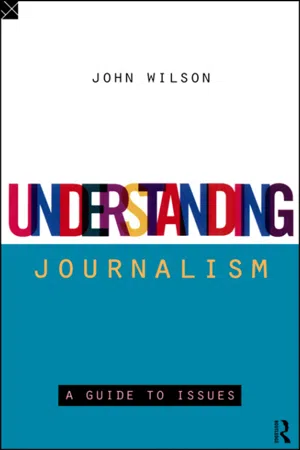
Never has the media been so critically regarded as at the present time. Documenting many areas of debate and dispute between journalists, the media, public organizations and politicians, the author identifies why conflicts will continue. Covering topics from government bias to censorship, official secrets to freedom of information and animal rights to obscenity, this highly informative work is a valuable guide to all those involved in journalism and the media.
Information
chapter one – the contest
Among themany things called into question during the Thatcher years in 1980s Britain was the tradition that government, whatever complaints it might have about television and radio programmes, did not accept editorial responsibility for broadcasting. Government and governing party, the Conservatives, initiated the attack on the tradition and right-wing national newspapers – the majority of national newspapers – encouraged it. The newspapers showed an abiding hostility to the BBC in amixture of commercial interest and ideological conviction and they were intermittently critical also of other British broadcasters. The newspapers did not fully realise what they were doing. By the end of the 1980s they were themselves threatened by the very spirit of political criticism they had encouraged. They had helped make the idea of political interference in journalism acceptable.
The change was as subtle as it was significant. Before it, the established form of response to backbench members of parliamentwho criticised programmeswas for the relevantminister to tell theHouse of Commons ‘Programmes are amatter for the BBC.’ The same response applied to complaints against independent television and independent radio. They were amatter for the Independent Broadcasting Authority (IBA), the regulator in those days. The tradition did not forbid government criticism of programmes. They were often so criticised and had been for as long as broadcasting had existed, but it was not the business of government to do anything about it.Afewnational crises had occasionally threatened the traditional approach, notably after the Egyptian leader, Colonel Nasser, nationalised the Suez canal in 1956 when the government in London considered taking over the BBC for airing critcisms of the British, French and Israeli invasion of Egypt.
The traditional attitude was to an extent a pretence because the official ‘hands-off’ policy was combined frequently with political pressures, often stealthy, sometimes overt. Harold Wilson, as prime minister of the Labour government during the late 1960s, tried to bring the BBC under control by appointing a former Conservative cabinet minister, Lord Hill, to chair the governors only to find Hill a vigorous defender of editorial independence, a quality he had needed while chairing the original independent television regulator, the Independent Television Authority. Many other instances of general and particular pressure by government have been attested to. The pretence was, however, important, not hollow. It said that whatever government might do it was no part of its official function to interfere with programmes any more than it was part of its official duty to interfere with newspapers.
The pretence wore thin under the prime ministership of Margaret Thatcher who had embarked on a mission for radical change to the thinking, the behaviour, the policies and the institutions of Britain. Broadcasting, in particular the BBC,was recalcitrant, badly organised, backward-looking, an encourager of the ‘dependency culture’ exemplified in the assumption that social problems were to be solved by government throwing money at them – an assumption kept alive, it was said, with the help ofwet news programmes like Today, the BBC’s flagship news and current affairs show at breakfast-time on Radio 4. Government complained bitterly in public and in private, and attacked the BBC about coverage of social policy, including public spending, about its treatment of the Falklands War in 1982, about its editorial attitude to the prolonged miners’ strike of 1984–5, about its reporting of theAmerican air raids on Libya launched from bases in Britain in 1986, about coverage of the troubles in Northern Ireland, about dramas based on real-life incidents, about violence, sex and swearing, and an endless list of other programme failings over the years. In addition,Thatcherites complained, theBBCdid not earn its living in themarket. It was bloated on a tax, the licence fee. It should be split up, made to take advertising and compete as best it could with the commercial newcomers of satellite and cable who paid their own way in the world.
When the government was not active in ‘broadcaster bashing’, Conservative party headquarters were and whoever took the lead, Conservative-friendly, right-wing newspapers joined in vehemently. Hardly a week went by without denunciations of the journalism and general programme making of the BBC. Independent television suffered less often, though at times severely. One of themost powerful government-cum-newspaper attacks was against Thames Television for an investigative programme, Death on theRock, about the killing of three Northern Ireland terrorists in Gibraltar by British undercover security forces in 1988. Only months later that year, using powers not used for more than thirty years, government confirmed its willingness to interfere editorially in a direct act of censorship in the form of the Northern Ireland ban which stopped radio and television from broadcasting the voices of Irish terrorists and their supporters. As an additional restraint, government had already set up the Broadcasting Standards Council to oversee matters of taste and decency in programmes.
The zeal of a reformist government driven by party ideology combined with newspaper enthusiasm to de-stabilise British broadcasting. Deep editorial dislike travelled on the back of the commercial case for structural reform. In all the years of controversy stretching from the origins of the BritishBroadcasting Company in the early 1920s, broadcasting had never before been under an assault so sustained and so fundamental. Nicetiesof conventionwere abandoned. No longerwas it ‘amatter for the BBC’ or ‘amatter for the IBA’. It was abundantly clear that government and party, urged on by the acclaimof newspaper interests, required editorial reform.
The BBC survived the storm by reforming itself, slowly, painfully and with more editorial anguish among its journalists than editorial effect in its programmes. Independent television was shaken up by the Broadcasting Act of 1990, and the political hue and cry switched its attention to the national tabloid newspapers which obliged their critics by trampling on privacy like English soccer hooligans invading the pitch.
During the years of attrition, newspapers had attacked Granada or Thames, Independent Television News or the BBC, whoeverwas in the firing line that week, and because they believed their criticisms justified they did not recognise themselves to be in alliance with government against the editorial independence of broadcasting. In this, they were not behaving badly. They were behaving according to their nature. Part of their function is to expose and to criticise. In parallel with their right to criticise broadcasting, as any other part of national life, is a public interest need to do so. For their part, broadcasters failed to defend each other when they were under attack and they did not come to the rescue of newspaperswhen theywere threatened with regulation and criminal sanctions. Those who thought about it were likely to conclude that as broadcasting is regulated, why should newspapers be totally excluded from any framework of control. In any case, radio and television are not allowed to take sides. So, the organisations that make up the news media acted independently, either to attack one another or to be indifferent to the plight of their fellows.
The idea of a free press in Britain, as accepted by its practitioners, calls heavily on the belief that news organisations must act independently, as well as freely, so that many voices are heard. Newspaper people are at best suspicious and often hostile to the idea of coming together under common editorial standards because they believe itwould stifle individuality and variety of approach in news and views. They see it as a confinement even when the standards are commendable because in journalism the best of rules soon require exceptions, as recognised by the Press Council, predecessor of the Press Complaints Commission, which for years refused to draw up a code of practice.
The failings in the reality of newspaper behaviour frequently mock the decency of the theory. Part of the problem during the 1980s was that newspapers acting independently of each other moved together in the same direction because they were in league with the same political and commercial interests – and because, driven hard by the demands of competition, ‘a good story’ for one had to become a good story for them all. One of the best stories over the years was ‘Beeb bashing’, a story the BBC ineptly contributed to when it was under pressure by stumbling from one badly handled problemto the next. Tired of a story that had gone on for too long, recognising also that after Mrs Thatcher government took a more relaxed attitude to broadcasting, and sensing that the BBC, now in better control of itself, would survive strongly, newspapers turned to a bigger story, immorality bashing, seemingly endless revelations about private lives, mainly about sexual impropriety, financial impropriety and business greed. Government ministers, other politicians, other public figures and, most elevated of all, members of the Royal Family were victim to waves of disclosure and unabashed comment. Critics in parliament and in the country considered the press to be out of control and called for controls.
The problem reflects the permanent contradictions in which journalists are caught.They occupy a troubled position in a free society being an essential part of it, simultaneously as detached from it as they see fit, often working against what seem to be its best interests and being at odds with each other, with authority and with sections of the public about how they should serve it. Serious journalists can and do argue with conviction that the right to behave badly is fundamental to good journalism. They say journalists must question what large numbers of people would prefer to leave undisturbed. More than that: journalism is right to threaten cohesive values when there is occasion to question them; it is right to erode respect if it considers respect illdeserved, to shake institutions on which society relies for stability if they are held to be lacking, to highlight intractable problems regardless of whether it makes the conduct of government more and more difficult, and to drag down individuals who are unworthy. Journalists of themost disrespectful school say that colleagueswho aspire to respectability are more to be distrusted than journalists who, out of conviction or cussedness, refuse to observe conventional limitations on what should be written or said and how it should be written or said. But there are plenty of critics in newspaper journalism who accept that tabloid colleagues have gone too far. Few want laws aimed principally at journalists.Afewmore believe special laws are inevitable in the long term.More hope that self-regulation will work, a viewstrengthened in 1995 when the government declared against a privacy law. The broadcasters, by and large, stand aside because they are not so interested in ‘sex and sleaze’ but they know that a law on privacy, still a threat for the future, would affect their work as well as the work of newspaper journalists. It would harm serious investigative journalism almost as much as it would curb excessive intrusion.
The much talked about idea of a law to grant people a right to privacy, actionable in the civil courts and perhaps with criminal sanctions, is usually regarded as themost important of the suggestions for controlling journalists in Britain if they do not behave as their critics say they should. There are other ideas, normally put forward as additional restraints but which could apply alone.Onewould guarantee a right of reply to make sure the media put right what they got wrong, as exists in a number of European countries. Yet another, which ought to be themost disliked by newspaper editors because it is the most farreaching and in truth themost important, would set up a statutory body for the print news media. In its most comprehensive, some would say vindictive version, it would set editorial standards and rules to be observed by all newspapers and periodicals,would oversee the training of journalists, would consider complaints and would have powers to punish – newspapers and magazines aswell as individuals.Punishment would be by as large a fine as appropriate or, if necessary, by banning publication for a time. The strength of these ideas, seriously put forward and noisily resisted by newspapers who enjoy a greater reputation for independence than broadcasters do, demonstrates that the news media in Britain were rarely, if ever, more controversial than during the 1980s and 1990s.
The controversies over privacy and the use of intrusive technology like hidden listening devices and long lens photography obscured a contrary fact about the British media. Newspapers, television and radio in theUKoperate in conditions of considerable restriction. Compared to the media in the United States, they are seriously impeded. The rights of American journalists are constitutionally protected. Journalists in America benefit from the citizen’s right of access to all but themost sensitive of officially held information under freedom of information laws. They face benign defamation law which makes it very hard for public figures to sue successfully. What the Americans know as ‘prior restraint’ – legal powers to stop publication or broadcast – is nearly impossible. Neither president nor congress has power to intervene in broadcasting. The concept of contempt of court ismuch lighter than in Britain, probably a deal lighter than is good for American justice. In the context of these freedoms,America’s privacy law is a minor restraint most helpful to ordinary people whose improprieties are not worth disclosing.
Significantly, in their freer circumstances, American newspaper journalists are generally better behaved than British newspaper journalists. This is not to say their journalism is better. It says they offend less. Criticised they are but less often and less bitterly. They havemore freedom to behave badly and they use it to behave better.
Some British journalistswould be tempted byAmerican benefits if they were offered a package of helpful reforms in return for a privacy law. As a prime instance, serious journalism and popular journalism would enjoy freedom of information. It would give them access to vast amounts of information held by Whitehall, by town halls and county halls, an incalculable contribution to insight about problems and policies. As it is now, in spite of tentative ministerial concessions, government in Britain is highly secretive, a protected process that puts the convenience of governing way above the need of the governed to know. The package would have to include a marked relaxation of British defamation law so that public figures would not be able to shelter behind problems of proving the truth. All journalists who have had anything to do with libel cases know that a number of people win damages for true allegations because they have not been proved to the satisfaction of the law.The reform package to improve the chances of good journalism in Britain would have to tackle the ease with which programmes and newspaper articles can be stopped by court order, that is by injunctions. There are too many granted too readily. Contempt of court, also, is an all too sweeping restraint, the effects of which are not appreciated at all by the public and not much by politicians. It is noteworthy that contempt orders to restrict news coverage of cases before the courts are usually removed or reduced in scope when challenged by the media. But many are not challenged because the process is greatly time-consuming and can be expensive. Reform could curb the readiness of judges to restrict. For good measure, parliament could amend the Police and Criminal Evidence Act to make it more difficult for the police to acquire journalistic material for use in criminal investigations and prosecutions. On the uncontained power of government to restrict broadcasting as it didwith the Northern Ireland ban, parliament could limit the use of the power to matters of the most serious national emergency – or could remove it altogether. It could make the Prevention of Terrorism Act less onerous in relation to journalists. It could, further, lift the power of veto over programmes given to political election candidates by the Representation of the People Act and could remove other restrictions in the Act on programme coverage of elections.
The list of desirable reforms might suggest that British journalism is a cowed creature when clearly it is not. It is bolder journalism, though not necessarily of better quality, than in France where there has been a general media law for many years. Journalists in other European countries benefit too from constitutional protections and from freedom of information without having better newspapers and better broadcasting. Public service broadcasting flourishes in Britain, in the commercial sector as well as in the BBC, to an extent enjoyed nowhere else and which has been eroded, in particular in the older Commonwealth countries where government lacked the will to fund it adequately. By comparison with the messy confusions of most of the countries of former communist Europe where numbers of journalists disregard standards of reliability or are bound in by politically motivated restrictions, Britain is a haven of media order and freedom. None the less, set against the mildest vision, its journalism labours under very considerable disadvantages.
The restrictions built up piecemeal over the years, not fashioned as a consistent whole, in many ways reflect canniness in the British character. Reporters who run up against reluctant informants recognise the preference in many British people for information to be private unless there is a powerful reason for it to be public. Although tabloid newspapers find a justification for their worst behaviour, public opinion is a restraint on journalism.The broadsheet newspapers and the local papers are sensitive to what their corner of the market tells them. They have to be if they are to reflect the interests of their readers who are their supporters. National broadcasting, though it cannot be all things to all people as many people would like it to be, appeals across the social spectrum in its news and current affairs in ways that take many more newspapers to satisfy. Just as the media are more controversial than ever, the public are more vigilant than ever. The media which holds authority to account is itself increasingly held to account – by its readers, its audiences and its contributors. They are more important as influences than the politicians. Newcomers to journalismand students of it might imagine that all journalists have to do is to make sure they ‘get it right’. There are in fact many other problems and many acceptable answers. One of the worst things for a journalist is to stumble on them unawares and unprepared.
chapter two – regulators
too many and none
People in British broadcasting complain from time to time that they have to answer to too many regulators established by law. British newspapers, by contrast, do not have any regulators in law, and an essential feature of the voluntary Press Complaints Commission, the body that receives and examines complaints against newspapers, is that it is part of self-regulation. Its primary purpose is to stave off legal regulation bymaking self-regulation effective.
It can be argued that broadcasting in Britain has fewer regulators than the critics assert. For any body to be truly a regulator itmust have a general or crucial authority over the activities of whatever it regulates. The Independent Television Commission (ITC) and the Radio Authority are certainly regulators. They are established by law, the Broadcasting Act, and exercise a general authority: they award the licences to broadcast to independent television, which generally means non-BBC television originating in Britain, and to independent radio, which generally means non-BBC radio originating in Britain; they oversee the system by setting terms consistent with the Act that the stations must observe; they assess performance; they consider complaints and they can impose sanctions. The board of governors of theBBC is a regulator in that it has tomake sure the BBC, the first and still the biggest of the British broadcasting organisations, meets its obligations under the Charter and Licence, a matter of general authority. The Welsh Authority, S4C, is a regulator as well as a provider of a television service, the Welsh language service seen on Channel 4 in Wales. The Broadcasting Complaints Commission (BCC) and the Broadcasting Standards Council (BSC) – the two bodies usually objected to by the critics of excessive regulation – are set up by law, again the Broadcasting Act, but neither has general authority over any broadcaster. The BCC considers complaints from individuals and organisations that believe they have been treated unfairly, and the BSC considers matters of taste and decency generally on radio and television. Both have powers with regard to complaints: to require broadcasters to co-operate in the investigation of themand to publicise their adjudications. But their powers are not general or crucial. The BSC has a suggestion of general authority over broadcasting with its code on violence and taste and decency, issued at the behest of parliament and which broadcasters have to take into account in their programme decisions, a light requirement. However lig...
Table of contents
- Cover Page
- Title Page
- Copyright Page
- preface
- chapter one – the contest
- chapter two – regulators
- chapter three – editorial values
- chapter four – trouble spots
- chapter five – violent events
- chapter six – special treatment
- chapter seven – disputed practices
- chapter eight – politics
- chapter nine – state interests
- chapter ten – the public
- chapter eleven – social values
- chapter twelve – regional values
- chapter thirteen – the law
Trusted by 375,005 students
Access to over 1.5 million titles for a fair monthly price.
Study more efficiently using our study tools.
Frequently asked questions
Yes, you can cancel anytime from the Subscription tab in your account settings on the Perlego website. Your subscription will stay active until the end of your current billing period. Learn how to cancel your subscription
No, books cannot be downloaded as external files, such as PDFs, for use outside of Perlego. However, you can download books within the Perlego app for offline reading on mobile or tablet. Learn how to download books offline
Perlego offers two plans: Essential and Complete
- Essential is ideal for learners and professionals who enjoy exploring a wide range of subjects. Access the Essential Library with 800,000+ trusted titles and best-sellers across business, personal growth, and the humanities. Includes unlimited reading time and Standard Read Aloud voice.
- Complete: Perfect for advanced learners and researchers needing full, unrestricted access. Unlock 1.5M+ books across hundreds of subjects, including academic and specialized titles. The Complete Plan also includes advanced features like Premium Read Aloud and Research Assistant.
We are an online textbook subscription service, where you can get access to an entire online library for less than the price of a single book per month. With over 1.5 million books across 990+ topics, we’ve got you covered! Learn about our mission
Look out for the read-aloud symbol on your next book to see if you can listen to it. The read-aloud tool reads text aloud for you, highlighting the text as it is being read. You can pause it, speed it up and slow it down. Learn more about Read Aloud
Yes! You can use the Perlego app on both iOS and Android devices to read anytime, anywhere — even offline. Perfect for commutes or when you’re on the go.
Please note we cannot support devices running on iOS 13 and Android 7 or earlier. Learn more about using the app
Please note we cannot support devices running on iOS 13 and Android 7 or earlier. Learn more about using the app
Yes, you can access Understanding Journalism by John Wilson in PDF and/or ePUB format, as well as other popular books in Languages & Linguistics & Journalism. We have over 1.5 million books available in our catalogue for you to explore.