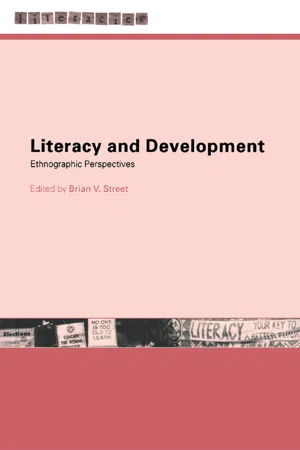
Literacy and Development is a collection of case studies of literacy projects around the world.
The contributors present their in-depth studies of everyday uses and meanings of literacy and of the literacy programmes that have been developed to enhance them. Arguing that ethnographic research can and should inform literacy policy in developing countries, the book extends current theory and itself contributes to policy making and programme building.
A large cross-section of society is covered, with chapters on Women's literacy in Pakistan, Ghana, and Rural Mali, literacy in village Iran, and an 'Older Peoples' Literacy Project.
This international collection includes case studies from: Peru, Pakistan, India, South Africa, Bangladesh, Mali, Nepal, Iran, Eritrea, Ghana.
- 240 pages
- English
- ePUB (mobile friendly)
- Available on iOS & Android
eBook - ePub
About this book
Information
Part I: LITERACY AND DEVELOPMENT
Ethnographic perspectives on schooling and adult education
INTRODUCTION
The chapters in this part of the book all address educational interventions, whether at the level of school or of adult programmes. Adopting an ethnographic perspective on education involves, first, suspending judgement on the educational aims and agendas of developers rather than taking them as the ground from which further analysis follows. It is not, for instance, self-evident that programmes for literacy acquisition are necessarily in the best educational or social interests of the target audience. Nor are approaches to learning and teaching considered ‘state of the art' or ‘progressive' by developers and Western educators necessarily the most effective or successful in different contexts. Particular approaches, such a ‘learner-centred' or process writing may work in some contexts but we will not know whether they work in others until we have studied those other contexts: we cannot simply impose apparently ‘effective' methods and expect to see the same results everywhere–as Wagner states, ‘one shoe does not fit all'. An ethnographic perspective, then, obliges us to suspend judgement on such methods until we have understood better the context in which they are being applied. Local meanings and uses of communicative practices in general and of literacy practices in particular may indicate alternative approaches to the design of literacy programmes to those that may seem obvious from outside. The accounts in this part, based upon ethnographic research mainly in India and Africa, both on local literacy practices and on educational projects as themselves social practices, call into question such centralist sentiments. We are helped instead to ‘see' local perspectives and nuances in indigenous and central conceptions of the educational process. Out of such re-viewing the authors hope that more sensitive programmes might emerge. That is, the researchers are not interested simply in the theoretical and methodological insights arising from their research but are also committed to working through their practical implications. Developers and programme designers as well as academics in the field of language and literacy should therefore find much of interest in these chapters: if these traditionally separate groups are facilitated to overlap to some extent and to learn from each other's perspectives, then the authors will feel their work has been worthwhile.
Caroline Dyer and Archana Choksi in ‘Literacy, schooling and development: views of Rabari nomads, India' consider these issues with respect to nomadic people, focusing on questions of literacy and power. The Rabaris of Kachchh, Gujarat, India, are a caste of transhumant pastoralists who were traditionally camel herders, but have diversified to husband sheep, goats, cattle and occasionally buffaloes. Over the centuries, they have enjoyed an occupational niche that has enabled them to maintain their entire, holistic way of life–a careful equilibrium of God-human-animal. Since the 1980s, Rabaris have been increasingly negatively affected by the state's pattern of development, which in its focus on industrialisation and ‘modernisation' is causing sources of fodder and water available to pastoralists to shrink ever more rapidly. In this era of increasing pressures which appear to be rendering their traditional way of life unviable, Rabaris have started to look for alternatives. Their way of life precludes them from making use of any of the static modes of educational provision offered by the state, yet Rabaris are unanimously in favour of ‘literacy'. Under their present circumstances, peripatetic adult literacy teaching seemed the most logical form of provision for nomadic groups who cannot remain in one place for longer than three weeks at the most. In a two-year period of ethnographic research, during which Dyer and Choksi conducted several action research experiments with literacy teaching and learning, they found that Rabaris see various uses of the written word in their local environments, but that ‘literacy' is seen in terms of a series of discrete functions, such as being able to read a bus destination board or sign a name. Significantly, the uses they talked of in this connection were all public literacy events–places when highly independent and self-sufficient Rabaris felt compromised by having to ask for the help of others. When it came to issues of power, Rabaris did not have much conviction of the use of adult literacy; they made very much stronger connections between power and the processes of schooling, where children would not only learn to read and write, but would also learn ‘how to speak'–use the language and behaviour of power. To them, ‘development' followed a path of sedentarising and sending their children to regular government schools where they would learn these skills, which their parents could not impart through their indigenous patterns of education. Schools were seen as offering the way into social and economic security in the contemporary context, where the traditional occupation of transhumant pastoralism is seen to have neither value nor social status. Conversely, Rabaris felt that peripatetic adult literacy, which attempted to validate their traditional occupation but marry it with the literacy skills required in modern times, was tantamount to condemning them to remain ‘backward' and ‘barbaric'. Dyer and Choksi, then, offer a careful antidote to the romanticised uses of ethnography as simply privileging local values and conditions: in New Work Order conditions, marginalised peoples like the Rabaris want to be part of economic development and are prepared to make compromises. This appears to require both traditional and progressive literacy practitioners to revise their assumptions about programme development and to work with a more nuanced understanding of their implications for literacy learning and teaching.
Uta Papen's chapter ‘”Literacy–your key for a better future”? Literacy, reconciliation and development in the National Literacy Programme in Namibia' likewise addresses contradictions and contestations in views of what a literacy programme should look like, in her case the National Literacy Programme in Namibia (NLPN). The NLPN was initiated by the new government after the country gained independence from South Africa in 1990. Since 1992, it has been implemented in all regions of the country. The programme begins with two years of reading and writing in mother tongues (Stages 1 and 2) followed by one or two years of English literacy (Stages 3/4). Since 1998, the ‘Adult Upper Primary Education' (AUPE) programme has been added to the NLPN. It consists of a three-year (Stages 5-7) course of basic education equivalent with formal primary education.
The research on which this chapter is based combines an ethnography of literacy practices in and around the NLPN with a policy analysis of the NLPN, attentive especially to new communicative practices and to the location of literacy practices in a post-revolutionary context that is already deeply embedded in global politics. Papen's ethnography of literacy practices describes the uses and meanings of literacy in different social contexts and institutional settings of the NLPN, e.g., in the classrooms, in training sessions for literacy teachers and in the broader context that informs particular programme choices and decisions. Context, as she understands it here, encompasses institutional structures, social relationships, economic conditions, historical processes and the ideological formations or discourses in which literacy is embedded. Emphasising in particular the insights to be gained by focusing on discourses, Papen suggests that literacy in the NLPN is framed by a range of discourses about literacy and learning and about education in general. Furthermore, the NLPN is directly related to other governmental policies and their discourses. In this chapter, she is particularly interested in the broader state policies of social and economic development to which the NLPN is tied. The aim of this research is not to evaluate or to critique the programme and its policies and structures, but to understand them, that is to understand the social practices, the discourse formations and the ideological interests in which teaching and learning in the NLPN are embedded.
The chapter consists of three sections. In the first part, Papen briefly introduces the theoretical concepts which underlay her research and which link closely to those outlined above. In the second main part, she discusses the role of the NLPN as part of the government's reconciliation and development policy. The core of this section is a portrait of the National Literacy Day celebrations on 4 September 1999 which Papen attended as a participant observer. The purpose of her account of the festivities is to illustrate the meanings attached to literacy and education in the context of the development policies that she outlines. In the concluding section of the chapter, she describes some of the literacy practices used in the NLPN classrooms. She argues that the dominant conceptions of literacy and education, and the larger political aims attached to literacy, which she introduced in the second section, not only bear upon the content of the programme, but also privilege certain understandings of knowledge and influence the kind of literacy practices used in the programme. What counts as knowledge in the new epistemological order of, in this case, a post-revolutionary ‘developing' society, is highly contested and fraught. Such epistemological assumptions underpin the decisions and choices made within a programme. The strength of Papen's chapter is to offer us a way of ‘seeing' these processes where they are often hidden and to recognise their importance where they often appear too ‘academic' to be of concern to practitioners and developers.
Martha Wright in ‘Multilingual literacies, ideology and teaching methodologies in rural Eritrea' similarly offers a way of re-viewing dominant conceptions of what counts as literacy and what counts as good ways of imparting it. Like Papen and Dyer and Choksi, Wright provides a reflective and often self-critical account of the assumptions that developers (in Hobart's sense of both Northern and Southern development workers), literacy workers and researchers bring to literacy programmes. The new nation of Eritrea emerged in 1991 from thirty years of war with Ethiopia and with an ambitious programme of educational reform. The Eritreans hold out great hope that through the provision of education, especially literacy, they can bring their people into the new world order, and make restitution for the deprivations of this past generation and the previous several centuries of domination by foreign powers. As in many developing countries, much educational reform in Eritrea has been based on imported ideologies, from Christian missionaries to Marxist revolutionaries to teacher trainers armed with communicative methodology; each has left its mark on literacy instruction as practised today. Primary school teachers in modern Eritrea are the recipients of this political, cultural and educational heritage, and have been given the task of integrating their experience growing up in colonial and insurgent Eritrea with the pervasive reform which parents and educators hope will transform the lives of the new generation in one of the world's poorest countries. Wright's ethnographic study of literacy instruction in the rural town of Ghinda looks at how early literacy is accomplished, focusing on English as a foreign language and also Tigrinya and Arabic. She examines the ways in which these teachers integrate modern, Western language-teaching methodologies into their personal and cultural experience, as observed by the researcher in their classrooms and as the teachers themselves have accounted for their practices, in formal and informal interviews. The teachers' beliefs–about learning in general, about their students in Ghinda, about the practical limitations placed on them by the specific situation–are discussed in relation to the ways in which they determine their approach to the teaching of as many as three distinct literacies.
The chapter represents the kind of reflective ethnography advocated in a number of the chapters and that appears to lead to the ethnographer exposing herself to criticism and beginning to change her own cherished assumptions.
Wright had come to Eritrea espousing ‘progressive' language process approaches and was rather shocked to observe teaching methods that appeared to involve traditional memorisation, choral repetition and copying: she could not at first ‘see' what was going on within and behind the surface appearance of these practices. For instance, she ‘found to her embarrassment that not only did I not recognise “groupwork” when it was right before my eyes, I didn't recognise “active” student participation either'. Gradually, however, close observation, interviews and conversations with the participants and self-questioning led her to recognise that what was going on did not necessarily represent the stereotypical mindless repetition that progressive Western educators have criticised. Rather, there was a complex adaptation of Islamic and Eritrean methods to modern conditions. A major contribution of her findings to literacy policy is that it might be less important to focus on what teaching methodology is being employed than to focus on what research methodology is being used to understand it. As Wagner has demonstrated with respect to Morocco and elsewhere, programmes tend to put too much weight on teaching methodologies as though these will resolve the problems of learning, drop out and motivation cited in the programme evaluations (cf. Abadzi above). Rather it is the conceptualisation of the whole programme and its context, including recognising the often creative meanings that teachers frequently bring to new situations, that matters more than a particular method of teaching. Wright concludes: ‘The innovations and adaptations which many teachers in the developing world have already devised within the constraints of their situation need to be “mined”, so to speak– scrutinised for negative and positive attributes, adjusted accordingly, tested and incorporated into more realistic teacher training…integrating the best from their traditions.' Indeed, state of the art methodologies from outside the context may actually lead to people being disempowered by the very thing they were led to believe would liberate them.
Priti Chopra's ‘Betrayal and solidarity in ethnography on literacy: revisiting research homework within a north Indian village' addresses both educational issues of the kind raised by Wright and other authors in this part and the broader issues of literacy and development raised by authors throughout the book, but from the perspective of a more general question–how do/can researchers engage in research on such issues and what is their relationship with the researched? In the case of literacy, the researched are people who are frequently constituted as ‘illiterate' by the agencies who come to ‘empower' them. Chopra feels that she sits ‘in a fidgety manner' in this book, because she is interested not so much in such ‘illiterate' subjects, as in people ‘who refuse to be “illiterate” subjects', in her case within a literacy centre in a north Indian village and within her ethnographic study. Yet her dilemma, which remains more or less explicit in the other contributions, is that these subjects still remain captured in her writing, as subjects of literacy. Is this capturing a kind of betrayal? This issue clamours for reflexivity in ethnographic research on literacy, both her own and others'.
The first purpose of her own reflexivity is to reflect upon the interplay of betrayal and solidarity as an issue for ethnographers, like herself, in representations of people she knows and works with as subjects of literacy. Secondly, her focus on non-attendance in a village literacy centre aims to contribute to the efforts of ethnographic research, exemplified in this volume, as a way for hearing the voices of ‘illiterate' subjects. She uses the chapter to review and reflect on these dilemmas, revisiting her research ‘homework' in a north Indian village in order to become (under the reader's gaze) self-conscious of these acts of ‘knowing' as neither innocent nor transparent. She uses the term ‘home' rather than ‘field' as the site of her research work since, for her, ‘home is not a fixed space but rather a shifting space that encompasses acts of betrayal and solidarity. Home represents, for me, a space in which I am attached, in which I belong, but also a space which is not free from confrontation, struggle and transformation.' She presents this review in the form of three narratives based in and near a village in which she was both observer and participant in a literacy programme. The first narrative is her translation, from a literacy facilitator's writing in Hindi about a meeting, including many non-attending participants, at the village literacy centre, an account Chopra entitles ‘Re-citing Saraswati's writing on meeting no. 1’. In the second narrative, ‘Story 1', she revisits an interview with a non- attending participant, Lakshmi, who refuses to be the ‘illiterate' subject of the literacy centre and of her ethnographic study...
Table of contents
- COVER PAGE
- TITLE PAGE
- COPYRIGHT PAGE
- FIGURES
- CONTRIBUTORS
- INTRODUCTION
- Part I: LITERACY AND DEVELOPMENT: Ethnographic perspectives on schooling and adult education
- Part II: LITERACY AND DEVELOPMENT: Local literacies and development agendas
- AFTERWORD: Problematising literacy and development
Trusted by 375,005 students
Access to over 1.5 million titles for a fair monthly price.
Study more efficiently using our study tools.
Frequently asked questions
Yes, you can cancel anytime from the Subscription tab in your account settings on the Perlego website. Your subscription will stay active until the end of your current billing period. Learn how to cancel your subscription
No, books cannot be downloaded as external files, such as PDFs, for use outside of Perlego. However, you can download books within the Perlego app for offline reading on mobile or tablet. Learn how to download books offline
Perlego offers two plans: Essential and Complete
- Essential is ideal for learners and professionals who enjoy exploring a wide range of subjects. Access the Essential Library with 800,000+ trusted titles and best-sellers across business, personal growth, and the humanities. Includes unlimited reading time and Standard Read Aloud voice.
- Complete: Perfect for advanced learners and researchers needing full, unrestricted access. Unlock 1.5M+ books across hundreds of subjects, including academic and specialized titles. The Complete Plan also includes advanced features like Premium Read Aloud and Research Assistant.
We are an online textbook subscription service, where you can get access to an entire online library for less than the price of a single book per month. With over 1.5 million books across 990+ topics, we’ve got you covered! Learn about our mission
Look out for the read-aloud symbol on your next book to see if you can listen to it. The read-aloud tool reads text aloud for you, highlighting the text as it is being read. You can pause it, speed it up and slow it down. Learn more about Read Aloud
Yes! You can use the Perlego app on both iOS and Android devices to read anytime, anywhere — even offline. Perfect for commutes or when you’re on the go.
Please note we cannot support devices running on iOS 13 and Android 7 or earlier. Learn more about using the app
Please note we cannot support devices running on iOS 13 and Android 7 or earlier. Learn more about using the app
Yes, you can access Literacy and Development by Brian V. Street in PDF and/or ePUB format, as well as other popular books in Languages & Linguistics & Linguistics. We have over 1.5 million books available in our catalogue for you to explore.