- 256 pages
- English
- ePUB (mobile friendly)
- Available on iOS & Android
eBook - ePub
About this book
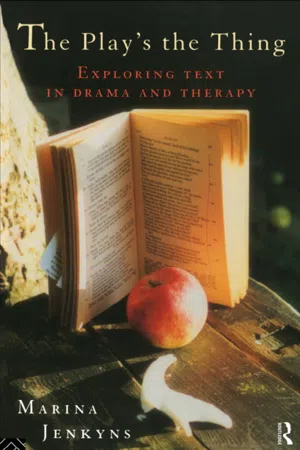
Marina Jenkyns conveys the excitement of working therapeutically with dramatic text though a personal and highly readable analysis of plays from a variety of periods and cultures. Influenced by the theories of Winnicott and Klein she lays bare the dynamics of relationships and plots to show how they can be used to help us understand our own relationships to each other and the world around us. This highly innovative text integrates therapeutic practice and literature in an engaging and challenging book which will hold the attention of a wide audience.
This book contains new ideas for dramatherapy practice, theatre directors and teachers.
Trusted by 375,005 students
Access to over 1.5 million titles for a fair monthly price.
Study more efficiently using our study tools.
Information
1
DRAMATHERAPY
Through the lens of the play
INTRODUCTION
The play’s the thing
Wherein I’ll catch the conscience of the king.(Hamlet Act II, Scene 2: 616)
When Hamlet lays a trap for his uncle Claudius to check if he really has killed his father as the Ghost has suggested, he chooses the device of the theatre. When the players arrive at Elsinore he asks the Player King to put on the Murder of Gonzago:
We’ll ha’t to-morrow night. You could, for a need, study a speech of some dozen or sixteen lines, which I would set down and insert in’t, could you not?(ibid.: 550)
It is the text which will touch Claudius; it will act like a truth drug giving Hamlet the evidence he needs. And indeed it does.
I have heardThat guilty creatures, sitting at a play,Have by the very cunning of the sceneBeen struck so to the soul that presentlyThey have proclaimed their malefactions.(ibid.: 661)
Hamlet’s image of the power of the play is shocking. It is as though the text can be a kind of thought-police from Orwell’s Nineteen Eighty-Four. But there are other ways in which this power identified by Hamlet can be used; the play can be a powerful mirror of human experience, not only to catch out the guilty, which is Hamlet’s focus here, but also to show us who we are, to mirror our lives to us.
Aristotle in The Poetics, writing of Tragedy and the tragic poet, says, The poet’s function is to describe, not the thing that has happened but a kind of thing that might happen i.e. what is possible as being probable or necessary. . . . Poetry is something more philosophic and of graver import than history, since its statements are of the nature rather of universals whereas those of history are singulars. By a universal statement I mean one as to what such or such a kind of man will probably or necessarily do – which is the aim of poetry.(Bywater 1920: 43)
This word ‘universal’ is extremely important when we consider the use of a dramatic text, for it is that ability of the playwright to present a text ‘to which every bosom returns an echo’ which draws us to the theatre. If in the theatre we can watch fellow human beings doing what we might do, we can tap into the universal community of human experience. Such doing need not, of course, be literal. Theatre is in itself a metaphor for life and its function symbolic. We do not have to have literally killed to understand Claudius’ feelings when he sees his crimes enacted on the stage; we can identify with our own murderous thoughts. Claudius gives them ‘a local habitation and a name’ and thus helps to make the unbearable bearable, the unspeakable spoken. The connection can be actual as well as metaphoric; the actor Brian Cox reports that after he had played King Lear at Broadmoor, the British secure psychiatric hospital,
A consultant came and told me that three of her patients . . . came quite separately to her and said, ‘I did so envy the ability of Cordelia and her father to have a farewell . . . it made me think about my own situation, particularly before I murdered my parents.’(M. Cox 1992: 56)
Claudius has the reality of himself mirrored to him by being audience of a representation of himself, his situation and his deeds. The patients at Broadmoor similarly. They were, in a sense, both actors and audience. Sitting and watching they were members of an audience, but they were, through empathic identification, actors reliving their own situation as it was, like Claudius, or as it might have been, like the patients.
The idea of a play within a play is a frequently found theatrical device. Its popularity with dramatists may lie in the fact that it is a language in which characters explore their world in a way that cannot be done by any other means. By this method playwrights underscore the value of plays themselves as means of communication. I want to invite the reader of this book to look at them with me because I believe that the reading of, the thinking about, the experiencing of plays are vital ways of deepening the dramatherapist’s awareness. Jones, responding to Landy’s concerns about the ways in which dramatherapy theory needs to be defined in ‘theory derived from drama’ (Landy 1986) finds the problem as ‘one of defining a language that is meaningful for dramatherapy’ (Payne 1993: 42).
In defining a language we also define our thoughts and the very process of defining our thoughts depends on the language we already have. The way we think about a play is different from the way in which we read either a theoretical study or exposition, different from the way we learn from reading case studies and clinical material, different from understanding our own work through recordings or the supervision process, different from practical work we may do in improvisation or being a participant in a dramatherapy group. In reading dramatic text we can develop the language of metaphor in the way we think about dramatherapy.
In the reference with which I began this chapter, Hamlet asks the Player King to ‘study a speech of some dozen or sixteen lines’, in other words dramatic text. At the moment of ‘action suiting the words and the words to the action’ Claudius reacts to his secret laid out before him. When watching the play Claudius rises, unable to endure it. He has survived the dumb show which wordlessly tells the story of the usurper poisoning the king, wooing the widowed queen and gaining her. He has seen his own actions mirrored precisely. But he does not apparently react. It is only when the words are suited to the action and the action to the words, when the scripted version is enacted before him, that he experiences the full impact of the meaning of the play as it applies directly to himself. We do not know precisely when ‘the king rises’ but we do know the last words the usurper has spoken. Referring to the poison which he is about to pour into the sleeping king’s ears he says,
Thy natural magic and dire propertyOn wholesome life usurp immediately.[Pours the poison into the sleeper’s ears](Hamlet Act III, Scene 2: 265)
It is the brilliant placing of the word ‘usurp’ which causes the reverberation in the depths of Claudius’ being. He himself not only had usurped the crown, his brother, but also has, in doing so, blasted the ‘wholesome life’ of Denmark. The famous line ‘Something is rotten in the state of Denmark’ complements this: what is wholesome has become rotten. And not gradually but immediately. ‘The funeral meats did coldly furnish forth the marriage feast’, as Hamlet puts it, corroborated by Horatio, ‘Indeed my lord it followed hard upon.’ All Claudius’ crimes are therefore in that one line. The use of the word ‘usurp’ to personify the poison mirrors Claudius to himself, not only as a usurper and poisoner but also as poison itself. It dehumanizes him and makes him one with his deed. Claudius experiences the power of the drama both to mirror his life to him and in doing so to present him with alternatives for his future action.
This moment illustrates the powerful ways in which metaphoric language coupled with dramatic action can speak to us. However much it might be described, elucidated, analysed, it can have its full impact only in its context, played on the stage at best, at second best read with the reader’s imagination supplying the theatre. Take the example of ‘All the world’s a stage’; the precise meaning of this sentence which may be used by many people who do not know where it originates, lies in its metaphoric value. (For an illuminating and entertaining example of the extent of Shakespearian usage in everyday English see Levin (1986) quoted in Cox and and Theilgaard (1987), p. 44.) As in all poetry it is multi-layered and gives expression to something the speaker wants to express at that precise moment for which no other words will do. Let us look at what has just happened. Automatically, when faced with the use of metaphoric language, images and associations reverberate at both a conscious and unconscious level; our perceptions are expanded cognitively, emotionally, psychically and maybe spiritually at the same time. This is what happens to Claudius. He does not stop to think, he acts. The action may be an externally visible one, as in Claudius’ rising. It may also be an inner shifting of feeling and perception, not visible externally. We find this when Hamlet witnesses the Player King’s acting and prompts Polonius’ comments on the actor’s pallor and tears. The effect of the acting on Hamlet is to create shifts of feeling and perception within himself which find their voice only when he is on his own; marvelling at the actor’s ability to feel emotion for things and people so far removed from himself causes Hamlet to say,
What would he doHad he the motive and the cue for passionThat I have?(Hamlet Act II, Scene 2: 570)
Then action follows – the action of deciding to use the performance of a play to mirror Claudius’ crime.
Responding to a dramatic text, therefore, is one way of helping us not only to think but also to perceive dramatically. A dramatherapist needs to perceive dramatically for drama is at the heart of our work; we need to allow the characters, plot, dialogue, form, language and structure of a play into our repertoire of thought mechanisms and perceptions. Such perceiving, not just thinking, is, I believe, integral to the development of the dramatherapist’s practice. It is neither more nor less important than those other ways in which dramatherapists develop their art. It is simply different – and to my mind equally important. It is part of the language in which dramatherapy must be defined.
OUR COUNTRY’S GOOD AND DRAMATHERAPY: WORLDS WITHIN WORLDS
In this chapter I shall be discussing some of the central concepts of dramatherapy through reference to a single dramatic text. It is not my intention to present a definition of dramatherapy or to go over ground already well-worked by other writers (e.g. Landy 1986; 1993; Jennings 1990; 1992; Grainger 1990). It is, rather, to draw attention to ways in which we can read those concepts in the text and read the text in them.The text provides us with a framework for thinking about dramatherapy, what it is and how it works, whether we are familiar or unfamiliar with it.
The play which provides my framework is Our Country’s Good by Timberlake Wertenbaker. It is a play which revels in the theatre. Seeing it on stage one is drawn in by the many levels of theatrical metaphor at which it operates; it creates a theatrical hall of mirrors. Some of the reflections in those mirrors have relevance for the dramatherapist. It has already sharpened and honed the dramatherapist I am, as I believe dramatic text should. Some of what I have written already was developed by my engagement with this text – by the events, the characters and the world of the play, both as it is lived out in the play and as a metaphor for life. It takes a singular historical experience, which combined with the dramatic art form reflects a universal one – a combination of Aristotle’s opposites.
The play is based on the novel, The Playmaker, by Thomas Keneally (1987), which in turn is based on the historical fact that a group of deported convicts staged a play in New South Wales in 1788.
A play is a world in itself, a tiny colony we could almost say.(Act II, Scene 2)
The Governor’s words are a neat inversion of Shakespeare’s ‘All the world’s a stage’. This kind of tightness of metaphor, echoing, and multi-layered allusion are typical of Wertenbaker’s writing and are why it is exciting as a text. It triggers off image, memory, half-forgotten, half-remembered moments of theatre and life. Indeed I suspect that it relies on this kind of audience response for its success. So what is it about?
Basically its story is simple. A lieutenant eager for promotion directs a group of convicts in the rehearsal and performance of Farquhar’s The Recruiting Officer. The performing of a play is born of the fabric of the social unit which is this colony and weaves itself into it. One of the important questions it raises is: can new cloth be made from old to clothe this community in garments which are not the same as those of the old world? Can this colony become indeed a New World? And if so what place has theatre in this transformation?
These are also the questions that face the dramatherapist working with a group of people which will become a ‘tiny colony’ called a dramatherapy group.
Let’s look at Wertenbaker and see who are the ‘group members’ of her tiny colony.
In the dark hold of the convict ship the convicts ‘huddle together in the semi-darkness’ while one of their number is being flogged. The officer monotonously counts the lashes. From the silence a convict speaks into the hushed and darkened theatre. Thus John Wisehammer:
At night? The sea cracks against the ship. Fear whispers, screams, falls silent, hushed. Spewed from our country, forgotten, bound to the dark edge of the earth, at night what is there to do but seek English cunt, warm, moist, soft, oh the comfort of the lick, the thrust into the nooks, the crannies of the crooks of England. Alone, frightened, nameless in this stinking hole of hell, take me, take me inside you, whoever you are. Take me my confort and we’ll remember England together.(Act I, Scene 1)
Let’s juxapose this passage with another. In Act I, Scene 6 we find the officers arguing like true eighteenth-century gentlemen; their subject? The theatre. The Governor, Arthur Phillip, is encouraging Lieutenant Ralph Clark in his proposal to produce a play with the convicts. Ralph struggles to articulate his ideas in the face of some strong opposition from his superiors.
RALPH: . . . in a small way this could affect all the convicts and even ourselves, we could forget our worries about the supplies, the hangings, the floggings, and think of ourselves at the theatre, in London, with our wives and children, that is, we could, euh –PHILLIP: Transcend –RALPH: Transcend the darker, euh – transcend the –JOHNSTON: Brutal –RALPH: The brutality – remember our better nature and remember –COLLINS: England.RALPH: England.A moment(Act I, Scene 6)
Both groups have one very obvious thing in common, which is their isolation from their homeland. From England. They deal with it in different ways but both ways are aspects of the whole, though at this stage they are polarized. The feelings of rejection by both convicts and officers, equally at the mercy of the hostile land and climatic conditions, are common to both. Here they are all ill-adapted. In King Lear’s words they are all ‘unaccommodated man’ subjected to the environment and dependent on a supply ship which might or might not arrive. All are vulnerable. And they are interdependent.
The two groups represent to us, the audience, two facets of the wider society of any human group and these are important to understand if we are to fully appreciate the significance which the performing of a play in this colony has.
The convicts have escaped death by being sentenced to transportation. They have in a sense come up from the bottom. They have nothing to lose and perhaps something to gain, if – but only if – this community can be different from the one they have left. All their lives they have been victims of a harsh and unequal society, abused, exploited and brutally punished. The officers are in some ways therefore, in terms of the shock to their system, in a worse state than the convicts. They have everything to lose and little to gain in terms of the privileged life they are used to.
But maybe they do have something to gain.
PHILLIP: . . . we, this colony of a few hundred will be watching this together, for a few hours we will no longer be despised prisoners and hated gaolers. We will laugh, we may be moved, we may even think a little.(Act I, Scene 6)
What they may gain is a sense of integration, a glimpse of a more equal society, less split, less polarized, more humane. A state of being unintegrated is not one conducive to thought. The fact the Governor says, ‘we may even think a little’ indicates his belief in the play’s ability to effect change.
What is important to be aware of here is the level at which these two different groups experience commonality. The splits mean nothing if the two groups are not part of the same whole. I believe they are. In the text there is much to support the view that both share the rejection and sense of abandonment, and both groups are deeply vulnerable, needy and afraid. Both groups find ways of expressing their feelings and experience and both find ways of dealing with it. In the passages quoted both groups talk of fear, darkness, the need for comfort, the need to somehow retain the memory of England. Let us look at these passages in a little more detail and explore some of the psychological and emotional sub-text, the meaning held by the metaphor.
In his opening lines Wisehammer gives us a picture of the experience of these convicts and an understanding of their need for both escape and containment. It is a male vision and the female is both mother and mistress, the Oedipal dream enacted, the punishing father banished. (See also the last lines of Greek by Steven Berkhoff (1988).)
Take me, take me inside you.(Act I, Scene 1)
In the play this place of comfort is represented, for these English convicts, by England and English women, the brilliant play on words of the ‘nooks, the crannies of the crooks of England’ suggests the merging of mother, mi...
Table of contents
- Cover Page
- Title Page
- Copyright Page
- ACKNOWLEDGEMENTS
- AUTHOR’S NOTE
- PROLOGUE
- 1: DRAMATHERAPY: Through the lens of the play
- 2: PLAYING WHERE TWO WORLDS MEET
- 3: THEORY INTO PRACTICE: Means and methods
- 4: BEGINNING: Roots by Arnold Wesker
- 5: PAST INTO PRESENT – THE WIDER CONTEXT: Cloud Nine by Caryl Churchill
- 6: ‘THAT WAY MADNESS LIES’: Thursday’s Child by Daphne Thomas
- 7: THE OPPRESSION OF TABOO: Ghosts by Henrik Ibsen
- 8: WALLS WITHIN WALLS – SOCIETY, FAMILY AND THE INDIVIDUAL: A Shaft of Sunlight by Abhijat Joshi
- 9: DEATH AND ACCEPTANCE: Riders to the Sea by J. M. Synge
- 10: THE EPILOGUE
- BIBLIOGRAPHY
Frequently asked questions
Yes, you can cancel anytime from the Subscription tab in your account settings on the Perlego website. Your subscription will stay active until the end of your current billing period. Learn how to cancel your subscription
No, books cannot be downloaded as external files, such as PDFs, for use outside of Perlego. However, you can download books within the Perlego app for offline reading on mobile or tablet. Learn how to download books offline
Perlego offers two plans: Essential and Complete
- Essential is ideal for learners and professionals who enjoy exploring a wide range of subjects. Access the Essential Library with 800,000+ trusted titles and best-sellers across business, personal growth, and the humanities. Includes unlimited reading time and Standard Read Aloud voice.
- Complete: Perfect for advanced learners and researchers needing full, unrestricted access. Unlock 1.5M+ books across hundreds of subjects, including academic and specialized titles. The Complete Plan also includes advanced features like Premium Read Aloud and Research Assistant.
We are an online textbook subscription service, where you can get access to an entire online library for less than the price of a single book per month. With over 1.5 million books across 990+ topics, we’ve got you covered! Learn about our mission
Look out for the read-aloud symbol on your next book to see if you can listen to it. The read-aloud tool reads text aloud for you, highlighting the text as it is being read. You can pause it, speed it up and slow it down. Learn more about Read Aloud
Yes! You can use the Perlego app on both iOS and Android devices to read anytime, anywhere — even offline. Perfect for commutes or when you’re on the go.
Please note we cannot support devices running on iOS 13 and Android 7 or earlier. Learn more about using the app
Please note we cannot support devices running on iOS 13 and Android 7 or earlier. Learn more about using the app
Yes, you can access The Play's the Thing by Marina Jenkyns in PDF and/or ePUB format, as well as other popular books in Psychology & Theatre History & Criticism. We have over 1.5 million books available in our catalogue for you to explore.