- 248 pages
- English
- ePUB (mobile friendly)
- Available on iOS & Android
eBook - ePub
About this book
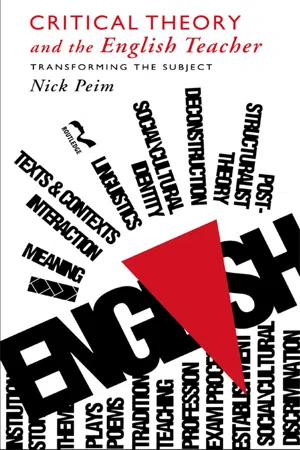
In this radical exploration, Nick Peim, himself a practising English teacher, shows how teachers can use critical theory to bring students' own experience back into the subject. The author explains how the insights of discourse theory, psychoanalysis, semiotics and deconstruction can be used on the material of modern culture as well as on and in oral work. The book is written in a style which even those with no background in critical theory will find approachable, and arguments are backed up with practical classroom examples.
Trusted by 375,005 students
Access to over 1.5 million titles for a fair monthly price.
Study more efficiently using our study tools.
Information
Topic
EducationSubtopic
Education General1 The habits of English
AN EVERYDAY TALE OF ENGLISH FOLK
Reading stories in the name of English is routine in many senses. In schools it happens every day. In thousands of classrooms in schools across the nation, teachers—English teachers, teachers of English— read stories to their classes. So commonplace an activity forms an apparently natural part of what has been called ‘bread and butter English’ to the point where English might well seem unimaginable without it. Whatever the brand of English being espoused (and it has recently been officially conceded that there are many brands of English), reading stories constitutes something central, essential—even quint-essential—about English. The central place accorded to this activity in the universal education system could be expressed as the core of the core—often conceived of as a kind of spiritual essence at the heart of English, itself at the heart of, even the heart itself— of the national curriculum. Reading stories is one of the great universal activities of English, and English is one of the core subjects, if not the core subject, of national education. Reading is obviously and explicitly at the centre of practical, theoretical and ideological concerns in education. Questions about reading, differences in relation to reading, engage significant cultural and political tensions. Reading stories must be caught up in this arena of differences.
Throughout the primary and secondary school, the essential features of the scene may be envisaged. In its ideal form we may imagine the teacher giving an engaging—but not actively or overtly leading— rendering of the story in fine, modulating tones. The class listens or follows attentively as the story works its magic on the uniformly enchanted group. Somehow the students’ responses begin to stir. A discussion or writing may follow. Issues will have been raised, responses formulated and developed. At the end of the process everyone will be the richer for the encounter. In its idealized and conventional description the reading of stories is often represented as just such an uncomplicated and essentially self-contained process. There is—in a very important sense—no need to justify the activity. Its value is held to be self-evident—a truth universally acknowledged. It just seems to be obvious, common sense that stories should be central to the English curriculum, that their reading should produce positive, enriching effects and that stories constitute an essential stage on the royal road to literacy —as well as promoting the humanly desirable qualities of empathy, awareness, and knowledge of the world beyond.
An interrogative approach to the business of reading stories in English might aim to examine critically the common-sense and commonly held assumptions that sustain the perceived meaning and value of stories in English, and that inform attitudes to reading and textual communication generally. The idea is to question the centrality of stories, to enquire into what stories are and how they function, and—in doing so—to begin to challenge assumptions about what English is: why it takes the particular forms it does, why it promotes certain ideas and activities; also to begin to propose that there may be alternatives to current practices, and that there may be very good reasons why alternatives should be considered.
The approach offered here uses ideas from ‘theory’ to question the common-sense assumptions that tend to operate in the uses of stories in education and in the reading of stories more generally. The intention, though, is to avoid the—often alienating—language of high-level theory and to borrow terms and procedures from ‘common sense’ in order to exercise a critique of established reading practices. Starting from a single example it is possible to begin to approach the well-established, commonsense position on stories. The kind of questioning procedure used in what follows is perfectly plausible in classroom practice. Carefully prepared questions themselves, asked with sufficient persistence, can be enough to begin the process of unmasking the theories of English and constructing new ideas, new models.
QUESTIONS: STORIES IN EDUCATION?
Some form of critical analysis of dominant practices might begin by asking a few questions to raise and identify issues—in this case about the role of stories in education. It is important to establish, one way or another, that common-sense readings and common-sense versions of the business of reading are bound up with an ideology of knowledge— a system of ideas, often explicit or unspoken, but regulating what can and should be thought. The apparently simple, innocent, everyday event of reading stories carries with it, in fact, powerful ideas and assumptions, in the first place, about the nature of the text, the communication process, appropriate responses to the text, to this kind of text. Beyond this, reading stories also will tend to reinforce certain kinds of culturally stereotypical ideas about identity, about reality, about meaning—fundamental issues of social life. And the more sophisticated the text, very often, the more sophisticated will be the means of reinforcing these stereotypes or myths. That this should be done—via reading stories—on the mass scale of public education seems to be a phenomenon worth exploring.
Some preparatory exploration of ideas and assumptions about reading stories may be gleaned readily and quickly by asking for some five-minute written responses to three questions asked of the class—in this case a group of year ten students (secondary fourth years). These questions may be used to provide a context for work on stories to take place. In most practices of English it’s likely that the questions asked here will not be asked and the issues they might raise will be excluded from the daily working of the curriculum. The questions below are merely brief examples of what could be a more extended group project to examine beliefs and attitudes about stories.
- What are stories?
- What are stories for?
- What is the place of stories in education?
Responses to question 1 have included the following:
‘Stories are tales that have happened or are made up for people’s benefit and enjoyment.’
‘Stories are telling something. Getting a message across about something.’
‘Stories are a way of putting down events on paper. They can be fictional or non-fiction. They can be an account of what’s happened or just from the imagination.’
‘Stories are pieces of communication which relate a situation, sometimes fiction, sometimes true.’
Some representative responses to question 2:
‘Stories help people to find out and learn new things.’
‘Stories are for anyone. They give people ideas about things that could happen or instances that will come about in the future.’
‘Stories can be used for many things—to put a point across, to educate, to provide enjoyment and to set you thinking in a different way.’
Responses to question 3:
‘Stories are a way of learning things and help you to understand things.’
‘Stories are very educational and tell people what could happen, ways of speech, how to act. People learn from them.’
‘Stories can be used in education in many ways. I think they are useful for expanding the way you think (in older children) and for learning (in young children).’
It is evident that, although not always coherent and consistent, these responses indicate that stories have certain effects or properties relevant to the purposes of education: stories are informative, mind-expanding, an aid to understanding. Stories convey meanings, they communicate, they convey messages—for benefit and/or enjoyment. This brief survey can do no more than identify views already held by the group. These may simply be identified at first—perhaps by listing some of them anonymously on a printed sheet or on the board—and then perhaps put to the test in the reading of the story and what follows.
WHY CHANGE STORIES?
Why interfere with an already established practice that seems to offer so many beneficial effects? It seems brutal to attack so innocent an activity as reading stories with a heavy bombardment of theoretical questions. Brutal and futile, perhaps. Why attempt to disrupt what’s now apparently firmly in place? If stories are somewhere at the foundation of English, doesn’t their ‘deconstruction’ somehow imply the destruction of English itself? And why should anyone want to contemplate that apparently anarchistic prospect? Why bother? What’s the point? What’s at stake? These are big and important questions, essential to the present project. They can only be answered by careful examination and argument.
It’s part of the argument of this book to assert that using ideas gleaned from theory with students is, in practice, a potentially very positive move. Even if this means no more than giving students access to certain kinds of questioning processes, it will be a development beyond what’s conventionally and commonly held to be English. A whole new field of study may, in fact, be opened up: a field of study concerned with texts and meanings more generally, for example, locating stories within a wider cultural context or seeking to understand how ideas like ‘fiction’, ‘story’, ‘truth’, ‘reality’ and ‘history’ operate in the general circulation of meanings constituting our cultural life in all its aspects. Perhaps this kind of project might appear too ambitiously grandiose—especially in the context of the secondary comprehensive school. But simply beginning with any of the most cherished practices of English in a questioning, probing—or theoretical —way may yield endlessly productive results.
The End of Something
In the old days Hortons Bay was a lumbering town. No one who lived in it was out of sound of the big saws in the mill by the lake. Then one year there were no more logs to make lumber. The lumber schooners came into the bay and were loaded with the cut of the mill that stood stacked in the yard. All the piles of lumber were carried away. The big mill building had all its machinery that was removable taken out and hoisted on board one of the schooners by the men who had worked in the mill. The schooner moved out of the bay towards the open lake carrying the two great saws, the travelling carriage that hurled the logs against the revolving, circular saws and all the rollers, wheels, belts, and iron pile on a hull-deep load of lumber. Its open hold covered with canvas and lashed tight, the sails of the schooner filled and it moved out into the open lake, carrying with it everything that had made the mill a mill and Hortons Bay, a town.
In the old days Hortons Bay was a lumbering town. No one who lived in it was out of sound of the big saws in the mill by the lake. Then one year there were no more logs to make lumber. The lumber schooners came into the bay and were loaded with the cut of the mill that stood stacked in the yard. All the piles of lumber were carried away. The big mill building had all its machinery that was removable taken out and hoisted on board one of the schooners by the men who had worked in the mill. The schooner moved out of the bay towards the open lake carrying the two great saws, the travelling carriage that hurled the logs against the revolving, circular saws and all the rollers, wheels, belts, and iron pile on a hull-deep load of lumber. Its open hold covered with canvas and lashed tight, the sails of the schooner filled and it moved out into the open lake, carrying with it everything that had made the mill a mill and Hortons Bay, a town.
The one-story bunk-house, the eating-house, the company store, the mill office, the big mill itself stood deserted in the acres of sawdust that covered the swampy meadow by the shore of the bay.
Then years later there was nothing left of the mill except the broken white limestone of its foundations showing through the swampy second growth as Nick and Marjorie rowed along the shore. They were trolling along the edge of the channel-bank where the bottom dropped off suddenly from sandy shallows to twelve feet of dark water. They were trolling on their way to the point to set night lines for rainbow trout.
‘There’s our old ruin, Nick,’ Marjorie said.
Nick, rowing, looked at the white stone in the green trees.
‘There it is,’ he said. ‘Can you remember when it was a mill?’ Marjorie asked.
‘I can just remember,’ Nick said. ‘It seems more like a castle,’ Marjorie said.
… ‘You don’t have to talk silly,’ Marjorie said; ‘what’s really the matter?’
‘I don’t know.’
‘Of course you know.’
‘No I don’t.’
‘Go on and say it.’
Nick looked at the moon, coming up over the hills.
‘It isn’t fun any more.’
He was afraid to look at Marjorie. Then he looked at her. She sat there with her back towards him. He looked at her back. ‘It isn’t fun any more. Not any of it.’
She didn’t say anything. He went on. ‘I feel as though everything was gone to hell inside of me. I don’t know, Marge. I don’t know what to say.’
He looked at her back.
‘Isn’t love any fun?’ Marjorie said.
‘No,’ Nick said. Marjorie stood up. Nick stood there, his head in his hands.
‘I’m going to take the boat,’ Marjorie called to him. ‘You can walk back around the point.’
‘All right,’ Nick said. ‘I’ll push the boat off for you.’
‘You don’t need to,’ she said. She was afloat in the boat on the water with the moonlight on it. Nick went back and lay down with his face in the blanket by the fire. He could hear Marjorie rowing on the water.
He lay there for a long time. He lay there while he heard Bill coming into the clearing, walking around through the woods. He felt Bill coming up to the fire. Bill didn’t touch him, either.
‘Did she go all right?’ Bill said. ‘Oh, yes,’ Nick said, lying, his face on the blankets.
‘Have a scene?’
‘No, there wasn’t any scene.’
‘How do you feel?’
‘Oh, go away, Bill! Go away for a while.’
Bill selected a sandwich from the lunch basket and walked over to have a look at the rods.
(Hemingway 1977)
In the imaginary everyday English classroom, what kinds of activities might follow from the reading of this story? An enlightened teacher might simply give the story time to settle in, as it were, and, after due pause, might ask the great open question: What did you make of that? There’s nothing, apparently, leading in this, nothing directing anyone’s responses, nothing inhibiting any particular reactions. This kind of open question, inviting open responses is central to what might be called liberal humanist practice. It imagines each student as an autonomous ‘subject’, bearing valued personal opinions, each with unique, individual responses ready to hatch from its open encounter with the story. The question is a mere prompting, a formality designating an open invitation to express yourself, even to find and to know yourself through and in the story. It closes nothing off and asks with perfect openness for no particular kind of reaction. It neither guides nor inhibits. And yet we know in relation to this question that certain kinds of response will either not be proffered or, if proffered, will not be allowed. We know the limits and the constraints that operate. And we know that these limits and constraints exist independently of the teacher, the story, the class; even, to some extent, of the question. So, for example, the simple response: ‘It’s boring’ —which may very well be quite appropriate—would be a response as difficult to manoeuvre as, for example: ‘It’s stupid’ or ‘It doesn’t make sense’ or other responses of an equally curt but more trenchant nature that would require the intrusion of teacher’s authority into the reading and responding situation. These kinds of response are all in effect discounted. But it isn’t just these—perhaps disreputable— responses; a whole host of other responses, entire ways of looking at the story or of reading it are very likely to be discounted, too, by the already established procedures of reading and responding at work. If these procedures, for some reason or other, are not at work, they must be taught.
THE ESTABLISHED CATEGORIES OF RESPONSE
An obliging, well-read-to, well-trained class, though, might begin to proffer a whole range of immediate responses to the original open question: What did you make of that? Theory might suggest that these responses will be expressed around a group of familiar categories, all of them, theory would also suggest, constructed completely independently of the text itself. These categories, or ideas, would be, for instance:
| character | plot/development |
| place | time |
| theme | coherence |
| meaning | author |
| reader | personal response |
| presence | reality |
| significance | life |
| empathy |
Why are these particular ideas dominant over others? Working with students on stories and ideas about stories it’s perfectly possible to pursue this enquiry further and to interrogate each of these categories and their interdependence. Take, for example, the idea of coherence. The idea of coherence assumes that the text is completely (or at least largely) coherent—that all the bits are connected in some necessary way with one another, that there is a logical sequence, from the beginning, through the middle bits, to the end, and that at the end the story is complete: so that in the case of The End of Something it is important that Hortons Bay is ‘described’ at the beginning, and there must be some essential and unifying connection between Hortons Bay, Marjorie’s silence and the sandwich at the end. Some kind of development will be assumed to have taken place, perhaps consisting of events and changes of some significance. Indeed, the events and/or changes would have to be of some significance, because to concede that they might be of no significance, or of indeterminate significance, would tend to render the whole exercise— story reading, that is— meaningless or incoherent. The idea of meaning itself is pretty essential, also, to a conventional approach to story reading.
THE IDEA OF MEANING
It tak...
Table of contents
- COVER PAGE
- TITLE PAGE
- COPYRIGHT PAGE
- TEACHING SECONDARY ENGLISH
- LIST OF EXAMPLES
- LIST OF FIGURES AND TABLES
- GENERAL EDITOR’S PREFACE
- ACKNOWLEDGEMENTS
- INTRODUCTION
- 1: THE HABITS OF ENGLISH
- 2: THEORY AND THE POLITICS OF ENGLISH
- 3: ON THE SUBJECT OF READING
- 4: GRAMMATOLOGY FOR BEGINNERS
- 5: ORAL THEORY
- 6: LITERATURE, LANGUAGE, LITERACY AND VALUES
- 7: ASPECTS OF ENGLISH
- 8: NEW BEARINGS
- BIBLIOGRAPHY
Frequently asked questions
Yes, you can cancel anytime from the Subscription tab in your account settings on the Perlego website. Your subscription will stay active until the end of your current billing period. Learn how to cancel your subscription
No, books cannot be downloaded as external files, such as PDFs, for use outside of Perlego. However, you can download books within the Perlego app for offline reading on mobile or tablet. Learn how to download books offline
Perlego offers two plans: Essential and Complete
- Essential is ideal for learners and professionals who enjoy exploring a wide range of subjects. Access the Essential Library with 800,000+ trusted titles and best-sellers across business, personal growth, and the humanities. Includes unlimited reading time and Standard Read Aloud voice.
- Complete: Perfect for advanced learners and researchers needing full, unrestricted access. Unlock 1.5M+ books across hundreds of subjects, including academic and specialized titles. The Complete Plan also includes advanced features like Premium Read Aloud and Research Assistant.
We are an online textbook subscription service, where you can get access to an entire online library for less than the price of a single book per month. With over 1.5 million books across 990+ topics, we’ve got you covered! Learn about our mission
Look out for the read-aloud symbol on your next book to see if you can listen to it. The read-aloud tool reads text aloud for you, highlighting the text as it is being read. You can pause it, speed it up and slow it down. Learn more about Read Aloud
Yes! You can use the Perlego app on both iOS and Android devices to read anytime, anywhere — even offline. Perfect for commutes or when you’re on the go.
Please note we cannot support devices running on iOS 13 and Android 7 or earlier. Learn more about using the app
Please note we cannot support devices running on iOS 13 and Android 7 or earlier. Learn more about using the app
Yes, you can access Critical Theory and The English Teacher by Nick Peim in PDF and/or ePUB format, as well as other popular books in Education & Education General. We have over 1.5 million books available in our catalogue for you to explore.