- 304 pages
- English
- ePUB (mobile friendly)
- Available on iOS & Android
eBook - ePub
About this book
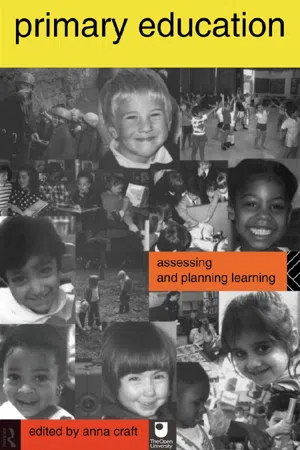
This wide ranging sourcebook draws together a range of recent and specially commissioned pieces which examine how policy development and research findings have influenced planning and assessing learning for young children. Topics covered include standards, quality control, league tables, teacher and performance assessment. It also looks at the enabling of learning, focusing on authentic activity and learning, implicit values, the role of learner choice and classroom management.
The book also raises which will effect assessing and planning learning into the next century, and sets an agenda for reform and development including teacher training, funding of primary education, early years education and entitlement in primary school.
Trusted by 375,005 students
Access to over 1.5 million titles for a fair monthly price.
Study more efficiently using our study tools.
Information
Topic
EducationSubtopic
Education GeneralPart I
Assessing learning
Chapter 1
Standards and quality in education
Richard Pring
This is an edited version of a much more substantial article in which Pring examines political arguments made about falling standards in education, and ways of monitoring and measuring this supposed phenomenon.*
POLITICAL CONTEXT
There has in the last fifteen years been a steady flow of warnings from government about ‘declining standards’. The 1977 consultative document Education in Schools commented on Callaghan’s Ruskin speech in the following way:
[it] was made against a background of strongly critical comment in the press and elsewhere on education and educational standards. Children’s standards of performance in their school work was said to have declined. The curriculum, it was argued, paid too little attention to the basic skills of reading, writing and arithmetic, and was overloaded with fringe subjects.
(DES, 1977)
Already we see two kinds of decline in standards—poor performance in the basic skills (children not writing, reading, adding and subtracting as well as a similar cohort of children would have done in a previous age) and the neglect of more traditional subjects as these were usurped by fringe subjects (no doubt peace studies and other forms of integrated studies). But the document goes on to mention poor discipline and behaviour and the neglect of economic relevance.
The consultative document was produced by a Labour government, but one which was reacting, first, to well-orchestrated populist appeals from the political right and, second, to the concerns of commerce and industry which argued that the output of the educational system—yes, even those who came up to traditional standards—were ill-prepared for the economic world they were entering into. Therefore, there were four areas of quality concern— basic skills, traditional learning, discipline, and economic relevance. ‘Quality’ is reflected in the standards, explicit or implicit, to which reference is made when performance is judged. In that sense quality and standards are logically related concepts, and therefore the four areas of quality concern picked out in Callaghan’s speech reflect four different kinds of standard—which kinds may not, as we shall see, always be compatible with each other.
‘Standards’ and ‘quality’ have been rallying calls to all political parties and government initiatives ever since. One will recall Sir Keith Joseph’s (then Secretary of State) North of England Conference speech in January 1984, when, deeply concerned with the poor standards of many young people, he affirmed the aim of bringing 80–90 per cent of all pupils at least to the level which is now expected and achieved in the 16+ examination by pupils of average ability in individual subjects. In thus raising standards, Sir Keith first proposed the need to define the objectives of the 5 to 16 curriculum so that everyone would know the levels that should be achieved. And, following this line of reasoning, the Secretary of State argued for the change in 16+ examinations so that they would measure ‘absolute’ rather than ‘relative’ performance. The same message was reiterated by the succeeding Secretary of State, Kenneth Baker, who argued for greater standardization and higher standards in anticipation of the 1987 Consultation Document which thus stated:
The government has concluded that these advantages and consistent improvements in standards can be guaranteed only within a national framework for the secular curriculum…. The imaginative application of professional skills at all levels of the education service, within a statutory framework which sets clear objectives, will raise standards.
Let us pause to see where the argument is developing. There is wide concern about standards. Generally speaking these need to be higher. This concern, however, is about different sorts of standards—those relating to traditional learning, those relating to ‘basic skills’, those relating to behaviour, and those relating to economic relevance. And presumably standards need to be higher in each of these independent areas. To raise standards requires expressing these standards quite explicitly—they thus become the clearly stated objectives (the absolute benchmarks) against which a pupil’s performance might be judged. There might, within any one area of standards (let us say, within the area of the basic skill of reading or within the traditional learning area of history), be logically related standards pitched at different levels or in a hierarchy. In that sense one can talk of differentiated and higher standards. Thus, for example, Mr Eggar, in addressing the fifth annual conference of the Joint Council for the GCSE, said that ‘many of the challenges which have to be faced have to do with standards. There is the need for adequate differentiation, particularly for more able pupils’ (Eggar, 1991). This requires the introduction of level 10 in National Assessment Which is demonstrably more demanding than the existing Grade A of GCSE’. It is the job of schools, therefore, to make sure that the performance of pupils, in each of these general standards areas, improves in the sense of measuring up to standards further up the hierarchy. Thus presumably the standard expressed in ‘can read fluently most words with four syllables’ is higher than the standard expressed in ‘can read fluently most words with three syllables’ because the one would seem to subsume the other (but this is not necessarily true).
Two questions therefore seem to be appropriate: why choose a particular objective of performance as the standard of measurement? And why choose one level, in the hierarchy of levels, rather than another as the appropriate standard for a particular age group? The first question would itself seem to raise two subsidiary questions: why are these particular statements of objectives chosen out of an infinite number of possible statements (that is, is there anything in the nature of historical enquiry or economic relevance which makes these rather than those the appropriate standard bearers)? And who has the authority for deciding which, amongst many competitors, are to be the appropriate standards? The National Curriculum, and the subsequent reports on the Foundation Subjects, do not on the whole address these questions…
MONITORING OF STANDARDS
…In meeting the public concern over standards, the government has pursued several courses of action. It has established ‘absolute standards’, hierarchically related, in areas of traditional learning. It has re-asserted the ‘flagship role’ of ‘A’ levels. It has expressed confidence in the standards set by the degree awards of higher education, despite the decline in the unit of resource.
Nonetheless, it is one thing to assert these things. It is quite another to check that the assertions are correct—to monitor what is in fact the case. Monitoring standards in schools and in higher education has been of several different kinds.
First, this has been a central role of HMI (and of local advisers). It would be argued that the accumulation of experience, the corporate awareness of what is good work, the sense of judgement established through constant critical discussion in the context of widely observed practice—that such professional activity gives insight and judgement that escapes others. Wide experience enables them to have a comparative perspective. They are reluctant to be too specific in what they say about a school or a department, partly because of the political consequences of being so specific, but partly because of the difficulties in capturing the immensely complicated process of children’s learning within a few well-chosen words.
Second, there are the results of public examinations. Thus, the examinations at GCSE or at ‘A’ level are graded; grades are totted up or averaged; league tables are produced in the Good School Guides. Each year one knows school by school, or nationally, or regionally, whether there are more or fewer students achieving particular grades. These grades, then, become the test of quality. They set the standards, and evidently there are more young people now coming up to these standards. But the standards are set by the examiners: first, in their setting of questions and agreeing of marking schemes, and, second, in the discussion of individual and marginal cases—guided (though not totally determined) by norms of grade distribution. It is a sophisticated system, but it is ultimately based on the judgement of experienced examiners, speaking with the authority of those who have been initiated into a particular tradition within a recognized area of learning. Indeed, becoming an ‘A’ level examiner requires a kind of apprenticeship, with the forming, through criticism, of a sense of judgement which outstrips explicit criteria and which depends upon comparisons across candidates and over the years. Difficulties arise, of course, in the comparing of grades of different examination systems—in the calibration, for example, of CSE Grade 1 with GCE Grade C, or GCE Grade C with GCSE Grade C, or different modes of the same examination (e.g. Mode 1 with Mode 3 CSE in French), or different Examination Boards. But these difficulties were tackled with technical skills and statistical devices of, first, the Schools Examination Council and, then, of the Schools Examination and Assessment Council.
Third, there have been, in the last fifteen years, the attempts by the Assessment of Performance Unit to provide longitudinal comparisons of performance across the curriculum and, on a very light sampling basis, across the country at different ages. The reports on languages, on science and on mathematics have provided us with the very best evidence available on what pupils can or cannot do. But it is impossible to draw from these simple conclusions of the kind ‘standards have done down in mathematics’ because, as was pointed out earlier, aims change over time and, thus, so do what are to count as appropriate standards. An attempt to provide a unitary and mathematical yardstick of comparison in the Rasch model was shown to be both conceptually and technically flawed. None the less, the APU evidence on pupil performance in general terms provided valuable information on the basis of which any one school, by drawing upon the item bank, could look comparatively at its own achievement.
Fourth, the educational system has been monitored by the occasional evaluation study—the in-depth probe by researchers. By and large, however, quality has been ascertained through inspection and through examination of individual performance, and by the anecdotal account and the ‘general impression’ that the public and government receive through the media.
The major weakness in these ways of monitoring standards, pointed to by critics, is the lack of explicit and detailed criteria by which judgements are made. Just as a knife is judged good or bad according to how well it cuts— and the criteria for cutting well can be established beforehand (does it slice through this tomato without the juice spitting out?)—so too might any performance be judged by its ‘fitness for purpose’. That being so, then the purpose of the activity needs to be clearly spelt out, and the criteria for successfully achieving that purpose established. How can you know that a knife is good or bad unless you know whether it cuts and, then, in turn, know what is to count as good cutting? How can you know whether a person is good at maths unless you know what specific mathematical understandings and skills are worth learning, and, then, in turn, know what that person has to do to demonstrate that he or she has those understandings and those skills? What (the critics will say) is lacking from the judgements of HMI and from the gradings of examination boards are the ‘performance criteria’ or ‘performance indicators’ according to which judgements are made. GCSE was intended to shift the norm-guided judgements of GCE to the criterion-referred judgements of GCSE, from the intuitive judgements of the one to the performance-related judgements of the other. Thus, whereas under GCE the possession of a GCE History Grade C gave little indication of what the possessor of the certificate could do or understand, under GCSE (so it was argued) one would be able to tell what a person so graded knew or could do.
Therefore, quality is now to be ‘assured’ through the application of ‘performance indicators’, and such indicators are to permeate the system of education at every level. Each institution should have such indicators. One performance indicator will be examination results, but these examination results in turn will arise from the application of performance indicators to the students. Furthermore, these performance indicators will be explicit and justified against the purposes that the institution or examined subject is trying to serve—and, hence, the importance of ‘mission statements’, a mixture of ethical judgements (about what is worthwhile) and specific goals, which pin that worthwhileness down to attainable objectives.
This quality assurance requires a system—a mechanism for establishing the purposes, for deciding upon the criteria which demonstrate the achievement of those purposes, and for checking whether those criteria have been applied. Such a mechanism is increasingly modelled on that of industry. Thus, distinctions are made between quality control and quality assurance. ‘Quality’ is seen in terms of fitness for purpose, that purpose being established partly by the customers of the service but mainly by the government as the custodian of the interests of the customer. ‘Quality control’ refers to the particular procedures for ensuring that those purposes are established and that the performances conform to specifications (that, for example, x number of students obtain the grades in different subjects which indicate that the learning objectives have been met). ‘Quality assurance’ refers to the mechanism for ensuring that the ‘quality control’ techniques are carried out—the ‘audit’ of this second tier of performance (for example, the monitoring meetings and the external evaluation). Finally, the whole system should be geared to ‘quality improvement’—getting institutions to set higher goals in their mission statements, to teach a greater proportion of students to achieve these goals, but above all to increase the ‘value addedness’ of the teaching—to widen the gap, in other words, between what the learners can do or understand before teaching and what they can do afterwards. Quality control (and thus quality assurance) needs constantly to monitor the ‘value addedness’ of the institution. There have to be measurements, and measurements of performance both before and afterwards (both at the input and at the output stages) should be provided under the quality control system. Quality requires therefore the adoption of business practice—and business language: fitness for purpose, quality control and assurance, mission statements and performance indicators, value addedness and audits. And there is a competition between major political parties to put forward the most effective and credible scheme for ensuring this happens…
In each of the three contexts [of academic, vocational and ‘capability’], quality, and thereby the standards impli...
Table of contents
- Cover Page
- Title Page
- Copyright Page
- Notes on contributors
- Acknowledgements
- Introduction
- Part I: Assessing learning
- Part II: Enabling learning
- Part III: Policy development in assessing and planning learning
- Part IV: Into the twenty-first century
Frequently asked questions
Yes, you can cancel anytime from the Subscription tab in your account settings on the Perlego website. Your subscription will stay active until the end of your current billing period. Learn how to cancel your subscription
No, books cannot be downloaded as external files, such as PDFs, for use outside of Perlego. However, you can download books within the Perlego app for offline reading on mobile or tablet. Learn how to download books offline
Perlego offers two plans: Essential and Complete
- Essential is ideal for learners and professionals who enjoy exploring a wide range of subjects. Access the Essential Library with 800,000+ trusted titles and best-sellers across business, personal growth, and the humanities. Includes unlimited reading time and Standard Read Aloud voice.
- Complete: Perfect for advanced learners and researchers needing full, unrestricted access. Unlock 1.5M+ books across hundreds of subjects, including academic and specialized titles. The Complete Plan also includes advanced features like Premium Read Aloud and Research Assistant.
We are an online textbook subscription service, where you can get access to an entire online library for less than the price of a single book per month. With over 1.5 million books across 990+ topics, we’ve got you covered! Learn about our mission
Look out for the read-aloud symbol on your next book to see if you can listen to it. The read-aloud tool reads text aloud for you, highlighting the text as it is being read. You can pause it, speed it up and slow it down. Learn more about Read Aloud
Yes! You can use the Perlego app on both iOS and Android devices to read anytime, anywhere — even offline. Perfect for commutes or when you’re on the go.
Please note we cannot support devices running on iOS 13 and Android 7 or earlier. Learn more about using the app
Please note we cannot support devices running on iOS 13 and Android 7 or earlier. Learn more about using the app
Yes, you can access Primary Education by Anna Craft in PDF and/or ePUB format, as well as other popular books in Education & Education General. We have over 1.5 million books available in our catalogue for you to explore.