Our attitudes towards `nature' and the countryside are fickle. The conservation movement, despite enjoying its highest membership ever, has achieved only limited success over the last one hundred years of campaigning. Can conservationists now shake off their insular, disunited and negative image so as to gain the influence that the size of their movement warrants?
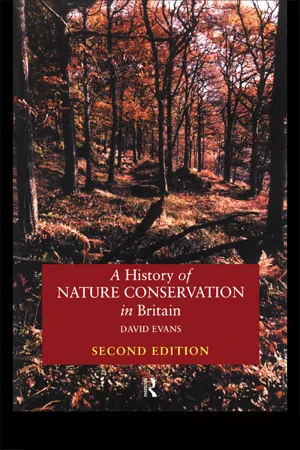
A History of Nature Conservation in Britain traces the rise of the conservation movement from its beginnings in Victorian coffee houses to today's societies with their membership numbering in the millions. The first complete history of the British, and oldest, branch of the movement, David Evans's book offers invaluable insights into the campaigns for countryside protection and access, from battles against the use of pesticides, against pollution and genetic engineering through to legislation for the protection of our wildlife and the freedom to walk the mountains.
The 2nd Edition has been fully revised and updated. Topical issues are considered afresh; and new chapters reflect the rapid changes throughout the 1990s both in social attitudes, conservation practices, legislation, funding and within conservation organizations themselves. In the light of recent developments, Evans also looks at some difficult choices to be made in years ahead and asks how the conservation movement will fare on the new global stage.
- 312 pages
- English
- ePUB (mobile friendly)
- Available on iOS & Android
eBook - ePub
A History of Nature Conservation in Britain
About this book
1 The why and the wherefore
The facts and figures that make up the landscape of Britain today pose a pertinent question: has ‘the most comprehensive and the most advanced system of nature conservation in the world’ had the right effect? Has it done anything towards conserving nature or has it merely built itself into an impressive but toothless piece of machinery? Should we look to the figures with pride and satisfaction or do the facts warrant disappointment and concern?
Quite clearly, the movement in itself is very healthy indeed. The voluntary bodies continue to grow in strength and number, part cause and part effect of an increasing interest in conservation generally. But fundamental changes in outlook are needed before the conservationists can expect to succeed on a scale that befits their numbers.
The history of the movement shows it always to have been fragmented and parochial; very often, not a movement at all. Groups have studied their own speciality in isolation from all other interests both within and without the sphere of nature conservation. It is astounding that many groups still work in that fashion, even though we now accept the inter-connection of all interests through the ‘web of life’—all creatures and plants depending, in some way, on all the rest. How can these groups expect to survive as responsible societies? How have they survived in the past? How, in fact, has the ‘movement’ come through its first hundred years?
It has survived thanks to two characteristics which, at first sight, appear to be weaknesses but which have in reality ensured its success and should continue to do so if handled wisely. They have no firm scientific base, still less an economic one. The first is the aesthetic appeal of the natural world. The second is the peripheral importance of ‘nature’ to so many other interests.
AESTHETICS
Take so much time leaning on a gate and watching cattle grazing; lie down for a while and smell the good earth and the growing grass; stand for a few moments on a high down and gaze your fill on the patchwork quilt of England; visit the cloistered peace of a large wood in which the noise and bustle of your daily life will seem very far away; add just a small bunch of wild flowers to taste; and be grateful to the feathered choir around you for their melody. And there you have it, a country mixture which will do the winter-worn town dweller more good than gallons of medicine.
(A.G.Street, A Country Calendar)
Any number of passages with a similar sentiment can be found in English literature. Reasons for conserving nature are many, varied and, most significantly, often very personal. Ask any conservationist to disregard the well-rehearsed arguments and you will uncover a deep and personal reason; the one that makes it the right thing to do; the one that makes them conservationist in outlook. They may struggle to find the words but, even without them, the tune rings true within.
much of what we call beauty in the countryside stems from conditions of ecological repose. We sense the beauty even if we have not a clue about the ecology.
(Darling 1971)
Understanding nature and acting accordingly safeguards a certain set of physical human needs. But there are other needs, less tangible and often less articulatable, yet long characteristic of our species. These involve the exercise of sentiment and the stimulation of our sense of order and purpose, our appreciation of beauty and freedom.
(Durrell 1986)
It has been said that ‘as an argument on its own, beauty—natural or aesthetic— has never cut much ice in England’ (Bonham-Carter 1971). In official circles, that may be the case, but officialdom does not indulge in sentiment. Beauty cut ice with the founders of the National Trust and it cuts ice with millions of concerned people today. This accounts for the movement’s reliance, past and present, on voluntary effort and why so many people who do not count themselves as naturalists in any way support the conservation organisations. It also accounts for our ‘potentially dangerous preoccupation with the exotic and the rare’ (Mabey 1980). Many conservationists look upon efforts to save near-extinct species, or those close to the edge of their natural range, as futile and expensive exercises.
Let us face the issue fairly and squarely. A large number of animals and plants now have little or no hope of survival in the wild. It is an inevitable part of the whole process of evolution that extinction overtakes those which have failed to adapt themselves to changing environments and circumstances. Also many of the niches, which would have offered chances of survival for at least a long time ahead, have been destroyed, albeit unwittingly by man.
(Stamp 1969)
But for personal and aesthetic reasons, we continue to do our best for such species.
It is perhaps traditional that the people of Britain, sometimes slow to accept an idea, once they are convinced, take up a cause with widespread and tenacious enthusiasm. If the cause is sufficiently worth-while, there is always a vast reserve of voluntary effort. No one expects to be paid for doing a job which obviously must be done.
(Stamp 1969)
There is also the more negative but equally valuable and valid reason: the fight against something evil or ominous; and here, if ever, is an example of the ‘tenacious enthusiasm’ referred to above.
So there are dogged defensive actions, backs to the wall, adrenalin constantly flowing, time and money sacrificed, relations grieved, acquaintances lost; but it is enormously worthwhile; all the time there is the deep satisfaction of knowing that this is a battle not solely to save a last wilderness and the living past but also against greed and materialism. Few causes could be more inspiring.
(Sayer, in Lowenthal and Binney 1981)
The movement relies upon its inspired and committed practitioners, whether their reasons be negative or positive, their actions defensive or combative. While the cause remains to them ‘enormously worthwhile’, all will not be lost. But for each of them, the inspiration issues from a different sentiment; the satisfaction settles on a different set of values. We can only ask each in turn and hope to be allowed a glimpse of what makes them tick.
I know few pleasures greater than standing in a newly established nature reserve which one has helped to set up. You feel that you have made a special link with the plants and animals around you and with the people who will come to look at their descendants in the future. It is difficult to analyse why this is so satisfying. It is not just because a conservation battle has been won. I suspect that the underlying pleasure—relief is almost a better word—is connected with a desire to produce something permanent in today’s world, in which so much else is subject to unpredictable change. Setting up a nature reserve has similarities with painting a picture or writing a scientific paper: a great deal of hard work has been done, obstacles have been overcome and, at the end, something new has been created. One has impinged on the future as well as the present. Of course, nothing can be predicted with absolute certainty—political madness or war may undo one’s work or mismanagement may mar it—but what can be done has been done.
(Moore 1987)
Feelings; personal conviction. The cause of nature conservation—any cause— could have no stronger ally. The things closest to a person’s heart are the things for which that person will fight most keenly. The voluntary organisations have always used this fact most wisely to attract support. Their advertising focuses upon suffering or loss, on damage or destruction of those things dearest to us. Thus we are shown poisoned animals, trapped birds, toppled trees, trodden plants, bland or barren landscapes. ‘Direct action’ groups, most notably Friends of the Earth and Greenpeace, have attracted much public sympathy for the cause, in spite of some extravagant tactics, by highlighting emotive issues such as the culling of baby seals and the dumping of noxious chemicals in our beloved seas. Even efforts on behalf of our less-loved creatures have played upon emotions, such as the campaigns of the Fauna and Flora Preservation Society on behalf of bats and snakes.
But even feelings have not cut much ice in official circles. Such dearly held personal conviction ought to have done but, because it cannot be measured and evaluated, and because the conservationists have not spread the word sufficiently, it has been ignored by the policy-makers. It is these two extremes of reaction to personal emotions that account for the movement’s having become so large while its practical results have remained so slight.
Feelings are shunned in the sharp scientific discourse of modern ecological conservation—which I find rather sad, because a compassion for and a delight in the natural world are what turn people to act in its defence in the first place. The fact that such feelings are impossible to quantify does not make them irrelevant.
(Mabey 1980)
On the contrary, because they cannot be quantified, it is all the more important to give them full consideration. But in an economic world, if a thing cannot be costed, it remains irrelevant. In a legal world, feelings have no sway. In a geographical world, climate and topography dictate the best land use. Only in a political world can the feelings of individuals have any effect at all and only then if those individuals present a sufficiently united front. This is the main hope for the nature conservation movement and very gradually it is coming to realise this fact.
Feelings, though, while bringing personal conviction to the cause, have also been responsible for preventing the crystallisation of a ‘movement’. The ‘tune within’ has often been too individual, too intimate. This is where sentiment, in one way the saviour of nature conservation, has also come to threaten its effectiveness. Darling gave the warning in the 1969 Reith Lecture which did so much to bring the cause to general notice.
Sentiment and ethics should never be confused. Ethics stand firm and are to be sought by spirited and intellectual effort of reflection; sentiment is a poor guide in the mosaic of ecology and conservation.
(Darling 1971)
He talks of a ‘hardheaded’ attitude towards conservation; specifically, to draw some monetary return from it in the then-forthcoming economic 1970s. He was attempting to focus the various attentions of the conservationists and to make them credible to those outside the ‘movement’. He could see the cause and the effects of the parochial past. The cause—those personal feelings giving a blinkered and self-centred view. The effects—its two great weaknesses: its inability to unite within itself and its unwillingness to make allowance for other interests outside natural history. How could those ‘outsiders’ have been expected to understand the conservationist point-of-view? There was little common ground.
ASSOCIATIONS
What common ground there was arose from that second fortunate characteristic of ‘nature’: its peripheral but pertinent relevance to other interests. Basically, almost any activity which takes place out of doors—and many which do not— inevitably come into contact with the natural world. The huntsman has a vested interest in preserving the stocks of his quarry and, for the last thousand years, has taken positive steps to do so. Strange then that we should still see eyebrows raised when the sportsman labels himself ‘conservationist’. Farming and woodland management have relied through the centuries on healthy and sustaining practices which ensured a varied flora, fauna and landscape. Variety is health in the natural world. Only in the last fifty years have the practitioners, now known as agribusinessmen and blanket foresters, taken to bulldozing nature as though it is no longer of relevance to them.
The estate owners of the eighteenth century planted trees and encouraged wildlife—apart from certain outlawed species—in order to enhance their domestic surroundings. Their leisure time gave them an interest in nature study, but they gave no thought to its conservation. Today, more people enjoy increasing hours of leisure time. Coupled with modern mobility, this has brought about an explosion of hobbies, pastimes and interests, many of which depend upon access to the countryside. The pathway to free access has always been strewn with obstacles and many remain today. Improvements have given us the National Parks and the long-distance footpaths. But access to the countryside conflicts with the basic needs of nature conservation, and the two interests have developed separately. Thus we have had a Countryside Commission and a Nature Conservancy; a National Parks system and a series of National Nature Reserves. But the world became too small to bear their conflict and the 1990s saw them accept an inevitable coming together (p. 211). Natural history is such an important feature of the countryside to which access is demanded, and freedom to get out and enjoy the countryside so vital to an interest in conservation, that the two could remain apart no longer.
Familiarity breeds, not contempt, but comprehension. Modern media have nurtured some knowledge and understanding of the countryside, but unless it is followed up with an enquiring visit, it remains a strangely isolated experience. Nature needs to be enjoyed at first hand. Leisure and mobility have done much more than any number of magazines and television programmes to cancel out the effects of enforced isolation from our countryside. Britain was the first industrialised country. Most people live in towns and have traditionally enjoyed no real contact with the countryside, so that, as Bonham-Carter (1971) has written:
it is all too easy to convey the impression that amenity is an extra, something which—though good to strive for—can be added to life on top of the real business of existence. This attitude, typical of urbanised countries and particularly true of this one, is a heritage of the Industrial Revolution, which dehumanised work and divorced man from Nature.
…once the damage done by industrialism had gone deep and man had become disorientated—say by the third quarter of the 19th century—the approach (or return) to amenity was…hesitant and piecemeal …The whole movement, if such it can be called, was a series of actions and reactions, irregular in direction and pace, touching a variety of apparently disconnected subjects, from the protection of wild life to the betterment of housing.
The history of nature conservation in Britain has been moulded by the sportsman and the rambler; the day tripper and the country dweller; the town and country planner and, occasionally, the conservationist. Sometimes they have done good for the...
Table of contents
- COVER PAGE
- TITLE PAGE
- COPYRIGHT PAGE
- PLATES
- FIGURES
- TABLES
- ACKNOWLEDGEMENTS
- ABBREVIATIONS
- INTRODUCTION
- 1: THE WHY AND THE WHEREFORE
- 2: ‘PREHISTORY’: ISOLATION AND IDEALS
- 3: 1890–1940: SOCIETIES AND SUBURBIA
- 4: 1940S: NATIONAL PARKS AND NATURE RESERVES
- 5: 1950S: REFUGES AND RECONSTRUCTION
- 6: 1960S: NEW CONSERVATIONISTS AND THE COUNTRYSIDE ACTS
- 7: 1970S: GOING PUBLIC AND GETTING PLACES
- 8: 1980S: BUILDING BRIDGES AND BRINGING DOWN BARRIERS
- 9: 1990S: GOVERNMENT INERTIA AND GLOBAL INITIATIVE
- 10 FUTURE: THE MECHANICS AND THE MISSION
- REFERENCES AND FURTHER READING
Trusted by 375,005 students
Access to over 1.5 million titles for a fair monthly price.
Study more efficiently using our study tools.
Frequently asked questions
Yes, you can cancel anytime from the Subscription tab in your account settings on the Perlego website. Your subscription will stay active until the end of your current billing period. Learn how to cancel your subscription
No, books cannot be downloaded as external files, such as PDFs, for use outside of Perlego. However, you can download books within the Perlego app for offline reading on mobile or tablet. Learn how to download books offline
Perlego offers two plans: Essential and Complete
- Essential is ideal for learners and professionals who enjoy exploring a wide range of subjects. Access the Essential Library with 800,000+ trusted titles and best-sellers across business, personal growth, and the humanities. Includes unlimited reading time and Standard Read Aloud voice.
- Complete: Perfect for advanced learners and researchers needing full, unrestricted access. Unlock 1.5M+ books across hundreds of subjects, including academic and specialized titles. The Complete Plan also includes advanced features like Premium Read Aloud and Research Assistant.
We are an online textbook subscription service, where you can get access to an entire online library for less than the price of a single book per month. With over 1.5 million books across 990+ topics, we’ve got you covered! Learn about our mission
Look out for the read-aloud symbol on your next book to see if you can listen to it. The read-aloud tool reads text aloud for you, highlighting the text as it is being read. You can pause it, speed it up and slow it down. Learn more about Read Aloud
Yes! You can use the Perlego app on both iOS and Android devices to read anytime, anywhere — even offline. Perfect for commutes or when you’re on the go.
Please note we cannot support devices running on iOS 13 and Android 7 or earlier. Learn more about using the app
Please note we cannot support devices running on iOS 13 and Android 7 or earlier. Learn more about using the app
Yes, you can access A History of Nature Conservation in Britain by David Evans in PDF and/or ePUB format, as well as other popular books in Physical Sciences & Geography. We have over 1.5 million books available in our catalogue for you to explore.