This book is available to read until 4th December, 2025
- 240 pages
- English
- ePUB (mobile friendly)
- Available on iOS & Android
eBook - ePub
Available until 4 Dec |Learn more
Philosophy goes to the Movies
About this book
Philosophy goes to the Movies is a new kind of introduction to philosophy that makes use of movies including The Matrix, Antz, Total Recall and Cinema Paradiso, to explore philosophical ideas.
Topics covered include:
*the theory of knowledge
*the self and personal Identity
*moral philosophy
*social and political philosophy
*philosophy of science and technology
*critical thinking.
Ideal for the beginner, this book guides the student through philosophy using lively and illuminating cinematic examples. It will also appeal to anyone interested in the philosophical dimensions of cinema.
Frequently asked questions
Yes, you can cancel anytime from the Subscription tab in your account settings on the Perlego website. Your subscription will stay active until the end of your current billing period. Learn how to cancel your subscription.
At the moment all of our mobile-responsive ePub books are available to download via the app. Most of our PDFs are also available to download and we're working on making the final remaining ones downloadable now. Learn more here.
Perlego offers two plans: Essential and Complete
- Essential is ideal for learners and professionals who enjoy exploring a wide range of subjects. Access the Essential Library with 800,000+ trusted titles and best-sellers across business, personal growth, and the humanities. Includes unlimited reading time and Standard Read Aloud voice.
- Complete: Perfect for advanced learners and researchers needing full, unrestricted access. Unlock 1.4M+ books across hundreds of subjects, including academic and specialized titles. The Complete Plan also includes advanced features like Premium Read Aloud and Research Assistant.
We are an online textbook subscription service, where you can get access to an entire online library for less than the price of a single book per month. With over 1 million books across 1000+ topics, we’ve got you covered! Learn more here.
Look out for the read-aloud symbol on your next book to see if you can listen to it. The read-aloud tool reads text aloud for you, highlighting the text as it is being read. You can pause it, speed it up and slow it down. Learn more here.
Yes! You can use the Perlego app on both iOS or Android devices to read anytime, anywhere — even offline. Perfect for commutes or when you’re on the go.
Please note we cannot support devices running on iOS 13 and Android 7 or earlier. Learn more about using the app.
Please note we cannot support devices running on iOS 13 and Android 7 or earlier. Learn more about using the app.
Yes, you can access Philosophy goes to the Movies by Christopher Falzon in PDF and/or ePUB format, as well as other popular books in Philosophy & Philosophy History & Theory. We have over one million books available in our catalogue for you to explore.
Information
1
PLATO'S PICTURE SHOW – THE THEORY OF KNOWLEDGE
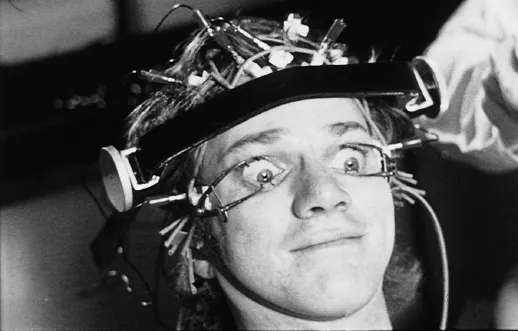
A Clockwork Orange.
Credit: Warner Bros. (Courtesy The Ronald Grant Archive)
Credit: Warner Bros. (Courtesy The Ronald Grant Archive)
In Bernardo Bertolucci's 1970 film The Conformist, the protagonist, Marcello Clerici (Jean Louis Trintignant), joins the Italian Fascist movement and is sent to Paris to assassinate his former mentor, a philosophy professor. In one key scene, Clerici goes to visit the professor in his study. The professor reminds him that Plato's cave was the subject of his unfinished thesis. As they talk, Clerici remarks that when the professor entered the lecture room, he would always close the windows to keep out the light and noise. Clerici now goes to the window and closes the shutters himself, leaving only a shaft of light. He then recounts how the professor used to lecture on Plato's cave, and begins to recite the myth. So why does Clerici close the shutters? What is Plato's cave doing in Bertolucci's film? What is its significance for this tale of Fascist delusion? And what does this appearance tell us about the cave story itself? We will come back to these questions shortly, but in order to answer them it is necessary to pay a visit to Plato's cave itself.
Plato's cave
Plato's cave is one of philosophy's most memorable and haunting images. I have already said a little about it in the Introduction, but we can now start to explore it in more detail. In the Republic, Plato asks us to imagine prisoners in an underground cave with a fire behind them. The prisoners are bound so they can only see the shadows on the wall before them. These shadows are cast by puppets that are being carried by unseen figures behind them, moving up and down in front of the fire. The prisoners think that the shadows are the only things there are to see. If they are released from their bonds and forced to turn around to the fire and the puppets, they become bewildered and disoriented, and would much rather be left in their original state. Only a few can bear to realize that what they see are only shadows cast by the puppets, and these courageous few begin their journey of liberation that leads past the fire and eventually out of the cave. Here, outside the cave, they find not merely puppets but the real things, the objects of the real world (see Plato 1974, 514-18; these numbers refer to the standardized pagination which appears in the margins of most editions of the Republic).
What makes this image so compelling is its suggestion that we might be like these prisoners, that everything we ordinarily take to be reality might in fact be no more than a shadow, a mere appearance, and that the real world might be something quite different. In our ordinary experience, of course, we are perfectly familiar with the apparent as well as the real, and can usually tell the difference between them. The stick in water appears to be bent, but we can readily establish that it is really straight. But if absolutely everything that we encountered, everything in our ordinary experience, was merely an appearance, an illusion, and quite different from what was really the case, we would have no idea that we were being systematically deluded in this way. We would imagine that we had genuine access to reality, that what we saw was all that there was to see. And if anyone were able to pierce through this veil of appearances, and to grasp the true nature of reality, they would view those left behind as no more than prisoners confined to a world of illusion. To them everything that those left behind took to be solid reality would seem to be no more than shadows.
There are a number of ways in which the cave story can be interpreted. First of all, it can be read as ‘an invitation to think, rather than to rely on the way things appear to us' (Blackburn 1994, 253). In other words, it is an invitation to engage in philosophical reflection. To start thinking philosophically about our beliefs, we have to abandon our unthinking confidence that what we ordinarily take to be knowledge really is knowledge. We have to become critical of received opinion and commonsense beliefs, beliefs that are presented to us as self-evident or unquestionable. Second, the cave story illustrates Plato's positive philosophical views about the nature of knowledge. Philosophers have always been interested in giving an account of knowledge, of the nature, scope and limits of what we can know — an area of philosophical reflection that has come to be known as epistemology. And the cave serves as a concrete representation of Plato's own epistemological position. It is a representation of his view that all that our senses reveal to us are mere shadows, mere appearances removed from reality. For Plato we are just like the prisoners in the cave to the extent that we think the world we ordinarily encounter through our five senses is the real one. In order to comprehend the world as it really is, we have to escape from this prison; we have to go beyond what is given to us in experience.
The cave image is also significant because it brings us to our first encounter between philosophy and the cinema. As I mentioned in the Introduction, it has often been noted that there are uncanny similarities between the cave Plato imagines and the modern cinema. As in Plato's ‘picture show', so too in the cinema we sit in darkness, transfixed by mere images that are removed from reality. The very structure of the cinema parallels that of the cave. The cinema audience watches images projected onto a screen in front of them. These images are projected from a piece of film being moved past a light, behind them. And the images on this piece of film are themselves merely copies of the real things outside the cinema. There are some striking parallels here. Indeed, if anything, the cinema improves on the cave as a place of illusion. What are being projected on the cinema screen are not mere shadows, but sophisticated, highly realistic images. The history of the cinema is itself one of increasingly sophisticated representations of reality, with the progressive addition of sound and colour making the illusion more and more complete. Moreover, through seamless editing, films usually do not call attention to the fact that they are merely representations of reality up on the screen, not reality itself – the so-called ‘reality effect'.
There is a sense then in which, as Ian Jarvie puts it in Philosophy of the Film, we recreate Plato's thought experiment every time we step into a cinema (see Jarvie 1987, 48). And it is always possible to think of the cinema itself in cavelike terms, as a refuge from reality, a place where we can go in order to escape from the outside world, to lose ourselves in deception, illusion and fantasy. However it is important to note that despite the clear similarities between the cinema and Plato's cave, there are also some significant differences. In particular, the kind of deception involved in Plato's account is much more profound than anything we might find in the cinema. If the cinematic image is a mere representation, an illusion, it is an illusion that we voluntarily subject ourselves to, which we allow ourselves to be taken in by and in full awareness of its status as an illusion. That we are not seriously taken in by the cinematic image reflects the fact mentioned earlier, that ordinarily we can distinguish perfectly well between illusion and reality, between the apparent and the real. We can do this even if the illusions are relatively sophisticated, like those we find in the cinema. Moreover, leaving the cinema and returning to the ‘real world' all takes place within our ordinary experience, just as the distinctions we make between appearance and reality are ordinarily made within the realm of our ordinary experience. For Plato in contrast, it is ordinary experience as a whole that is illusory. In order to escape from illusion and to comprehend reality, we have to escape entirely from the realm of ordinary experience.
Now, Plato's account does not only have to do with knowledge, but also with a certain kind of liberation bound up with knowledge. Ignorance for Plato is not bliss, but rather a form of enslavement. We are prisoners insofar as we are prevented from grasping the true order of things by the limits of everyday experience, the limits of our commonsense understanding of the world. To gain knowledge is to escape from the imprisonment of our ordinary conception of the world. There is also a suggestion in Plato's account that ignorance can enslave us in a more concrete sense as well. Plato portrays the prisoners as mistaking for reality the shadows of puppets that are being carried by others. The implication is that we can be effectively enslaved or controlled by other people when we take for reality the images they feed to us, when we believe what they want us to believe. Only if we become critical, if we come to see these false images for what they are, will we be in a position to free ourselves from this kind of enslavement.
Seen in these terms, Plato's story of the cave, of imprisonment and its overcoming, starts to acquire wider resonances. It calls to mind first of all what is involved in the process of an individual's growing up, of leaving childhood behind and becoming an adult. This is more than simply a process of physical development. An important part of growing up is intellectual growth, in which we come to question the ideas and beliefs, along with the moral principles and standards, that have been fed to us by our parents, teachers and others over the years. When we are young, of course, we uncritically accept whatever we are told about the world. As a result we are very much influenced and determined in our thinking by the views, opinions and attitudes of those around us. As we grow up, however, we often find that many things we have hitherto accepted without question are in fact questionable, and may even be false. In so doing, we start to become critical, to examine our existing beliefs and standards, to sift through them and weigh them up. Such critical thinking is an important part of breaking away from dependence on others and of establishing our own identity, our own views on the world, and our intellectual and personal independence.
Second, the cave calls to mind forms of imprisonment and their overcoming in a wider social context. An important way in which people can be controlled or manipulated is by filling their heads with misleading or false images of the world. And this is a far more effective form of social manipulation than straightforward coercion, because here we are willingly doing what other people want us to do. Consider for example the advertising images manufacturers bombard us with, designed to make us think that their products are indispensable to our well-being or happiness. Or consider the role of political propaganda in fostering certain views of the world, or in orchestrating public opinion in various ways, in order to help bring about the political goals of others. And movies too have sometimes been seen as part of this, as instruments of cultural or political indoctrination, encouraging people to mistake a false cinematic reality for the reality of life in the world. So in this wider social and political context as well it would seem that we can become like Plato's prisoners, controlled by others because we take the images they present us with for reality. This is by no means to suggest that we are nothing more than passive, unthinking dupes, completely at the mercy of these images, as some commentators have supposed. We can still differentiate between appearance and reality. What the possibility of such deception means, once again, is that it is important to be critical. Becoming critical of these images imposed on us, seeing them for what they are and grasping the truth of our circumstances, is an important part of breaking away from this kind of subjection, of attaining some degree of independence in our lives.
These are some of the wider implications of the cave image, and they are often alluded to in cinematic portrayals that make use of the cave image. Let me cite some examples of this. First of all, as Erich Freiberger (1996) argues, Cinema Paradiso (Giuseppe Tornatore, 1989) makes use of the cave image, and indeed the parallel between the cave and the cinema, to portray the development of its main character Toto towards adulthood and intellectual independence. In the film, Toto (played as an adult by Jacques Perrin) tells the story of his childhood, and in particular, his childhood friendship with the projectionist at the local cinema. On Freiberger's reading, the local cinema can be seen as a cave-like place, in which the villagers are spellbound and seduced – in effect ‘bound' – by the conventional opinions and standards of behaviour they see on the screen. But Toto has already begun to escape from this cultural confinement because he has turned away from the screen and has come to know the projectionist (Philippe Noiret) ‘behind the scenes'. The liberating escape from the cave that Plato envisages is paralleled in the film's overall story, which traces how Toto gradually comes to escape from the narrow confines of small village life, and heads off into the wider world to gain an education.
In Cinema Paradiso the cave image figures in a tale that is primarily about an individual's journey out of childhood and intellectual confinement. The cave has also been used in order to comment on forms of confinement in a wider social and political context. Bertolucci's The Conformist is a good example of this. As Julie Annas notes in her Introduction to Plato's Republic (1981, 257-8), Bertolucci uses Plato's cave image quite deliberately and explicitly in the film to comment on the imprisoning delusions of Fascism (it does not appear in the Alberto Moravia book on which the film was based). Clerici, having closed the shutters and turned his old philosophy professor's office into a gloomy, cave-like place, recalls how the professor used to lecture on Plato's cave. In response, the professor compares the deluded prisoners in the cave with the inhabitants of Fascist Italy, blinded by propaganda. Since Clerici is himself one of those who has been trapped and blinded, one of the cave-dwellers, he is unaware of the irony of his own recollections. But Bertolucci underscores the professor's point, because there is enough light entering the room to cast shadows on the wall behind them. At one point in Clerici's exposition, as he is emphasizing a point, his shadow is caught appearing to make a Fascist salute; and at the end, after the professor expresses doubts that Clerici is at heart really a Fascist, he opens the shutters and Clerici's shadow disappears in the resulting light. In this way, Bertolucci uses the cave image to emphasize both the shadow world of Fascist beliefs, and Clerici's ultimately uneasy relationship with it.
Before moving on there is one more allusion to the cave worth noting. One of the most interesting cinematic portrayals of the cave, once again in the form of a cinema, appears in Stanley Kubrick's A Clockwork Orange (1971). Here, the enslaving force is psychological conditioning in the service of the state, part of a future totalitarian government's campaign to clear the prisons of ‘mere common criminals'. As a condition for his release from prison, the film's vicious anti-hero Alex (Malcolm Macdowell) is subjected to a kind of cinematic brainwashing. In this cinema, he is strapped to his seat, unable to turn his head away from the screen. Clips on his eyelids mean that he is unable even to close his eyes. Behind him, shadowy, white-coated scientists orchestrate the proceedings. He is shown a string of violent film images, and with the help of drugs is gradually conditioned to feel sick at the very thought of violence. The result is a model citizen, of sorts. This scenario strongly recalls Plato's cave because Alex is literally bound to his seat, unable to look away from the cinematic images; and because when he is brought under the sway of these images his independence is destroyed and his behaviour controlled. However Kubrick also introduces a number of perverse twists that sets it apart from other cinematic representations of the cave. In this cave story, Alex has to go into the cave, to submit to the brainwashing, in order to gain his freedom from imprisonment. Moreover, because he has now become a prisoner in a more profound sense, Kubrick gets us to sympathize with Alex, but it is not at all clear that it would be a good thing for this particular prisoner to escape from his cave.
Descartes, dreams and demons
We have been looking, with the help of some cinematic portrayals, at ways in which Plato's cave image can be used to think about aspects of our social and political existence. We will touch once more on these broader issues of knowledge and society towards the end of the chapter. For now, let us return to matters more directly related to the issue of knowledge. Plato, as we have seen, uses the cave image to illustrate his account of knowledge. In it he throws into question the faith we ordinarily place in our senses. All that our senses reveal to us, he thinks, are mere shadows and illusions, removed from reality. But Plato is not the only thinker to question our faith in the senses. Here it will be helpful to look at the thought of a more recent philosopher, the French philosopher René Descartes (1596-1650). Some two thousand years after Plato, in the seventeenth century, Descartes published his Meditations on First Philosophy. And here, he raises issues very similar to those raised by Plato. Like Plato, he wants to question our ordinary reliance on sense experience for our knowledge of the world, and to challenge our complacency, our confidence that what we take to be knowledge really is knowledge. In order to do so, Descartes presents a number of sceptical arguments, which are designed to show that a great deal of what we think we know on the basis of our experience can in fact be called into question – even what seems most obvious. He employs two arguments in particular here, the dream argument and the evil demon argument.
Descartes begins by pointing out that we sometimes go wrong in our judgements about small or distant objects, for example thinking that a distant tower is square when it is in fact round. This is the first kind of sceptical consideration he raises, but as he himself recognizes, this is not enough to radically call into question what our experience tells us about the world. In such cases we can always correct our mistake in the light of further experience, for example by approaching the tower and inspecting it more closely. So it would seem at first glance that we are perfectly capable of distinguishing between the illusory and the real in our ordinary experience. But like Plato, Descartes wants to raise the possibility that our experience might radically mislead us about the world. He proceeds to raise a more radical doubt about what experience tells us, to suggest that he might go wrong even about things which are right before us, for example that he is sitting by the fire, in his dressing gown, holding a piece of paper in his hand. This Descartes does through his famous dream argument. He raises the question: how does he know that he is sitting by the fire, writing, and not asleep, in bed, merely dreaming that he is sitting by the fire, writing? The difficulty in answering this throws into question those beliefs that seem to be based on the evidence of one's immediate experience.
Just as Plato's cave provides a handy model for thinking about the cinema, so too do dreams. It has often been suggested that viewing a film has similarities with dreaming. Speaking of Hollywood as the ‘dream factory', and of theatres as ‘dream palaces', is not merely to employ a picturesque metaphor. In the cinema as well, we are in a darkened room, our physical activity has been limited, and our visual perception is heightened to compensate for our lack of movement. It has been argued by some that it is precisely because the film viewer's situation is like that of the dreamer that we accept what we see as real, and ‘flimsy two-dimensional images have the uncanny substance of real bodies and things' (see Stam et al. 1992, 144). A good deal of film theory based on Freudian psychoanalysis takes its start from this. However, when we come to consider the issue that Descartes poses, of whether it is possible to determine whether we are dreaming or not, it is the differences between films and dreams that come to the fore. As we have already seen in connection with Plato's cave, if the cinematic image is an illusion, it is an illusion that we voluntarily subject ourselves to, and in full awareness of its status as an illusion. So we can easily distinguish between the cinematic ‘dream' and reality. With his dream argument, Descartes is suggesting the possibility of a much more radical kind of deception, arising because of the difficulty in determining whether what we see is a dream or reality.
We can however find situations that more fully parallel the dream argument portrayed within films. An updated version of the dream argument appears for example in Total Recall (Paul Verhoeven, 1990). In one scene, a doctor tries to convince the hero Doug Quaid (Arnold Schwarzenegger) that he is not in fact an invincible secret agent, fighting the villains on Mars. Rather, he is a lowly construction worker strapped into a chair back on Earth, and he is merely dreaming that he is an invincible secret agent fighting the villains on Mars. It is all part of a futuristic ‘holiday' in which one buys memories of one's trip rather than actually going on the journey. However, the doctor continues, things have gone wrong, they cannot wake Quaid back on Earth, and he is a mere representation sent into Quaid's dream to help him return to reality. All that Quaid has to do is to swallow a little pill, as a ‘symbol of his desire to return to reality'. Quaid, of course, has to work out whether the doctor is telling the truth or is in fact in league with the evil forces that Quaid is fighting, and his whole story is really a fabrication designed to trap him. As it happens, he is able to do so. About to swallow the pill, he notices a trickle of sweat running down the doctor's brow, a sign of nervousness that convinces him the doctor is lying.
This might seem like a reasonable enough kind of response to the dream argument – you find some test to determine whether or not you are dreaming, such as some element in your present experience that is inconsistent with your being in a dream. But one of the intriguing things about the dream argument is that it has a way of resisting such easy responses. The problem is that any test we might come up with ...
Table of contents
- Front Cover
- Half Title
- Title Page
- Copyright
- Dedication
- CONTENTS
- Acknowledgements
- Introduction
- 1 Plato's picture show – the theory of knowledge
- 2 All of Me – the self and personal identity
- 3 Crimes and Misdemeanors – moral philosophy
- 4 Antz – social and political philosophy
- 5 Modern Times – society, science and technology
- 6 The Holy Grail – critical thinking
- Glossary
- Further Reading
- Bibliography
- Index