From the moment a child is born, they interact with the sensory world, looking at colours, feeling textures; constructing mental and physical images of what they see and experience. Within all early years settings and into primary school, the aim for the practitioner, is to provide as many opportunities as possible to stimulate, excite and ignite the visual and tactile imagination of the young children they teach.
Young Children as Artists considers how art can be managed, understood and relished as an essential ingredient towards the creative potential of each unique young child. The book focuses, on how to enjoy, celebrate and extend what a young child can do in art and show how engaged adults and the wider school community can become confident participants in the process of early years art making.
Full of practical advice, on to how to design, develop, resource and extend art and design environments within the early years setting, the book covers:
Developing skills for positive and participative adult interaction and engagement
Understanding and analysing child involvement in art
Planning for opportunities and responding to observation and schema in art and design
Practical suggestions for activities and resources (inside and out)
Ideas to explore sensory development and awareness
Ways to manage and savour the art transition into KS1
Ways to encourage parental participation and understanding of the art process with their children
Opportunities to engage with practising artists
This book will help to invigorate the art experiences offered in your early years setting by considering what is accessible, individual, inspiring and meaningful for young children and how you can best support their formative paths of enquiry.
Trusted by 375,005 students
Access to over 1.5 million titles for a fair monthly price.
‘Nothing there!’ said Peter, and they all trooped out again – all except Lucy. She stayed behind because she thought it would be worthwhile trying the door of the wardrobe, even though she felt almost sure that it would be locked.
(C. S. Lewis, 1998: 12)
Introduction
Children can be astounding to work with as we watch them discover the wonders of life and within this first chapter we look at how curiosity and involvement are richly combined in the journey of a young artist. We will consider a general view of the young child’s innate and overwhelming desire to find out and become immersed in curiosity-driven play. This play is what allows them to discover, think and refine and it is this sequence that forms their artistic character. It is important, initially, to establish what drives the young child to exist in an exploratory moment.
Absorption of the moment
The image of the absorbed child whose tongue sticks out as they carefully draw a line or whose jaw is set whilst their fingers deftly work a pair of scissors is very familiar to us all as adults who work with young children. Both these external indicators inform us as to the intensity of involvement that has, at that particular moment, consumed the child. Fully submerged engagement such as this is an unselfconscious indulgence in the unequivocally challenged moment of exploration; a state which young children frequently experience.
We, as busy adults in our world of chores, timescales and deadlines, can easily forget how wonderful it can feel to switch off from all external pressures or expectations and indulge in ‘the moment’. As we grow older, we only occasionally remember to lose ourselves in a sensory-based or investigative experience. For young children, however, it is central to their world of discovery and hence understanding of their existence. Their ability to be consumed in what they are researching, to be totally absorbed in study, where no distraction is powerful enough to shift concentration, allows them to make sense of their world and also to make new and exciting discoveries.
Being curious
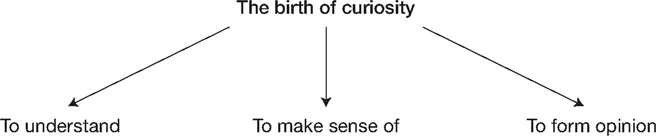
We first need to contemplate and value what it is that sparks a child’s interest. Interest comes from the sense of being curious and as Keith Gentle (1985) so rightly stated a few decades ago: ‘All children are born curious … they have a natural curiosity and like to touch and hold things, to manipulate them and include them in their play’ (Gentle, 1985: 53). Curiosity feeds the hungry and expectant mind and explorations follow repast and so quests are sustained. Curiosity is the search engine inside a child that enables the stratification of understanding. This busy and intensive cognitive laboratory develops the ability to rationalise, realise and form opinions as suggested in Figure 1.1.
Curiosity motivates learning; a child is captured in a moment of ‘wanting to know’ and so they are motivated to find out and consequently learn something new. A good early years setting should always have a sense of ‘curiosity’ about it – interesting materials, strange artefacts, unusual books, for example. Contained within these props are motivational qualities that spark the imagination. EYFS guidance reminds us of this as outlined in the two following statements:
Provide stimulating resources which are accessible and open-ended so they can be used, moved and combined in a variety of ways.
Children will become more deeply involved when you provide something that is new and unusual for them to explore, especially when it is linked to their interests.
Let us magnify and examine a curiosity-driven moment. Have in your mind two children as they unwrap a mysterious parcel found in the classroom. This unknown and unwrapped object is like a jewel to a magpie for the children. The parcel’s presence provokes powerful motivational forces – seeing it, approaching it, prodding it, pulling at the string, tearing it open and looking inside to see what it contains … Once it is opened, they will probe further and explore its contents.
Figure1.1 The birth of curiosity
Their eagerness has vigour, determination and, importantly, excited interest. There is no doubt that, in this moment, curiosity was the trigger for engagement and a conduit for learning in action.
Curiosity-based play
Within us all there exists a powerful tug-of-war between a desire to satisfy curiosity, to explore the unknown, and a need to adhere to that which is familiar, comfortable and safe. For an artist, the challenge of the new, the magnetism of the unfamiliar, is stronger than the need to reinforce the status quo.
(Prentice, 1994: 127)
Children often engage in two types of curiosity-based play – ludic: playing in a more open-ended, ad-hoc way, and epistemic: exploring to find out – knowledge acquisition. It is arguable that the former will lead to the latter but perhaps this is not always the case as if it was it would undermine the delicious unknown of the ludic explorer. A mission to ‘understand’ is not always part of the agenda. As we get older, our curiosity tends to dwell in the epistemic camp, as we want to know and understand a situation, a problem or a new experience with more clarity.
Epistemic curiosity states are aroused by novel questions, complex ideas, ambiguous statements, and unsolved problems, all of which may point to a ‘gap’ in one’s knowledge, and reveal a discrepancy between that which one knows and desires to know.
(Litman et al., 2005: 559)
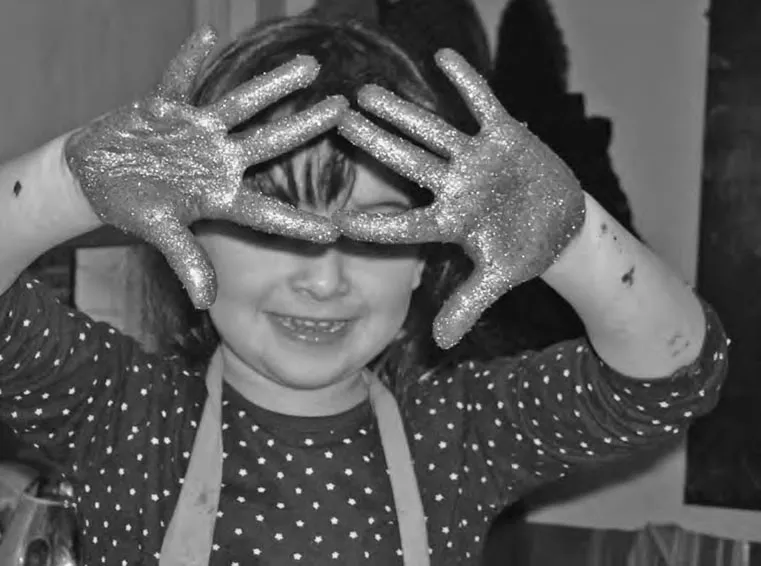
It could be argued that human maturation brings with it fewer opportunities and self-induced limitations to exploring with a carefree spirit. We are less open to ludic curiosity and play as it may unbalance our status quo and send us off on other tangents, which can be time-consuming. Children, it seems, veer between the two but their ability to indulge and wallow in ludic curiosity leads to great and surprising adventures, as the child in Figure 1.2 discovered.
Marion Dowling (2005) once referred to young children as ‘sparkly thinkers’, defining the image of a young child very much alive and buzzing with ideas. If we value and listen to these energised young bodies – what they are doing, what inspires them to be curious in their thoughts and where these ‘sparkles’ travel – we realise how exceedingly unpredictable they are. Whether it is that our paths of enquiry become more linear, logical and predictable as we get older is debateable, but adults have moved away from the often surprising tangents that young children take. It is wise not to underestimate the value of ‘surprise’ both as a learner and as a teacher – it is something intangible and unique that we cannot plan for but can maximise when it happens. We will consider the element of surprise in learning and motivation in more detail in Chapter 3.
Figure1.2 Sparkly investigations
Curiosity and personal transcendence
If we return our thoughts to the ‘sparkly’ element of young children, we need to understand and relive what it might be like to encounter their sense of adventure. The unknown is a phenomenon and there is an almost ‘magical’ aspect to children’s ability to pore over and work out. Dowling (2005) talks of young children’s experiences of ‘transcendence’, where their great adventures and explorations enable them to reach out to the limits of their world as part of growing up. The magical spirituality of childhood is something that is inexplicable and not easy to describe in words.
This living enchantment is so very personal and often fleeting, but it does very much exist in young children’s engagement with the world. As previously stated, we adults can miss a momentary phenomenon, for reasons mostly to do with our busy lives. The joy of spending time with young children is that they can remind us of a beautiful spider web that has rain droplets hanging from it on the walk home from nursery, that the moon is out at the same time as the sun, that there is a ladybird crawling up a brick wall … someone wise once referred to these as ‘beads of happiness’.
Children are very successful at collecting such beads all through the day – existing in their esoteric and individual encounters. It is a testament to their age that they allow themselves to be distracted by beauty, fun, interest and phenomena. Spiritual curiosity such as this throws into the ring all the whys, whats, wheres and what fors, and requires the young mind and brain to think, consider and ask questions.
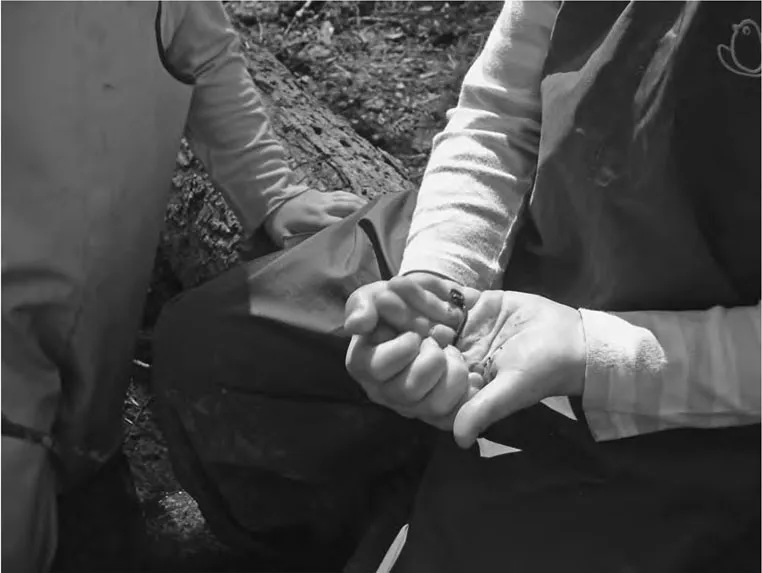
In Figure 1.3, we witness India, who found a woodworm in the thick, peeling bark of a tree. She had been brushing her hands against the rough surface and suddenly squealed as her hands and eyes met to find a worm. Her discovery was non-verbal in its description of the experience, her hands told the story of the two haptic experiences – hard bark and soft wiggly worm. Her experience had a secret sense of discovery and her absorption in the moment was intense.
Let us contemplate that feeling of absorbed concentration, where curiosity has ignited involvement. As writers, we know the experience of being so absorbed in an idea that we lose all track of time; as readers, we know the joy of reading a novel that is so gripping that we cannot put it down; as internet users, we know that the myriad of connections can take us to ideas and concepts so fascinating that time ebbs away. As artists, colour, shape, form and line can become so all-consuming in their infinite possibilities that dawn turns to dusk.
Figure1.3 India discovers a woodworm
‘Beads' – leading to creativity
Allow yourself to take a journey back in time to remember a ‘bead’:
a wonderful moment of play;
a captured experience of wonder;
a moment of curiosity and excitement.
If you can do this, consider the emotions involved in those experiences and the glorious memories attached to discovery, exploration and a whole world alive with mysteries to be solved. They are emotions associated with familiar sensations such as butterflies in the stomach, lumps in the throat and tingles down the spine. We are all familiar with such human responses and recognise them but they are perhaps less prominent in our everyday lives as adults. They are, however, essential and necessary in the holistic development of children if we want to treasure what makes them the ‘children’ of their ‘todays’.
The task of nourishing young children’s spirituality is one of releasing, not constricting, children’s understanding and imagination. We can think about this as the internalisation of a young child’s learning, as it brims over with natural fascination. Their unpredictability is what makes them so alive. Hart’s (2003) studies on the spirituality of young children and their insights emphasises an infant’s ability to surpass the ideas held by adults, because they have a natural sensitivity that allows them to hear their inner wisdom. Listening to intuition means noticing those subtle cues that we often tell children not to pay attention to – a gut feeling, a vague discomfort, a fleeting idea.
Eisner (2002) refers to these early exploration...
Table of contents
Cover
Half Title Page
Title Page
Copyright Page
Table of Contents
List of illustrations
Acknowledgments
Introduction
1 Curiosity and the sparkly thinker
2 The idiosyncratic child: schemas and styles
3 The world of senses: transforming the consciousness
4 Observing the process: analysing the experiences
5 Adult interaction and engagement
6 The environment: spaces and invitations
7 Following their footsteps
8 A shared understanding
9 Artists: an external dynamic
Bibliography
Index
Frequently asked questions
Yes, you can cancel anytime from the Subscription tab in your account settings on the Perlego website. Your subscription will stay active until the end of your current billing period. Learn how to cancel your subscription
No, books cannot be downloaded as external files, such as PDFs, for use outside of Perlego. However, you can download books within the Perlego app for offline reading on mobile or tablet. Learn how to download books offline
Perlego offers two plans: Essential and Complete
Essential is ideal for learners and professionals who enjoy exploring a wide range of subjects. Access the Essential Library with 800,000+ trusted titles and best-sellers across business, personal growth, and the humanities. Includes unlimited reading time and Standard Read Aloud voice.
Complete: Perfect for advanced learners and researchers needing full, unrestricted access. Unlock 1.5M+ books across hundreds of subjects, including academic and specialized titles. The Complete Plan also includes advanced features like Premium Read Aloud and Research Assistant.
Both plans are available with monthly, semester, or annual billing cycles.
We are an online textbook subscription service, where you can get access to an entire online library for less than the price of a single book per month. With over 1.5 million books across 990+ topics, we’ve got you covered! Learn about our mission
Look out for the read-aloud symbol on your next book to see if you can listen to it. The read-aloud tool reads text aloud for you, highlighting the text as it is being read. You can pause it, speed it up and slow it down. Learn more about Read Aloud
Yes! You can use the Perlego app on both iOS and Android devices to read anytime, anywhere — even offline. Perfect for commutes or when you’re on the go. Please note we cannot support devices running on iOS 13 and Android 7 or earlier. Learn more about using the app
Yes, you can access Young Children as Artists by Suzy Tutchell in PDF and/or ePUB format, as well as other popular books in Education & Early Childhood Education. We have over 1.5 million books available in our catalogue for you to explore.