- 224 pages
- English
- ePUB (mobile friendly)
- Available on iOS & Android
eBook - ePub
About this book
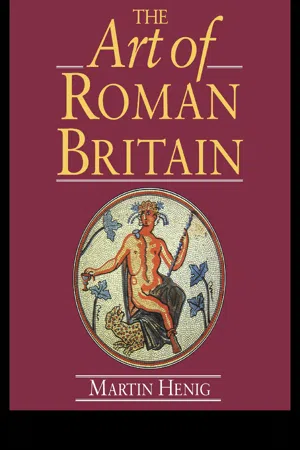
With the help of over 100 illustrations, many of them little known, Martin Henig shows that the art produced in Britannia--particularly in the golden age of Late Antiquity--rivals that of other provinces and deserves comparison with the art of metropolitan Rome. The originality and breadth of Henig's study is shown by its systematic coverage, embracing both the major arts--stone and bronze statuary, wall-painting and mosaics--and such applied arts as jewelery-making, silversmithing, furniture design, figure pottery, figurines and appliques. The author explains how the various workshops were organized, the part played by patronage and the changes that occurred in the fourth century.
Trusted by 375,005 students
Access to over 1.5 million titles for a fair monthly price.
Study more efficiently using our study tools.
CHAPTER ONE
The Art of the Celts
Sometime we see a cloud that’s dragonish;
A vapour sometime like a bear or lion,…
That which is now a horse, even with a thought
The rock dislimns, and makes it indistinct
As water is in water.
A vapour sometime like a bear or lion,…
That which is now a horse, even with a thought
The rock dislimns, and makes it indistinct
As water is in water.
For anyone accustomed to the traditions of Classical and Hellenistic art, the dissolution of natural forms must imply a retreat from reality. The Celtic artist thrived on those very ambiguities evoked by Mark Antony in his final despair. We have only to look at the bird heads incorporated in the fleshy leaf forms derived from Greek acanthus ornament upon the circular shield-boss from Wandsworth, or the reinterpretation of the head of Apollo and the biga respectively on the obverse and the reverse of Gaulish and British copies of the gold staters of Philip II of Macedon to see what was involved.1
Nevertheless, the art of Mediterranean lands was a constant stimulus to the Celtic craftsman in the lowland zone of mainland Britain until the Roman Conquest. Thereafter, the disciplines of classicism appear generally to have been paramount, although Celtic inspiration can be seen behind a continued liking for line and pattern as well as in certain specific forms and motifs. Indeed, a considerable quantity of metalwork, mainly brooches, pins, studs and other such trinkets, were still ornamented in the traditional style and embellished with enamel. Celtic-derived ornament is even to be found on thoroughly Roman items such as the trullae used in Roman houses and at religious shrines for the service of food and libations, and seal-boxes which protected wax impressions made with signet rings. Ireland, never incorporated in the Roman Empire, and most of Scotland, only part of which was occupied for about a century, remained thoroughly Celtic in culture, and any art practised there was in the La Tène style throughout the Roman Iron Age; so much so that the main problem, in Ireland at any rate, is to date it.2 The continuity of native art through large parts of Britain led to a reflorescence of high-quality metalwork during the Dark Ages. The apogee of late Celtic achievement, manuscripts and associated ecclesiastical metalwork, was compared by Giraldus Cambrensis in the twelfth century to ‘the work of angels’, but this art was itself a fusion between native and Roman ideas as its literate Latin and Christian context testifies, and it could not have come into being but for Rome.3
Earlier attempts at such fusion between two very different artistic cultures can be seen in the Roman province of Britain. Although purely Celtic art was confined to comparatively unimportant items of dress and the style was otherwise only manifested directly in a few motifs, notably S-scrolls and the almond-shaped eyes on some human figures even in major sculpture, other far deeper influences illustrate the debt. With regard to the Roman mainstream of artistic development, which is the chief theme of this book, it was the qualities of the Celtic imagination in terms of pattern, design and colour which gave distinction to the art of the north-western provinces in general, and especially that of Britain. One of the aims of this book will be to suggest that the strength of Insular and Gaulish art lay in a constant tension between the Graeco-Roman prototype and a native interpretation of it.
To many enthusiasts for Celtic culture the advent of Rome was a disaster, a classic case of a colonial power destroying a refined and delicate local civilization. The best-formulated expression of this idea, as noted in the introduction, is that of Collingwood when he writes that the Britons had been brilliant artists until the brutality and ‘vulgar efficiency’ of the conquest had ‘destroyed that gift and reduced their arts to the level of mere manufactures’.4 The concept of the Celt as a victim doubtless appealed to Collingwood in the era of rampant fascism, but it ignores the fact that the Romans were normally very careful not to attack native identity, but rather to encourage it and thereby help it to conform to their own ideals. The process is most familiar in the case of religion, where it is called syncretism, but the equation of Sulis with Minerva, for example, not only created a new language for religion but, at the same time, new means of artistic expression. It has not only been the specialist in Celtic culture who has judged the results harshly. The dedicated classical archaeologist has seen the standards of Graeco-Roman civilization swamped by barbarism, although on the whole such an attitude has been expressed either as a result of ignoring Romano-British (or Gallo-Roman) art or at best by relegating it to a footnote in wide surveys of the Roman achievement; after all there is a great deal to survey and is it not a perverse desire to survey Roman art through the medium of a remote provincial culture?
In order to understand the art of Roman Britain it is vital to come to an appreciation of both Celtic design and Graeco-Roman art. Those who have written seriously and sympathetically on Celtic art, such as Paul Jacobsthal in his great work Early Celtic Art, have indeed explored the debt of the Celts to the Greek world in the early period.5 The most characteristic fleshy lobes and sweeping free-flowing curves derive from palmettes and vegetal friezes. Satyr-heads become fantastic masks; naturalistic lions, curious half-abstract beasts. Masterpieces such as the Lorraine flagons in the British Museum could not have existed without Greek and Etruscan metalwork and the wine trade, but they required smiths of enormous skill and artistic flair for their realization. However, most students have seen the coming of the Romans to Gaul and Britain in the first centuries BC and AD as having had a very different effect, as though classicism was like medicine, a little being beneficial and a lot being poison. Admittedly, apart from the present writer, this has been questioned explicitly by Professor E.M.Jope and implicitly by others writing on provincial culture.6 We can be certain that, if a change occurred, it did so because patrons and artists willed it and that there was a good reason for a change of direction, lying in the nature and limitations of Celtic art.
Surviving examples of Celtic art, established in the British Isles from about the fourth century BC, are largely confined to metalwork, although wood-carving may well have had considerable importance and patterned textiles, too, probably had cultural significance. There are a few carved stones in Ireland, notably the Turoe Stone, which perhaps had a religious or commemorative significance, but there was no major tradition even here, and it may be assumed that large-scale sculpture as well as painting were unknown. Art was thus used in a fairly narrow range of circumstances and, as far as our knowledge of it is concerned, it was largely synonymous with the craft of the iron-, bronze-and gold-smiths who produced weapons, armour, horsegear, fire-dogs, buckets and cauldrons, drinking vessels, torques and other jewellery and mirrors. It was a means of display at the feast and in battle, and was thus central to the rather limited requirements of a tribal society. The major pieces belonged to chieftains and their wives, who could only establish their rank in society either by the intrinsic worth of their possessions or by the virtuosity of workmanship displayed by the craftsman in their employ.
As far as I know, no major item of Celtic art in Britain actually comes from the battlefield or from the feasting hall where it was displayed. The preservation of so much art is the result of secondary use. In some instances, these objects accompanied their owners to the grave. One important area for such finds lies in eastern Yorkshire and north Lincolnshire (Humberside) where they are associated with the so-called Arras culture of the second century BC.7 Grave goods include swords with decorated scabbards for men and brooches and mirrors for women. A small canister with engraved curvilinear ornament from a grave at Wetwang Slack is an example of a more unusual item; perhaps containing either some precious commodity or an amulet.8 A century and more later, the graves of the chieftain class of the Aylesford- Swarling culture of Kent and the Welwyn culture of Hertfordshire, Essex and contiguous counties contain a more luxurious range of treasures, many of them influenced by Rome if not actual Roman imports, associated with the drinking of wine—such as the Aylesford bucket itself.9 The iron fire-dogs from several of the Welwyn culture graves demonstrate the skills of a local blacksmithing tradition, which could also be used in constructing a stand for Italian amphorae. 10 Almost half of the fine series of some 36 recognized British mirrors with decorated backs are known to have come from burials of women, and range from Essex in the east to Cornwall and Gloucestershire in the west.11 However, weapons were not generally thought appropriate in male burials by this period and perhaps this indicates a change in custom towards the consumerism prevalent in Roman times. Certainly, art-objects continued to be placed in graves long after the Conquest, and although the practice was universal in the ancient world, it is tempting to see many of the insular examples, such as the Bartlow barrows on the Cambridgeshire—Essex border, as marking the final Romanization of a native rite, even though by the second century none of the art was truly Celtic.12 Whatever the exact form of the objects, they established the status of the deceased in the other world, and incidentally provide us with a showpiece of their cultural and artistic aspirations.
The other way in which objects have been preserved was their deliberate deposition in rivers or lakes, or in pits on dry land. Posidonius quoted by Strabo tells us of the gold ornaments deposited in sacred lakes near Toulouse (Strabo iv, i, 13). The caches of gold torques from Snettisham, Norfolk, seem to mark a similar series of votive deposits within a sacred area on land, and the Ipswich torques may be part of another such deposit.13 The cache of bronze objects, armour and horse- and chariot-fittings from Llyn Cerrig Bach in Anglesey, many of which are decorated, indeed came from a lake, and the vast majority of single finds of metalwork in Britain were dredged from rivers, and are likewise votive offerings.14 To some degree this is equivalent to the gift of a precious object to a Roman temple, but a prestige item such as the Battersea shield (1), once it was thrown into the Thames, was no longer available to advertise its original owner’s greatness, unlike a piece of plate deposited in a temple during Roman times, which continued to be used in temple ritual or at least shown to worshippers on feast days. In human terms the only moment at which the former could serve such a purpose was at the very moment of the sacrifice when it was removed from circulation for ever.15 Of course the intricate artistry could hardly be admired in such circumstances, again unlike the treasures in Greek and Roman temples which frequently served as museums. For us it seems odd that art should be destroyed in this way; part of the answer must be that the lost objects continued to have a real life in the hands of the unseen powers (like the sword Excalibur in Arthurian myth). The practice may also have helped to preserve the owners of great wealth from envy, both human and divine, and, after all, goldsmiths and bronzesmiths were at hand to replace what was lost. Most surviving Celtic art has thus been found in special contexts where it had been discarded.
Some art does come from settlement sites of high status, such as hillforts, albeit mainly as fragments or else as small items such as brooches. Coins, too, deserve a mention here as decorated objects of wide circulation. Such material enables us to relate Celtic art to daily life. The workshop debris found at Gussage All Saints, Dorset, dating from the first century BC is of particular importance.16 The site lay close to the perimeter, at the main entrance of the fort, which makes sense considering the danger of fire. Over 7000 fragments of moulds for the manufacture of horse trappings were found, as well as some discarded scrapmetal, a small billet of tin bronze, modelling tools of bone and fragmentary crucibles.
As far as we can tell from the designs on the moulds, which include leaf-like ornament for a terret identical to one from Mill Plain, Suffolk, and a triskele for a lynchpin like an example found at Owlesbury, Hampshire, the style drew on a repertoire common throughout southern Britain. It can be argued that the workshop only flourished for a brief period and that the smith was itinerant. Clearly, the existence of a koiné without pronounced regional variation suggests smiths travelling from patron to patron. On the other hand it has been pointed out that a bronze-casting workshop demanded organization, with supplies of oak-charcoal, beeswax, levigated clay, sand and metals being available. Smiths moved from court to court and doubtless they could be sought out by other patrons and might expect to find facilities in which to practise their craft elsewhere. The appearance of smiths on coins of Cunobelin (2) and Dubnovellaunus, of course, demonstrate their assured status in Iron Age society. Even more significant than the existence of a couple of coin-types depicting smiths is the fact of coinage itself, struck by the ruling powers of the Celtic world. This demonstrated the importance of the courts of tribal chieftains in patronage, either simply as p...
Table of contents
- COVER PAGE
- TITLE PAGE
- COPYRIGHT PAGE
- ILLUSTRATIONS
- INTRODUCTION
- CHAPTER ONE: THE ART OF THE CELTS
- CHAPTER TWO: ART IN THE ERA OF THE CONQUEST
- CHAPTER THREE: ART AND THE ROMAN ARMY
- CHAPTER FOUR: THE USES OF ART IN ROMAN BRITAIN
- CHAPTER FIVE: NATIVES AND STRANGERS IN ROMAN BRITAIN
- CHAPTER SIX: ARTISTS AND THEIR PATRONS
- CHAPTER SEVEN: ART IN LATE ROMAN BRITAIN
- CHAPTER EIGHT: ATTITUDES TO THE ART OF ROMAN BRITAIN
- ABBREVIATIONS
- NOTES AND REFERENCES
- BIBLIOGRAPHY
- GLOSSARY
Frequently asked questions
Yes, you can cancel anytime from the Subscription tab in your account settings on the Perlego website. Your subscription will stay active until the end of your current billing period. Learn how to cancel your subscription
No, books cannot be downloaded as external files, such as PDFs, for use outside of Perlego. However, you can download books within the Perlego app for offline reading on mobile or tablet. Learn how to download books offline
Perlego offers two plans: Essential and Complete
- Essential is ideal for learners and professionals who enjoy exploring a wide range of subjects. Access the Essential Library with 800,000+ trusted titles and best-sellers across business, personal growth, and the humanities. Includes unlimited reading time and Standard Read Aloud voice.
- Complete: Perfect for advanced learners and researchers needing full, unrestricted access. Unlock 1.5M+ books across hundreds of subjects, including academic and specialized titles. The Complete Plan also includes advanced features like Premium Read Aloud and Research Assistant.
We are an online textbook subscription service, where you can get access to an entire online library for less than the price of a single book per month. With over 1.5 million books across 990+ topics, we’ve got you covered! Learn about our mission
Look out for the read-aloud symbol on your next book to see if you can listen to it. The read-aloud tool reads text aloud for you, highlighting the text as it is being read. You can pause it, speed it up and slow it down. Learn more about Read Aloud
Yes! You can use the Perlego app on both iOS and Android devices to read anytime, anywhere — even offline. Perfect for commutes or when you’re on the go.
Please note we cannot support devices running on iOS 13 and Android 7 or earlier. Learn more about using the app
Please note we cannot support devices running on iOS 13 and Android 7 or earlier. Learn more about using the app
Yes, you can access The Art of Roman Britain by Martin Henig in PDF and/or ePUB format, as well as other popular books in History & Ancient History. We have over 1.5 million books available in our catalogue for you to explore.