- 208 pages
- English
- ePUB (mobile friendly)
- Available on iOS & Android
eBook - ePub
About this book
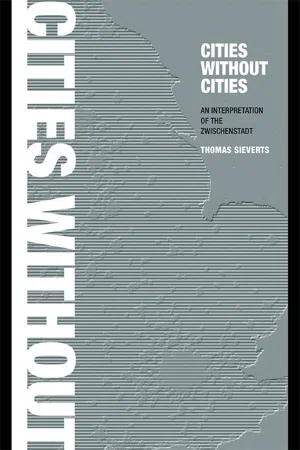
This book investigates the characteristics of today's built environment: no longer simply a city but increasingly large conurbations made up of a number of development clusters, linked by transport routes. The diffusion of the once compact city into a city web, the 'meta city' is mirrored by changes in society from communities with strong social cohesion and interest in their towns and cities to individuals pursing their own goals, with global social links and little interest in their city.
Information
Chapter 1: The living space of the majority of mankind–An anonymous space with no visual quality
Since the railway, car and electronics have exploded the spatial limits imposed by the muscular capabilities of human beings and animals, the city has been extending almost without restraint into the countryside. Its expansion and the degree of its dispersal follow the relevant traffic and communications technologies: the railway results in a star-shaped, linear expansion, the car fills in the surfaces and electronics leads to ‘borderless’ expansions. However, this development is based not only on technical inventions but also on far-reaching historical causes. The forces which produced the compact city and kept it together for 150 to 200 generations – by which I mean the priest-kings and religious associations, temples and churches, walls and markets, feudalism and the guilds – had definitively come to an end before these technical inventions.
It is possible that the compact city is itself only an interlude in the development of human civilisation. According to interpretations of the theory of evolution, human beings are primates, social animals living in loose groups who prefer life in the wide-open savannah and at the edge of light forests. The compact, walled city would therefore be an historically imposed form which would dissolve ‘naturally’ the moment the causal social forces are taken away.
Against this it might be argued from the perspective of cultural history that the cultural development of mankind in the past 5,000 years was inseparably connected with the development of the compact city. As result, it is part of the essence of human beings as cultural beings and with its dissolution the cultural development of humanity might also be jeopardised.
The dispute as to whether the disappearance of walls and moats around 1800 was a liberation or a loss of uniqueness and safety is as old as the event itself. Many citizens felt that through the opening up of the city to the open countryside they were being exposed to anxiety, whereas others greeted the liberation from narrowness and constraint. Goethe was one of those who welcomed the opening of the city:
Even relatively large cities are now pulling down their walls, the moats even of princely castles are being filled in, cities are only large blotches, and if you see such a thing on your travels you think general peace is confirmed and the Golden Age is at the door. Nobody feels comfortable in a garden which does not look like open countryside; there should be no reminders of art or constraint, we want to be completely free to breathe the air without restriction.2
Whatever the reaction of citizens at the time may have been, it must be recorded that throughout the whole world the ‘city’ of the modern age extends into its environment and thus creates the peculiar forms of an urbanised landscape or a landscaped city.
Following a venerable tradition we still call distinct regions of settlement ‘cities’. Or we describe them with such abstract concepts as ‘city agglomerations’, ‘areas of concentration’, ‘urbanised landscapes’, etc., because we note how inappropriate the concept of ‘city’ is when applied to these fields of settlement as they evoke completely different associations. For want of a better term, we shall call these structures which consist of ‘fields’ of various uses, construction forms and topographies Zwischenstädte. They take up large areas, and they have both urban and rural characteristics. The Zwischenstadt stands between the individual, special place as a geographical and historical event and ubiquitous developments of the global division of labour; between the space as an immediate living area and the abstract traversing of distance which is only measured in the consumption of time; between the mythical Old City which is still very effective, and the Old Cultural Landscape which remains anchored deep in our dreams.
The Zwischenstadt as an international phenomenon
This Zwischenstadt, which is neither city nor landscape, but which has characteristics of both, neither has a suitable name nor is it concrete. Despite the fact that it has no name, it can be found all over the world. Intermediate cities with 20–30 million inhabitants have emerged in Asia and South America. For all the massive differences, depending on the state of economic development, culture and topography, they have the shared feature that they have almost nothing to do with the relevant local pre-industrial urban traditions. Across all cultures of the entire world, they share specific common characteristics: a structure of completely different urban environments which at first sight is diffuse and disorganised with individual islands of geometrically structured patterns, a structure without a clear centre, but therefore with many more or less sharply functionally specialised areas, networks and nodes.
We find Zwischenstädte of this kind particularly conspicuous in areas in which cities grow beyond their own extensions into a city cluster, but most clearly where the historical, traditional city-composing forces never really took effect, such as in the Ruhr area, or also in the metropolitan areas of the Third World. In the Zwischenstadt the ratio of open landscape and built-up areas has frequently been reversed; the landscape has changed from being an all-inclusive ‘background’ to being a contained ‘figure’. Conversely, the settlement surface has increased in size and openness and has acquired something of the character of a surrounding landscape. This Zwischenstadt is a field of living which, depending on one’s interest and perspective, can be interpreted either as city or as country. Although the causes of this diffuse form may differ, they share the feature that the historical city-forming forces and the limits imposed by them had reached their end.
The Zwischenstadt as a result of innumerable individual rational decisions
As a whole, the diffuse city gives an ‘unplanned’ impression, but it has arisen out of innumerable individual, and – considered on their own – rational decisions. A typical example from an old industrial region might run as follows: a road exists, a factory is built, either because agricultural products are to be processed or because mineral resources are available, the processing of which might supply a growing market. The factory attracts worker settlements to it, and gardens are allocated to the workforce to enhance its self-sufficiency. The population next needs schools and shops. The growing employment and consumption market attracts further institutions and, as the social richness increases, a basis is formed for new specialisation and further division of labour. New traffic routes and public establishments become necessary, and in this way the evolution of the city continues on the principle of ‘settlement creates settlement’, without following any pattern planned in advance.
Another example, but coming from the Third World, may be that: an old city functions as a centre of attraction for city migrants who leave their villages for the widest possible range of reasons – usually there are several – ranging from overpopulation or lack of basic foodstuffs, caused by unemployment, to the promise of emancipation offered by migration to urban centres. Such migrants look for a place of settlement in which they have access to the blessings of the city but can still operate a modest semi-urban agricultural economy. The consequence of these decisions, each of which is logical in its own terms, is a less structured, more open settlement between city and country, which develops further with its own workplaces and facilities into a more or less independent Zwischenstadt.
Structurally comparable results are produced by the behaviour of house buyers in our cities. They are looking for properties which they can still afford, from which the core of the city can still easily be reached and at the same time access is open to the country. The consequence of such an accumulation of decisions, each cogent in itself, is the ‘settled’ landscape, which initially is almost exclusively residential and, after a period of intensification and consolidation, attracts workplaces and consumer provision. Only then does it develop into a Zwischenstadt which frees itself from its original dependency, supplies itself and enters into a relationship of mutual exchanges with the original city.
Statistical analysis in Germany shows that it is not so much the small towns, the central places prescribed for this purpose by town planning, which attract new inhabitants, but rural communities on the periphery of the ‘central places’. From a fore- cast of the Federal Research Institute for Regional and National Development it is apparent that the borders of today’s settlements, according to a conservative estimate, will expand by a further 10 per cent by 2010 (against a core growth of only about 2–4 per cent). ‘It is becoming increasingly obvious that the residential environment is becoming more and more decisive for where we live and no longer, as in the past, the proximity of the workplace.’3
In the USA a similar development is taking place on a much larger scale; the triggers in many cases are motorway exits, major shopping centres and, for several years now, major office complexes on motorway intersections. These are at the same time the consequences and causes of settlement activity. Also these very widespread Zwischenstädte have long since separated themselves from the original city, but here the dependency relationship has often been reversed – the impoverished core city now looks for its work places in the surrounding Zwischenstadt.4
Even in cases in which the planning of major interconnected urban expansions offer possibilities for strong concentration, these newly planned urban configurations are rather uniform, only marginally centralised and differentiated, because the configurations of day-to-day living are relatively diffuse and changing.5
In the sequence of the development of the Zwischenstadt, internationally comparable stages are apparent.
After a phase of rapid urbanisation, accelerated by migration between country and city, there is usually a slower phase, in which the surplus birth rate is normally the main cause of growth. In still later phases, as is apparent in Western Europe, the annual growth of the city falls to below 1 per cent, and the rate of immigration increases again. This also conceals the consequences of excess ageing in the cities and the emigration of families with small children and the prosperous to the attractive surrounding small towns and villages.’6
Over time, the original freedom of the choice of location becomes increasingly restricted. The area fills up, new developments have to respond to a context which is becoming more and more built-up and constricted. At some stage, the available land is fully developed, the Zwischenstadt has ‘grown-up’, and further development can and may only be implemented through intensification, reutilisation and the regeneration of disused sites. Old urban fabric and uses become superfluous, they are converted, reused, rebuilt and finally removed. All this taken together produces a carpet of settlement which appears to be without any plan but has the nature of a palimpsest in which old, superfluous and deleted text and images glimmer through the new text.
The unique character of the Zwischenstadt
Urban development in different parts of the world is subjected to very different forces. Whereas urban expansion in the Ruhr, Wallonia and the English Midlands is directed by heavy industry, in countries such as India, Africa and South America it is subject to the pressures of overpopulated rural areas. In the USA and Western Europe trends follow the investment of wealth in private residential areas or the compulsion towards affordable housing on inexpensive land. Despite the massive differences in the forces behind urban development, the result in each case is the diffuse form of the Zwischenstadt, which separates itself from the core city – if one still exists – and achieves a unique form of independence.
These characteristics link the area of Greater Tokyo with the Ruhr area, São Paulo with Boswash – the area between Boston and Washington in the USA which has merged into an integrated city environment – and Mexico City with Bombay. Even the area of Greater Stuttgart or the Rhine–Main area could be characterised in this way. Major differences are based on the varying densities of residential and car use. The Zwischenstädte in the Third World are on the whole still denser and more compact than the more dispersed forms in the industrialised world. When compared with the giant Zwischenstädte in Asia and South America, comprising more than 20 million people, perhaps we should regard the increase in areas of concentration in European Countries as one single Zwischenstadt.7
What Karl Ganser says about the Emscher region applies to all cities across the whole world as soon as they have grown beyond the size of small major cities or, indeed, have formed in a period in which historical city-forming forces were no longer effective.
As, for example, in the Ruhr area:
This 800 sq. km large settlement area . . . is essentially fully developed. It is a Zwischenstadt, which does not correspond to our ordinary image of the city and our yearning for an intact landscape. With the weak growth potential of the time ahead of us, this settlement structure can no longer be reconfigured. We must assume that it is a given and develop its hidden qualities.’8
In all intermediate cities, characteristic patterns of interpenetration of open spaces and built form have become apparent. A generally common characteristic of the Zwischenstadt is the continued search for the implementation of the ‘Tucholsky principle’, the simultaneous yearning for both the urban and rural ideal which he describes in one of his famous poems entitled ‘The Ideal’. The Tucholsky principle is the search for reconciliation between the contrasts of participation in human society, the life of the city, and participation in nature. In other words, it is the yearning for a combination of pastoral romanticism and the comforts of the city.9 This search for a resolution to the underlying paradox of a combination between urban centrality and contact with the countryside was also shared by the early socialists Owen and Fourier, by the reformers Cerdá and Howard and by the visionary architects Frank Lloyd Wright, Le Corbusier and Hilberseimer.10 It is also still being pursued by innumerable home and land owners in day-to-day practice and is leading to a maximisation of the interface between built-up area and the countryside. These boundaries are of particular ecological interest and fit in well with the ‘primate nature’ of man. In the last few years they have excited the interest of ‘fractal researchers’ who have attempted to represent these growth processes in mathematical terms, with extremely interesting results.11 They show how, at the macro level of the city region, growth processes and the distribution of the different sizes of settlements occur quite similarly in major agglomerations throughout the world and how similar the developments appear at different levels of scale. These patterns form virtually independent of the political, cultural and socio-economic backgrounds.
In Germany, these settlement patterns have been characterised by the particular form of local authority self-administration – with heavy competition between communes.
The developments have been driven by immigration and segregation against which town planning is powerless. At the same time, these are the problem areas which result from the decisions of the inhabitants which affect them most directly. This means that definitions of the problems of urban development would more sensibly be concentrated on not denying these trends but rather by accepting them as critical conditions for the development of the problem.
In addition, the developments are based on the fact that the local authorities each have to pursue their own interests. Their competition forms the basis for the tendency to exploit the advantages of the peripheral location against the settlement centres and to plan for residential and commercial areas which only drive forward the process of settlement expansion with all its consequences. Against this, city development planning is powerless – at least as long as it conceives itself as ‘local authority development planning’. It will not be able do anything else until such time as the local authorities in the agglomeration areas merge into political units (and not only sectoral specialist associations). For this purpose, however, they must largely give up or restrict their political existence; but this cannot be expected from them.’12
However, planning across local authority boundaries is restricted due to sovereignty and public expenditure limits. Simultaneously, with the restriction of public funds for publicly subsidised housing, infrastructure and public facilities, urban and regional planning is losing one of its last instruments for an effective, active influence on the evolution of urban areas.
Zwischenstadt and landscape
Whereas obvious, though sometimes politically and culturally modified international comparisons can be observed at the macro level of the Zwischenstadt, there are clear differences at the micro level of the three-dimensional urban structure caus...
Table of contents
- Cover Page
- Title Page
- Copyright Page
- Cities without Cities
- Other Titles Available From Spon Press
- Foreword to the English Edition
- Foreword
- Acknowledgements
- Chapter 1: The Living Space of the Majority of Mankind –an Anonymous Space with No Visual Quality
- Chapter 2: An Interpretation of the Zwischenstadt
- Chapter 3: The Organisation of Everyday Living Space
- Chapter 4: The Zwischenstadt as a Focus for Design
- Chapter 5: Perspectives for a New Form of Regional Planning
- Postscript to the Second Edition: The City in the Second Modern Age
- Postscript to the Third Edition: On Dealing with Uncertainty in Urban Development
- Notes
Trusted by 375,005 students
Access to over 1.5 million titles for a fair monthly price.
Study more efficiently using our study tools.
Frequently asked questions
Yes, you can cancel anytime from the Subscription tab in your account settings on the Perlego website. Your subscription will stay active until the end of your current billing period. Learn how to cancel your subscription
No, books cannot be downloaded as external files, such as PDFs, for use outside of Perlego. However, you can download books within the Perlego app for offline reading on mobile or tablet. Learn how to download books offline
Perlego offers two plans: Essential and Complete
- Essential is ideal for learners and professionals who enjoy exploring a wide range of subjects. Access the Essential Library with 800,000+ trusted titles and best-sellers across business, personal growth, and the humanities. Includes unlimited reading time and Standard Read Aloud voice.
- Complete: Perfect for advanced learners and researchers needing full, unrestricted access. Unlock 1.5M+ books across hundreds of subjects, including academic and specialized titles. The Complete Plan also includes advanced features like Premium Read Aloud and Research Assistant.
We are an online textbook subscription service, where you can get access to an entire online library for less than the price of a single book per month. With over 1.5 million books across 990+ topics, we’ve got you covered! Learn about our mission
Look out for the read-aloud symbol on your next book to see if you can listen to it. The read-aloud tool reads text aloud for you, highlighting the text as it is being read. You can pause it, speed it up and slow it down. Learn more about Read Aloud
Yes! You can use the Perlego app on both iOS and Android devices to read anytime, anywhere — even offline. Perfect for commutes or when you’re on the go.
Please note we cannot support devices running on iOS 13 and Android 7 or earlier. Learn more about using the app
Please note we cannot support devices running on iOS 13 and Android 7 or earlier. Learn more about using the app
Yes, you can access Cities Without Cities by Thomas Sieverts in PDF and/or ePUB format, as well as other popular books in Architecture & Architecture General. We have over 1.5 million books available in our catalogue for you to explore.