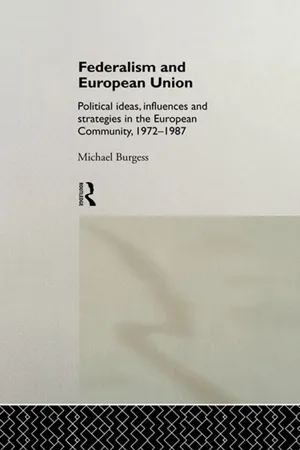
One of the most frequent criticisms levelled at the European Community is the discrepancy between federalist rhetoric and the intergovernmental response: between its ideological aspirations and contemporary political reality. The federalist heritage of the European Community has become discredited by contemporary political thinkers, and yet it still forms an important part of the community's ideological foundations. Within this book the contrasting theories of Spinelli and Monnet are subjected to rigorous criticism, examining the benefits and pitfalls of their proposals for a unified Europe, and the probability of the gap between theory and actuality ever being bridged in the future.
eBook - ePub
Federalism and European Union
Political Ideas, Influences, and Strategies in the European Community 1972-1986
- 240 pages
- English
- ePUB (mobile friendly)
- Available on iOS & Android
eBook - ePub
Federalism and European Union
Political Ideas, Influences, and Strategies in the European Community 1972-1986
About this book
Information
Chapter One
FEDERALISM AND THE FEDERALISTS
It will be clear from our introductory discussion that the particular kind of federalism which we shall be investigating here is different from the federalism associated with domestic state government and politics. It is linked to but distinct from the sort of federalism which we might study in Spain, France or Belgium and in the three recognised federations of Western Europe, namely, Austria, Switzerland and West Germany.(1) Our focus instead will be upon the federalism which seeks to bring together both the states and the peoples of contemporary Western Europe, especially those which currently comprise the European Community, into a new form of union, namely, a federal state. This new federal state is something which, qualitatively and quantitatively, extends beyond the existing European Community and is both more binding and regulated in a formal constitutional and political sense than present organisational arrangements. A federal state, emerging out of the Community’s current acquis communitaire, would necessarily be founded upon stronger, more direct, institutional linkages between the member states as states and between the peoples of Europe as European citizens. Let us probe a little further.
Thus far we have distinguished between federalism as the accommodation of diversity within a state, something concerned with domestic political organisation, and federalism as both a process and a strategy for political unification, a means by which European states can be brought together to form a new overarching federation. Both sorts of federalism, it should be noted, can be identified as process and strategy. Federalists after all operate both within and across states. This is what Charles Pentland referred to as the ‘international-domestic cleavage’.(2) In a certain sense there is no need to insist upon this qualitative distinction between these two dimensions of federalism, especially if we wish to underline the cultural and sociological continuity of federalism within the unique European tradition.(3) We will not however pursue this line of enquiry here. Rather it is more important for our purposes to call attention to the crucial distinction which Murray Forsyth has emphasised between a Federal union and a federal state, or a federation.(4) In the specific context of the European Community this distinction is more than merely academic. It also has significant practical implications both for the way that the Community is perceived and for federalist political strategy.
Let us examine this distinction a little more closely. Forsyth takes ‘Federal Union’ to be ‘the spectrum between interstate and intrastate relations’. It is the ‘intermediary stage between normal interstate relations and normal intrastate relations’. The ‘federal state’, however, can be represented as ‘the spectrum between federal union and the unitary state’.(5) In other words federal unions are simply another label for what are commonly know as confederations. And Forsyth’s principal concern is with the theory and practice of Confederation as a discrete area of investigation. Where, then, does his impressive analysis of Confederation leave those of us who wish to concentrate upon the study of federalism? What does the distinction which he makes between federal union (or confederation) and federal state (or federation) suggest about the analysis of federalism in the particular context of the European Community?
First let us stress the importance of the state. Forsyth’s observation that ‘there has been an unfortunate tendency…to apply paradigms and models to the Community in which reference to the state is either completely avoided, or kept to an absolute minimum,(6) is an instructive one. Much of the past theoretical literature on European integration, unwittingly or not, conveyed a view of the state as permeable, an entity which could be gradually corroded and eventually superseded. But this was very often normative theory with a highly prescriptive bias. It offered hypotheses and explanations which were tendentious. And not unnaturally the European Community encapsulated this theoretical prejudice. It seemed to point the way towards a new union of states which would ultimately transcend the old established nation state. But it was often unclear what the new political authority would look like. New institutional structures would forge and manifest new linkages designed to reflect new centres of loyalty detached from the old state which would be rendered increasingly redundant. The study of Confederation, however, is less apocalyptic. It presents the European Community essentially as an economic confederation albeit with some significant institutional features which characterise a political union of states but a union none the less of states.
Federal union, then, is not a state. It is ‘not a union of individuals in a body politic, but a union of states in a body politic’. It is ‘the process by which a number of separate states raise themselves by contract to the threshold of being one state, rather than the organisation that exists once this threshold has been crossed’; it occupies ‘the intermediary ground between the interstate and the state worlds, of going beyond the one but of not unequivocally reaching the other’.(7) By adopting the interstate perspective, then, the federal state is located somewhere beyond the federal union, since it is a state, but it does not reach the position and status of a unitary state. Forsyth’s conceptual analysis of Confederation thus clarifies the sometimes confusing relationships which can be observed in the world of states.
A careful study of the conceptual basis of Confederation can implicitly provide some interesting insights into the nature and meaning of federalism. In our present study which focuses upon federalism and the European Community two important points arise from a consideration of Confederation both of which affect perceptions of the Community and have significant practical implications for federalist political strategy. The first of these concerns the delineation of federalism as a process. Much has been written about this in the mainstream theoretical literature on federalism. It is most closely associated with the work of Carl Friedrich and it has generated considerable, although not always fruitful, academic controversy.(8) We have already presented federalism as both process and strategy in this discussion but we must pause for a moment to consider what might conceivably have invidious consequences for the European Community. By presenting federalism as a process and the federal state as the spectrum between Confederation and the unitary state the impression is easily conveyed that federations are merely an intermediary phase or stage along the road towards the complete union, namely, the unitary state. This view has been part of the academic controversy surrounding federalism to which we have already referred and it has, for example, the authority of William Riker to recommend it.(9) But it is a misleading assertion for the simple reason that it is historically invalid. The United States, Canada, India, Australia and Malaysia are clear evidence of the resilience and uniqueness of the federal state in the contemporary world of states. Furthermore there is an added, less explicit, imputation that the federal state is in some sense deficient. Terms like ‘unfinished’ or ‘incomplete’ union are regularly used to portray it as somehow lacking in the essential qualities necessary to achieve the rank of being a normal state, a unitary state. On this reckoning the world is composed only of unitary states and confederations of one type or another—a view which paradoxically excludes some of the world’s most populous and powerful states. Yet the history of the past two centuries surely confirms the opposite: confederations have become states and federal states are just as viable and distinct as unitary states. They are neither better nor worse, just different.
Closely related to this discussion about federalism as a process is our second point which bears more directly upon the European Community and federalist political strategy. If federations are assumed to be as yet incomplete states on the road towards a more solid unitarism and federalism, as Christopher Hughes believes, is to be described as a form of unitary government,(10) the implications for the relationship between federalism and the Community become clear. And they too will be misleading. Viewed from this standpoint, federalism becomes literally menacing. It constitutes a direct attack upon the Community’s member states, pushing them, via increasing centralisation, assuredly towards a unitary denouement. But is this necessarily true? Is it in reality the case that federalists, in pursuit of federation, seek to construct a new European state ultimately in a unitary form? One of the most difficult hurdles for federalists to overcome in their struggle to achieve political unification in Europe is precisely this mental and psychological perception of their intentions. It is made all the more difficult because the perception is rooted in the experience of traditional state-building and national integration. Critics of the European Community often base their anxieties and objections upon the assumption that its emergence and subsequent development is comparable to the evolution of the nation state. This is perhaps an understandable assumption but it is none the less a false one.
The implications for a successful federalist strategy in the Community are obvious. Federalists must be constantly sensitive to the genuine fears engendered by the word itself. Critics of federalism have used it to warn against the emasculation of the nation state and the destruction of inveterate cultural values and traditions. The idea of a federal Europe is easily misrepresented as a monstrous new Leviathan straddling Europe and trampling upon hallowed beliefs and modes of behaviour in its single-minded pursuit of social homogeneity and cultural standardisation. Any decisions taken by the Community which strengthen its own independent, overarching corporate personality can thus be construed as movement in this dangerous direction. The dilemma for federalists is particularly tantalising: how can they advocate closer, more binding, political and constitutional arrangements in the Community without arousing legitimate consternation about the perceived consequences of such projected centralisation? How can they reconcile what are usually depicted as irreconcilable objectives? Assurances of new constitutional guarantees will not silence their critics. Nor will they calm considered public fears no matter how misplaced.
Apart from a long-term process of political education and growing familiarity with membership of the Community itself, there appears to be no ready-made antidote to this problem. Federalists must accept the dilemma and be cautious in their general public statements and activities. Each and every action must be carefully weighed in terms of its anticipated reception. The risks of confusion and misunderstanding are self-evident as are the ever-present attempts by national elites to misrepresent their case. History suggests that this is the price which all great ideas, movements and innovators must pay before their visions are translated into reality.
This short excursion into the prescriptive world of a European federation which does not yet exist serves to highlight another aspect of federalist political strategy to which we have already alluded in the Introduction to this book. This is the question of small steps, also known as incremental change, and the big leap forward. In a recent seminal article published in International Affairs and entitled “European Community and nation-state: a case for a neo-federalism?”, John Pinder has explored the ambiguous relationship existing between these two federalist political strategies.(11) Using key examples from the European Community’s own historical development Pinder has tried to lean on this experience in order to clarify and understand the circumstances which enabled ‘increments of federal institutions or competences’(12) to be decided in the Community up to today. His plea for a shift of focus away from the great leap forward and towards the notion of incremental federalism must be seen as a realistic and practical response to the kind of federalist dilemma which we have just identified above. Such a reappraisal would have the double benefit of presenting federalism as a perfectly rational commonplace process of piecemeal political development and of allaying the sort of public fears and misconceptions which we have already underlined. In learning the lessons of a familiar past by drawing upon the Community’s own successes and failures we are increasingly compelled to look upon such increments of federal institutions and competences that we have as natural evolution. Here incremental federalism grows out of practical experience.
These, then, are some of the dangers inherent in perceiving federalism to be a process. If misinterpreted it can do immense harm to the federalist cause in Europe. Old myths and bigotries thrive upon distortions of ideas and intentions. Federalists are, to their undoubted regret, hampered by traditional concepts which have been used in a variety of different contexts and ways in the past. A word which at the domestic state level enjoys popular legitimacy can suddenly incur an odium at the interstate level which is difficult to dissipate. How, then, can this conundrum be resolved without the need for a neologism? Neologisms can be counterproductive in politics. They smack of legerdemain. They enable critics to invent conspiracies where they do not exist. The defence of the federal idea would then appear increasingly as an apology. European federalists, however, can avoid this awkward predicament by pointing to contemporary developments within the state which could conveniently be harnessed to their cause. There is a need to take an overall perspective of what is happening to many of the states in Western Europe, some of which are already members of the European Community.
Looking broadly at what has happened to the state in Western Europe since about the mid-1960s it is clear that we have witnessed ‘a steady decentralisation of the politics in those states’ and that we have been slow to accept it as ‘part of a general trend’.(13) This general political decentralisation in Western Europe has not always assumed the same form, nor has it arisen at the same levels in different countries. The United Kingdom and West Germany are notable exceptions to this general trend. But ‘the decade of the 1980s constitutes a phase in which the process of the transformation of West European states appears to be converging’.(14) Italy, France, Belgium and Spain in particular attest to this seeming convergence of official responses to an assortment of pressures and demands for local and regional reforms. Indeed such has been the impact of this overall trend towards political decentralisation that a new category—the regional state—has recently crept into political science terminology (15). Belgium and Spain probably come closest to this construct in the way that their respective territorial sub-state units and identities have recently become entrenched in new constitutions, but there are also other important distinguishing features, such as limited financial autonomy, which would have to...
Table of contents
- Cover
- Half Title
- Full Title
- Copyright
- Dedication
- Contents
- Preface
- Introduction
- 1. Federalism and the Federalists
- 2. The European Community’s Federal Heritage
- 3. Jean Monnet and Altiero Spinelli: The Two Faces of Federalism
- 4. The Origins and Growth of European Union, 1969–1979
- 5. European Union Relaunched, 1980–1984
- 6. Federalism, European Union and the Intergovernmental Response, 1984–1985
- 7. Federalism and the Single European Act, 1985–1987
- 8. Conclusion
- Index
Trusted by 375,005 students
Access to over 1.5 million titles for a fair monthly price.
Study more efficiently using our study tools.
Frequently asked questions
Yes, you can cancel anytime from the Subscription tab in your account settings on the Perlego website. Your subscription will stay active until the end of your current billing period. Learn how to cancel your subscription
No, books cannot be downloaded as external files, such as PDFs, for use outside of Perlego. However, you can download books within the Perlego app for offline reading on mobile or tablet. Learn how to download books offline
Perlego offers two plans: Essential and Complete
- Essential is ideal for learners and professionals who enjoy exploring a wide range of subjects. Access the Essential Library with 800,000+ trusted titles and best-sellers across business, personal growth, and the humanities. Includes unlimited reading time and Standard Read Aloud voice.
- Complete: Perfect for advanced learners and researchers needing full, unrestricted access. Unlock 1.5M+ books across hundreds of subjects, including academic and specialized titles. The Complete Plan also includes advanced features like Premium Read Aloud and Research Assistant.
We are an online textbook subscription service, where you can get access to an entire online library for less than the price of a single book per month. With over 1.5 million books across 990+ topics, we’ve got you covered! Learn about our mission
Look out for the read-aloud symbol on your next book to see if you can listen to it. The read-aloud tool reads text aloud for you, highlighting the text as it is being read. You can pause it, speed it up and slow it down. Learn more about Read Aloud
Yes! You can use the Perlego app on both iOS and Android devices to read anytime, anywhere — even offline. Perfect for commutes or when you’re on the go.
Please note we cannot support devices running on iOS 13 and Android 7 or earlier. Learn more about using the app
Please note we cannot support devices running on iOS 13 and Android 7 or earlier. Learn more about using the app
Yes, you can access Federalism and European Union by Michael Burgess in PDF and/or ePUB format, as well as other popular books in Politics & International Relations & European Politics. We have over 1.5 million books available in our catalogue for you to explore.