- 266 pages
- English
- ePUB (mobile friendly)
- Available on iOS & Android
eBook - ePub
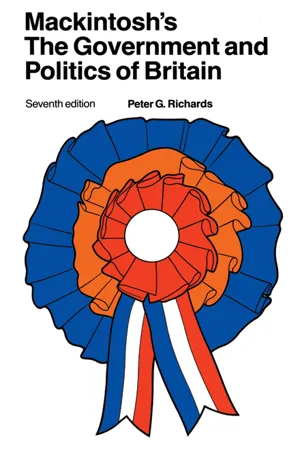
Mackintosh's The Government and Politics of Britain
About this book
This student mainstay continues to be organised around constitutional themes, with new material on local elections, the politics of the centre and the limits of state power. Essential for all introductory students of British politics and current affairs.
Information
1 Describing the British Constitution
It is often said that Britain has an unwritten constitution, but this is true only in the sense that rules guiding the system are not set out in a single document with a special procedure required for amending these rules, as was done in the United States. But a great number of these rules are written and embodied in Acts of Parliament such as the Representation of the People Act 1948, which prescribes the arrangements for holding elections, or the Parliament Acts of 1911 and 1949 which set out some of the relations between the House of Lords and the House of Commons. Other aspects of the system which are not laws but are established practices (such as the convention that the Queen asks the leader of the majority party after an election to form a government) are written down in many books on British politics. It is not illegal to break these established practices but if a serious attempt to avoid them occurred, it would indicate that profound changes were taking place in the whole system. Again, there is another category of practices, examples being the way the Cabinet is organized or parliamentary candidates selected, which are neither law nor established conventions but are simply convenient methods of procedure whose change would involve no major shake-up in the process of government. It might even be some time before such changes were noticed.
The difficulty in producing an accurate and comprehensive account of these laws, conventions and practices is partly that they are scattered over the history of the country from the Habeas Corpus Act of 1679, which prevents people being held in prison without trial, and the convention that the Queen will not veto legislation, which has been built up since 1708, to recent changes in parliamentary procedure dealing with the control of public expenditure. In part, the difficulty is that situations which call for the application of certain conventions may be few and far between. Thus, how far a convention would apply today may not be absolutely clear, while some conventions (such as ‘the collective responsibility of ministers’) may have changed their actual content or meaning though the words used remain the same. As a result, to try and describe the British Constitution is like trying to explain the working of an ancient university with its old statutes, more recent regulations, traditions begun for one purpose but still useful for another where new students and teachers are continually altering current practice.
There is yet a further problem in that so many developments of all kinds in Britain and in the rest of the world have some effect on the working of the institutions that it is hard to know where to stop the account. For example, changes in voters’ attitudes are likely, in time, to alter the responses of the political parties and to have an influence on the kind of people who are prepared to go into politics. In 1955, a combination of forces inside and outside Parliament led to the end of the BBC’s monopoly of broadcasting and the creation of commercial television which has probably had some effect on the public’s responses. On the other hand, Acts of Parliament insisting on political balance in television have meant that the public receives much of its political news without the slant and editorializing which is normal in newspapers. At a different level, British membership of the Common Market has already altered the tax system and has begun to change the methods by which agriculture is supported. Further afield, a wave of isolationism in the United States and the withdrawal of her forces in Europe could force Britain to return to conscription and to forge closer defence links with her European partners.
It is because of the ancient origins of many of the laws and conventions of the constitution that books on British government often start with an historical section. However, it is not essential to go far back into history because most of the conventions, practices and maxims which have been inherited either date from the late nineteenth century or were in operation then. Also it is important not just to list the various acts or to describe how Parliament or the civil service developed, but to show their interconnections. Each part of the machinery of government can only be understood in terms of the other cog wheels with which it must intermesh and many of the maxims or descriptions are only meaningful if they can be seen in relation to the whole system in operation at the time when the conventions became established.
It so happens that the pattern of government which evolved in Britain between 1870 and 1914 was regarded then (and by many since then) with particular satisfaction. Not only were a large number of books written about it, but most of the commentators assumed that there could scarcely be any improvement. There were several reasons for the belief that the system prevailing at that time was close to perfection. In those years Britain was particularly powerful and successful, the dominating mood being one of confidence that progress would continue and that Britain’s peculiar and powerful position in the world would always remain. Looking back, it seemed clear to the Victorians that Britain had been through the social and political phases or overcome the difficulties then besetting most other nations. Personal liberty and equality before the law had been established. A respected monarchy gave continuity and an aura of authority to the government, yet all personal or arbitrary rule had been eliminated. The aristocracy had never been marched to the guillotine, yet their powers had been tempered and shared with the other classes in the community. As late as the 1860s, there had been serious worries that any move towards democracy would introduce class warfare and political instability but, by the 1880s, these fears had faded. It was accepted that Britain had managed, apparently with unique success, to combine a proper degree of governmental authority with responsiveness to popular opinion, that patriotism, property and stability had been fortified rather than endangered by bringing all sections of the population into a continuing debate about public policy.
Exemplifying this self-confidence, late nineteenth-century historians tended to regard all aspects of British history as stages in an inevitable march towards this happy conclusion. They thought they had discovered that the Anglo-Saxon tribes, even before coming to Britain, had always proceeded by open decisions at ‘folk moots’ and that these albeit rudimentary democratic practices had tempered the Norman autocracy introduced into England after 1066. Any further attempts at despotic rule were countered by baronial revolts which forced respect for basic liberties upon recalcitrant sovereigns. These concessions and rights were embodied in Magna Carta. Then the practices of presenting grievances, of agreeing to grants of taxation and of making proclamations clarifying ancient custom, were all brought together in periodic Parliaments dating from the time of Simon de Montfort and Edward I. The Lancastrian kings, it was alleged, were involved in a ‘constitutional experiment’ of rule with Parliament, while even the Tudor despotism only served to confirm these trends, since Parliament was used to carry through the Reformation and to show patriotic support for Queen Elizabeth. From this point of view, Charles I may have had a tragic history but he was guilty of attempting to halt the country’s steady progress towards constitutional monarchy and the emergence of the House of Commons as an essential partner in government. Charles II and James II had the same failings and the English genius for nonviolent progress was revealed when the latter monarch was allowed to escape. A new monarch was installed and what these historians dubbed as ‘the Glorious Revolution of 1688’ established simply that Parliament could not be set aside or overruled. Next, it was argued that the late seventeenth century saw the invention of the two-party system, the descendants of the Roundheads and Cavaliers becoming the Whigs and Tories who were content to fight it out at the hustings and in the House of Commons. According to this version of British history, George III’s great error was to try and restore a measure of personal rule but luckily this was abandoned by his successors. The Reform Bill of 1832 created a uniform right to vote for men of property who were thus brought into the political system without any sharp break with tradition. Then the Reform Acts of 1867 and 1884 carried the process further and gave all established male householders a voice and a vote.
This, known as ‘the Whig theory of history’, viewed the system of government in practice in Britain between 1880 and 1914 as virtually the last word. The pattern then established was regarded as not only the culmination of fifteen hundred years of progress but was itself so simple, so logical, so effective and satisfactory, that the accounts of it had great force. These accounts filled the books and the minds of students of British government long after much had changed and were still regarded as largely correct until the 1940s. Thus the conventions and practices of the late Victorian period were not considered as merely true for that time, they were regarded as proper or normal. When further changes occurred, they were noticed with reluctance and tended to be regarded as departures from the norm, the main features of this system, which may be called ‘the Westminster model’, still dominating the textbooks in use after the Second World War. It then became the basis of the constitutions which were carefully written up for emergent nations of the Commonwealth on the grounds that if this system was the most advanced yet produced, why not hand it on in its complete form to the new states of Africa and Asia? Also, nationalist leaders who learnt their politics in Britain or from British books and teachers were so convinced by the merits of the system that they would settle for nothing less. Any adaptations to meet special historical or social conditions in their countries would have been regarded as insulting, as suggestions that they were not capable of the most advanced form of democracy.
Because of the strength of this tradition, to understand the meaning and original relevance of much that is said about current British government and politics, it is worth considering ‘the Westminster model’ as it was supposed to work at the end of the last century. Those describing it at the time neglected to note that as is always the case, social, political and legal conditions were changing. They did not think they were writing about a stage but an end-product and thus their account may not have been true of any one precise moment, since practices they thought essential may have been declining and trends they had failed to notice may have been starting. But the account was broadly correct for the 1880-1914 period and relevant for this book in that it explains what is still for many British politicians and informed observers, the proper state of affairs and the values and attitudes which continue to underlie many of the maxims used to describe the British political system.
2 The Westminster Model
The key feature of the British system of the 1880–1914 period, according to its exponents, was the Cabinet. This body of some sixteen senior political leaders, presided over by the Prime Minister, had two functions. On the one hand, the Cabinet governed the country and on the other, it sat in, led, was maintained, criticized and influenced by the House of Commons. As Bagehot put it in 1865, the ‘Cabinet is a combining committee – a hyphen which joins, a buckle which fastens, the legislative part of the state to the executive part of the state’. In the Cabinet, which operated totally informally without officials present or minutes taken, all the major policy issues were thrashed out. The Prime Minister might, like Peel or Gladstone, have a commanding presence or, like Lord Aberdeen, might act essentially as a chairman taking no major part in discussions himself. While Prime Ministers advised the Crown as to who should be appointed to the Cabinet, the House of Commons played a background role in the selection. Some men had such a reputation that they could not be omitted and, conversely, to be a failure in the House was a serious disqualification for high office. Also, leaving a powerful man on the backbenches might expose the Cabinet to dangerous attacks. Most of those likely to be appointed were men of wealth, usually with a considerable social or commercial reputation which gave them a position which was not solely derived from politics. For these reasons, the relationship between the Prime Minister and his colleagues was said to be that of a primus inter pares; he could lead and suggest but his fellow ministers had to be persuaded. Sacking ministers was scarcely proper but they were usually ready to resign if they had major doubts on policy issues, though no Prime Minister or Cabinet wanted to face the parliamentary problems that would be created by pointed criticisms from ex-ministers.
The source of the Cabinet’s strength and its ultimate responsiveness to criticism came alike from the ministers’ position in the House of Commons. There they normally enjoyed the support of a majority held together by party loyalty. MPs were returned at elections largely because of their views which indicated the party they supported, though many MPs had a personal hold on their constituencies. Once in the House, they wanted to see the leaders of their party succeed and were likely, other things being equal, to provide the Cabinet. with fairly steady support. On the other hand, if the policies of the government failed, if it seemed to run counter to the principles espoused by its followers or if the Opposition seemed to be winning the argument, MPs might become restive and vote against their own leaders. The Cabinet, sensing such dangers, could then agree to modify its policies. Thus ministers enjoyed considerable power in the House so long as their policies were successful and were arousing both public acclaim and the enthusiasm of their own supporters. But a dispirited leadership, external setbacks, an impression of incompetence or of internal disagreements could lead to heavy pressure on the government to change its policies. If this yielded no results, the Commons might go on to dismiss a government, a general election only being necessary if the Parliament was near the end of its life or if MPs were not prepared to support another combination of ministers.
Because of the pressure of the House of Commons, all administration had to be handled by ministers answerable to Parliament. In the early nineteenth century, some administrative functions had been allocated to commissioners or boards (e.g. the administration of the Poor Law) simply because it was feared that the monarch might use appointments to such posts as a method of influencing the House of Commons. After the 1830s, these fears ceased and Parliament began to insist on its right to question all policies. MPs demanded that every aspect of central government should be allocated to one or other minister who could then be held responsible for all the actions of his department. This was the doctrine of ‘ministerial responsibility’ which had reality in two senses. First, the departments were small enough for the minister to have seen and to have endorsed every decision likely to arouse outside comment and, second, if there was comment, the House of Commons would insist on holding the minister personally responsible. A further doctrine of ‘collective responsibility’ arose also in the face of parliamentary pressure. Ministers found that they had to support each other, for if one of them voiced doubts, it made the position of the entire Cabinet too precarious. This convention was reasonable in that all major decisons were taken collectively by the Cabinet.
Little was said about the process of administration because it was relatively simple. If the Cabinet proposed something and the House of Commons agreed, then the senior civil servants had merely to write the appropriate letters. There was no problem of the relations between officials and ministers as the distinction between political decisions and the execution of policy was so clear. Civil servants were, after the reforms of 1870, all recruited by open competition, the administrative class from the universities, the executive class from those who had completed a full school education and the clerical grade from those with a suitable, more elementary education. The civil service was not supposed to have views on politics or on policy issues or to have contact with outside interests. They were protected from parliamentary criticism and were allowed to serve one government after another on the assumption that they loyally carried out whatever policy was determined by the Cabinet. The small amount of local, as opposed to central, administration was placed in the hands of elected county and borough councils.
The primary tasks of the House of Commons in this period have been explained; each party evolved a leadership which it supported while the House as a whole commented on and criticized the performance of those leaders who were in office at that time. The House exercised these functions through the traditional forms of the power to legislate, to grant money and to debate. The process of legislation was designed to let the House know what the Cabinet or the private members sponsoring the bill intended (first reading), to give MPs ample time to debate the principles involved (second reading), to amend the proposal in detail (Committee of the whole House) and to have a look at the final result (third reading). In financial matters, the House worked on the same annual programme as the government. It scrutinized civil and defence estimates in the spring, and could amend or alter them. Then from April to July both the detailed expenditure proposals and the methods of raising revenue were debated and determined. In the autumn, the Public Accounts Committee (set up in 1860) scrutinized the accounts for the previous year to see that every penny had been spent as authorized by Parliament. The responsibility for raising the money and watching over its expenditure within the government lay with the Treasury which thus acquired a central and commanding position inside the government. Finally, with the Commons controlling the use of two or three days’ time each week and with the government reluctant to close or curtail debate (powers to do so were taken in 1882), there was little need for a special question time or methods of getting at ministers. The House could and did debate any issue as it arose, private members could call for papers (that is, for official documents), they could propose select committees of investigation, move and carry bills and go on and on talking about the Cabinet’s proposals until they had arrived at a conclusion. Ministers had to attend the House on every sitting day and explain and defend their policies with the Prime Minister (if he was in the Commons) acting as Leader of the House and chief spokesman for the Cabinet.
The House of Lords was of secondary importance but it had powers to amend and reject bills passed by the Commons though its leaders usually accepted that a measure clearly demanded by that House and by the country had to be passed. If the mass of peers looked like holding out against the Commons on a serious issue, the Cabinet could in the last resort ask the Crown to create sufficient peers to alter the balance. The Lords could also do much useful tidying up of legislation and its members contained sufficient men of talent to provide about a third of the ministers in nineteenth-century cabinets.
In such a system, there was little room for royal initiative. The Crown provided an impartial or non-political focus of loyalty, an embodiment of national feeling. The political functions of the Crown were to provide continuity, particularly when a Cabinet was defeated either in the Commons or at a general election. Then the king or queen had the task of initiating consultations to find out which new leader was most likely to command the confidence of the majority in the Commons. In nine cases out of ten, the answer was obvious and in the tenth was soon established. Apart from this, the Crown could, under very special circumstances, refuse to grant a dissolution (if it was thought that the existing House of Commons was ready to maintain another Prime Minister without an election being held). The sovereign could also, as Bagehot put it, insist on being consulted and then encourage or warn ministers but, in the last resort, the views of the Cabinet had to prevail.
Little was said in most descriptions of the Westminster model about the electorate or the electoral system. There were discussions of the transferable vote or proportional representation (tried in a limited form in certain three-member seats after 1867) but on the whole it was accepted that either single or double-member seats (which largely disappeared after 1884) were an adequate way of allowing public opinion to express itself. There was also little emphasis on the party machines outside Parliament for these were only growing up in the 1880s. In general, it was still assumed that elections were for the purpose of choosing a House of Commons and were not a means of selecting a government. Thus the laws designed to diminish the influence of money in elections set limits not on expenditure in the national campaigns but on the costs of standing in individual constituencies. Party leaders did, from the 1870s, tour the country and candidates explaine...
Table of contents
- Cover
- Half Title
- Title Page
- Copyright
- Contents
- Preface to the fifth edition
- Preface to the sixth edition
- Preface to the seventh edition
- Preface
- 1. Describing the British Constitution
- 2. The Westminster model
- 3. Forces of change
- 4. British government today
- 5. Political leadership – producing a Prime Minister
- 6. Political leadership – the strength of the Prime Minister
- 7. Political leadership – the limitations on the Prime Minister’s power
- 8. Political leadership – can the Prime Minister be sacked?
- 9. The leadership and its relations with the electorate; the state and the citizen
- 10. Governing through Parliament
- 11. Governing through the Whitehall departments
- 12. Government outside Whitehall
- 13. The direction of change: the attitudes of the parties
- Further reading
- Index
Trusted by 375,005 students
Access to over 1.5 million titles for a fair monthly price.
Study more efficiently using our study tools.
Frequently asked questions
Yes, you can cancel anytime from the Subscription tab in your account settings on the Perlego website. Your subscription will stay active until the end of your current billing period. Learn how to cancel your subscription
No, books cannot be downloaded as external files, such as PDFs, for use outside of Perlego. However, you can download books within the Perlego app for offline reading on mobile or tablet. Learn how to download books offline
Perlego offers two plans: Essential and Complete
- Essential is ideal for learners and professionals who enjoy exploring a wide range of subjects. Access the Essential Library with 800,000+ trusted titles and best-sellers across business, personal growth, and the humanities. Includes unlimited reading time and Standard Read Aloud voice.
- Complete: Perfect for advanced learners and researchers needing full, unrestricted access. Unlock 1.5M+ books across hundreds of subjects, including academic and specialized titles. The Complete Plan also includes advanced features like Premium Read Aloud and Research Assistant.
We are an online textbook subscription service, where you can get access to an entire online library for less than the price of a single book per month. With over 1.5 million books across 990+ topics, we’ve got you covered! Learn about our mission
Look out for the read-aloud symbol on your next book to see if you can listen to it. The read-aloud tool reads text aloud for you, highlighting the text as it is being read. You can pause it, speed it up and slow it down. Learn more about Read Aloud
Yes! You can use the Perlego app on both iOS and Android devices to read anytime, anywhere — even offline. Perfect for commutes or when you’re on the go.
Please note we cannot support devices running on iOS 13 and Android 7 or earlier. Learn more about using the app
Please note we cannot support devices running on iOS 13 and Android 7 or earlier. Learn more about using the app
Yes, you can access Mackintosh's The Government and Politics of Britain by Peter G. Richards in PDF and/or ePUB format, as well as other popular books in Politica e relazioni internazionali & Costituzioni. We have over 1.5 million books available in our catalogue for you to explore.