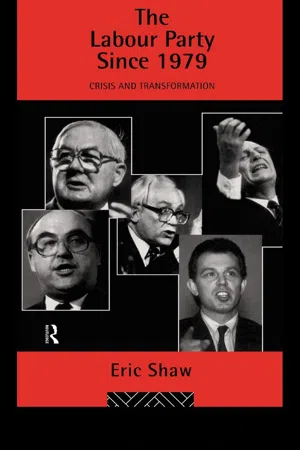
The Labour Party since 1979: Crisis and Transformation challenges the claim that Labour's only real hope for the future lies in shedding its ideological baggage. It rejects the notion taht the 'shadow budget' was the prime cause of its 1992 defeat and argues that the strategyof seeking an image of 'responsibility' and 'respectability' - which under the new leadership has become a paramount concern - does not offer the best route forward for the party.
The effect of this strategy - of abandoning traditional tenets, and adopting a policy profile more to the tastes of its critics in business and the media - will be to deprive Labour of its sheet-anchor; and even if successful electorally, the price will be that the hopes and aspirations of its supporters will be highly unlikely to be fulfilled.
- 280 pages
- English
- ePUB (mobile friendly)
- Available on iOS & Android
eBook - ePub
About this book
Information
1
LABOUR’S MULTIPLE
CRISES 1979–83
The period 1979 to 1983 was one of the most stormy and eventful in the Labour Party’s history. With the left in control of the policy-making machine, it engaged in an extensive process of policy innovation which culminated in the supplanting of many of the governing ideas and policies of the past generation by a considerably more radical programme. In order to establish a benchmark against which to measure the scale of programmatic change both under the left and subsequently when the right regained control, this chapter opens with an outline of revisionist social democracy, Labour’s ruling body of ideas until decomposition set in from the mid-1970s. It then assesses the left’s alternative programme which took definitive form in the 1983 manifesto. After Labour’s defeat in 1979 the smouldering tensions between left and right ignited into a veritable civil war encompassing organisational as well as ideological and policy matters. Further, the success of the left precipitated a major schism as senior right-wingers quit to form the Social Democratic Party (SDP). An analysis of these issues forms the second part of this chapter. The ferocity of the internal struggle coupled with the advent of the SDP shattered Labour’s standing in the polls, reversing any hope of recovery after its ousting from government in 1979. This intensified the process of electoral decline, from which Labour was already suffering and, in conjunction with one of the most ramshackle campaigns it has ever mounted, led to the electoral disaster of 1983: this constitutes the subject matter of the third part of the chapter.
REVISIONIST SOCIAL DEMOCRACY AND ITS DECOMPOSITION
For a generation, from the late 1940s to the end of the 1970s, the political thinking and practice of the Labour Party were governed by the precepts of revisionist social democracy. It constituted what Kitschelt has called a social democratic ‘discourse’, that is, ‘the set of key organising principles and axiomatic propositions that drive the programmatic vision of socialist parties and is invoked by socialist politicians to propose solutions for concrete policy problems in the economic, social or cultural realm’ (Kitschelt, 1992: 194). Labour’s ‘discourse’ whilst in part the sedimentation of its history and experiences also incorporated the thinking of revisionist intellectuals, most notably that of Tony Crosland, who was a prominent theoretician, a confidante of one leader (Hugh Gaitskell) and a senior minister in administrations formed by his two successors, Harold Wilson and James Callaghan.
Keynesianism and public ownership
Prior to the War, socialists had contended that capitalism was incapable of providing either full employment or decent living conditions for the mass of the population because it suffered from an endemic propensity to swing between boom and slump and because it distributed income and wealth in a highly inegalitarian manner. These ills were innate in a private enterprise system and thereby could only be overcome by a major extension of public ownership. It followed, as the post-war leader of the Labour left, Aneurin Bevan, put it, ‘that one of the central principles of socialism is the substitution of public for private ownership’ (Tribune 13 June 1952, quoted in Greenleaf, 1983: 471). This belief was challenged by revisionist social democracy which contended that the defects to which capitalism was prone (inequality, unemployment and economic instability) could be surmounted by the application of Keynesian economics, rendering alterations in the ownership structure superfluous. By manipulating the level of aggregate demand a social democratic government could smooth out the oscillations of the business cycle and, by preventing the recurrence of inadequate demand and excess savings, maintain higher levels of consumption, investment and employment. Further, Keynesian macro-economics provided the state with the means to establish social control of the economy – that is to say, impress upon the prevailing economic pattern priorities other than short-term profit maximisation – through the use of fiscal, monetary and regulatory instruments. As Crosland argued, ‘political authority has emerged as the final arbiter of economic life’ (Crosland, 1964: 29). Hence social democracy could combine private ownership and the market, on the one hand, with the pursuit of full employment, economic growth and equality on the other. Whilst nationalisation – of natural monopolies and of vital but economically insecure industries – might be advisable to protect the interests of the economy as a whole or to avert major job losses, it was not a necessary means to achieve socialist ends.
Keynesianism, in short, supplied the basis for a rapprochement between private corporate interests and the common good. In Przeworski’s words, it ‘held out the prospect that the state could reconcile the private ownership of the means of production with democratic management of the economy’ (Przeworski, 1985: 207). It performed a triple function: firstly, it showed that the basic goals of the labour movement – full employment, decent wages and the public provision of social goods – need not be placed at the mercy of market forces but could be achieved by the purposive use of state power. Secondly, it provided a sound basis in economic theory for the sustained pursuit of social democratic goals: as Padgett and Paterson commented, it ‘legitimised the doctrine of equality, since it demonstrated that economic expansion depended on broadening the basis of consumption through a diffuse distribution of income and wealth’ (Padgett and Paterson, 1991: 23). Thirdly, it greatly enhanced the economic credibility of social democratic politicians by inviting the voters to decide not who was most qualified to manage a market economy but who was best equipped to use the power of the state to advance economic performance.
Capital, labour and the state
The Labour Party had never subscribed to the theory of class struggle: rather it saw its role as to secure for the working class the full right to participate in the established social order. With the emergence of the Keynesian state able to countermand the power of capital, and with the arrival of full employment which had transformed the balance of industrial power between management and the unions, revisionism held that this had largely been achieved. Because of the organic link between the Party and the unions, and because the bulk of its electorate was composed of working class voters, revisionism accepted (though with a degree of unease) that Labour had to some degree to operate as a vehicle for working class interests, as defined by the unions. But it believed that the Party’s ultimate responsibility was to foster social cohesion and industrial harmony, a balancing of roles which could never be wholly free of friction.
The inflationary upsurge of the 1970s following the huge increases in the price of oil exacerbated the friction and greatly complicated Labour’s task. Following the pattern of more successful social democratic parties in Northern Europe, the revisionist response was ‘the social contract’, a corporatist experiment in policy-making. At its core was a bargain between the government and the unions in which wage restraint was exchanged for legislative concessions and the grant to the TUC of guaranteed rights of access to key policy-making centres. In part, corporatism was a device to master inflationary pressures, but, in a broader sense, it was a new means to achieve industrial order through an institutionalisation of co-operation between the unions, business and government.
State and market
The central economic proposition of revisionist social democracy thinking was that an appropriately regulated, predominantly privately-owned market system could attain most of the objectives that socialists regarded as desirable. In the late 1980s it became fashionable both for Labour’s leaders and for many commentators to interpret the new economic stance outlined in the Policy Review as a rupture with the Party’s traditional preference for planning and state intervention and thus a belated recognition of the superiority of the market economy. This is an inaccurate judgment: Labour’s ‘discourse’ had long presupposed, as Hirst has pointed out, that, within the appropriate demand regime, ‘private management in industry could be left to make the right decisions about levels of investment and manufacturing methods’ (Hirst, 1991: 250, 251). Thus Labour never sought to challenge the market as the organising principle of economic life. Whilst it advocated state intervention to remedy market defects, or (to use Marquand’s phrase) ‘hands-on Keynesianism’ (Marquand, 1988: 45–7) it rejected what Crosland called ‘the traditional socialist case for planning’ – that is, an assumed conflict between production for use and production for profit – accepting that ‘the price mechanism is now a reasonably satisfactory method of distributing the great bulk of consumer-goods and industrial capital-goods’ (Crosland, 1964: 346). Beer summed up the process of programmatic change accomplished by the revisionists when he commented: ‘In revisionist thinking and in the Party documents that reflected it there was during the 1950s a growing emphasis not only upon the private sector of the economy and the mechanisms of the market but also upon the incentives of gain and competition’ (Beer, 1969: 237). Revisionist social democracy, in short, sought not to displace the market but to use state power to render it more responsive to social ends.
Social democratic values and the welfare state
Although revisionism abandoned the traditional view that socialism entailed the transformation of the economic system, it retained a distinctive and radical ideological edge. Crosland identified two key aspirations which demarcated a socialist party from its rivals. The first was social welfare: the relief of distress and squalor was, he argued the main object of social policy and ‘a socialist is identified as one who wishes to give this an exceptional priority over other claims on resources’ (Crosland, 1964: 76–77). The second was equality. This involved challenging the class system which he defined in terms of pronounced inequalities in access to social resources arising from deep, cumulative and reinforcing social disparities. The belief in social equality, Crosland declared, was ‘the most characteristic feature of socialist thought’, its promotion Labour’s prime task (Crosland, 1964: 77).
Labour’s prime task (Crosland, 1964: 77). The major instrument to accomplish these objectives was the welfare state. Whilst production was to be left mainly in private hands, revisionism advocated the socialisation of consumption in which the economic surplus of the private sector could be recycled to meet social needs. This strategy was based on the notion that in a capitalist democracy resources are allocated by two mechanisms: the market and a democratically controlled state. The inequality and hardship generated by the former could be effectively balanced by the latter’s endeavour (under Labour control) to advance equality and social justice. The welfare state constituted the goal, Keynesianism the vital means which provided the funds to finance it, whilst at the same time positively aiding, rather than impairing, the accumulation function which drove the market economy.
However, precisely since revisionism wished to avoid damaging capital accumulation or heightening social tensions, redistribution was seen as politically and economically feasible only when the economy was growing. The increments of growth would furnish the resources to finance an expanding social services, tackle social deprivation and spur the moves towards greater equality without imposing any additional burdens on higher income groups, who could then be expected to acquiesce in the process. It followed that it was upon the ability of Keynesianism to foster economic growth and maintain full employment, that the viability of revisionist social democracy ultimately rested. This programme was never formally adopted – unlike the SPD’s Bad Godesberg programme – and therefore lacked an official status. But it provided the motive force behind successive Labour election manifestos and – more haltingly – its conduct in government.
Revisionism in disarray
However, the emergence of stagflation – a combination of high inflation and unemployment – shook confidence in the verities of Keynesian demand management. By the mid-1970s, a mix of monetarism and economic liberalism had become the ruling economic wisdom throughout the West. It was in this unpropitious environment that the Labour Government in 1976 blundered into a speculative crisis culminating in a request for an IMF loan. The IMF insisted upon drastic cuts in public spending and tighter control of the money supply, conditions which were only accepted after a long struggle in Cabinet and on the insistence of the Prime Minister, Jim Callaghan and his Chancellor, Denis Healey. Along with Tony Benn, Michael Foot and Peter Shore, Crosland was a staunch opponent of the loan but eventually capitulated on the grounds that rejecting the Prime Minister’s advice on such a crucial matter would precipitate a sterling crisis and shatter Party unity. But as for the loan and its attached conditions he remained convinced that it was ‘wrong economically and socially, destructive of what he had believed in all his life’ (Benn, 1989: 674).1 He understood that the loan signalled the abandonment of revisionism. In a few jotted notes he summed up the consequences: ‘unemployment, even if politically more wearable = grave loss of welfare, security, choice’ (quoted in Marquand, 1991: 176). Six weeks later, Crosland died suddenly of a stroke.
Unlike the Conservatives, the Labour Government’s switch to monetarism was pragmatic, and hope lingered that, once the economy was set on the road to recovery, more resources could be committed to welfare programmes and cutting unemployment. Although steady progress was in fact made towards lower inflation, a stronger balance of payments and a lower budget deficit, the misjudged 5 per cent pay policy insisted upon by Healey in the autumn of 1978, and the decision to delay the election until 1979, contributed to the explosion of pay claims and the industrial strife of the winter of 1978–9: the Winter of Discontent. The Winter of Discontent eliminated any prospect of Labour holding on to power, and, indeed, has dogged it ever since. Just as the IMF loan marked the disintegration of Keynesianism as the governing economic doctrine so too the Winter of Discontent signified the collapse of corporatism. Without these two pillars, revisionist social democracy fell to pieces. The election was held shortly after and Labour tumbled to an inevitable and major defeat.
THE SOCIALIST ALTERNATIVE
The left had always been critics of revisionism. They claimed that it exaggerated the capacity of the Keynesian state to control corporate behaviour and was far too sanguine in its belief that the market and the private sector could achieve sustained growth or that social policy of itself could bring about effective progress towards equality without challenging the ownership of property (Holland, 1975). Labour’s Programme 1973 (drawn up by the left-leaning National Executive Committee (NEC)) reasoned that since the interests of large corporations ‘cannot be expected to coincide with the interests of the national economy’ and since fiscal and monetary policy or tax incentives alone were incapable of modifying their behaviour, a future Labour government would have to ‘act directly at the level of the giant firm itself.’ Objectives such as higher investment, increased exports, full employment and regional balance could only be achieved by a substantial expansion of public ownership in profitable industries.2 The 1974–9 Labour Government took little notice of this argument but defeat at the polls in 1979 transferred the initiative to the left-controlled NEC, constitutionally responsible for policy formulation. It moved with alacrity and embarked on an ambitious programme of policy renewal culminating in the compendious Labour’s Programme 1982.
The greatest source of the left’s influence in this period lay in the fact that it was their experiences as largely impotent critics of the 1974–9 Government, their belief that it demonstrated the bankruptcy of revisionist social democracy and their frame of reference that governed the way in which most policy matters were considered. In contrast, predominantly right-wing former ministers had a limited input: many were demoralised, intellectually fatigued and could only rely on the exiguous organisational and constitutional resources of the Parliamentary Labour Party (PLP). Hence the conclusions they drew from their time in government and their definition of the problems Britain faced were of little relevance. The leading critics of the key IMF loan decision within the cabinet were, as we have noted, Crosland, Benn, Shore and Foot. By November 1980, Foot was leader of the Party, Shore the shadow chancellor and Benn the chairman of the Home Policy committee and effectively the senior policy-maker on the NEC.
However, the NEC was not the only policy conduit. A second channel of policy formation was the TUC–Labour Party Liaison Committee, which comprised representatives of the unions, the NEC and the Parliamentary leadership. It had been established in 1972 in order to repair the breach between the Labour Government and the unions which had occurred in the 1960s, although it served an additional purpose of reducing the left NEC’s hold over policy. It had a particular responsibility for matters of especial interest to the unions, like pay and labour law, and in this period its influence reached a peak as it shaped policy on industrial matters as well as participating in the devising of Labour’s overall economic strategy. This, as we shall see, ensured that Party policy did not solely reflect the thinking and preferences of the left.
Keynesianism
The left’s macro-economic policy was unashamedly Keynesian. It promised ‘a major increase’ in public investment, ‘a huge programme’ of construction and ‘substantial’ increases in social expenditure. By boosting demand, public spending-driven reflation would, it was anticipated, generate more investment growth and job opportunities, and (via higher tax yields) the greater revenue needed to refurbish the public services.3 The crucial objective was to reduce unemployment to below one million within five years of taking office. Policy-makers recognised that a substantial injection of demand was bound to suck in more imports, whilst the programme as a whole would shake the confidence of the money markets, but the left’s response was not to bend before such pressures but to seek to restrict the economy’s exposure to international pressures by introducing import and exchange controls. However, on this point, the left’s preference for protection was checked by the free trader Shore, who, as shadow chancellor, favoured the standard Keynesian response of devaluation. Labour’s final policy, as agreed in the 1983 Manifesto, was a compromise between the two stances, calling for ‘a realistic and competitive’ exchange rate, import controls if necessary and exchange controls to counter currency speculation and redirect capital from overseas to domestic investment.4 Whether this would have enabled a Labour Government to resist international pressures is a question to which we shall return.
Pay, inflation and the unions
Pay policy had been the issue which had brought the last Labour Government crashing to the ground and it continued to be a cause of difficulties after 1979. But the twin questions of pay and inflation were, in this period, viewed very much from the perspective of that Government’s left-wing critics who viewed incomes policy as simply a form of wage restraint designed to ensure...
Table of contents
- COVER PAGE
- TITLE PAGE
- COPYRIGHT PAGE
- PREFACE
- ACKNOWLEDGEMENTS
- ABBREVIATIONS
- 1. LABOUR’S MULTIPLE CRISES 1979–83
- 2. TRANSITION: ORGANISATIONAL AND POLICY CHANGE 1983–7
- 3. LABOUR’S CAMPAIGN AND COMMUNICATIONS STRATEGY 1983–7
- 4. A PALER SHADE OF PINK: THE POLICY REVIEW
- 5. ORGANISATIONAL MODERNISATION
- 6. LABOUR’S CAMPAIGN AND COMMUNICATIONS STRATEGY 1987–92
- 7. THE DETERMINANTS OF PARTY TRANSFORMATION
- 8. ASSESSING LABOUR’S CAMPAIGN AND COMMUNICATIONS STRATEGY
- 9. CONCLUSION
- NOTES
- REFERENCES
Trusted by 375,005 students
Access to over 1.5 million titles for a fair monthly price.
Study more efficiently using our study tools.
Frequently asked questions
Yes, you can cancel anytime from the Subscription tab in your account settings on the Perlego website. Your subscription will stay active until the end of your current billing period. Learn how to cancel your subscription
No, books cannot be downloaded as external files, such as PDFs, for use outside of Perlego. However, you can download books within the Perlego app for offline reading on mobile or tablet. Learn how to download books offline
Perlego offers two plans: Essential and Complete
- Essential is ideal for learners and professionals who enjoy exploring a wide range of subjects. Access the Essential Library with 800,000+ trusted titles and best-sellers across business, personal growth, and the humanities. Includes unlimited reading time and Standard Read Aloud voice.
- Complete: Perfect for advanced learners and researchers needing full, unrestricted access. Unlock 1.5M+ books across hundreds of subjects, including academic and specialized titles. The Complete Plan also includes advanced features like Premium Read Aloud and Research Assistant.
We are an online textbook subscription service, where you can get access to an entire online library for less than the price of a single book per month. With over 1.5 million books across 990+ topics, we’ve got you covered! Learn about our mission
Look out for the read-aloud symbol on your next book to see if you can listen to it. The read-aloud tool reads text aloud for you, highlighting the text as it is being read. You can pause it, speed it up and slow it down. Learn more about Read Aloud
Yes! You can use the Perlego app on both iOS and Android devices to read anytime, anywhere — even offline. Perfect for commutes or when you’re on the go.
Please note we cannot support devices running on iOS 13 and Android 7 or earlier. Learn more about using the app
Please note we cannot support devices running on iOS 13 and Android 7 or earlier. Learn more about using the app
Yes, you can access The Labour Party Since 1979 by Eric u University of Stirling Shaw in PDF and/or ePUB format, as well as other popular books in Politics & International Relations & Political Campaigns & Elections. We have over 1.5 million books available in our catalogue for you to explore.