- 216 pages
- English
- ePUB (mobile friendly)
- Available on iOS & Android
eBook - ePub
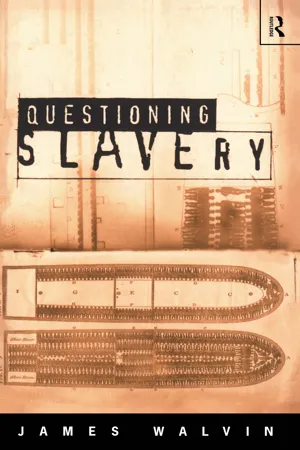
Questioning Slavery
About this book
For the best part of three centuries the material well-being of the western world was dependent on slavery. Yet these systems were mainly brought to a very rapid end. This text surveys the key questions of slavery, and traces the arguments which have swirled around its history in recent years. The latest findings on slavery are presented, and a comparative analysis of slavery in the English-speaking Americas is offered.
Trusted by 375,005 students
Access to over 1.5 million titles for a fair monthly price.
Study more efficiently using our study tools.
Information
Subtopic
World HistoryIndex
History1
Forging the Link
Europe, Africa and the Americas
The European invasion of the Americas, tentative and hesitant initially, had dramatic consequences for three continents: first, and most obvious, for the Americas and its various civilizations and native peoples; second, for Europe which soon developed a voracious appetite for the land, products and staples of the Americas; and third, for Africa which, in time, came to provide the workforce which broke open key areas of the Americas to profitable cultivation. Looking back, the association between black slavery and the Americas seems so natural, so much a part of the historical and economic development of the region, that the two seemed obvious partners. Quite the contrary, it was no such thing; but by, say, the mid-eighteenth century, when the European appetite for African slaves seemed insatiable, Africa seemed the natural place to recruit labour for the Americas.
When the Europeans launched their first invasion of the Americas, in the wake of Columbus, they encountered various local peoples and indigenous civilizations throughout the region: nomadic and agricultural Indian societies were scattered across the hemisphere. Three major civilizations—Mayan, Aztec and Incan—had control of, or access to, products which were much prized by the invading Europeans. One by one, their civilizations fell: many were put to the sword by ruthless invaders, more were weakened by disease and sickness transmitted unknowingly by the Europeans. It is, even now, hard to grasp what happened to the Indian peoples of the Americas. They died in their hundreds of thousands, first in the Caribbean, then in Central America and Peru, later in North and South America. In Mexico, the population is thought to have fallen by 95 per cent in seventy-five years; in Peru the population of 9,000,000 fell to 600,000 in a century. Time and again, the story was repeated wherever Europeans (and Africans) made contact with local people.1
The early contacts provided a grim foretaste of what was to come. In Hispaniola, one of the first European settlements, the local population collapsed from 4,000,000 to 100,000 by 1508. Cuba followed the same route. Indian peoples everywhere bemoaned their fate, capturing the stunned horror which overtook them in haunting words. Before the white men, said one Indian from the Yucatan,
There was then no sickness; they had no aching bones; they had then no high fevers: they had then no smallpox...At that time, the course of humanity was orderly. The foreigners made it otherwise when they arrived here.2
They fell, not to the gun or the sword (though there was plenty of violent killing), but to hidden and unknown microbes; to influenza, typhus, measles, chickenpox, diphtheria, scarlet fever, typhoid, whooping cough, bubonic plague. But worst of all was smallpox, which spread from the Caribbean in 1518 throughout the hemisphere, sometimes advancing ahead of the white man. It killed whole communities, leaving survivors stunned, disfigured and utterly demoralized. Some scholars have calculated that up to 90,000,000 people died.3 A German missionary wrote, in 1619, that Indians ‘die so easily that the bare look and smell of a Spaniard causes them to give up the ghost’.4
Nor was it just the Spaniards. The French and Portuguese took smallpox to Brazil, the English to Florida and New England, the French to the Indian tribes of Canada. By 1600 some twenty epidemics had surged through the native peoples of the Americas— leaving a mere ten per cent of the population surviving. And more was to come. To use the words of an Inca lament, night fell on the Indian peoples. Of course Europeans (and Africans) also suffered. But never on the same scale.
What was abundantly clear, from the early days of settlement, was that Indian peoples en masse would never be likely to help their conquerors in their new ventures of settlement and economic development. Some, of course, worked side by side with the invaders in shaping the initial settlements in towns and rural areas. But the decline of the Indian populations and the demoralization (and flight) of survivors ensured that there were rarely enough indigenous people to help Europeans with their local schemes. Nor were there enough European settlers available for the back-breaking work of pioneering, frontier life. But there were other forms of labour, already in use in other parts of the world, which were to provide the missing pieces in the European equation. They had, in the Americas, other important assets—land, natural resources and potential—in an abundance which even they could scarcely imagine. They also had access to European capital and technical and managerial know-how. What they also needed, however, was labour to unlock the potential of the region.
The answer to their labour problems had already been suggested in the earlier experience of plantation management, in the Mediterranean and Atlantic islands. Europeans first developed plantations for sugar cane cultivation in the eastern Mediterranean at the time of the Crusades. Slowly, these early sugar plantations moved westward, from Palestine to Cyprus—though always on a small scale—on to southern Spain and North Africa. European maritime expansion took settlement—and the plantation—on to the Atlantic islands of the Azores, Madeira, the Canaries and the Cape Verde islands, later still to Fernando Po and São Tomé. These islands were, in effect, stepping-stones between the old societies and economics of the Mediterranean and the New World of colonial settlement on the far side of the Atlantic. The most crucial spot was São Tomé, close to Africa, ideally suited to sugar cane production and close to supplies of African labour in the Kingdoms of Kongo and Benin.5
Though small-scale compared to the later history of plantations, the basic elements of plantation production were in place: colonial lands, settled by marauding and mercantile Europeans, alien labour, and European finance and expertise. It seemed natural enough to try these arrangements in the New World after 1492. Cane cultivation was tried unsuccessfully in the Caribbean in 1493, again in 1503, and more successfully (with labour from the Canaries) in 1517. But wherever cane was planted in the early sixteenth century—in Spanish settlements in Jamaica, Puerto Rico and coastal Mexico—the problem remained that of labour. The Portuguese had more luck.
In the mid-1540s, they transplanted sugar from Madeira to Brazil. Within twenty years, Brazilian production matched the tonnage from Madeira, and by 1580, Brazil produced 5000 tons. Fifty years later the output reached 20,000 tons.6 The Portuguese were able to make this dramatic progress thanks to their trading connections in West Africa. European explorations in West Africa had revealed complex trading systems which involved the movement of a host of goods and products within Africa. Among those items of trade were slaves, normally prisoners of war sold and bartered as trade and removed from their native region. Some were shifted north, across the Sahara, for sale to North Africa. The total number was very small, however; no more perhaps than 5000 a year.7 Whatever the scale, when Europeans made their early maritime contacts with West Africa, they found slave systems in place which they could turn to their own advantage. Initially, however, West Africa offered other more lucrative prospects, most spectacularly gold. The thriving African gold industry used slave labour. Thus, both in the embryonic gold trade between Europeans and Africans, and in the development of the offshore São Tomé sugar industry, the Portuguese quickly involved themselves in trading in African slaves. When sugar plantations began to thrive in Brazil in the mid-sixteenth century, it seemed natural (easy, an extension of existing systems and, thanks to convenient currents and trade winds, navigationally direct) to ship slaves from West Africa to Brazil.
Early experiments in sugar cultivation in Brazil had used Amerindian slaves. But the Indians tended to die out in the face of diseases from Europe and Africa. Nor was the problem solved by simply bringing more Indians from the interior to the coast, for they too had no resistance to alien diseases. Slowly, but perceptibly, imported Africans began to fill their place. They, too, died in large numbers; but unlike the local Indians the Africans could be replaced by fresh imports from West Africa. Moreover, the Atlantic crossing to Brazil was relatively quick; the faster the crossing, the lower the on-board mortality rates. African slaves imported to Brazil were thus relatively cheap. So was Brazilian sugar. The abundance of suitable land offered economies of scale which enabled the Brazilian sugar industry to overtake quickly the volumes and costs of sugar from the Atlantic islands. Brazil soon attracted European capital, and the human/economic mould took shape. European money and skills, American land and African labour—together, on the plantation, they produced a commodity which Europeans consumed in ever-growing volumes. Here, then, was a form of tropical production and colonial investment which seemed to yield prosperity and wellbeing in all directions: to the Brazilian settlers, to the European capitalists, to European mercantile interests and European consumers. But where was the profit, the well-being, for the local Indians and imported Africans? The example of Brazil—and of Brazilian sugar—was to dazzle Europeans in other parts of the Americas. And, from the first, European settlers appreciated the benefits of African imported labour.
Over a period of fifty years, there was a marked shift from using Indian to African labour in Brazilian sugar. As sugar yielded profits to the Portuguese planters, they invested their money in Africans and material improvements. In the 1550s and 1560s there were virtually no slaves in the sugar mills of northeast Brazil. Twenty years later, they formed a striking minority. But between 1600 and 1620, Africans began to dominate the labour force: these were years of relative international calm, good sugar prices in Europe and consequent expansion throughout the Brazilian sugar industry.
The Portuguese had long used Africans as slaves, at home and on their Atlantic islands. They knew their skills and benefits but, above all, were impressed by their experience of sugar work in Madeira and São Tome. It seemed natural enough for their contemporaries in Brazil—closer in sailing times than the maps suggest—to think of Africans as the natural workers for their northeastern sugar industry. Skilled sugar workers were among the first Africans working on plantations. But, as the Atlantic slave trade grew in the last decades of the sixteenth century, as more Africans arrived direct from Africa, growing numbers were to be found in the fields. More than that, it was perfectly clear that planters quickly came to value Africans much more highly than local Indians. Wherever we look in the Americas, planters paid Indians much less than what they paid for slaves. The formula was simple: Africans were a better investment than Indians. In the words of one commentator in Carolina in 1740 (but in a quote that rings true for other regions and times), ‘with them [Indians] one cannot accomplish as much as with Negroes’.8
This was clearly true in Brazil where prices of/wages for the two groups were always different. The African labourer was worth more, however we compute their relative value. More than that, recent calculations suggest that Africans produced more than the Indians (whose productivity was notoriously low). The simple truth remained that, although it seemed that Portuguese planters paid more initially for their African slaves, they got a better return on their investment. Though Indians were valuable as a source of very cheap local labour in the early days of settlement and in the drift to sugar in Brazil, they were soon revealed to be much less valuable when the industry slipped into higher gear. In all this, the international market played its own crucial role. The development of the Atlantic slave trade needed outside economic agencies. Fortunately for planters, financial and maritime organizations were in place to support and make possible the movement of African slaves across the Atlantic. Compared to the mature Atlantic system of the eighteenth century, it looks simple, even rudimentary, though in outline it was recognizably similar. The Atlantic slave economy was conceived and nurtured by European capitalist interests, able and willing to marshal finance, expertise (and labour), and to move it relatively quickly from one part of the world to another. In the process Africans were quickly transmuted into the human commodity which was to shape the Atlantic economy for the best part of three centuries.
The Portuguese had pioneered the first major Atlantic slave trade systems, moving Africans to Europe, the Atlantic islands and then the Americas. Their effective monopoly had seen 40,000 Africans moved across the Atlantic. But when the Dutch conquered northern Brazil in 1630, they were in a position to put a colony and the maritime strength to take over from the Portuguese. The Dutch had some experience of the industry, for their ships and refineries (in Holland) had already tapped into the Portuguese sugar trade. Conquest consolidated that trade. The Dutch quickly moved into the old Portuguese empire around the world, acquiring all the economic benefits that flowed from that far-flung system of colonies and trading stations. In the Atlantic, they secured major entrées to West Africa, in northern Brazil and a string of West Indian islands. Most of these possessions were run by the two major Dutch trading companies: in the Atlantic, control fell to the West India Company whose prime aim was to squeeze out competitors, on both sides of the Atlantic, and to create, as far as possible, a Dutch monopoly.
With their own colony in Brazil after 1630, the Dutch company took a much keener interest in its African trading posts and in the necessary trade of supplying Africans to the sugar industry in Brazil. Whatever doubts the Dutch may have had about the morality of buying and selling Africans, those doubts simply did not surface in the early papers of the West India Company: scruples were swept aside by the power of economic self-interest.9 Dutch traders to Africa had put down their first tentative roots in 1612, though the initial interest was in gold. Now, the Brazilian need for labour shifted their African concerns from natural products to human commodities. Gradually, the Dutch displaced the slave-trading Portuguese on the African coast by force of arms and through commercial deals with Africans. By 1641, the Dutch had completely usurped the Portuguese, removing them from their forts and trading posts. It was now their turn to contend with the piratical raids of other (northern) Europeans, themselves anxious to secure a share in the lucrative trade in black humanity.10 Thus, from the first, events in the New World were the key to what happened in Africa. But such a formula is, of course, far too simple. Though the labour demands of the Americas—in this case Brazil—prompted the search for African slaves, it was all made possible by that more broadly based economic change which saw the rapid emergence of powerful mercantile states in northern Europe, their wealth enhanced by trading links to the wider world.
The Dutch grip on Brazil was tenuous, and had been made possible by internal Iberian conflicts. Portuguese planters eventually rose against the Dutch, who lost control of Brazil by 1654. Not surprisingly, the Dutch importation of slaves had been small-scale, and riddled with uncertainty. In the era of Dutch control over northern Brazil, some 26,000 slaves were imported. Though dwarfed by the numbers that followed, the Dutch trade established the Dutch as the main players in the Atlantic slave trade. Moreover, the loss of Brazil was not catastrophic for the Dutch because, at the point they lost control of Brazil, tempting commercial prospects revealed themselves further north, in the Caribbean. Though it was a longer, and therefore more costly, venture to ship Africans to the West Indies rather than to Brazil, the islands offered prospects which seemed boundless. Thwarted in Brazil, Dutch merchants turned their attention to Barbados.
The European settlement of the Caribbean was part of a much broader migration of people to the Americas, which saw the proliferation of European colonies planted throughout the hemisphere. Such colonies offered a relief from social pressures at home, freedom on the far side of the Atlantic for persecuted minorities, and a beachhead, in the Americas, for further attacks on the fabled wealth unlocked particularly by the Spaniards. Early settlers had little intention of using imported labour—except their own. Europeans used their own labour in winning over the land to useful and profitable cultivation. However, the regions settled by the British, for example, were remarkably different one from another—from Massachusetts to Barbados—and some regions developed quite differently from their original intentions. Geography, climate and the emergence of particular, successful crops—all these and more were the determinants of the human and economic transformation of the British (and French) settlements.
In Barbados, pioneer settlers broke open the land to smallscale cultivation, using indentured labour from Britain. But Brazil already provided powerful evidence that Africans were much more useful. For a start, they seemed more durable: more resistant to the ailments which afflicted and killed so many European settlers. In fact, they had different immunities and, though they too died in horrifying numbers, Africans seemed to be a better long-term economic bet. Even when they died prematurely, they could be readily replaced; quickly, cheaply and with little fuss. The same improved vessels which carried the bigger cargoes of sugar back to Europe, could carry larger cargoes of Africans across the Atlantic. Thus the haphazard, almost accidental, trickle of slaves to Brazil became something quite different. In the process, morality was simply relegated or ignored; cast aside by a burgeoning demand which disregarded any human sensibilities in pursuit of profit.
Barbadian settlers borrowed money from Dutch financiers, reinvesting their early profits in further agricultural expansion. Initially they grew tobacco, lured by the profits already being made in London. In its early days of settlement, Barbados was described as a colony ‘wholly built on smoke’.11 But as profits in London fell, and as British politicians began to favour Virginians, Barbados lost faith in tobacco. There was a consequent switch to cotton, later to indigo, but these too led to disappointment. But in all these experiments, Barbadian planters used white indentured ‘servants’. Indeed, a majority of wh...
Table of contents
- Cover
- Title
- Copyright
- Contents
- Preface
- Acknowledgements
- 1 FORGING THE LINK: EUROPE, AFRICA AND THE AMERICAS
- 2 BUT WHY SLAVERY?
- 3 VARIETIES OF LABOUR
- 4 DOMINATION AND CONTROL
- 5 COLOUR, RACE AND SUBJUGATION
- 6 MEN AND WOMEN
- 7 THE CULTURE OF RESISTANCE
- 8 CULTIVATING INDEPENDENCE
- 9 ENDING SLAVERY
- 10 FREEDOM AND VARIETIES OF SLAVERY
- Notes
- Index
Frequently asked questions
Yes, you can cancel anytime from the Subscription tab in your account settings on the Perlego website. Your subscription will stay active until the end of your current billing period. Learn how to cancel your subscription
No, books cannot be downloaded as external files, such as PDFs, for use outside of Perlego. However, you can download books within the Perlego app for offline reading on mobile or tablet. Learn how to download books offline
Perlego offers two plans: Essential and Complete
- Essential is ideal for learners and professionals who enjoy exploring a wide range of subjects. Access the Essential Library with 800,000+ trusted titles and best-sellers across business, personal growth, and the humanities. Includes unlimited reading time and Standard Read Aloud voice.
- Complete: Perfect for advanced learners and researchers needing full, unrestricted access. Unlock 1.5M+ books across hundreds of subjects, including academic and specialized titles. The Complete Plan also includes advanced features like Premium Read Aloud and Research Assistant.
We are an online textbook subscription service, where you can get access to an entire online library for less than the price of a single book per month. With over 1.5 million books across 990+ topics, we’ve got you covered! Learn about our mission
Look out for the read-aloud symbol on your next book to see if you can listen to it. The read-aloud tool reads text aloud for you, highlighting the text as it is being read. You can pause it, speed it up and slow it down. Learn more about Read Aloud
Yes! You can use the Perlego app on both iOS and Android devices to read anytime, anywhere — even offline. Perfect for commutes or when you’re on the go.
Please note we cannot support devices running on iOS 13 and Android 7 or earlier. Learn more about using the app
Please note we cannot support devices running on iOS 13 and Android 7 or earlier. Learn more about using the app
Yes, you can access Questioning Slavery by James Walvin in PDF and/or ePUB format, as well as other popular books in History & World History. We have over 1.5 million books available in our catalogue for you to explore.