- 118 pages
- English
- ePUB (mobile friendly)
- Available on iOS & Android
eBook - ePub
About this book
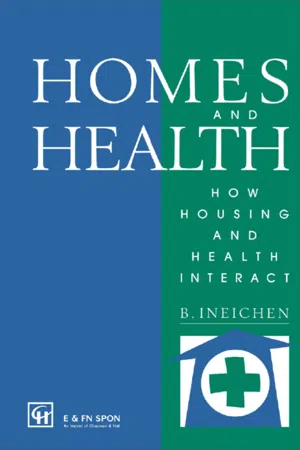
This book links where people live with their health. The author reviews how housing has influenced health throughout the past hundred and fifty years, discusses in detail current issues concerning housing and health and describes attempts at housing particular groups whose health is at risk.
Information
The legacy of the past 1
1.1 BEFORE WORLD WAR I
A good sewer is far nobler and far holier than the most admired Madonna ever painted.
Ruskin
Discussions of the history of housing in Britain that claim a relevance to modern-day society conventionally begin around the time of the ascent of the young Queen Victoria to the throne in 1837. It was a time of rapid social change. One third of the way through the nineteenth century the British population was growing at a furious pace, and even more dramatically, moving from the status of a rural peasantry to an urban proletariat.
Between the censuses of 1801 and 1851 the population of England and Wales doubled: cities grew at a frightful rate. Birmingham, Liverpool and Leeds more than tripled their populations; Manchester quadrupled; Bradford increased eightfold. Growth continued almost as rapidly during the second half of the century: by 1901 London had over six and a half million inhabitants. Glasgow—described by a Parliamentary Committee in 1840 as a place where ‘penury, dirt, misery, drunkenness and crime culminate to a pitch unparalleled in Great Britain’—was probably the dirtiest and unhealthiest of all British cities. Fever was so prevalent and distinctive that foreigners came to study it. It had nearly a million inhabitants, with a population density that exceeded a thousand people an acre in places (Smith, 1974).
Housing in these new settings was almost exclusively ruled by market forces. Rents were determined by simple supply and demand. Landlords could ask for whatever they thought they could get. House building was speculative, profit driven and largely unregulated. Behaviour was unregulated too: the new urban populations arrived without the experience of cooperation needed to bring even an approximation of civilised selfcontainment and dignity to their cheek-by-jowl existence. As one commentator has put it, the raw industrial cities into which migrants from rural England and Wales, the Scottish Highlands and Ireland poured were as unprepared to receive them as they were unprepared to live in an urban environment (Rosen, 1973).
Physical conditions in the cities could be dreadful. The smell was sometimes appalling. Doctors visiting Glasgow in 1840 report on one scene they found which tells us not just about the physical conditions but also something about why they endured.
We entered a dirty low passage like a house door, which led from the street through the first house to a square court immediately behind, which court, with the exception of a narrow path around it leading to another long passage through a second house, was occupied entirely as a dung receptacle of the most disgusting kind. Beyond this court the second passage led to a second square court, occupied in the same way by its dung hill; and from this court there was yet a third passage leading to a third court and a third dungheap. There were no privies or drains there, and dungheaps received all the filth which the swarm of wretched inhabitants could give; and we learnt that a considerable part of the rent of the houses was paid by the produce of the dungheaps.
Such smells were perceived as a major threat to health, ‘putrid miasmata’ in the medical jargon of the day. The miasma theory, that disease was due to noxious gases being breathed in, was at the forefront of the Victorian public health movement. Concern about noxious environmental influences grew alongside, and gradually became enmeshed with, concern about the housing standards of the ‘working class’; in effect the great majority of the urban population. Such concern predated precise scientific understanding of how the major epidemic diseases were transmitted.
In the rural settings from which the new town dwellers had migrated, thanks to fresh air and water, people lived longer and their health was generally considered to be rather better. But their wages were so low that they were barely able to stay alive at all. There was no spare money to pay for house improvements; but in many cases homes were tied to the job, and there was no incentive for employer/landlords to make improvements either. Many labourers’ homes were no better than hovels. Contemporary accounts in the 1860s describe large families, even with lodgers, crowded into one-bedroom cottages; whole families ill with fever and lying in the same room as a corpse; of damp walls, saturated floors and smoke-filled rooms. A national enquiry in 1864 found cottage dwellers had less than one third of the air-space required in workhouses, and little over half of that needed in common lodging-houses (Burnett, 1986).
The Poor Law appeared a close and constant reality. One village investigation in 1873 found one in eleven residents were officially paupers, and three–quarters were likely to be so at some stage in their lives. Pressure on domestic space increased with the premature destruction of spare homes due to the enclosure of farm land or to reduce the opportunities of Poor Law claimants.
A Times reporter visited Exning, Suffolk in 1874, and gives a vivid, firsthand account of the a dilemmas created by rural housing shortage.
Many cottages have but one bedroom. I visited one such cottage in which father, mother, and six children were compelled to herd together—one a grown-up daughter… In another case the woman said they had put the children upstairs, and she and her husband had slept in a bed on the brick floor below until the bottom board of the bed had fallen to pieces from damp, and then they had to go among the children again. The sanitary inspector visits these dwellings occasionally to prevent overcrowding, but the difficulty is for the poor to find other cottages, even when they are inclined to pay more rent. Some of the worst of these cottages belong to small occupiers; some are mortgaged up to the hilt, and the owners often can afford neither to rebuild nor repair. It is a hard thing, again, for the sanitary inspector to pronounce a cottage unfit for human habitation, when no better—perhaps literally no other— can be had for the family.
Source: F.Clifford (1875) The Agricultural Lockout of 1874, William Blackwood.
Urban health problems such as malaria and typhus were not unknown in conditions of rural squalor, nor were TB and respiratory illness, for which poor ventilation was to blame. But housing conditions in the towns were considerably worse. At the beginning of the nineteenth century, the farm labourer with normal strength and energy could usually find the land and material to build himself a dwelling, however rudimentary. In the towns half a century later, new arrivals from the countryside had to squeeze themselves and their dependants into a housing stock already bulging with occupants.
Improvement was to be brought about by various methods: the use of legislation (at first on a voluntary basis, later by compulsion) which regulated the building of new houses, improved their environment, and cleared the worst of the slums away; through the design of new dwellings to ensure minimum standards; and by the education of poor people and the regulation of their domestic lives.
These changes did not all progress at the same rate, and at times they worked against one another. The progress of public health legislation has received the most attention from historians, possibly because it is easiest to trace.
1.1.1 LEGISLATING FOR PUBLIC HEALTH
In the earliest years of Victoria’s reign, concern over public health issues grew rapidly, fuelled by the escalating costs to public funds that followed epidemics. Edwin Chadwick’s Report on the Sanitary Condition of the Labouring Population of Great Britain was a notable milestone, published in 1842 and selling 100 000 copies. It was followed by a series of legislative measures—over 40 in the years between 1850 and 1880—which slowly ameliorated some of the health problems of the poor and established a public health service.
The first Medical Officer of Health was appointed in Liverpool in 1847, and other appointments followed, although they remained discretionary until the Public Health Act of 1872.
Restrictions on new building were initially put into practice on a local basis, as a result of the efforts of individual Medical Officers of Health. However by-laws to prevent the construction of poor quality housing such as ‘back-to-backs’ were often ignored and it was not until the Housing, Town Planning Act, 1909 that there was a general prohibition. Opposition was based on the facts that whatever the disadvantage, back-to-backs made efficient use of building plots, were cheap to construct (and hence to rent) and for all but the end houses guaranteed at least some form of warmth (Wohl, 1983).
Alongside restrictions on new types of buildings went powers to prosecute landlords who did not maintain their property. Under the Torrens Act, 1868, it became the duty of householders to keep their property in good repair; and if they failed, the local authority could do the job themselves and charge them for it, or close the property down. The Cross Act, 1875 went further by encouraging slum clearance and rebuilding on a large scale. Slowly conditions improved. Taxes on bricks, glass and timber were removed between 1850 and 1866. Sanitation and decent drinking water were gradually provided in the rapidly growing cities. Hitherto, water supplies may have been from standpipes distant from the houses and switched on only briefly during the day, or delivered by water cart at erratic times. Obtaining water was hard work for poor families and often led to quarrels between them. It was also expensive. Many middlemen might be involved; tenants who had paid their rent might stand to lose their supplies if the landlord had not paid his waterrate (Gauldie, 1974, pp. 77–8).
Overcrowding, so crucial to the persistence and spread of many of these conditions, was reduced but slowly: the pace did not quicken till the next century. Overcrowding was seen as a threat to moral as well as physical health: phrases such as ‘moral corruption’ and ‘herded into promiscuity’ recur as churchmen and politicians deplore what they find, with adolescents of both sexes sharing bedrooms, children sharing with their parents and adults driven out to spend their free time in pubs. Overcrowding was particularly bad in Scotland, where in 1861 64% of the population lived in one- or two-roomed houses. In Glasgow there was an attempt to deal with it directly: a system of ‘ticketing’ houses was introduced in 1866, by which the number of residents in any particular house was limited by sanitary inspectors. By the 1880s, one seventh of the city’s population came under these rules, but enforcement was difficult (Worsdall, 1989).
The clearance of the worst areas of housing was achieved with some success following the Cross Act. In London 40 acres, responsible for the highest death rates, were cleared, mostly in the late 1870s, and new accommodation provided for over 27 000 people. However, the cost was considerable, both for local ratepayers, and for those rehoused, who found they had to pay considerably higher rents (Wohl, 1977).
The poverty of the new townspeople created what seemed for many decades an impossible trap: unable to pay enough rent to house themselves adequately, in a housing market where it was in nobody’s interest to add appreciably to the housing stock, because owners of new houses would never receive sufficient rent to make their investment worthwhile. Various Acts of Parliament between 1855 and 1862 encouraged the creation of working-class housing by commercial companies, financed by cheap loans. But the results were disappointingly meagre. Only towards the end of the century, when sufficient earning power had filtered down to the poorest families, did this situation change, by which time both philanthropists and local authorities were making a contribution to new housing stock. This process took a considerable time. In the earlier part of the century, skilled artisans acquired reasonable standards of housing several decades before unskilled labourers, as case studies in several towns have shown (Chapman, 1971).
There were several reasons why Victorian public health and housing legislation did not immediately benefit those most in need. Much legislation was originally voluntary, and became mandatory only subsequently. It called for local resources which were often provided piecemeal, and sometimes local authorities could promote their own Acts of Parliament which effectively restricted the impact of national measures. This happened in Liverpool, reducing the amount spent on new houses.
Progress in providing adequate working-class housing varied from city to city. Some local political groups were particularly powerful, standing in the way of improvements. Back-to-back housing was forbidden by an Act of Parliament in 1842, yet continued to be built for long after. The local administration in Leeds, hand-in-glove with builders’ interests, went on building them until 1937 (Beresford, 1971).
Poverty, housing and health in Liverpool Outside London and Glasgow, Liverpool was probably the unhealthiest of British towns in the middle of the nineteenth century. In 1843 life expectancy of its citizens was 26, against 37 in London and 45 in Surrey. At one period over half the children were dying before their fifth birthday.
The migration of families escaping from the famine in Ireland added considerably to its problems. It was the most densely populated English city, well over double that of London in 1844, with over 700 people per acre in one group of six enumeration districts.
Large numbers of the population (estimates vary between 28 000 and 39 000 in the late 1830s) lived in cellars. The majority of these had been evicted by 1851 as a result of new legislation which followed from Chad wick’s 1842 Report. At the same time, the Council feared the implication of proposed regulations concerning new housing, which would put up building costs considerably. When the Building Regulation Bill, 1842 was introduced, Liverpool was able to gain exclusion, and subsequent housing regulations were governed by rules formulated locally. As a result, little new building took place, and tenants evicted from cellars were forced into already existing overcrowded housing.
Source: Treble (1971); Taylor (1974).
Secondly, much of the legislation merely closed down some options (e.g. the banning of the use of cellars as homes) without providing alternatives. It was not until after 1880 that legislative emphasis shifted from clearing away the worst houses to providing new ones. Measures to improve housing actually made some people homeless. The building of railways reduced urban housing still further. Railway companies were not obliged to place limits on their site clearance operations in towns until 1874, when they were required to give eight weeks’ notice before taking possession of working-class houses and to provide alternative accommodation. The regulations were easily evaded and did not succeed in ensuring the provision of alternative homes for the neediest of those displaced. According to one estimate, 76 000 homes were lost to railway building between 1853 and 1901 (Dyos, 1982).
Progress in improving workers’ housing conditions in rural areas was if anything even slower. The 1909 Housing Act achieved some progress; in the first three years of its operation, 15 000 properties were improved and 5000 cottages compulsorily closed. But Medical Officers of Health were often reluctant to issue closing orders in areas of housing shortage on the grounds that to reduce further the stock of accommodation would only drive labourers and their families into the towns—or the workhouses. Loans to local authorities sanctioned the building of fewer than ten per cent of the number of cottages pulled down under the Act (Burnett, 1986).
Urban environmental improvements had their costs too: White (1980) describes how when Flower and Dean Street in Whitechapel, a slum area long associated with crime and prostitution, was purchased in 1885 in order to rebuild it as ‘philanthropic’ dwellings, existing tenants were simply evicted: and one died of exposure.
Thirdly, the new legislation called for the creation of entirely new organizations to perform entirely new tasks. The whole apparatus investigation, the identity and measurement of problems, and the devising and execution of remedial action had to be created from scratch. The gradual growth of public health departments has already been noted and public health education was similarly hesitant. The first course of Public Health lectures took place at St. Thomas’s Hospital in 1856 and a Diploma in State Medicine (later to become the Diploma in Public Health) was instituted in Dublin in 1870 and in English cities soon after. All medical officers in large districts had to possess one by 1888, and those in County Councils by 1909. Their staff of ‘sanitary inspectors’ remained minute—Mile End had one per 105 000 population in 1884—and the inspectors’ training was often rudimentary until very late in the century.
One new activity which became a valuable adjunct to the public health movement arose from the Victorian passion for counting. The Registrar- General’s office was founded in 1837, and the appointment of Dr William Farr as Compiler of Abstracts provided the public health lobby with its first reliable statistician to contribute to their campaigns. Farr and his colleagues published figures on mortality and disease. In particular they contrasted the life and disease rates for people in different parts of the country, focusing attention on health differentials between ‘good’ and ‘bad’ areas. Variations between places and over time in child mortality (62 per cent of labourers’ children died before the age of 5) were especially shocking. Reports from the Poor Law Commissioners and local statistical societies added to the impact. Chad wick’s Report was able to draw on all this statistical material, and the expertise which made it possible. Subsequently the ability of the Medical Officers of Health to assemble and publish statistical material was a great force in shaping public awareness and achieving political action. In Wohl’s (1977) words
Their emphasis on the moral dangers of overcrowding could not be ignored…and their convinced environmentalism forced men to consider causes other than character for the sorry plight of the urban masses.
Fourthly, countervailing forces...
Table of contents
- Cover Page
- Title Page
- Copyright Page
- Acknowledgements
- The legacy of the past 1
- Current Concerns 2
- Living on the Margins 3
- Conclusions 4
- References and further reading
- Unhealthy Housing
- Design Against Fire
Trusted by 375,005 students
Access to over 1.5 million titles for a fair monthly price.
Study more efficiently using our study tools.
Frequently asked questions
Yes, you can cancel anytime from the Subscription tab in your account settings on the Perlego website. Your subscription will stay active until the end of your current billing period. Learn how to cancel your subscription
No, books cannot be downloaded as external files, such as PDFs, for use outside of Perlego. However, you can download books within the Perlego app for offline reading on mobile or tablet. Learn how to download books offline
Perlego offers two plans: Essential and Complete
- Essential is ideal for learners and professionals who enjoy exploring a wide range of subjects. Access the Essential Library with 800,000+ trusted titles and best-sellers across business, personal growth, and the humanities. Includes unlimited reading time and Standard Read Aloud voice.
- Complete: Perfect for advanced learners and researchers needing full, unrestricted access. Unlock 1.5M+ books across hundreds of subjects, including academic and specialized titles. The Complete Plan also includes advanced features like Premium Read Aloud and Research Assistant.
We are an online textbook subscription service, where you can get access to an entire online library for less than the price of a single book per month. With over 1.5 million books across 990+ topics, we’ve got you covered! Learn about our mission
Look out for the read-aloud symbol on your next book to see if you can listen to it. The read-aloud tool reads text aloud for you, highlighting the text as it is being read. You can pause it, speed it up and slow it down. Learn more about Read Aloud
Yes! You can use the Perlego app on both iOS and Android devices to read anytime, anywhere — even offline. Perfect for commutes or when you’re on the go.
Please note we cannot support devices running on iOS 13 and Android 7 or earlier. Learn more about using the app
Please note we cannot support devices running on iOS 13 and Android 7 or earlier. Learn more about using the app
Yes, you can access Homes and Health by Bernard Ineichen in PDF and/or ePUB format, as well as other popular books in Medicine & Urban Planning & Landscaping. We have over 1.5 million books available in our catalogue for you to explore.