Jung's discovery of the 'collective unconscious', a psychic inheritance common to all humankind, transformed the understanding of the self and the way we interpret the world. In On the Nature of the Psyche Jung describes this remarkable theory in his own words, and presents a masterly overview of his theories of the unconscious, and its relation to the conscious mind. Also contained in this collection is On Psychic Energy, where Jung defends his interpretation of the libido, a key factor in the breakdown of his relations with Freud. For anyone seeking to understand Jung's insights into the human mind, this volume is essential reading.
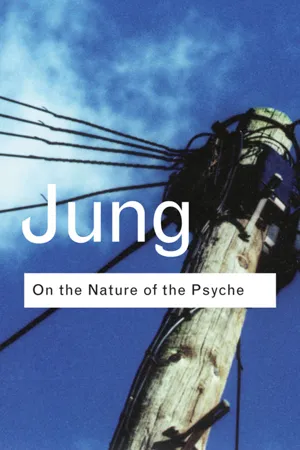
- 208 pages
- English
- ePUB (mobile friendly)
- Available on iOS & Android
eBook - ePub
On the Nature of the Psyche
About this book
Information
I
On Psychic Energy
ON PSYCHIC ENERGY1
I. GENERAL REMARKS ON THE ENERGIC POINT OF VIEW IN PSYCHOLOGY
a. Introduction
1 The concept of libido which I have advanced2 has met with many misunderstandings and, in some quarters, complete repudiation; it may therefore not be amiss if I examine once more the bases of this concept.
2 It is a generally recognized truth that physical events can be looked at in two ways: from the mechanistic and from the energic standpoint.3 The mechanistic view is purely causal; it conceives an event as the effect of a cause, in the sense that unchanging substances change their relations to one another according to fixed laws.
3 The energic point of view on the other hand is in essence final;4 the event is traced back from effect to cause on the assumption that some kind of energy underlies the changes in phenomena, that it maintains itself as a constant throughout these changes and finally leads to entropy, a condition of general equilibrium. The flow of energy has a definite direction (goal) in that it follows the gradient of potential in a way that cannot be reversed. The idea of energy is not that of a substance moved in space; it is a concept abstracted from relations of movement. The concept, therefore, is founded not on the substances themselves but on their relations, whereas the moving substance itself is the basis of the mechanistic view.
4 Both points of view are indispensable for understanding physical events and consequently enjoy general recognition. Meanwhile, their continued existence side by side has gradually given rise to a third conception which is mechanistic as well as energic—although, logically speaking, the advance from cause to effect, the progressive action of the cause, cannot at the same time be the retrogressive selection of a means to an end.5 It is not possible to conceive that one and the same combination of events could be simultaneously causal and final, for the one determination excludes the other. There are in fact two different points of view, the one reversing the other; for the principle of finality is the logical reverse of the principle of causality. Finality is not only logically possible, it is also an indispensable explanatory principle, since no explanation of nature can be mechanistic only. If indeed our concepts were exclusively those of moving bodies in space, there would be only causal explanation; but we have also to deal conceptually with relations of movement, which require the energic standpoint.6 If this were not so, there would have been no need to invent the concept of energy.
5 The predominance of one or the other point of view depends less upon the objective behaviour of things than upon the psychological attitude of the investigator and thinker. Empathy leads to the mechanistic view, abstraction to the energic view. Both these types are liable to commit the error of hypostatizing their principles because of the so-called objective facts of experience. They make the mistake of assuming that the subjective concept is identical with the behaviour of the thing itself; that, for example, causality as we experience it is also to be found objectively in the behaviour of things. This error is very common and leads to incessant conflicts with the opposing principle; for, as was said, it is impossible to think of the determining factor being both causal and final at the same time. But this intolerable contradiction only comes about through the illegitimate and thoughtless projection into the object of what is a mere point of view. Our points of view remain without contradiction only when they are restricted to the sphere of the psychological and are projected merely as hypotheses into the objective behaviour of things. The causality principle can suffer without contradiction its logical reversal, but the facts cannot; hence causality and finality must preclude one another in the object. On the well-known principle of minimizing differences, it is customary to effect a theoretically inadmissible compromise by regarding a process as partly causal, partly final7 a compromise which gives rise to all sorts of theoretical hybrids but which yields, it cannot be denied, a relatively faithful picture of reality.8 We must always bear in mind that despite the most beautiful agreement between the facts and our ideas, explanatory principles are only points of view, that is, manifestations of the psychological attitude and of the a priori conditions under which all thinking takes place.
b. The possibility of quantitative measurement in psychology
6 From what has been said it should be sufficiently clear that every event requires the mechanistic-causal as well as the energic-final point of view. Expediency, that is to say, the possibility of obtaining results, alone decides whether the one or the other view is to be preferred. If, for example, the qualitative side of the event comes into question, then the energic point of view takes second place, because it has nothing to do with the things themselves but only with their quantitative relations of movement.
7 It has been much disputed whether or not mental and psychic events can be subjected to an energic view. A priori there is no reason why this should not be possible, since there are no grounds for excluding psychic events from the field of objective experience. The psyche itself can very well be an object of experience. Yet, as Wundt’s example shows,9 one can question in good faith whether the energic point of view is applicable to psychic phenomena at all, and if it is applicable, whether the psyche can be looked upon as a relatively closed system.
8 As to the first point, I am in entire agreement with von Grot—one of the first to propose the Concept of psychic energy—when he says: “The concept of psychic energy is as much justified in science as that of physical energy, and psychic energy has just as many quantitative measurements and different forms as has physical energy.”10
9 As to the second point, I differ from previous investigators in that I am not concerned in the least in fitting psychic energy processes into the physical system. I am not interested in such a classification because we have at best only the vaguest conjectures to go on and no real point of departure. Although it seems certain to me that psychic energy is in some way or other closely connected with physical processes, yet, in order to speak with any authority about this connection, we would need quite different experiences and insights. As to the philosophical side of the question, I entirely endorse the views of Busse.11 I must also support Külpe when he says: “It would thus make no difference whether a quantum of mental energy inserts itself into the course of the material process or not: the law of the conservation of energy as formulated hitherto would not be impaired.”12
10 In my view the psychophysical relation is a problem in itself, which perhaps will be solved some day. In the meantime, however, the psychologist need not be held up by this difficulty, but can regard the psyche as a relatively closed system. In that case we must certainly break with what seems to me the untenable “psychophysical” hypothesis, since its epiphenomenalist point of view is simply a legacy from the old-fashioned scientific materialism. Thus, as Lasswitz, von Grot, and others think, the phenomena of consciousness have no functional connections with one another, for they are only (!) “phenomena, expressions, symptoms of certain deeper functional relationships.” The causal connections existing between psychic facts, which we can observe at any time, contradict the epiphenomenon theory, which has a fatal similarity to the materialistic belief that the psyche is secreted by the brain as the gall is by the liver. A psychology that treats the psyche as an epiphenomenon would better call itself brain-psychology, and remain satisfied with the meagre results that such a psycho-physiology can yield. The psyche deserves to be taken as a phenomenon in its own right; there are no grounds at all for regarding it as a mere epiphenomenon, dependent though it may be on the functioning of the brain. One would be as little justified in regarding life as an epiphenomenon of the chemistry of carbon compounds.
11 The immediate experience of quantitative psychic relations on the one hand, and the unfathomable nature of a psycho-physical connection on the other, justify at least a provisional view of the psyche as a relatively closed system. Here I find myself in direct opposition to von Grot’s psychophysical energetics. In my view he is moving here on very uncertain ground, so that his further remarks have little plausibility. Nevertheless, I would like to put von Grot’s formulations before the reader in his own words, as they represent the opinions of a pioneer in this difficult field:
(1) Psychic energies possess quantity and mass, just like physical energies.
(2) As different forms of psychic work and psychic potentiality, they can be transformed into one another.
(3) They can be converted into physical energies and vice versa, by means of physiological processes.13
12 I need scarcely add that statement three seems to require a significant question mark. In the last analysis it is only expediency that can decide, not whether the energic view is possible in itself, but whether it promises results in practice.14
13 The possibility of exact quantitative measurement of physical energy has proved that the energic standpoint does yield results when applied to physical events. But it would still be possible to consider physical events as forms of energy even if there were no exact quantitative measurement but merely the possibility of estimating quantities.15 If, however, even that proved to be impossible, then the energic point of view would have to be abandoned, since if there is not at least a possibility of a quantitative estimate the energic standpoint is quite superfluous.
(i) The subjective system of values
14 The applicability of the energic standpoint to psychology rests, then, exclusively on the question whether a quantitative estimate of psychic energy is possible or not. This question can be met with an unconditional affirmative, since our psyche actually possesses an extraordinarily well-developed evaluating system, namely the system of psychological values. Values are quantitative estimates of energy. Here it should be remarked that in our collective moral and aesthetic values we have at our disposal not merely an objective system of value but an objective system of measurement. This system of measurement is not, however, directly available for our purpose, since it is a general scale of values which takes account only indirectly of subjective, that is to say individual, psychological conditions.
15 What we must first of all consider, therefore, is the subjective value system, the subjective estimates of the single individual. We can, as a matter of fact, estimate the subjective values of our psychic contents up to a certain point, even though it is at times extraordinarily difficult to measure them with objective accuracy against the generally established values. However, this comparison is superfluous for our purpose, as already said. We can weigh our subjective evaluations against one another and determine their relative strength. Their measurement is nevertheless relative to the value of other contents and therefore not absolute and objective, but it is sufficient for our purpose inasmuch as different intensities of value in relation to similar qualities can be recognized with certainty, while equal values under the same conditions plainly maintain themselves in equilibrium.
16 The difficulty begins only when we have to compare the value intensities of different qualities, say the value of a scientific idea compared with a feeling impression. Here the subjective estimate becomes uncertain and therefore unreliable. In the same way, the subjective estimate is restricted to the contents of consciousness; hence it is useless with respect to unconscious influences, where we are concerned with valuations that go beyond the boundaries of consciousness.
17 In view of the compensatory relationship known to exist between the conscious and the unconscious,16 however, it is of great importance to find a way of determining the value of unconscious products. If we want to carry through the energic approach to psychic events, we must bear in mind the exceedingly important fact that conscious values can apparently disappear without showing themselves again in an equivalent conscious achievement. In this case we should theoretically expect their appearance in the unconscious. But since the unconscious is not directly accessible either in ourselves or in others, the evaluation can only be an indirect one, so we must have recourse to auxiliary methods in order to arrive at our estimates of value. In the case of subjective evaluation, feeling and insight come to our aid immediately, because these are functions which have been developing over long periods of time and have become very finely differentiated. Even the child practises very early the differentiation of his scale of values; he weighs up whether he likes his father or mother better, who comes in the second and third place, who is most hated, etc. This conscious evaluation not only breaks down in regard to the manifestations of the unconscious but is actually twisted into the most obvious false estimates, also described as “repressions” or the “displacement of affect.” Subjective evaluation is therefore completely out of the question in estimating unconscious value intensities. Consequently we need an objective point of departure that will make an indirect but objective estimate possible.
(ii) Objective estimate of quantity
18 In my study of the phenomena of association17 I have shown that there are certain constellations of psychic elements grouped round feeling-toned18 contents, which I have called “complexes.” The feeling-toned content, the complex, consists of a nuclear element and a large number of secondarily constellated associations, The nuclear element consists of two components: first, a factor determined by experience and causally related to the environment; second, a factor innate in the individual’s character and determined by his disposition.
19 The nuclear element is characterized by its feeling-tone, the emphasis resulting from the intensity of affect. This emphasis, expressed in terms of energy, is a value quantity. In so far as the nuclear element is conscious, the quantity can be subjectively estimated, at least relatively. But if, as frequently happens, the nuclear element is unconscious,19 at any rate in its psychological significance, then a subjective estimate becomes impossible, and one must substitute the indirect method of evaluation. This is based, in principle, on the following fact: that the nuclear element automatically creates a complex to the degree that it is affectively toned and possesses energic value, as I have shown in detail in the second and third chapters of my “Psychology of Dementia Praecox.” The nuclear element has a constellating power corresponding to its energic value. It produces a specific constellation of psychic contents, thus giving rise to the complex, which is a constellation of psychic contents dynamically conditioned by the energic value. The resultant constellation, however, is not just an irradiation of the psychic stimulus, but a selection of the stimulated psychic contents which is conditioned by the quality of the nuclear element. This s...
Table of contents
- Cover
- Half Title
- Title Page
- Copyright Page
- Table of Contents
- EDITORIAL NOTE
- PART I On Psychic Energy
- PART II On the Nature of the Psyche
- BIBLIOGRAPHY
- INDEX
Trusted by 375,005 students
Access to over 1.5 million titles for a fair monthly price.
Study more efficiently using our study tools.
Frequently asked questions
Yes, you can cancel anytime from the Subscription tab in your account settings on the Perlego website. Your subscription will stay active until the end of your current billing period. Learn how to cancel your subscription
No, books cannot be downloaded as external files, such as PDFs, for use outside of Perlego. However, you can download books within the Perlego app for offline reading on mobile or tablet. Learn how to download books offline
Perlego offers two plans: Essential and Complete
- Essential is ideal for learners and professionals who enjoy exploring a wide range of subjects. Access the Essential Library with 800,000+ trusted titles and best-sellers across business, personal growth, and the humanities. Includes unlimited reading time and Standard Read Aloud voice.
- Complete: Perfect for advanced learners and researchers needing full, unrestricted access. Unlock 1.5M+ books across hundreds of subjects, including academic and specialized titles. The Complete Plan also includes advanced features like Premium Read Aloud and Research Assistant.
We are an online textbook subscription service, where you can get access to an entire online library for less than the price of a single book per month. With over 1.5 million books across 990+ topics, we’ve got you covered! Learn about our mission
Look out for the read-aloud symbol on your next book to see if you can listen to it. The read-aloud tool reads text aloud for you, highlighting the text as it is being read. You can pause it, speed it up and slow it down. Learn more about Read Aloud
Yes! You can use the Perlego app on both iOS and Android devices to read anytime, anywhere — even offline. Perfect for commutes or when you’re on the go.
Please note we cannot support devices running on iOS 13 and Android 7 or earlier. Learn more about using the app
Please note we cannot support devices running on iOS 13 and Android 7 or earlier. Learn more about using the app
Yes, you can access On the Nature of the Psyche by C.G. Jung in PDF and/or ePUB format, as well as other popular books in Psychology & History & Theory in Psychology. We have over 1.5 million books available in our catalogue for you to explore.