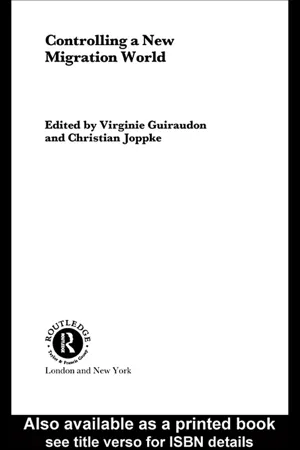
Controlling a New Migration World explores the factors that drive recent migration control policies and, in turn, sheds light on the unintended consequences of policies for the new character of migration. This book asks how we can account for the immigration policies of liberal states. Is the recent linkage between migration and security a rhetorical invention of elites or a reflection of changing migrant profiles? Are states' control policies effectively containing or only redirecting unwanted migration flows? This increasingly relevant issue will be of great use to anyone working in comparative politics, sociology and studying ethnicity or international migration, as well as professionals working in the migrant/asylum and public law fields.
- 272 pages
- English
- ePUB (mobile friendly)
- Available on iOS & Android
eBook - ePub
Controlling a New Migration World
About this book
Information
1 Controlling a new migration world
Virginie Guiraudon and Christian Joppke
This volume deals with the efforts of contemporary nation-states to control international migration. Its purpose is to circumscribe the new strategies and instruments of control that migrant-receiving states have devised at the local, national and transnational levels to cope with new forms of migration that deviate fundamentally from “classic” immigration: illegal migration, mass asylum-seeking, circular migration, and organized human smuggling. This entails a dual focus on state policy and new migration patterns “on the ground.” Assembling political scientists studying the policy process and sociologists studying migrants and migration flows, we wish to understand the impact of migration flows on the development of state policies and, in turn, to shed light on the unintended consequences of policies for the character of migration flows.
In this introduction, we discuss the relationship between flows and policies, a surprisingly neglected topic in migration studies, and the main focus of this volume (1); flesh out the infrastructure of contemporary immigration policy in terms of certain “control dilemmas” that plague them (2); present a typology of state responses to these dilemmas (3); look at a tabooed and often neglected dimension of the discursive “securitization” of migration: increasing crime rates among migrants (particularly of the irregular kind) (4); and point to some unintended consequences of tightened migration controls, such as selecting risk-prone and shadowy migrant profiles adept at circumventing the controls, and feeding the growth of human smuggling organizations (5).
Flows and policies
In the multidisciplinary field of migration studies there is a peculiar divide between the study of migration flows and the study of state policies that seek to solicit, channel, or contain these flows. The low degree of interaction between both camps is visible in the astonishing statement of a recent state-of-the-art work on migration flows that the link between “state policies” and international migration has remained “under-theorized and little studied” (Massey et al. 1998: 286). This statement shows its distinguished authors, primarily demographers and economists, strangely ignorant of the small library on the comparative politics of immigration control and immigration and citizenship that has accumulated since the 1980s. On the opposite side, students of state policies are often ignorant of the very object of these policies, the causes and dynamics of migration flows and networks, which in important respects resist the attempts by states to control and regulate them. There is evident need to overcome the mutual ignorance of demography and political science in migration studies, and to systematically relate migration flows and state policies
This book looks at the relationship between flows and policies at a particular historical juncture, where the supply of international migrants has come to greatly exceed the demand for them. At this point in time, immigration policy becomes “control” policy, in which states seek to stem, rather than solicit, international migration. The distinction between “stemming” and “soliciting” is fundamental, though surprisingly little reflected on. In the “old” migration world, epitomized by the classic guestworker recruitment in continental Europe in the 1950s and 1960s and the resumption of wanted settler immigration in the United States in the mid-1960s, the imperative of “soliciting” prevailed over that of “stemming.” In the “new” migration world the opposite is the case, and even ongoing or renewed efforts and episodes of “soliciting” proceed within the logic of “stemming” – examples being the recent cutting of social benefits and spiked-up “deeming” provisions for legal immigrants in the United States, or the restrictions on settlement and family reunification that frame the second-generation “guest-worker” programmes of some European states in the 1990s.1 The historical moments that ushered in the new migration world are well known, even though their impact and importance differ across regions: the European stop to new labor migration after the first oil crisis in 1973, which was notably not followed in North America and Australia; the onset of mass asylum seeking in the 1980s, which resulted from the dual factors of decolonization and civil wars in Asia and Africa and the closure of labor migration in Europe; and the concern about illegal immigration, organized human smuggling, and crime that has come to dominate the post-Cold War era of the 1990s and beyond.
Immigration “control,” which deals with migration that is happening despite and against the opposite intention of states, automatically directs the attention to the relationship between flows and policies.2 Whenever there is the stated need for “control”, there is the unstated admission that current policies have failed to prevent migration from happening. Control policies thus necessarily include theories about the causes and dynamics of flows.
In a scathing attack on current attempts in the United States to contain illegal immigration from Mexico, Douglas Massey (1998) has argued that the demographic theory underlying US immigration control is wrong, thus generating misguided and counterproductive policies. According to the (implicit) theory underlying US control policies, migration is “pushed” by poverty in Mexico and “pulled” by the lure of higher wages and public benefits in the United States, and proceeding as the one-directional move by insulated, utility-maximizing individuals. This theory, which interestingly mirrors the microeconomic assumptions of classic migration theory (see Massey et al. 1998: 288), informs the attempts of recent US governments to contain the “push” factor through supporting Mexican development in the context of the North American Free Trade Association (NAFTA), and to reduce the “pull” incentives through cutting social benefits for immigrants and fortifying the border.
The underlying demographic theory is not only wrong, according to Massey, but also leading to policies that increase rather than decrease unwanted immigration from Mexico. First, it is not a lack of development but development itself that pushes migration; development dislocates people and creates the aspirations and cognitive horizons that make them ready for moving. To the degree that NAFTA succeeds to spur Mexican development, it is therefore bound to further increase migration from Mexico. Second, migration is not an act of isolated individuals driven by the lure of higher wages and benefits, but of individuals embedded in larger family units that seek capital accumulation at home and “insurance” against economic risk, which are partially financed by the remittances of family members delegated abroad. Accordingly, manipulating the incentive structure in the receiving society, for instance, through cutting social benefits or making illegal immigrants ineligible for public health services and education, is unlikely to prevent people from migrating. Third, deterrence at the border, in the form of higher fences and beefed-up border guards, only turns circular into one-directional migration (that is, “immigration”), at least it makes the once-caught migrant smarter not to get caught the second time (and thus to build the “human capital” that drives migration). Finally, and most importantly, migration is sustained by social networks and characterized by “cumulative causation”, in which each act of migrating begets more migration; this process of network-formation is generally outside the control of governments. Based on these demographic findings, Massey (1998: 32) suggests a “realistic” immigration policy that “accept(s) the flow as a reality and work(s) to channel it in directions that are beneficial to the United States”. Elements of such a “realistic” policy would be the creation of a temporary worker category that legalizes a migration flow that is too deeply entrenched to be crossed out by government fiat, or support for savings banks and credit institutions that would tie migrants to the sending society and increase their propensity to return.
While a rare and important attempt to investigate (and improve) the linkage between flows and policies, Massey’s invective against US immigration policy’s “march of folly” pays too little attention to the actual forces that shape this policy. It may be desirable to devise control policies that are based on the “right” demographic theory, but the underlying picture of public policy as the product of an impartial lawmaker guided by cognitive rationality is naive. While “irrational” from the point of view of the demographer, US immigration policy is highly rational from the point of view of the interest groups and political entrepreneurs that determine its course. For instance, the long-standing quest for effective internal controls and employer sanctions having been thwarted by a powerful coalition of business and ethnic and civil liberty groups, as recently in the 1996 Illegal Immigration Act, it was inevitable that the control focus would shift from the workplace to the border – in fact, due to cultural and geographic factors, the border had always been the prefered site of US immigration control. Given the public disquiet about “uncontrolled” illegal immigration from Mexico, local political careers could be made by showing toughness in the various “gatekeeper” or “hold the line” operations, and the presidential election in 1996 was at least partially decided by the Democratic incumbent’s unwillingness to cede the high ground on immigration control to his Republican challenger (see Andreas 1998). Calling this “symbolic politics” is correct, but symbolism has always been the essence of politics.
Massey’s critique of a mismatch between flows and policies, and his fatalistic suggestion that we “accept immigration as inevitable” (Massey et al. 1998: 289), may be appropriate to the particular case of US–Mexican immigration, one of the most deeply entrenched “migration systems”3 in the world. It would be wrong to conclude from it a general incapacity of states to control migration flows once they have started. The same US state, for instance, has been highly efficient in containing unsolicited Cuban and Haitian migration through high-seas interception and the deflection of flows to offshore “safe havens,” which suggests the pivotal role of geography for the effectiveness of controls (see Neuman 1995).
Turning from America to France, after 1945 Europe’s only country to solicit permanent immigration, Patrick Weil (1996) has told the opposite story of a state that is too efficient in controlling existing flows. Like all West European states after the recruitment stop for new labor migrants in 1973/4, France continued to receive legal immigrants, though at a reduced pace of approximately 90,000 to 120,000 new entries per year. Most of these were “as-of-right” immigrants whom France had to accept for legal-constitutional reasons: EU migrants, who enjoy free movement rights on the basis of European Community law; family members of settled migrants, who are protected by the domestic constitution; refugees and asylum-seekers on the basis of domestic constitutional and international convention rights; and a trickle of highly skilled labor migrants, the only left-overs of solicited immigration after 1974. By the early 1990s, the numbers in all categories were down, and on objective grounds it would be far-fetched to deem France in a “migration crisis.” However, ever since a right-wing party, Le Pen’s National Front, had been luring big chunks of the electorate with its demagogic demand to expel most (Muslim) immigrants from France, immigration had become more politicized than anywhere else in Europe, and even mainstream politicians were arguing in favor of “zero immigration” – an obvious impossibility if France wanted to honor its Republican values and legal commitments. The Le Penist fringe impulse fully seized the center with the “loi Pasqua” of 1993, named after its originator, the hard-line Gaullist Interior Minister Charles Pasqua. Dictated by the desire to win back the voters of the National Front, this was the full-blown attempt to stem even the existing legal flows: for instance, through prohibiting foreign students from accepting job offers by French employers after completing their studies, and making them ineligible for the all-important “carte de dix ans” that would stabilize their residence in France; or through increasing the waiting period for family reunification from one to two years, and denying resident permits to foreign spouses who had been in the country illegally before the marriage.
As Weil points out, these repressive measures, while catering to the populist groundswell against immigrants, had undesired effects even on their own terms: legal migration flows were forced into illegality, which had to be the result of the tightening of family reunification; in turn, the artificial creation of “illegal” migrants imposed on police and the courts the burdens of unnecessary control and surveillance activities, reducing their capacity to go after the “real” culprits; and, last but not least, in deterring foreign students and young professionals, France deprived herself of a major source of human capital, making her a self-inflicted loser in the increasingly global competition for the brightest and best. His critique did not go unheeded. Invited by the new Socialist Prime Minister, Lionel Jospin, to prepare the intellectual grounds for a new immigration law, Weil’s policy recommendations were in fact inspired by the American model, in particular the hugely complex and differentiated US visa system (1997). The law adopted in 1998 has created special statuses for scientists and scholars based on his recommendations.
The American and French examples are extreme cases of a mismatch between flows and policies, in which a policy either increased the flow that it was supposed to contain (as in the US case) or tried to contain a flow that could not be contained without violating fundamental liberal values and even harming the national interest (as in the French case). Interestingly, the impartial French observer attributes a “highly rational” immigration policy to the one country that, in contrast to France and the United States, has untiringly claimed “not” to be a “country of immigration”: Germany (Weil 1998: 27). More than perhaps any other immigrant-receiving country, Germany has developed a highly tiered and differentiated immigration policy, in which different legal regimes apply to different migrant groups. This “rational” approach was favored by the absence of a vote-catching right-wing party, which allowed the mainstream parties to keep the immigration issue at low profile, despite some exceptions.4 Contrary to France, there has been no Pasqua-style spill-over from attacking illegal immigration to harming the rights of legal migrants. When faced with the threat of massive illegal migration from Eastern Europe in the 1990s, Germany responded with a dual approach of deflecting and legalizing this new migration pressure. “Deflection” occurred in the form of bilateral agreements (Rücknahmeabkommen) with most eastern European states, in which the latter agreed to take back caught illegal border crossers against financial compensation and logistic help in the build-up of effective immigration controls. This was no German invention, but part of a larger trend in European Union states to erect a “cordon sanitaire” around their external borders, particularly regarding asylum-seekers (see Lavenex 1998). “Legalizing” occurred in the form of new recruitment programmes for temporary and seasonal migrant workers, which – in contrast to their predecessors in the 1950s and 1960s – were framed by strict quotas and ter...
Table of contents
- Front Cover
- Controlling a New Migration World
- Routledge/EUI Studies in the Political Economy of Welfare
- Title Page
- Copyright
- Contents
- List of illustrations
- List of contributors
- Series editors’preface
- Acknowledgements
- 1 Controlling a new migration world
- Part I Reforming migration control
- Part II Linking migration and security
- Part III New migration world
- Index
Trusted by 375,005 students
Access to over 1.5 million titles for a fair monthly price.
Study more efficiently using our study tools.
Frequently asked questions
Yes, you can cancel anytime from the Subscription tab in your account settings on the Perlego website. Your subscription will stay active until the end of your current billing period. Learn how to cancel your subscription
No, books cannot be downloaded as external files, such as PDFs, for use outside of Perlego. However, you can download books within the Perlego app for offline reading on mobile or tablet. Learn how to download books offline
Perlego offers two plans: Essential and Complete
- Essential is ideal for learners and professionals who enjoy exploring a wide range of subjects. Access the Essential Library with 800,000+ trusted titles and best-sellers across business, personal growth, and the humanities. Includes unlimited reading time and Standard Read Aloud voice.
- Complete: Perfect for advanced learners and researchers needing full, unrestricted access. Unlock 1.5M+ books across hundreds of subjects, including academic and specialized titles. The Complete Plan also includes advanced features like Premium Read Aloud and Research Assistant.
We are an online textbook subscription service, where you can get access to an entire online library for less than the price of a single book per month. With over 1.5 million books across 990+ topics, we’ve got you covered! Learn about our mission
Look out for the read-aloud symbol on your next book to see if you can listen to it. The read-aloud tool reads text aloud for you, highlighting the text as it is being read. You can pause it, speed it up and slow it down. Learn more about Read Aloud
Yes! You can use the Perlego app on both iOS and Android devices to read anytime, anywhere — even offline. Perfect for commutes or when you’re on the go.
Please note we cannot support devices running on iOS 13 and Android 7 or earlier. Learn more about using the app
Please note we cannot support devices running on iOS 13 and Android 7 or earlier. Learn more about using the app
Yes, you can access Controlling a New Migration World by Virginie Guiraudon,Christian Joppke in PDF and/or ePUB format, as well as other popular books in Politique et relations internationales & Droit de l'immigration. We have over 1.5 million books available in our catalogue for you to explore.