eBook - ePub
Transportable Environments 2
- 160 pages
- English
- ePUB (mobile friendly)
- Available on iOS & Android
eBook - ePub
Transportable Environments 2
About this book
This book explores aspects of the historical and theoretical basis for temporary and transportable environments and provides an insight into the wide range of functions that they are used for today, the varied forms they take and the concerns and ideas for their future development. Themes in the book range from wide-ranging topical issues like the ecological implications of building to more focused investigations such as shelter after disaster. The book will be of interest to both students and practising architects, engineers and those involved in the creation of the built environment. It will also be of value to those involved in areas of product design, design history, building component manufacture and urban design.
Information
Theory
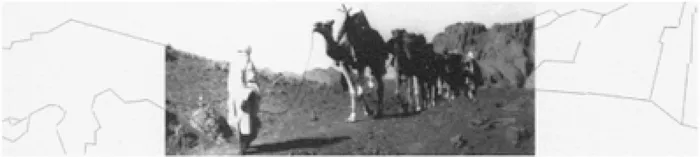
1.1 Nomads at a waterhole near Arak (courtesy of Rob MacDonald)
Freedom and Transience of Space (Techno-nomads and transformers)
Gary Brown
Centre for Architecture, Liverpool John Moores University
Movement and growth
Architecture is in motion; it is kinetic both literally and phenomenally. Of course we all know this everything is in motion relative to something else. Kinetic motion, however, is now becoming an integral part of architectural thought and realisation. Architecture has adopted kinetic motion as a process of growth. We now consider architecture as extendable and changeable in time as well as space. This growth is not merely relative to size or motion but concerns energy and the transformation of spatial forms and material substances. Architecture has matured back to its roots. It has become integral with the cycles of the earth—a holistic, open system. The influences that have brought about this change in the approach to architectural design have come from many different sources. The conceptual model of the environment has changed from a mechanical model to an organic model. Computers have made handling the mass of ever more complex information easier and more visual. Communication has become mobile, linked to individuals rather than social or communal provision. Ecological issues and sustainability have reintroduced the importance of appropriate architectural interaction with the local and universal environment in which it is built.
Machine system-organic system
Recent theory has altered the system reference we use as a basis for design conception from a machine system to an organic system. Organic theory emerges from nature, an environment that possesses evolutionary patterns that have a base code, and an inherent programme where information is strategically interrelated to produce forms of growth and strategies of behaviour, optimising each particular pattern to the contextual situation. Codes are fixed, but the way they are expressed or repressed is dependent on the environment in which they exist. ‘The forms and strategies are the result of extrapolated codes to environmental optimisation’ (Frazer, 1995). This natural cycle produces the strategic patterns from its code repository that are necessary for survival. Each entity remains individual through its inherent individual programme, but is also an integral part of the overall natural cycle. The entities in this natural order are no longer conceived of as singularities. The entity can, in itself, be the medium for other entities or can form systems of entities like flocks of sheep or blades of grass. These systems of entities can be said to form a context. There is some kind of relationship between the entity and the system where the entity should be seen primarily as emerging from the system, rather than being distinct from it. its existence is interdependent with the system. Open systems are delocalised and are interdependent with other open systems.
Environmental patterns can therefore be envisaged as ephemeral, continually reforming in response to environmental flows, fluxes and rhythms, creating a multitude of space, times and objects. The prevalence of organic systems theory over the former machine systems theory has altered the conceptual model that we apply in order to comprehend our environment and consequently design in our environment. Mae-Wan Ho in his article ‘The New Age of the Organism’ sets out what he considers to be the main differences between the mechanical universe as it was conceived and the new organic universe.
Mechanical Universe; Static, deterministic; Separate, absolute space and absolute time, universal for all observers space time frames; Inert objects with simple locations in space and time; Linear, homogeneous space and time; Local causation; Given, non-participatory and hence, impotent observer;
Organic Universe; Dynamic, evolving; Space-time inseparable, contingent observer (process) dependent; Delocalised organisms with mutually entangled space-times; Non-linear, heterogeneous multidimensional space times; None-local causation; Creative, participatory entanglement of observer and observed.
(Ho, 1997)
Flows-flux
Our adoption of an organic conceptual model over the mechanical model can influence the way we actually see. The organic model diminishes the importance of determined territories and formal bodies and emphasises the importance of the programmatic factors that govern the perpetual development of environmental form. Change in the mechanical world is cyclical, but there is no development; instead, the same factors and programmes are continually repeated. The organic world is also cyclical; however, this system is developmental. Organisms respond to environmental clues and cues and adapt their behavioural strategies to take advantage of environmental changes. These adaptations to the organisms’ strategic behaviour may then reciprocally generate changes in the local environment. The organic model is constantly altering and is reciprocal; there is a feedback and response mechanism. If we look for a geometrical analogy of these two system models then a closed circle could represent the mechanical system and an endless spiral could represent the organic system. The organic model is progressive: programmatic flows, fluxes and rhythms within the environment continually generating strategic patterns as temporal, ephemeral forms through their convergence and divergence. These strategic patterns form in response to the environment and are therefore relative only to a particular moment in time. We can interpret these patterns as a language of environmental flow, and can formulate theories that can be applied (and constantly amended) in relation to the flow of information from the changing environment. This ability to abstract and formulate theories from environmental pattern recognition has enabled us to intervene in them successfully.
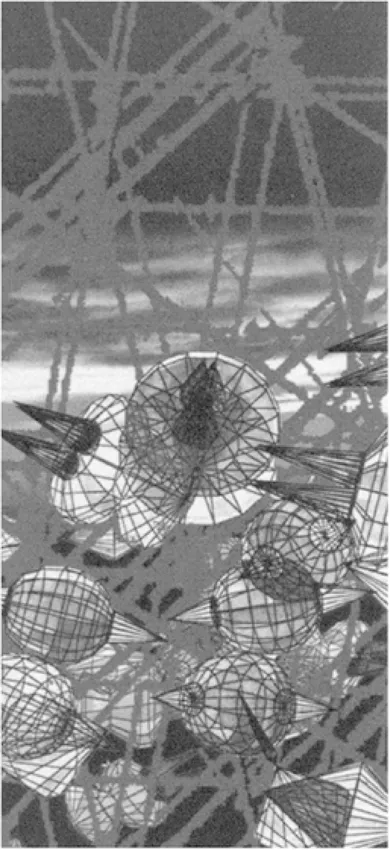
1.2 Interactive sprites. The being of things in this natural order consists of open systems that are delocalised and are interdependent beside other open systems (1996)
These theories, when applied, reciprocally affect the way that we view the environment. There is, however, a world of difference between the reciprocal pattern language resulting from ‘inhabiting the landscape’ and ‘inhabitation as landscape’. The complexities of nature prevail in ‘inhabiting the land-scape’ whilst in ‘inhabitation as landscape’ the complexities of our own nature prevail.
Temporal-transient
How we see the world affects the way that we interpret it and respond to it. If we interpret our cityscape using an organic theory the city patterns can be considered as having emerged from the topography in response to programmatic forces emanating from a holistic matrix/milieu amalgam. The patterns are a strategic material redistribution of the earth, similar to Gottfried Semper’s ‘mound’ (Semper, 1989). This strategic, formal, distribution is a reflection of the local milieu as programmatic requirements are laid down (and adjusted) over time. The patterns can consequently be envisaged as sets of interrelated spatial matrices (three-dimensional patterns) with interrelated flowing programmatic forces that are constantly influencing both the emerging and emerged forms. City form is never more than a result of the temporal existence of things. It can be described as a single frame in the animated growth of appropriate solutions from one super-positioned state to another. This movement reveals the patterns of a city’s strategies and consequently the programmes that constitute its haecceity, i.e., what makes its unique existence so unique. Form is temporal and transient—space, and its ‘potential of becoming’, is a more desirable design reference.
Static-stasis
Greg Lynn explains a conceptual viewpoint in the way designers conceive of the urban landscape: ‘Architecture is by definition the study and representation of statics. Architecture of the city must however embrace motion, classical models of pure static essentially timeless form and structure are no longer adequate’ (Lynn, 1997). Lynn goes on to explain that neither architecture nor urbanity need be viewed as static. Although architecture has a stable role, urbanism is characterised by more ‘diffuse and transitory interactions’, and both architecture and urbanism need to be conceived of ‘as in motion, liquid mediums’ related to ‘graduated motions and forces’. In The New Vision, Moholy-Nagy uses water to describe this formal flux as a response to environmental changes: ‘If we turn to water we come upon a surprising phenomenon, surprising not in its strangeness but its common-placeness Its changes arises from an extraordinary adaptability to the forces acting on it’ (Moholy-Nagy, 1939). The use of water as an example suggests a structure that possesses a complex dynamic balance where there is a continual altering of the ‘balance’ of the form in relation to local and universal stimuli.
Stable, strategic
Our urban landscapes are, however, already ubiquitous. The patterns, related to past theories (or past ways of seeing) have in many cases reached a mature state which, in their formal aspects, are considered static. It is this static nature which has become the problem. The city is an artifice, reflective of human actions and social strategies, but the patterns of the city do not adapt rapidly enough relative to the dynamics of human nature. The urban pattern is an artificial landscape that is likely to remain predominantly historic, referring to past theories and past social strategies. In the organic theory model which is derived from natural patterns, form is generative, reciprocally developmental, the constituents recyclable. City patterns have, in many cases, failed to evolve and are more often abandoned than recycled—they become patterns in the dust. Urban patterns need to become more motive, more adaptive in order to remain appropriate to the needs of the inhabitants. This is not to infer that stability does not have a role to play in the urban environment. There is, however, a difference between ‘static’ and ‘stable’. Stability in architectural and urban terms has a distinctive role as a supporting platform for motion. Certain elements of our artificial landscape need to stand as a defence against entropy, strategic platforms are important for the launch of movable objects. ‘Every mobile artifice springs in some way from a fixed material base, cars rely on roads, radio waves on a mast, planes on a runway’ (Hatton, 1989). Any concept denying the importance of the stability of Semper’s ‘mound’ to motion is a fallacy; there is a distinct relationship between infrastructure and mobility. Perhaps in terms of infrastructure, it is our relationship to scale that has changed, where the earth itself is now seen as an infrastructure supporting our needs. Particular forms of infrastructure are pinched, kneaded and condensed from the earth to become facilities, both as launch platforms for our mobility and as psychological, existential footholds in the form of monuments that remind humanity of its roots. The application of organic theories to the design of cities needs some kind of recognition of the historic ‘dead wood’, which, after all, also exists in the natural world (from which organic theory derives) as launch platforms for new life.
Permanence-polemic
This lack of adaptation of the urban landscape means that today’s cities constitute a polemic of permanence and transience, as a reflection of their milieus’ conflicting change within permanence. Permanence in urbanity consists of a multitude of stable forms, image and infrastructure, that the people recognise and relate to. These stable forms aid the generation of ‘place’ from ‘space’ and emanate a feeling of social continuity. They generate a psychological foothold, a mark upon the earth (even though the mark may just be a launch pad for a transient event). Facility and fashion, influenced by technology and the media, are ephemeral. Ever changing they often go hand-in-hand, for example, facility being presented in a fashionable/stylistic way. The difference between fashion and facility in the city is similar to that between fashion and clothing. Clothes are what we wear to facilitate ourselves within our environment in terms of social acceptance, comfort, and bodily protection. Fashion is more frivolous and chameleon-like. Considered by some to be ‘useless’ it is associated with changing moods, modes, shifting erogenous zones and is essentially ‘symbolic gossip’ at a social event. Similar to the garments we wear, facility and fashion have become inextricably linked in the urban landscape and have become, essentially, symbolic gossip that permeates the city. The contradiction is that this symbolic gossip has become one of the ways that we remember the city. The relative hierarchical importance between permanence and transience of form as generated by space as place in our memory has been amended. The prevalence of a consumer society based on instant image has made the facility and fashion events within the city monuments in our memories. The general social acceptance and economic need for the event/ obsolescence cycle mean that stability, despite its necessity as a launch pad, is considered an impediment to change. Monuments have become backgr...
Table of contents
- Cover Page
- Title Page
- Copyright Page
- Illustration Credits
- Foreword
- Theory
- Context
- Teaching
- Design
- List of Contributors and Delegates
- Selected Bibliography
Trusted by 375,005 students
Access to over 1.5 million titles for a fair monthly price.
Study more efficiently using our study tools.
Frequently asked questions
Yes, you can cancel anytime from the Subscription tab in your account settings on the Perlego website. Your subscription will stay active until the end of your current billing period. Learn how to cancel your subscription
No, books cannot be downloaded as external files, such as PDFs, for use outside of Perlego. However, you can download books within the Perlego app for offline reading on mobile or tablet. Learn how to download books offline
Perlego offers two plans: Essential and Complete
- Essential is ideal for learners and professionals who enjoy exploring a wide range of subjects. Access the Essential Library with 800,000+ trusted titles and best-sellers across business, personal growth, and the humanities. Includes unlimited reading time and Standard Read Aloud voice.
- Complete: Perfect for advanced learners and researchers needing full, unrestricted access. Unlock 1.5M+ books across hundreds of subjects, including academic and specialized titles. The Complete Plan also includes advanced features like Premium Read Aloud and Research Assistant.
We are an online textbook subscription service, where you can get access to an entire online library for less than the price of a single book per month. With over 1.5 million books across 990+ topics, we’ve got you covered! Learn about our mission
Look out for the read-aloud symbol on your next book to see if you can listen to it. The read-aloud tool reads text aloud for you, highlighting the text as it is being read. You can pause it, speed it up and slow it down. Learn more about Read Aloud
Yes! You can use the Perlego app on both iOS and Android devices to read anytime, anywhere — even offline. Perfect for commutes or when you’re on the go.
Please note we cannot support devices running on iOS 13 and Android 7 or earlier. Learn more about using the app
Please note we cannot support devices running on iOS 13 and Android 7 or earlier. Learn more about using the app
Yes, you can access Transportable Environments 2 by Robert Kronenburg, Joseph Lim, Wong Yunn Chii, Robert Kronenburg,Joseph Lim,Wong Yunn Chii in PDF and/or ePUB format, as well as other popular books in Architecture & Architecture General. We have over 1.5 million books available in our catalogue for you to explore.