eBook - ePub
The American Radical
- 400 pages
- English
- ePUB (mobile friendly)
- Available on iOS & Android
eBook - ePub
The American Radical
About this book
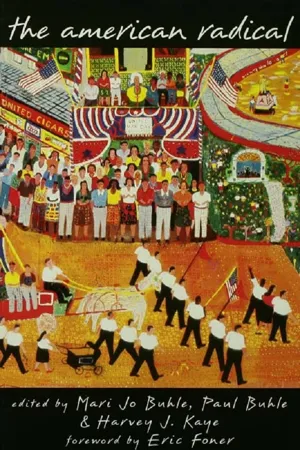
The American Radical tells the story of American democracy from the late 18th century to the present through the lives of the women and men who have fought to advance it.
1
PONTIAC AND NEOLIN
In the spring of 1763, Native Americans from Wisconsin to New York stormed the garrisons and frontier villages of the British North American empire. They came from at least eight tribes, and from two dramatically different language groups. Their attacks were neither spontaneous nor coordinated by a grand strategy, but they were quick, in many cases effective, in some cases, devastating. The assaults began at Detroit, Michigan, in early May, and then spread with news and rumor of Indian victories to the eastern slopes of the Allegheny Mountains and the western reaches of the Great Lakes. British officers, taken by surprise and thrown into confusion, confronted what appeared to be a general Indian uprising. The multitribal warriors were not followers of any single leader or pair of leaders, but two men, Pontiac and Neolin, may be taken as exemplars of the warriors’ militancy, a religiously spirited challenge to the world's most powerful empire. Pontiac, an Ottawa warrior, led the Indians’ seige of British Fort Detroit. Neolin, a Lenape religious leader in what is now eastern Ohio and western Pennsylvania, led no warriors, but his teachings inspired Pontiac and others to defy Great Britain.
Pontiac had emerged from youth as a steadfast supporter of the Ottawas’ alliance with France. The French had never conquered the Ottawas. Nor had they conquered any of the other tribes that would rise in 1763 against Britain. The French may have called their relationship with Indians an “empire,” but recent historians have seen it more as an alliance, or association, in which unconquered Indians had more power than the imperial French would openly admit. Various unreliable memoirs place Pontiac among the allies of France in three major actions which brought on or escalated the French and Indian War (1754—1760): the Pickawillany raid (1752), Braddock's Defeat (1755), and the Fall of Fort William Henry (1757). Pontiac definitely stood with the French at Fort Duquesne (Pittsburgh) in 1757, where he spurned British peace offers. There, in western Pennsylvania, he must have come to know many Lenapes; perhaps he met Neolin among them.
The tide of war turned against Pontiac's French allies in 1758, as British successes on the coasts and high seas cut off French supplies. Without supplies, Fort Duquesne's Indians drifted off, and the French abandoned it in the autumn. By 1760, Britain had conquered French Canada, gaining in the surrender terms the French forts on the Great Lakes. Pontiac, born and raised practically under the walls of the French fort at Detroit, saw it placed in the hands of the British.
We do not know Pontiac's attitude toward the British occupation of Detroit, but his compatriots allowed the redcoats to garrison the fort peacefully in 1760. Having dealt successfully for well over a century with one European power, the Indians had hope that they could deal as well with another. They expected the British to act like good allies, as the French had usually done. They wished the British, like the French before them, to give the Indians goods, traditionally called “presents.” In exchange, they would allow the redcoats their forts, and promise loyalty in war.
But the British Army's upper echelons, flush with their conquests of Quebec and Montreal, had not occupied Detroit to take French lessons from Ottawas. While French officers had earlier learned, through generations of Indian negotiation, to act as mediators of peace, providers of “presents,” allies in war, and strong, even loving, “Fathers,” the British high command demanded that its officers act as conquerors. The British attitude surfaced most clearly over the issue of “presents.” The North American commander in chief, General Jeffery Amherst, considered the “presents” to be but a form of bribery for good behavior. The British treasury considered them a costly waste. Detroit's British officers therefore terminated the French practice of giving gifts either on special occasions or in great annual councils.
This was more than an insult. It did more than demonstrate British contempt for Indians: it had material and political consequences. All cloth, metal goods, spirituous liquors, and ammunition ultimately originated in either Europe or a European colony. Without gifts, Indians could obtain these goods, on which they had come to rely, only by trading—and their most valuable commodities were animal pelts. French gifts had formerly provided an essential hedge against poor hunting or market conditions. British policymakers saw nothing of this. Like the inexperienced trader Alexander Henry, they saw in the Great Lakes region a “vast new market to British adventure.” The peltry trade alone, they assumed, would supply Indians with the needed goods. Theoretically, it might have: had Indian men acted only as hunters, had hunters remained well, and their hunting good. But Ottawas did not live in a theoretical marketplace. They lived in a world that knew war and disease, threats to the trading economy against which the French gifts—received in exchange for alliance—had once been a necessary buffer.
By refusing to distribute presents, the British proved themselves to be unfit as allies of the Great Lakes Indians. Pontiac sought in 1763 to prove them to be unfit as conquerors, and he had many supporters. As Pontiac called for the storming of Detroit in late April 1763, he invoked the spiritual teachings of the Lenape Indian “prophet” Neolin.
Neolin's birth, parentage, family, development, appearance, and death are all unknown. His name meant “four,” a sacred number. In 1763 he lived at the Lenape village of Tuscarawas in the Tuscarawas Valley region of eastern Ohio. In 1764 he lived among Shawnees at their village of Wakatomica, lower down the valley. Later he moved back upstream to live in the most important Lenape town, Newcomer's, where he counseled the important chief Netawatwees until at least 1766.
The Lenapes had a history that differed greatly from that of the Ottawas. They had once lived near the Atlantic, in what is now New Jersey and eastern Pennsylvania. British colonization had, in the late seventeenth and early eighteenth centuries, encouraged their westward migration, many as far as eastern Ohio by the 1730s. Because they had so recently arrived in the upper Ohio River region, and because the French were even later intruders into that area, the Lenapes did not have the long experience with the French that had been shared by the Ottawas of Detroit. Lenapes had only reluctantly allied with the French during the recent imperial war, and for but three and a half years between the summer of 1755 and winter of 1758–59. As the French then abandoned the region, Lenapes reentered into an uncertain peace with the British. They remained wary of the British posts, most notably at Fort Pitt (Pittsburgh), and they grew angry at the freckling presence of British squatters and hunters west of the Alleghenies. Still, they hoped for good trade and good relations. Wariness and anger gained the upper hand over hope, however, as the British developed Fort Pitt on an immense scale, as the British troops did little to prevent British squatting, as the prices of British goods rose, and as game, now also hunted by Britons, became harder to find. A British sergeant reported in 1761 that white hunters were infiltrating Indian lands in “crowds … at which the Indians seem very much disturbed and say the white people kills all their deer.” By 1762, an Ohio Indian accused Britons of making “our Game scarce.”
In short, though Lenapes had in 1759 hoped for good trade from the British, British officers and subjects had undermined those hopes. In both the upper Ohio and the Detroit regions, then, Indians had expressed a willingness to coexist with a limited, carefully defined British presence. They had not been hostile to British people, much less to all Europeans. But Britons failed to meet Indian expectations. “Your Conduct,” an Ohio Indian had told the British the previous December, “makes all the Indian Nations round you very Jealous that you have some bad designs against them.”
Turning militantly against the British, Neolin began predicting a war in 1761. By 1763, Pontiac was quoting his teachings. On the increasing shortages of game, Neolin promised that if the Indians drove out the British, the Master of life would “send back the animals for your food.” On British expansion, he warned that “if you suffer the English among you, you are dead men.” On the devastating effects of liquor and of European diseases, he cautioned distance from the British, else “Sickness, smallpox, and their poison [alcohol] will destroy you entirely.”
Though we have such vivid renditions of Neolin's teachings and prophecies, the man himself remains obscure. Historians have not been kind to him. In 1851 Francis Parkman, employing racism as his guide, attributed his rise to “the great susceptibility of the Indians to superstitious impressions.” Howard Peckham, in 1947, declared him “psychopathic.” Charles Beatty, a Presbyterian missionary who actually met Neolin in 1766, was more impressed: Beatty called Neolin a “young man,” which is all we know of his age. He struck Beatty as gentle, attentive, and respected. He treated Beatty well, demonstrated great hospitality, listened to sermons, and, when the village council concluded that it didn't need Presbyterian advice, he politely (no doubt gladly) ushered Beatty from the village.
Neolin had by 1763 won over Pontiac, who himself exhibited a strong concern for the sacred. Much as Neolin is known as a “prophet,” Ottawas have remembered Pontiac as a religious leader, a mide, a high-ranking shaman in their important Midewiwin festival. Still, Neolin and Pontiac came from different peoples and regions, and had different experiences with European empires. There was, therefore, a tension between the local and the intertribal dimensions of the event we call “Pontiac's War.” Pontiac and Neolin both sought to drive out the British, but for reasons that differed in emphasis. Pontiac, because the British had not behaved as the European occupiers of Detroit should behave. “When I go to see the English commander and say to him that some of our comrades are dead, instead of bewailing their deaths, as our French brothers do, he laughs at me and at you. If I ask anything for our sick, he refuses with the reply that he has no use for us.” Pontiac even visited the French officers who still remained in lower Illinois in 1764, asking them to “fight against this bad meat that would come and infest our lands.” In the same speech, he also obliquely referred to Neolin, when he told the French that to remain at peace was to go “against the orders of the Master of Life.” With sacred and profane arguments, he attempted to rally France against Britain. Pontiac could live with European allies; he would not live under European lords.
Like Pontiac, Neolin may have favored the French over the British, but he probably did not give them as much thought. One document states that, in July 1763, several of Neolin's Lenape followers demanded that Pontiac protect the French inhabitants of the Detroit region. They proclaimed to Pontiac that “thou art French as well as we.” What's more, though Lenape disciples of the prophetic movement would kill and capture thousands of British traders, soldiers, and settlers during the war, they did not make deliberate targets of French traders or settlers who remained neutral.
But despite these indications, Neolin was clearly less interested in the prospects of a new French alliance than he was in getting rid of the British posts and British trade. Indeed, most renditions of his visions say nothing of the French. The Lenapes had never been as concerned as the Ottawas with the French, so this is not surprising. Many of his speeches, recorded in English, condemn all “whites,” but the Lenape language has no colorless racial equivalent of the English term “white.” Perhaps he meant, in these speeches, only to condemn the British. Nervous Britons, recording secondhand news, may have taken him to mean all whites. Neolin had become fervently anti-British; it is doubtful that he lumped the French and British under a single racial heading. What is clear is that he looked more to sacred powers than to old allies for aid. Pontiac looked to both.
Pontiac's call to arms, supported by Neolin's sacred visions, initiated a war that stunned the British officers. Not only had they failed to preserve the peace; not only were they unable to defend the long borderlands of Virginia, Maryland, Pennsylvania, and New York; but their own posts faced siege and collapse. While Pontiac's forces failed to take Fort Detroit, and while Neolin's Lenapes failed to drive the British from Fort Pitt, nine smaller posts fell quickly to Indian siege or had to be abandoned. Even Fort Bedford, Pennsylvania, east of the Alleghenies, came under attack. Most astonishing was the fall in May 1763 of Fort Michilimackinac at the top of Michigan's mitten, taken by an Ottawa and Chippewa ruse that involved a game of lacrosse, a ball tossed over the ramparts, and the rush into the fort of warriors, ostensibly chasing the ball—but picking up weapons and killing Britons along the way. In June, Fort Presque Isle fell to an intertribal force of Ottawas, Chippewas, Wyandots, and Senecas. Senecas annihilated two British infantry companies just south of Fort Niagara on September 23. By the war's end, some 450 British soldiers, and probably 2,000 British subjects, had been killed or captured.
British responses were confused, ferocious, and then, conciliatory. At first, strong measures were taken and countenanced by officers from Amherst down. In the most savage of these, Fort Pitt's beleaguered garrison distributed blankets from a smallpox ward to Lenapes, a deliberate step toward germ warfare. On the strategic level, the British managed to reinforce Forts Niagara, Detroit, and Pitt. They also sent large armies into the upper Ohio country in 1764; which saw some heavy fighting and scattered Indian villagers, but which did not, by themselves, compel Indian surrender. On the popular level, in the frontier communities of Pennsylvania and Virginia, reeling from attacks and anxiety, vigilantes murdered neutral Indians of all sexes and ages—most of them local and Christian. But what brought the militant Indians to seek terms was their lack of ammunition, their realization that France was not resuming the war, and perhaps a growing sense that they had taught Britain a lesson.
Over the course of 1764 and 1765, as the war festered and negotiators struggled, the British quietly acknowledged greater responsibilities toward the Indians. Amherst left North America shortly after the outbreak of the war, and his replacement, General Thomas Gage, was more willing to accommodate Indian demands. Historian Richard White notes that the British reformed their Indian department, resumed the practice of dispensing gifts, limited to the Crown alone the right to purchase Indian land, and attempted to regulate the trade. Neither Ottawas nor Lenapes ceded any lands at the close of the war; the outcome was largely a draw. The British maintained a reduced presence in the west, but they did so at the cost of accepting, to some degree, the Indian demand that they behave as allies, not conquerors.
In the short term, Pontiac could be content that he had taught the British how to behave, as they now began to take up some of the obligations expected of them by the Indians. His policies had been somewhat successful, but he himself became an unfortunate failure. The British, who overestimated his importance, began to treat him as the most important “chief,” not just among the Ottawas, but west of Fort Pitt, a role for which there was no Indian precedent. As White argues, Pontiac “made the fatal mistake of acting the part.” During negotiations at Detroit in 1766, moreover, he killed an Illinois Indian. Resentment at his growing claims to authority, based largely upon mistaken British assumptions, led to his having to leave his homeland among the Ottawas, and his power quickly deteriorated. In April, almost six years after his opening calls for war, he was killed by an Illinois Indian in Cahokia.
Neolin's failure is more clear: no cosmic upheaval dislodged the British. While he had shown some favor for the French, and while, as the war wound down, he attempted to arrange a negotiation through the mediation of Pennsylvania's Quakers, he had long given up on reforming the British. Unlike Pontiac, he could not have been at all satisfied with the results of the war. Still, he retained local influence, and oddly—though no towns or automobiles bear his name—his ideas would be more lasting than Pontiac's. The Ohio region became home to many other Lenape “prophets” in the 1760s, who battled against Christian missionaries for the soul of the region's Indians. Because Neolin's vision of prophetic resistance depended less upon a European ally than did Pontiac's, it was more suited to Indian needs in later years. After the American Revolution, the region's Indians learned that they could count very little upon European imperial powers for assistance. Like Neolin, militants would turn to sacred powers instead. It is no accident that fifty years after the end of the war we now call “Pontiac's War,” a Shawnee man would collapse in a Lenape village and experience visions. These visions—strongly reminiscent of Neolin's—would set him and his followers against alcoholism and against trade with the Anglo-Americans. He too would strongly oppose any loss of Indian land to the expanding power in the East. Like Neolin, he would inspire Ottawas and others. His name was Tenskwatawa, the Shawnee Prophet. Together with his brother, Tecumseh, he would lead another intertribal effort to defend Indian lands. Between 1805 and 1813 these brothers would attempt to unite the tribes from the Great Lakes to the Gulf of Mexico in a spiritually charged struggle for independence from the United States. Very much in the tradition of 1763, they and their followers would not, in the Shawnee Prophet's words, “sit still and see the property of all the Indians usurped.”
Suggested Readings
Gregory Evans Dowd, A Spirited Resistance: The North American Indian Struggle for Unity, 1745–1815. Baltimore, Md.: Johns Hopkins University Press, 1992.
W. J. Eccles, Essays on New France. Toronto: Oxford University Press, 1987.
Michael N. McConnell, A Country Between: The Upper Ohio Valley and Its Peoples, 1724–1774. Lincoln: University of Nebraska Press, 1992.
Howard H. Peckham, Pontiac and the Indian Uprising. Princeton, N.J.: Princeton University Press, 1947.
Richard White, The Middle Ground: Indians, Empires, and Republics in the Great Lakes Region, 1650–1815. New York: Cambridge University Press, 1991.
2
TOM PAINE
Leaving England in 1774 at the age of thirty-seven, Tom Paine came to America and became a radical. Invigorated by the society he discovered and inspired by the great possibilities he recognized within it, Paine wrote a pamphlet, Common Sense, which succeeded in redefining American struggles against British imperial rule as a war for national independence and political revolution and, moreover, as the fundamental act of a world revolution against the tyranny and corruption of the old regimes of Europe. As Paine himself declaimed in words which fired the imagination of his fellow citizens-to-be: “We have it in our power to begin the world over again.”
Born in 1737 at Thetford in Norfolk, Paine's life confirms that “only the past is predictable,” for it is only with the hindsight of history that we can see in the years before his coming to America the making of a revolutionary and world-historical figure. His father, Joseph Paine, was a Quaker and staymaker, and his mother, Frances Cocke, was an Anglican and lawyer's daughter. Neither a happy nor an affluent couple, they nevertheless were extremely fond of their son and committed to his receiving a formal education. Thus, in addition to becoming well versed in the Bible at home, from the age of six to thirteen young Paine was enrolled in the village school where his favorite subjects were science and poetry. At fourteen, however, he was apprenticed to his father, from whom he learned the craft of corsetmaking and also, no doubt, the dissenting and egalitarian spirit of the Quakers and the historical memory of “turning the world upside down” in the English Revolution of the 1640s and ‘50s. It seems an artisan's life promised too sedentary a future, for at nineteen Paine ran away to serve aboard the privateer King of Prussia. Yet, whatever the adventure, the rigors and oppressions of life between the devil and the deep blue sea were too great and after a year he managed to get himself released, whereupon he went to London to work as a journeyman staymaker.
The next decade and a half were filled with tragic disappointments, mistakes, and failures. In 1759 Paine set up shop as a master craftsman on the southeast coast where he met and married his first love, Mary Lambert. Sadly, within a year he lost his wife in premature childbirth and soon after was forced to give up his business. He then prepared to become and in 1764 secured appointment as an excise officer, but was expelled a year later for having stamped goods without inspecting them (a not unusual practice). During the next few years he kept alive by working as a staymaker, a teacher, and even a preacher while he petitioned for reinstatement. Finally, in early 1768 Paine was posted to Lewes in Sussex. There he boarded with a tobacconist, whose daughter, Elizabeth Ollive, he married in 1771 on the shopkeeper's death. He also became active in local affairs and a “regular” in the Whiggish political debates at the White Hart Tavern, developing a friendly reputation as a man who enjoyed a few good drinks and who had a “skill with words.” David Freeman Hawke describes Paine, now in his early thirties, as possessing “a long face dominated by a large, drooping nose and blue eyes so lively and piercing that few failed to remark upon them after a first meeting.”
Recognizing his talents, Paine's fellow officers chose him to lead their campaign for higher salaries and, so commissioned, he penned his first pamphlet, The Case of the Excise Officers (1772), and moved to London to lobby Parliament. This stay in the capital increased his knowledge and resentment of aristocratic government and politics but, also, renewed his awareness of the popular radicalism of the middling and artisan classes. Additionally, it enabled him to advance his interest in natural philosophy through attendance at scientific lectures—occasions that placed him among circles of intellectuals and freethinkers which, fortuitously, included Benjamin Franklin. Unfortunately, the campa...
Table of contents
- Front Cover
- Half Title
- Title Page
- Copyright
- Dedication
- CONTENTS
- Foreword
- Introduction
- Acknowledgements
- Timeline
- 1 PONTIAC AND NEOLIN
- 2 TOM PAINE
- 3 FANNY WRIGHT
- 4 SOJOURNER TRUTH
- 5 GEORGE LIPPARD
- 6 ABBY KELLEY
- 7 FREDERICK DOUGLASS
- 8 WALT WHITMAN
- 9 ELIZABETH CADY STANTON
- 10 EDWARD BELLAMY
- 11 JOHN MUIR
- 12 EUGENE V. DEBS
- 13 UPTON SINCLAIR
- 14 EMMA GOLDMAN
- 15 WILLIAM D. HAYWOOD
- 16 W. E. B. DU BOIS
- 17 ISADORA DUNCAN
- 18 ELIZABETH GURLEY FLYNN
- 19 ARTURO GIOVANNITTI
- 20 JOHN REED
- 21 IDA B. WELLS
- 22 ROBERT M. LA FOLLETTE
- 23 RICARDO FLORES MAGON
- 24 MOTHER JONES
- 25 JOHN DEWEY
- 26 CLARENCE DARROW
- 27 WILLIAM Z. FOSTER
- 28 DOROTHY DAY
- 29 NORMAN THOMAS
- 30 LEWIS MUMFORD
- 31 CLIFFORD ODETS
- 32 WOODY GUTHRIE
- 33 RUTH FULTON BENEDICT
- 34 CARLOS BULOSAN
- 35 A. J. MUSTE
- 36 VITO MARCANTONIO
- 37 PAUL ROBESON
- 38 ELLA JOSEPHINE BAKER
- 39 I. F. STONE
- 40 WILLIAM APPLEMAN WILLIAMS
- 41 RACHEL CARSON
- 42 MALCOLM
- 43 MARTIN LUTHER KING, JR.
- 44 MICHAEL HARRINGTON
- 45 ABBIE HOFFMAN
- 46 AUDRE LORDE
- Afterword
- Additional Suggested Readings
- Historical Glossary
- Contributors
- *Photo Section following page
Frequently asked questions
Yes, you can cancel anytime from the Subscription tab in your account settings on the Perlego website. Your subscription will stay active until the end of your current billing period. Learn how to cancel your subscription
No, books cannot be downloaded as external files, such as PDFs, for use outside of Perlego. However, you can download books within the Perlego app for offline reading on mobile or tablet. Learn how to download books offline
Perlego offers two plans: Essential and Complete
- Essential is ideal for learners and professionals who enjoy exploring a wide range of subjects. Access the Essential Library with 800,000+ trusted titles and best-sellers across business, personal growth, and the humanities. Includes unlimited reading time and Standard Read Aloud voice.
- Complete: Perfect for advanced learners and researchers needing full, unrestricted access. Unlock 1.5M+ books across hundreds of subjects, including academic and specialized titles. The Complete Plan also includes advanced features like Premium Read Aloud and Research Assistant.
We are an online textbook subscription service, where you can get access to an entire online library for less than the price of a single book per month. With over 1.5 million books across 990+ topics, we’ve got you covered! Learn about our mission
Look out for the read-aloud symbol on your next book to see if you can listen to it. The read-aloud tool reads text aloud for you, highlighting the text as it is being read. You can pause it, speed it up and slow it down. Learn more about Read Aloud
Yes! You can use the Perlego app on both iOS and Android devices to read anytime, anywhere — even offline. Perfect for commutes or when you’re on the go.
Please note we cannot support devices running on iOS 13 and Android 7 or earlier. Learn more about using the app
Please note we cannot support devices running on iOS 13 and Android 7 or earlier. Learn more about using the app
Yes, you can access The American Radical by Mary Jo Buhle, Mary Jo Buhle,Paul Buhle,Harvey J. Kaye, Mary Jo Buhle, Paul Buhle, Harvey J. Kaye in PDF and/or ePUB format, as well as other popular books in History & Historical Biographies. We have over 1.5 million books available in our catalogue for you to explore.