Sexual crime is a topic of massive public concern. Yet the debate over its causes and the appropriate responses of the criminal justice system is often fuelled by ignorance and prejudice, with little understanding of the reality of sexual crime.
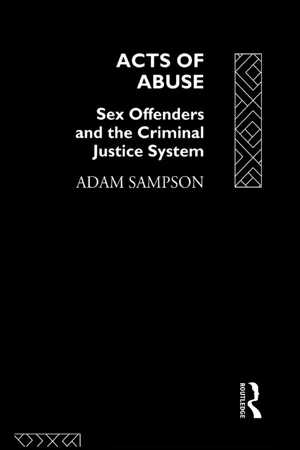
Acts of Abuse explores the response of the criminal justice system to this important issue. Its author, Adam Sampson, examines the existing research about the causes of rape and child abuse, the number of offences being committed, and the policy of the courts. He then examines in detail the responses of the probation service and the prison system to the increased number of offenders with which they are being required to deal.
Written by a prominent critic of the British penal system, this is the first comprehensive survey of the phenomenon of sexual crime in the British penal context. It will appeal to students and all those with an interest in issues relating to crime and justice.
- 156 pages
- English
- ePUB (mobile friendly)
- Available on iOS & Android
eBook - ePub
About this book
Information
Chapter 1
Background to the phenomenon: definitions and explanations
The starting point for any investigation into the penal response to sexual offending must be the theoretical background to the phenomenon. Three questions must be answered. What do we mean by sexual offending? What causes individuals to commit sexual offences? And are such offenders amenable to treatment?
Posing these questions immediately risks being embroiled in heated academic debate. Definitions and explanations of sexual crime are the focus for acrimonious discussion among psychologists, biologists and sociologists, and the differing academic and political perspectives from which they approach the problem often appear to render any meaningful and balanced debate impossible.
This is not just an academic argument, but one crucial to any critique of penal policy. Attempts to assess the true level of sexual crime require some agreement on those acts that are to be defined as sexual offences. Questions about the causes of offending and the treatability of offenders have a direct impact on the proper policy of courts towards sexual offenders and on the proper role of the prisons and probation service. Indeed, it is arguable that it is because these questions have not been carefully examined that recent penal policy towards sex offenders has been so disjointed.
BASIC DEFINITIONS
The first question is: What do we mean by a sexual offence? Superficially, the answer is obvious. The term ‘sex offending’ denotes those activities involving sex which are deemed to be outside the law. However, the law relating to sexual behaviour is often confused. For many years the precise legal status of rape within marriage has been a matter for considerable debate. In England, the Chief Justice Hale judgement of 1736, which held that a woman gave her body and consent to sex as part of the marriage contract, was only overturned by the House of Lords on 23 October 1991. Even then, the Law Lords were adamant that legislation is needed to clarify the situation.
This confusion also besets other sexual activity. The legal status of sado-masochism was thrown into doubt by a House of Lords ruling in a recent case involving a homosexual sado-masochistic sex ring, which held that the men concerned could be convicted of committing assaults on each other, despite the fact that what took place was with the full consent of all the participants. An even more curious twist was added when some defendants pleaded guilty to aiding and abetting assaults upon themselves.1 Even where the law is clear, there are obvious anomalies. Consensual buggery between males over 21 in private is legal; consensual buggery of a woman by a man is not.2
There is also little agreement about what is to be classified as a ‘sexual’ crime. English law, unlike that of many other jurisdictions, makes no formal distinction between sexual and non-sexual offending. The nearest thing we possess to a formal list of sexual offences comes in the Sexual Offences Act 1956, which forms the basis of the official Home Office statistics. These classify sexual crime into twelve separate classes of notifiable offence: buggery, indecent assault on a male, indecency between males, rape, indecent assault on a female, unlawful sexual intercourse (USI) with a girl under 13, USI with a girl under 16, incest, procuration, abduction, bigamy, and gross indecency with a child. When official statistics of the extent of sexual crime are issued, these are the crimes which are being counted.
The list covers a wide range of human behaviours. One amended version details forty-three different criminal offences involving sex. As a number of the provisions create more than one offence, the total number of different sexual offences possible runs into several hundred. However, these behaviours appear to have in little in common apart from a connection with sex. The list mixes together offences which require the performance of sexual acts (buggery, rape), offences which are motivated by sex but where no sexual act has actually taken place (abduction), and offences which are less directly sex-related (bigamy, procuration). Some acts, such as flagellation, are illegal by virtue of the act; others, such as rape, because of the lack of consent. Some acts, such as bestiality, are illegal by nature of the identity of the victim; in some, age is a vital variable—sexual intercourse is legal between a man of 20 and a girl of 16 if the latter consents but not if the girl is 15. Others depend merely upon the location—consenting homosexual sex between males over 21 is legal in private but not in public places.
Such a confused list scarcely provides a coherent definition of sexual crime. On the one hand, it includes offences which appear to bear little relation to sex. A Howard League Working Party on unlawful sex suggested that the classification of bigamy as a sexual offence was an outdated anomaly, and that it should be omitted. The position of other offences, such as those connected with prostitution, was more complicated, the Working Party argued. Although they are classified in Home Office Criminal Statistics as ‘sexual’ and contain crucial sexual elements, in many ways they have more to do with economic necessity than with sex.3
At the same time, the Home Office list excludes many offences which may contain a crucial sexual element. Indecent exposure is not formally classified as a sexual offence. Cases of aggravated burglary, a charge often used where a sexual assault has taken place during the course of a break-in, do not appear in official statistics as sexual crimes. The rape of a woman followed by her murder would be classified in the statistics as a crime of violence rather than as a sexual offence.
There is also the question of how far we should broaden or narrow our definition of which aspects of sexual behaviour should be classified as crimes. Andrea Dworkin has called for all sexual activity ‘not initiated by women’ to be classed as rape.4 It has also been argued that serial murders of women, such as those committed by Peter Sutcliffe, where no actual sexual assault took place, should be considered as sexual.5
However, many would argue that the Home Office list contains ‘crimes’ without victims, and that its range should be reduced rather than broadened. During the passage of the 1991 Criminal Justice Act, the gay activist organizations Outrage and the Stonewall Group argued vigorously against consenting homosexual activities between adult males being classified as sexual offences. In the initial drafting of the Bill, offences such as soliciting and indecency fell under the provisions of Section 25 of the Act, allowing sentencers to pass sentences of preventative detention on repeat offenders. However, this Section of the Act was not to be applied to offences involving (heterosexual) prostitution.6 These groups argued instead that the age of consent in the case of homosexual sex should be lowered to match that in the case of heterosexual sex. Males engaging in sex with other males over the age of 16 should not be classified as ‘sex offenders’, with all the opprobrium that implies. Still less should there be any search for an explanation for their behaviour or attempts at ‘treatment’.
These arguments enjoy powerful support. The Labour Party is committed to a lowering of the age of consent for homosexual sex to 16. The European Commission is also reported to be examining ways of standardizing ages of consent within the European Community.7 This process could well cause problems, even for the Labour Party. The age of consent is frequently lower elsewhere in Europe than it is in the UK: in Italy, the age of consent for both hetero-and homosexual sex is 14, in Spain 12. 8
Some would take matters further. The magazine Understanding Paedophilia, published by the Paedophile Information Exchange, carried articles advocating the complete abandonment of the concept of a legal age of consent, citing historical and foreign examples of the occurrence and acceptence of sex between adults and children. These contacts it regarded as healthy, positive and normal. It is only when there is ‘the use of threats, violence, unreasonable coercion, drugs, etc.’ that the law should intervene.9 Otherwise, paedophile sexual activity is natural, normal and requires no explanation.
Such claims go to the heart of the debate about what constitutes sexual crime. Despite (or indeed because of) the anger and disgust these arguments arouse, coherent attempts to counter them have been relatively rare.10 The traditional reliance on appeals to simple concepts of ‘normality’ and ‘morality’ as the basis for determining what should, and what should not, be classified as sexual crime has little force. Paedophilia, homosexuality and incest have been relatively common in both ancient and contemporary societies. Even within Christian Western society, the degree of moral turpitude attached to such acts as buggery and masturbation has varied according to the needs and attitudes of the time.11
The touchstones of normality and morality therefore appear of little use. However, that does not mean that no meaningful distinctions about what constitutes (or should constitute) sexual crime can be made. There is a basic distinction that can be drawn between sex which is deviant or illegal and sexual abuse, between behaviour which produces victims and behaviour which does not. Unless a sexual act is freely entered into with full, informed consent, or if its consequences are seriously harmful, then, it can be argued, it should be classified as a sexual crime. Thus rape and all nonconsensual sex are sexual abuse, but consensual, non-exploitative homosexual activity is not.
Many abusers, however, would defend their behaviour even in the face of such a distinction. Many rapists would argue that their victim enjoyed the experience. The central tenet of paedophile faith is that sex between adults and children is not harmful, and that it is freely entered into and fully consensual. There is some research evidence to support the paedophile case. Sandford found in his study of paedophile sex that many of the children reported it as a positive and pleasurable experience.12 Similar findings have been reported in the case of incest.13
However, the weight of evidence is overwhelming in rejecting the abusers’ arguments. The testimony of survivors quoted in the introduction is scarcely consistent with abusers’ claims. As Finkelhor points out (and confirms by means of data from his own surveys), the overwhelming majority of children who have had sexual experiences with adults do not regard it as having been a positive experience.14 Moreover, the research on the impact of abuse upon survivors’ lives is often devastating. The experience of abuse has been linked with later psychiatric problems, with the use of drugs, homelessness and prostitution.15 There is also some evidence that survivors of abuse experience later sexual problems.16
Nor can the claims made by abusers, that victims often consented, be allowed to pass unchallenged. The testimony of rape survivors repeatedly bears out the fact that when verbal consent is given, it is invariably under the threat of violence or coercion. The thesis that children freely consent to sexual involvement with adults is also questionable. Not only is it the case that what is presented as free consent on the part of the child is often unwilling consent elicited by threats and manipulation. It is also misleading to claim that children can give genuine consent to an activity about which they are often very ignorant, when they may not yet have developed the emotional maturity to deal with the experience.
The distinction between sexual abuse and non-abusive illegal sex is fundamental to the operation of the criminal justice response to sexual offending. It provides a justification for the intervention of the legal system in sex between adults and chidren (or older children and younger children). However, this justification becomes weaker as the children involved become older, with a consequent advance in knowledge and emotional maturity. It is also weaker in cases of apparently consensual under-age sex between children of the same age, where the dangers of abuse of power and authority are not so palpable, and which is not linked with such problematic after-effects. Indeed, it appears from the Kinsey Report and other surveys that, for most people, their first sexual experiences are as children with other children.17 Although, in theory, the ubiquity of under-age sexual experience puts the majority of the British population into the category of ‘sex offender’, in practice the operation of the law observes the distinction between sexual abuse and illegal sex, and rarely if ever intervenes.
Limiting one’s definition of sexual crime to abusive sex has crucial advantages in the search for an explanation of its cause. The huge range of behaviours that can be defined as sexual offending would otherwise make such a search impossible. Given the range of offences and the different nature of the circumstances that render them illegal, the search for explanation would appear not simply difficult but prima facie illogical. The violent rape of a stranger seems to have little in common with consensual homosexual sex in a public convenience, and an incident involving a middle-aged adult buggering a 5-year-old boy appears to differ fundamentally from the case of two 15-year-olds having consensual heterosexual intercourse. Although all four cases involve the commission of sexual acts which are against the law, it is difficult to see any other common feature.
EXPLANATIONS
It is for this reason that few of the explanations that are advanced for sexual crime seek to explain the full range of sexual behaviours that may fall foul of the law. Instead, they concentrate almost exclusively on sexual assaults against women and children. The most recent attempts to explain these fall broadly into three schools: the sociological, the biological, and the psychological. The first explains the occurrence of sexual crime (especially rape) by the operation of power and gender relationships in society, the second by Darwinian theories of evolution or by the influence of hormones on behaviour, and the third by the psychological functioning of individual offenders.
However, before moving on to consider the precise nature of those theories, three caveats need to be added about the research on which they are based. First, as the next chapter will show, very little sexual crime ever comes to the attention of the authorities, let alone in a form that is capable of being studied by criminologists or psychologists. Conclusions based on in-depth studies of convicted sexual offenders, or even on interviews with survivors of sexual abuse, are therefore undermined by the unrepresentative nature of their samples. As the authors of a recent study of convicted and imprisoned rapists admit:
It should be emphasised at this stage that the present study has looked at a population composed entirely of men who have been both convicted of and imprisoned for rape. Any generalisations about rapists who are not in prison, either because they have not been reported, apprehended, or convicted, should be made with extreme caution, if at all.18
The second caveat i...
Table of contents
- COVER PAGE
- TITLE PAGE
- COPYRIGHT PAGE
- ACKNOWLEDGEMENTS
- INTRODUCTION
- CHAPTER 1 BACKGROUND TO THE PHENOMENON: DEFINITIONS AND EXPLANATIONS
- CHAPTER 2 FROM CRIME TO CONVICTION
- CHAPTER 3 SENTENCING: JUST DESERTS AND PUBLIC PROTECTION
- CHAPTER 4 SEX OFFENDERS AND PROBATION: A CHALLENGE DUCKED?
- CHAPTER 5 A PRISON WITHIN A PRISON
- CHAPTER 6 TREATMENT IN PRISON: ORDER OUT OF CHAOS
- CHAPTER 7 CONCLUSION: DOUBTS AND DIFFICULTIES
- NOTES
Trusted by 375,005 students
Access to over 1.5 million titles for a fair monthly price.
Study more efficiently using our study tools.
Frequently asked questions
Yes, you can cancel anytime from the Subscription tab in your account settings on the Perlego website. Your subscription will stay active until the end of your current billing period. Learn how to cancel your subscription
No, books cannot be downloaded as external files, such as PDFs, for use outside of Perlego. However, you can download books within the Perlego app for offline reading on mobile or tablet. Learn how to download books offline
Perlego offers two plans: Essential and Complete
- Essential is ideal for learners and professionals who enjoy exploring a wide range of subjects. Access the Essential Library with 800,000+ trusted titles and best-sellers across business, personal growth, and the humanities. Includes unlimited reading time and Standard Read Aloud voice.
- Complete: Perfect for advanced learners and researchers needing full, unrestricted access. Unlock 1.5M+ books across hundreds of subjects, including academic and specialized titles. The Complete Plan also includes advanced features like Premium Read Aloud and Research Assistant.
We are an online textbook subscription service, where you can get access to an entire online library for less than the price of a single book per month. With over 1.5 million books across 990+ topics, we’ve got you covered! Learn about our mission
Look out for the read-aloud symbol on your next book to see if you can listen to it. The read-aloud tool reads text aloud for you, highlighting the text as it is being read. You can pause it, speed it up and slow it down. Learn more about Read Aloud
Yes! You can use the Perlego app on both iOS and Android devices to read anytime, anywhere — even offline. Perfect for commutes or when you’re on the go.
Please note we cannot support devices running on iOS 13 and Android 7 or earlier. Learn more about using the app
Please note we cannot support devices running on iOS 13 and Android 7 or earlier. Learn more about using the app
Yes, you can access Acts of Abuse by Adam Sampson in PDF and/or ePUB format, as well as other popular books in Social Sciences & Sentencing. We have over 1.5 million books available in our catalogue for you to explore.