- 512 pages
- English
- ePUB (mobile friendly)
- Available on iOS & Android
eBook - ePub
About this book
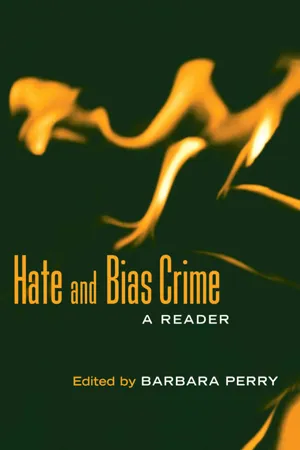
Covering everything from hate groups and extremist exploits to Black church arsons and the fall out violence from 9/11; this is an important collection that sheds much-needed light on this growing problem.
Information
PART ONE
DEFINING AND MEASURING HATE AND BIAS CRIME
INTRODUCTION
September 1565, Nassau County, Florida—Spanish troops, acting under orders from King Phillip II, massacre a settlement of French Huguenots at Fort Caroline, mutilating the dead by cutting out their eyes. The expedition’s commander, Pedro Menendez de Aviles, rationalizes the slaughter by telling the victims in advance, “I do this not unto Frenchmen, with whom my king is at peace, but unto heretics.”
February 1643, New Amsterdam, New York—Dutch soldiers raid both Wecquaesgeek settlements, ignoring their orders to kill only men, murdering and mutilating Native Americans of both sexes and all ages. Officers report seeing infants dismembered and burned, with others bound to planks before being hacked and stabbed. Corpses are mutilated to such an extent that civilians initially blame hostile Indians for the massacre.
Summer 1730, Williamsburg, Virginia—Several slaves are sentenced to “severe whipping” after they hold meetings to discuss their possible freedom. Six weeks later four abolitionist spokesmen are executed, as the illicit meetings continue. Rumors of impending slave revolts in Norfolk and Princess Anne Counties result in a government order requiring all white men to carry weapons to church. In New Orleans, nine rebel slaves are arrested and tortured with burning matches for information on rumored uprisings. One prisoner confesses, whereupon eight men are broken on the wheel and one woman is hanged.
September 1841, Cincinnati, Ohio—On September 1, white men armed with clubs attack a boarding house for blacks. On the 2nd, racial street fighting breaks out after white boys throw gravel at a group of blacks. Two whites are stabbed in the incident. On September 3, a major race riot erupts. Violence continues until September 5, with dozens reported killed and three hundred blacks jailed “for their own protection.”
January 1960—Several teenage vandals are arrested in a wave of anti-Semitic incidents. Racist graffiti is scrawled on synagogues and other buildings in New York City, Philadelphia, Chicago, Boston, and at least thirteen other cities. In New York City a Protestant and an Episcopal church are defaced with stars of David and pro-Jewish slogans on January 7 in apparent retaliation for the swastika attacks.
These illustrative examples are separated by time and, most important, by cultural understandings and definitions. Acts of discriminatory violence and intimidation—even prior to the 1980s—were not considered distinct in any substantial way from other acts of violence. Nonetheless, these startlingly similar examples lend credence to the assertions made by authors in this section that bias-motivated violence is not a new phenomenon in the United States. It is important to keep in mind that what we currently refer to as hate crime has a long historical lineage. The contemporary dynamics of hate-motivated violence have their origins in historical conditions. With respect to these processes, at least, history does repeat itself as similar patterns of motivation, sentiment, and victimization recur over time. Just as immigrants in the 1890s were subject to institutional and public forms of discrimination and violence, so too were those of the 1990s; likewise, former black slaves risked the wrath of the Ku Klux Klan when they exercised their newfound rights in the antebellum period, just as their descendants risked violent reprisal for their efforts to win and exercise additional rights and freedoms in the civil rights era; and women who demanded the right to vote on the eve of the twentieth century suffered the same ridicule and harassment as those who demanded equal rights in the workplace later in the century. While the politics of difference that underlie these periods of animosity may lie latent for short periods of time, they nonetheless seem to remain on the simmer, ready to resurface whenever a new threat is perceived.
Nonetheless, there is a dramatic difference among the examples listed above. Those drawn from the eras preceding the 1980s would not have been perceived as what we now think of as hate crimes. Rather, they might in fact have been seen as a normative part of the social fabric, insomuch as they represented nonpunishable, perhaps even celebrated behaviors in their day. In contrast, examples drawn from more recent years might be both defined and publicly perceived in a qualitatively different light.
Recent legislation at both state and federal levels is a manifestation of this shifting conceptualization of bias-motivated violence. Most notably, the Hate Crime Statistics Act of 1990 (HCSA) was the first piece of federal legislation to explicitly institutionalize this new understanding. As is typical of governmental decrees, the HCSA provides a narrow legalistic definition of hate crimes as “crimes that manifest evidence of prejudice based on race, religion, sexual orientation or ethnicity.” For the most part, states that subsequently (or previously) introduced hate crime legislation have followed suit, adopting a similar definitional style (more on this in the concluding section of the book). According to these definitions, the hate crime designation may only be applied where a “predicate offence” or underlying crime is committed as a result of bias or prejudice. While such a narrow restriction may be deemed necessary within the law enforcement community, it is not particularly satisfying from a social science perspective. In light of Petrosino’s argument included in this section, we might ask, what of equally intimidating or injurious acts motivated by prejudice that are nonetheless legal according to state statutes? What of the gay man in Colorado who is legally denied an apartment or job because of his sexual orientation? This is legal, but arguably still a violation of his basic human rights. Or what of the nineteenth–century Native Americans, forced off their land, raped and murdered in their villages? Again, perfectly legal, but also heinous violations, and in fact part of the semi-official program of westward expansion.
Therein lies the dilemma of defining hate crime. It is difficult to construct an exhaustive definition of the term hate crime. Crime—hate crime included—is relative. It is historically and culturally contingent, as Petrosino’s argument makes clear. As the above examples suggest, what we take as hate crime today in the United States, in another time, in another place, may be standard operating procedure. Michalowski (1985:15), for example, reminds us that it is a myth that “there exists some universally consistent definition of theft and violence as criminal acts.” On the contrary, both as a category and as a social phenomenon in and of itself, hate crime is dynamic and in a state of constant movement and change, rather than static and fixed” (Bowling, 1993: 238).
Bowling’s comments suggest yet another important consideration in defining crime. That is, crime is best understood as a process rather than an event. It does not occur in a cultural or social vacuum, nor is it “over” when the perpetrator moves on. For this reason, we must define hate crime in such a way as to give the term “life” and meaning, in other words, as a socially situated, dynamic process involving context and actors, structure and agency. It is useful to construct a conceptual definition that allows us to account for the predominant concerns raised by Bowling: historical and social context, relationships between actors, and relationships between communities. Seen in this context, it is apparent that our understanding of hate crime is furthered by a definition that recognizes the ways in which this particular category of violence facilitates the relative construction of identities, within a framework of specific relations of power. This allows us to acknowledge that bias-motivated violence is not “abnormal” or “anomalous” in the United States, but is rather a natural extension of the racism, sexism, and homophobia that normally allocates privilege along racial and gender lines. As expressions of hate, such acts of intimidation necessarily “involve the assertion of selves over others constituted as Other” (Goldberg, 1995: 270), where the self is thought to constitute the norm.
One consequence of the varied and divergent definitions used to conceptualize bias-motivated crime is that the confusion inevitably complicates the process of gathering data on hate crime. Berk, Boyd, and Hamner (this volume) astutely observe that “much of the available data on hate motivated crime rests on unclear definitions; it is difficult to know what is being counted as hate motivated and what is not.” As a result, while both academic and media reports make the claim that ethnoviolence represents a “rising tide,” the truth is we don’t know whether this is the case or not. For the most part, existing methodologies are both too new and too flawed to give us an accurate picture of changes over time. For example, because the hate crime data are collected in the same way as the other Uniform Crime Report (UCR) data, they are fraught with the same well-documented deficiencies (Bureau of Justice Assistance, 1997). In fact, some argue that hate crimes are even more dramatically underreported than other UCR offenses (Berrill, 1992; Weiss, 1993). The undocumented Mexican laborer may fear the repercussions of his or her status being revealed. Moreover, victims may well fear secondary victimization at the hands of law enforcement officials. At the very least, they may perceive that police will not take their victimization seriously. And perhaps they would be correct on both counts. It is not unheard of for police to further berate stigmatized victims, including people of color. Abner Louima, the Haitian immigrant sodomized by New York City police officers, could attest to the extremes to which officers might be willing to go in an effort to (re)assert dominance. Moreover, the UCR data count only officially designated criminal offenses, not other forms of violence and harassment that might also intimidate its victims (e.g., racial slurs, pamphleteering, etc.).
In spite of the difficulties of measuring hate crime, a small body of literature has nonetheless begun to identify consistent trends in the dynamics and patterns associated with hate crime—what we might refer to as the “empirical attributes” across categories of ethnoviolence. Levin and McDevitt (1993) offer a concise list of four such characteristics: excessive brutality, stranger victimization, interchangeableness of victims, and multiple offenders.
Hate crime victims are more likely to experience assaultive incidents than offenses against property. This is an inversion of trends for the general population. Consequently, such victims are also more likely to be at the receiving end of excessively brutal violence. To the extent that hate crime perpetrators are motivated by fear, hatred, mistrust, or resentment of their victims, for example, they are more likely to engage in extreme violence—violence that is beyond that necessary to subdue the victim. In the case of anti-gay violence, for example, homicide records indicate an elevated risk of multiple stabbings, genital mutilation, or torture where the intent is to “rub out the human being because of his (sexual) preference” (Mertz, cited in Berrill, 1992:25).
These brutal acts of violence are commonly perpetrated on strangers—people with whom the perpetrator has had little or no personal contact. The victim simply represents the Other in generic terms. That he or she is a member of the hated or demonized group is enough to leave them vulnerable to attack. Further knowledge of their identity, personality, or intent is unnecessary. Neither Michael Griffith nor Yusuf Hawkins were known to their assailants.* That they were black and in the “wrong” place was motive enough for their murders. Additionally, both of these cases reinforce the observation that hate crime often involves multiple offenders. This is a group activity, involving ratios as dramatic as ten to one, but more often in the neighborhood of three to one. A glance at the Southern Poverty Law Center (SPLC) Klanwatch Intelligence Report catalog of hate crimes also provides evidence of the tendency of pairs or groups of offenders to act together. It is, perhaps, this tendency that also helps to account for the brutality involved in hate crime.
There is a consistent pattern of risk of victimization. The most prevalent bias motivation is race, with African Americans the most vulnerable targets. Next in line are Jews and gay men. Moreover, victims are most likely to experience personal rather than property victimization. The exception to this appears to be violence motivated by religion (especially anti-Semitism), wherein victimization is more likely to involve damage to property, for example, vandalism involving swastikas painted on garages or cars, or desecration of cemeteries (see data in Appendix 1).
What little information is available with respect to hate crime perpetrators appears to paint a fairly consistent image as well:1 they are overwhelmingly young white males. Virtually every data collection method reinforces this perception. The profile is evident in UCRs, National Gay and Lesbian Task Force (NGLTF) reports, ADL audits, National Asian Pacific American Legal Consortium (NAPALC) audits, as well as in anecdotal measures such as the catalog offered by the SPLC Intelligence Reports. In short, young members of the dominant hegemonic bloc are consistently responsible for the victimization of subordinate groups.
*Both young black men were killed, presumably because they dared to enter predominantly white New York City neighborhoods.
NOTE
1. Victims are often unable to provide much information about their offenders, either because they did not see them (e.g., vandalism, telephone harassment), or because they were too overwhelmed to notice much about them.
REFERENCES
Berrill, Kevin, 1992, “Anti-Gay Violence and Victimization in the United States: An Overview,” in ...
Table of contents
- Cover Page
- Title Page
- Copyright Page
- Dedication
- Contents
- Acknowledgements
- Permission Acknowledgments
- Introduction
- Part One Defining and Measuring Hate and Bias Crime
- Part Two Causes and Consequences
- Part Three Victims
- Part Four Hate Groups
- Part Five Interventions
- Appendix One: Hate Crime Legislation
- Appendix Two: Hate Crime Data
- Appendix Three: Anti-Hate Resources
- Index
Trusted by 375,005 students
Access to over 1.5 million titles for a fair monthly price.
Study more efficiently using our study tools.
Frequently asked questions
Yes, you can cancel anytime from the Subscription tab in your account settings on the Perlego website. Your subscription will stay active until the end of your current billing period. Learn how to cancel your subscription
No, books cannot be downloaded as external files, such as PDFs, for use outside of Perlego. However, you can download books within the Perlego app for offline reading on mobile or tablet. Learn how to download books offline
Perlego offers two plans: Essential and Complete
- Essential is ideal for learners and professionals who enjoy exploring a wide range of subjects. Access the Essential Library with 800,000+ trusted titles and best-sellers across business, personal growth, and the humanities. Includes unlimited reading time and Standard Read Aloud voice.
- Complete: Perfect for advanced learners and researchers needing full, unrestricted access. Unlock 1.5M+ books across hundreds of subjects, including academic and specialized titles. The Complete Plan also includes advanced features like Premium Read Aloud and Research Assistant.
We are an online textbook subscription service, where you can get access to an entire online library for less than the price of a single book per month. With over 1.5 million books across 990+ topics, we’ve got you covered! Learn about our mission
Look out for the read-aloud symbol on your next book to see if you can listen to it. The read-aloud tool reads text aloud for you, highlighting the text as it is being read. You can pause it, speed it up and slow it down. Learn more about Read Aloud
Yes! You can use the Perlego app on both iOS and Android devices to read anytime, anywhere — even offline. Perfect for commutes or when you’re on the go.
Please note we cannot support devices running on iOS 13 and Android 7 or earlier. Learn more about using the app
Please note we cannot support devices running on iOS 13 and Android 7 or earlier. Learn more about using the app
Yes, you can access Hate and Bias Crime by Barbara Perry in PDF and/or ePUB format, as well as other popular books in Scienze sociali & Diritti civili in ambito legislativo. We have over 1.5 million books available in our catalogue for you to explore.