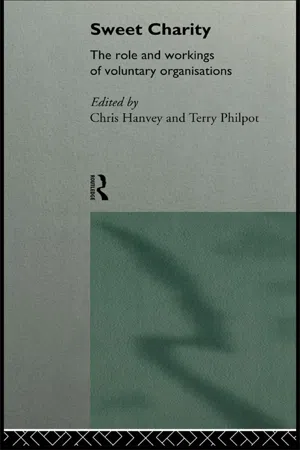
The world of UK charities has been transformed. Gone are the days when charities gained the majority of their money from rattled tins. Fundraising is a sophisticated art and charities often manage multi-million pound contracts to provide services. Those who manage such organizations are expected to adapt to an ever-changing world. Sweet Charity is about this changing world; the skills needed to manage, fundraise, run a successful lobbying campaign or attract new work and the way in which UK charities will increasingly operate in a European environment. Broadly divided into three parts, this book firstly describes the size and scope of the voluntary sector, how it operates and the ways in which changes to the welfare state have had a direct effect upon how charities operate. The second part breaks down the constituent parts of charities, looking in turn at the role of trustees, managers and fundraisers, financial staff and marketing experts. Lastly, the book deals with UK charities in a widening European context. Sweet Charity will attract an extensive readership from trustees and managers of voluntary organizations to academics, students and commentators on the voluntary sector.
To the millennium The changing pattern of voluntary organisations
Stuart Etherington
The voluntary sector is a complex animal. It spans multi-millionpound philanthropic charities through to small, local community groups. Analysing what will happen to the sector over a period even as short as five years is inevitably daunting. The starting point of this chapter is that social trends inevitably impact upon the sector in a variety of ways. The economy influences funding, government policies change the context of voluntary action, and broader cultural change will also shape its development.
Any starting point for an analysis of the voluntary sector has to be a consideration of the likely broader environmental trends. These trends can be analysed by reference to the UK economy, demographic change, technology, government policy and cultural shift. How are these likely to change in what remains of the twentieth century?
First, the economy. There is no sign that any fundamental strengthening of the UK economy has yet been achieved, and forecasts suggest an average growth rate of approximately 2.3 per cent. Government consumption is likely to rise as a proportion of gross domestic product and personal income will grow slightly less than GDP as more overall national expenditure will be devoted to exports and investment. There is likely to be a slow rise in the number of self-employed people, and a continued departure of staff from major corporations causing a rise in the number of small consultancy-based groupings and numbers of individuals contracting back their services to major organisations. This is likely to be as true of the public sector as it is for the private sector. It may even be a characteristic of the larger voluntary organisations.
But perhaps most important for the voluntary sector, is what will happen to people’s expenditure patterns, for this certainly impacts on the sector’s voluntary income. Most forecasts suggest the following: consumers will continue to spend on housing, and this is likely to increase, particularly in relation to appliances, DIY goods, insurance and mortgages; and negative equity is likely to reduce, but will still be a major issue over the next five years. It is likely that people will increase their spending on leisure activities and that, most importantly, more elderly people’s income and assets will be used up to provide long-term care for themselves. There will be greater private provision of medical care, pensions and social insurance generally. It is estimated that the percentage of personal disposable income used in ‘informal taxation’ will rise from 3.5 per cent to 5.1 per cent between 1989 and 1999, representing £22 billion, by the end of the century. Increasingly, as there are larger numbers of unemployed young people, there may be more significant intergenerational transfers of income and wealth, as middle-aged people are forced to assist their children beyond levels previously seen.
Employment patterns, too, will change. The number of young people in work will not change greatly if the proportions staying in education and training remain roughly the same. There is likely to be a greater number in further and higher education, although the trends for 1995 show an unexpected fall. The number of young adults aged between 25 and 34 will fall by 15 per cent. The number of people aged over 65 in the work force will fall by a half. More women will re-enter the labour market, but the increase will be less than from 1970 to 1990. Increasingly, employment will move to the service sector and there will be a continued decline in manufacturing and agriculture. There will be an increase in part-time and contract working, an increase in more flexible forms of organisation, and an increase in professional jobs requiring higher-level skills. There is likely to be an increase in home-working. Minimum wage legislation may well be introduced, and its effects on employment patterns are as yet unpredictable.
So in general, what can we say about economic trends during the period in question? First, it is likely that there will not be substantial growth. Resources may not be available for increased investment in either the public or the voluntary sectors. Within the overall limited growth of GDP, changes will take place and perhaps the most significant are an increasing amount of insecurity in the workplace and a higher percentage of personal disposable income being spent on services that were previously provided by the public sector. In short, there will be less disposable money available and this must inevitably impact on voluntary income of charities over the next five years. I will discuss the exact nature of this impact later on in this chapter.
Turning to demography, this will change the demand equation, particularly for those charities and voluntary organisations concerned with the provision of human services. First, the total population is forecasted to increase by 2.6 million. The working population will remain greater than the dependent population. It is estimated that 30 per cent of the working population will be in full-time work, 30 per cent in part-time work and 40 per cent dependent. The number of children is expected to be about the same. The number of young adults will fall by 2.4 million, leading to a higher average age in the working population. The number of people aged 65–79 will not change greatly, but significantly, the numbers over 80 will increase by 600,000.
What can we deduce from demographic change? There are perhaps two significant conclusions to be drawn. The first is that there will be less people in work to support a greater dependent population; and second, there will be a significant increase in the number of people over the age of 80. The demands that they will place, both on statutory and voluntary sectors, will be higher than the general population.
Let us now turn to the impact of technology. This, too, will change the way in which organisations work: in particular, it is likely to lead to higher degrees of productivity. For example, there will be continued rapid advances in computer performance, combined with falling hardware costs, and these will further extend the use of IT-based equipment. The parallel development in telecommunications will provide improved business links and a wider range of home-based services. The use of new technology may well lead to reductions in the work force, or higher degrees of productivity, and possibly an increase in home-working.
What then of government’s reaction to some of these economic and demographic changes? First, no government or opposition spokesperson appears to be talking about substantially increasing levels of taxation. With limited growth in GDP, an increasingly dependent section of the population and more money being used on a dependent population, it is unlikely that there can be any significant increase in government spending on the voluntary sector. Indeed, there has not been in the recent past. Central government spending on the voluntary sector has been falling with one significant exception, housing associations. If these are seen as part of the voluntary sector, then government spending has increased substantially, for housing association spending constitutes over 85 per cent of central government spending on the voluntary sector. Indeed, some would argue that has gone too far, and what was previously part of the voluntary housing movement has become state agency, with all but its governance being determined by central government policy. This may also be a trend in social care as a result of contracting. What is clear, however, is that the voluntary sector can expect no major increase in the amount of money available from central government.
There are other governmental trends which may influence events. One is a possible movement from nation-states to region downwards, and superstate upwards. This may depend on whether Europe widens or deepens. All the signs are that it will widen. Regionalisation, however, will continue, even if only on an administrative basis. This significantly affects those parts of the voluntary sector which are concerned with regeneration and with employment and training. Local government spending will only marginally increase. The other significant development, which may well continue for the next five years, is the growth in the number of quangos. This is part of a continuing fragmentation of government. If government changes, there may be pressure to democratise some of these new governance structures. The state, however, is less likely to play a significant role and will continue to contract out work through a variety of different agencies. There is some suggestion that the population is reacting to governmental trends by some movement to more voluntary forms of organisations. Single-issue campaigns and self-help responses to social problems may well be a result of this. This has been true in the environmental movement, but is increasingly true among certain black and ethnic minority groups, who are turning away from the state for solutions. This trend may continue as the general dissatisfaction with democratic politics increases. The voluntary sector may therefore find itself once again an instrument of civil renewal, outwith the actions of the state—returning to its traditional homeland.
So what can we say then about the influence of government? First, the voluntary sector can expect little extra money. Second, there may be an increasing fragmentation of administration into a variety of quasi-governmental bodies, and third, new forms of associational organisation may form around specific issues where individuals may place more of their energy, rather than in more formalised political activity.
Another area where trends will impact heavily on the voluntary sector is health and social care. While this is only one segment of the voluntary sector, it has continued, nevertheless, to remain large and influential. Since the creation of the NHS, the sector has never been particularly active in the field of acute health care, although it has made some in-roads in complementary medicine. It is in the area of long-term care where it has been more significant, and here the voluntary sector is likely to play a greater role, providing contracted services to the state. In this sense, it will cease to become the voluntary sector. Perhaps the most significant definition of the voluntary sector is that it draws its governance, its rationale, and a reasonable proportion of its money from outside the state. Organisations which are earning 80–90 per cent of their funds from the state have reached a level of dependency which makes them more part of the state than part of civil society. This is not necessarily wrong, but it should represent a conscious choice by the leadership of voluntary organisations. The move from the civil to the state raises important philosophical issues which contracting organisations ultimately have to answer. While their governance is still drawn from outside the state, the accountability of their managers is increasingly to those who prescribe the contract terms.
The final trend, which may well be important in terms of voluntary sector development, is cultural. This is the most difficult area to forecast. However, some tentative conclusions can be suggested. First, there is likely to be an increasing impact from broadcasting. The growth in the number of television channels and radio outlets is likely to be of significance. Getting your message across will be easier, and at the same time these activities will become more pervasive. There is likely to be an increase in homebased activity. More important, there is significant survey evidence of a decline of confidence in established institutions. This is true of politics, as I have mentioned earlier, but it is also true of a range of other institutions. The only place that there has been increase in confidence in British institutions between 1983 and 1993 is in trade unions, possibly a reaction to changes within the workplace. Patterns of attachment are switching to the family from established institutions, and there is a trend towards a more atomistic society, driven by both technology and a decline in support for institutions.
There is, however, a paradox within this issue of cultural change. It appears that society is becoming more atomistic, but at the same time, there appears to be a yearning for new forms of association around arts, sports, heritage and types of political campaigning. It is impossible to determine which of the drive to new associational forms or the drive to atomism will ultimately be more significant. The voluntary sector must hope that the continued desire of people to come together prevails. To this extent, it must remain concerned with the social changes implied by certain technological development and changing patterns of economic behaviour and work.
The first part of this chapter has sketched out some significant systemic changes which are likely to be of importance over the next five years. Five years is not a long time in terms of some of these developments, but nevertheless, some of the trends are already beginning to have their impact. The exact effect on the sector, and the way in which it may respond, is the subject of the remainder of this chapter.
First, let us look at the economy and the sector, and, in particular, the impact that economic changes may have on voluntary income. This is the story of how individuals may alter their behaviour in relation to the voluntary sector as a result of wider economic change. The first thing to note is that voluntary sector income tends to follow the pattern of GDP. It grew throughout the 1980s and early 1990s, but with the growth rate slowing since the mid-1980s. The voluntary sector is relatively small, it constitutes 4 per cent of GDP. Individuals’ expenditure patterns may change as the state withdraws from certain key areas, leaving individuals to pay for themselves, and leaving less available to donate to charity. Greater insecurity at work may lead to higher savings levels, with less available to give.
What impact might this have on individual giving patterns? The trends are already obvious. Planned, tax-efficient giving has not increased proportionally at all over the last five years. It has remained at approximately 10 per cent of total giving. This is unlikely to increase without increased tax concessions and largescale marketing. The Charities Aid Foundation has spent much of its history encouraging government to provide increased tax concessions, and indeed encouraging individuals to give through these methods. While this work has been important, the general lack of recognition by the public of a civil responsibility to give may ultimately have resulted in limited change. The public has very clear views about what charities should provide. British Social Attitude Surveys have continually revealed that charities have a distinctive role that is not connected with basic provision. This may ultimately be a major constraint on the public’s propensity to give. Certainly more could be done in the area of tax-efficient giving. The important thing to note is that this is unlikely to happen. It is difficult to see how, over the next five years, there can be any significant increase in the numbers of people giving by tax-efficient means. Donations have in fact fallen. The average donation fell from £1.40 per month in 1987 to £1.28 per month in 1993. Given increasing economic security, limited growth rates and a propensity to spend on other activity, it is by no means clear that this will change beneficially.
A significant change in giving patterns has been brought on by the National Lottery. There is much misunderstanding of the effects on charity of the National Lottery. It is very early days, but consumer research, both before and after the advent of the lottery, has shown a consistent fall of approximately 11 per cent of people giving as a result of the lottery. This could represent up to £300 million of lost donations, particularly to those charities which are involved in discretionary fundraising, raffles and street collections. These charities tend to operate in social and health care, environment, overseas aid and medical research. The lottery, however, represents a net gain for the sector as a whole. New monies are available to the arts, sports and environmental fields for capital projects. There will, therefore, be winners and losers. Winners will be those organisations particularly in the arts, sports and heritage field, who previously received little money, but can now apply to their relevant lottery boards for, what is, essentially, new money. Other, fundraising charities, particularly in the areas identified above, will lose money as a result of reductions in their fundraising income. There is not enough available to them through their distribution boards to compensate them for this loss. So within an overall difficult fundraising environment, an additional factor has arrived on the scene which distorts the picture of charitable giving. Whatever happens to fundraising, it is interesting to note that £1 billion created by the lottery, £250 million of which is likely to go to charities who were previously directly fundraising from donors, is now being dispensed by government-appointed boards: quite large-scale nationalisation of the charity industry for certain segments.
The other major area of individual giving is provided by directmail activity, and there is growing evidence that returns on investment in this area are diminishing and that donor acquisition is becoming more expensive.
Dwarfing these problems, however, is the mainstay funding of philanthropic charities, legacy income. Legacy income is important to established charities in two respects. For one group it represents a huge proportion of their income which allows them to continue to function independently of any government intervention. For others, legacy income represents money which is used for activity which is not contracted for, in particular the transactions costs associated with contracting, and indeed, maintaining a campaigning and policy stance independent of their state funders. What happens to legacy income is therefore important. Legacies have in fact been buoyant in the 1980s. However, there is some suggestion that as a result of the economic trends identified earlier in the chapter, this may not be true for the next five to ten years. What factors might drive this? First, there is a stagnant housing market. Charities derive much of their legacy income from properties that are left to them. Second, people are now required to pay more for their care in old age. This may mean simply that they have fewer assets when they die. This alone could cause a catastrophic reduction in the amount of legacy income. But, as has been suggested earlier, there are other trends which may impact on this form of income: the fragmentation of household structures, the economic insecurity of middle-aged and middle-class people, who are increasingly transferring any money that they have either into paying for the young adults in their families, or indeed making their own provision for health and social care, together with an increasing propensity to spend amongst older people. Many people die without leaving wills. Nevertheless, more of nothing is nothing, and it may well be that substantial areas of individual giving may decline over the next five years, causing major problems for certain forms of charities.
Thus, voluntary income is certainly not going to be an easy ride for the next five years: tax-efficient giving is static; individual giving has been declining as a result of the economic recession and may decline further as a result of the lottery. Direct mail is becoming increasingly expensive for charities, and legacies may well plummet. Therefore, there are likely to be downward income trends for voluntary organisations from this broad source of voluntary funding over the next five years.
What, then, of state funding? We have already seen that, if housing associations are excluded, central government funding for the sector is declining. There has been a reduction in urbanregeneration funding and voluntary sector activity has reduced. Funding for adult training has been cut by 38 per cent and often the voluntary sector is subsidising training places for disadvantaged groups. European funding is delayed each year, causing major cashflow problems for participating voluntary organisations. There is a distinct move from core to project funding and an increased fragmentation of government funding programmes. Overseas development had increased during this time, but recent announcements suggest that this may now decline.
Overall then, with the exclusion of housing association funding, central government’s contribution to the sector has been declining across most government departments. Taxation is not forecast to increase, the amount of money available to government is relatively static, and it is therefore unlikely that the voluntary sector can look to central government for succour.
Local government funding of the sector has, however, been rising. In 1992 it provided £588 million for voluntary organisations. By 1995, this had risen to £687 million. Within this overall growth, significant changes have taken place. There is a particular growth in social services funding for the sector as a result of community care changes. The Special Transitional Grant increases mask no growth in most other areas of local authority funding to the sector. There is a shift from grants to fees for service, and there is some evidence that local authorities look to voluntary organisations to use voluntary income to subsidise price. However, it is fair to say that the community care changes have led to increased amounts of money available to the voluntary sector through contracting in community care services.
The future is particularly difficult to predict. It is by no means clear what will happen when Special Transitional Grant conditions cease. Will local authorities continue to fund the voluntary sector to the same extent? Perhaps most important, however, is likely to be increased private sector competition. Local authorities are increasingly interested in constructing markets for the social care services that they provide. There is some evidence that the voluntary sector will be competing directly with private sector provis...
Table of contents
Cover page
Sweet charity
Title page
Copyright page
Illustrations
Contributors
Introduction
Chapter 1: To the millennium: The changing pattern of voluntary organisations
Chapter 2: Map of the new country: What is the voluntary sector?
Chapter 3: Swimming together: The tidal change for statutory agencies and the voluntary sector
Chapter 4: A mixed blessing?: How the contract culture works
Chapter 5: From those who know: The role of service users
Chapter 6: Standing up to be counted: Campaigning and voluntary agencies
Chapter 7: In trust: The changing role of trustees
Chapter 8: Giving in trust: The role of the grant-making trust
Chapter 9: A lawful endeavour: Charities and the law
Chapter 10: Balancing the books: Charitable finance
Chapter 11: At the top: The role of the chief executive
Chapter 12: Beyond the rattling tin: Funding and fundraising
Chapter 13: Marketing force: Meeting true need
Chapter 14: Light at the end of the tunnel?: A European perspective
Trusted by 375,005 students
Access to over 1.5 million titles for a fair monthly price.
Study more efficiently using our study tools.
Frequently asked questions
Yes, you can cancel anytime from the Subscription tab in your account settings on the Perlego website. Your subscription will stay active until the end of your current billing period. Learn how to cancel your subscription
No, books cannot be downloaded as external files, such as PDFs, for use outside of Perlego. However, you can download books within the Perlego app for offline reading on mobile or tablet. Learn how to download books offline
Perlego offers two plans: Essential and Complete
Essential is ideal for learners and professionals who enjoy exploring a wide range of subjects. Access the Essential Library with 800,000+ trusted titles and best-sellers across business, personal growth, and the humanities. Includes unlimited reading time and Standard Read Aloud voice.
Complete: Perfect for advanced learners and researchers needing full, unrestricted access. Unlock 1.5M+ books across hundreds of subjects, including academic and specialized titles. The Complete Plan also includes advanced features like Premium Read Aloud and Research Assistant.
Both plans are available with monthly, semester, or annual billing cycles.
We are an online textbook subscription service, where you can get access to an entire online library for less than the price of a single book per month. With over 1.5 million books across 990+ topics, we’ve got you covered! Learn about our mission
Look out for the read-aloud symbol on your next book to see if you can listen to it. The read-aloud tool reads text aloud for you, highlighting the text as it is being read. You can pause it, speed it up and slow it down. Learn more about Read Aloud
Yes! You can use the Perlego app on both iOS and Android devices to read anytime, anywhere — even offline. Perfect for commutes or when you’re on the go. Please note we cannot support devices running on iOS 13 and Android 7 or earlier. Learn more about using the app
Yes, you can access Sweet Charity by Chris Hanvey,Terry Philpot in PDF and/or ePUB format, as well as other popular books in Business & Nonprofit Organizations & Charities. We have over 1.5 million books available in our catalogue for you to explore.