eBook - ePub
Explaining Auschwitz and Hiroshima
Historians and the Second World War, 1945-1990
- 280 pages
- English
- ePUB (mobile friendly)
- Available on iOS & Android
eBook - ePub
Explaining Auschwitz and Hiroshima
Historians and the Second World War, 1945-1990
About this book
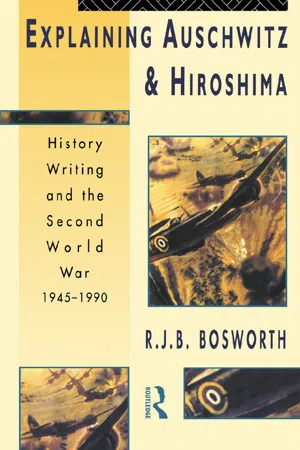
Explaining Auschwitz and Hiroshima explores the way in which the main combatant societies of the Second World War have historicised that experience. Since 1945, debates in Germany about `the past that would not fade away' have been reasonably well-known. But in this book, Richard Bosworth maintains that Germany is not unique. He argues that in Britain, France, Italy, the USSR and Japan, as well as in Germany the traumatic history of the `long Second World War' has remained crucial to the culture and the politics of post-war societies. Each has felt a compelling need to interpret this past event and thus to `explain' `Auschwitz' and `Hiroshima'. Bosworth explores the bitter controversies that have developed around a particular interpretation of the war, such as disputes over A.J.P. Taylor's, Origins of the Second World War , Marcel Ophul's film, The Sorrow and the Pity , Renzo De Felice's biography of Mussolini in the 1970s or in post- Glasnost debates about the historiographies of the Commonwealth of Independent States. Richard Bosworth's book is a wide-ranging and thoughtful excursion into comparative history.
1
The Second World War and the historians
In the prologue to the second volume of his war memoirs, Spike Milligan juxtaposes two citations:
Of the events of war, I have not ventured to speak from any chance information, nor according to any notion of my own. I have described nothing but what I saw myself, or learned from others of whom I made the most careful and particular enquiry.
Thucydides. Peloponnesian War
I’ve just jazzed mine up a little.
Milligan. World War II.1
‘Goak’ here, the attentive reader, accustomed to A.J.P.Taylor’s signal of fruitful ambiguity or aware of the post-war world’s lack of faith in the certainty of knowledge,2 should doubtless add. But it is also instructive that Milligan, voice of the ‘ordinary soldier’ of the Second World War, should invite this comparison of himself as historian with Thucydides and thus implicitly generalise his ‘unreliable memories’ about his war into a reading of all wars.
This reading from a people’s historian is all the more appropriate because of the intimate relationship between war and the first origins of written history, at least in the Western tradition—though epic conflicts, battles lost and won, are also frequently near the heart of oral traditions whether Western or not. In a recent brief history of time and its constructions, G.J.Whitrow has remarked that ‘historiography arose when an event occurred which in its magnitude matched the greatest events celebrated in legend’, when, that is to say, the terror, the horror and the grandiosity of the present or recent past equalled that which suffused the more distant past. According to Whitrow, Thucydides, in his writing about the conflict between Athens and Sparta, became the ‘Father of [Western, ‘factual’, ‘scientific’] History’, precisely because those wars, given their extent and duration and given their fraternal and fratricidal nature, irrupted into the consciousness of his Greek contemporaries, wounded and scarred them. ‘History’ —that is, a proper ordering of events and some attempt at their explanation—was needed because, for the years of civil war, time had seemed to stand still. This form of history was conceived as a cure for the trauma brought to Greek society by years of death and devastation. History was catharsis.
Moreover, Whitrow continues, tragedy, that classic literary vehicle of release and the channelling of ultimate emotions, was born at the same moment as history writing and this twin birth was no accident. As is the case with history, ‘a short continuous crisis, the origins and consequences of which cover a long period, seems to be the double requirement of tragedy and its double relationship to time’.3 In registering and analysing the freezing of time, both history and tragedy help to get the process of time moving again, if only by making manifest that time and society are, after all, always in movement.
Whether or not these speculations about wars of long ago are correct, there can be little doubt about the profound effect on the modern world of the Second World War. In Europe alone, 30 to 40 million died, about 50 per cent more than the total number of victims in the First World War. In Asia, where casualty figures are even more problematic, millions more perished. In Europe, about half those killed were civilians and, in Asia, this proportion was higher still. Whereas in the First War 90 per cent of deaths were military, now survival became almost as doubtful on the ‘home front’ as it was in battle (while Hiroshima promised that, in the Third World War, the graph of civilian casualties might soar towards 100 per cent).4
Where death came, so did devastation. Cities, towns and villages were flattened by bombardment from the air or the ground. At the end of the war, in Europe an estimated 16 million refugees craved hope and sanctuary. International bodies sought ineffectively to count and house them. And such agencies were then still sufficiently Eurocentric to ignore the larger number of refugees in Asia. Moreover, the war had not only devoured people’s bodies, their houses, shops, factories and farms. It had also assaulted and ravished their minds in a quite unprecedented fashion. The death camps and the other macabre features of the war, notably at its epicentre in Eastern Europe, mocked belief in Progress and the Good. The American historian, Karl Schleunes, has summed up well the impact of this aspect of the Second World War:
Violent death accompanying war in an age of industry and technology, by the 1940s, had its precedents. The institutions which most appropriately symbolise the Nazi era—Auschwitz, Dachau, Treblinka, and some fifty other concentration and extermination camps—had none.
These factories of death are now permanently catalogued in the darkest annals of the human story. Their existence casts a shadow over the hopes for our own future. The realisation that some men will construct a factory in which to kill other men raises the gravest questions about man himself. We have entered an age which we cannot avoid labeling ‘After Auschwitz’.5
Nor was ‘Auschwitz’ the only legacy of the war. During its course technologists had found the means and politicians the will to unleash the atom. After Hiroshima, the world had to live with the knowledge that a further conflict might liquidate civilisation itself and do so in an instant:
So long, Mom, I’m off to drop the bomb,
So don’t wait up for me….
Remember, mommy, I’m off to get a commie,v So send me a salami, and try to smile somehow.
I’ll look for you—when the war is over,
An hour and a half from now.6
So don’t wait up for me….
Remember, mommy, I’m off to get a commie,v So send me a salami, and try to smile somehow.
I’ll look for you—when the war is over,
An hour and a half from now.6
If any historical event deserves to be defined as traumatic, it is the Second World War. As a very recent student of the period has stated: ‘no other years [in human history] have transformed so drastically the expectations of millions of men and women’.7
In these circumstances, it is hardly surprising that historians, those dealers in the past and in time, have laboured to explain ‘Auschwitz’, ‘Hiroshima’ and the ‘long Second World War’ and have built a monument of words to them. Paul Fussell, himself a historian made in the Second World War, demonstrated almost two decades ago how the First War affected the relationship between words and time. He indicated that wordsmiths of one kind or another, the artificers of ‘modern memory’, had given new meaning to old phrases in order to forge an armour covering over the wounds of war.8 How much more wounding was the Second War and how much greater the need for the carapace of ‘explanation’?
At first, however, the writing of a history of the war’s experience, the preservation or construction of what in some circles would ironically be reduced to ‘post-modern memory’, occurred in an atmosphere of reverence and consensus, if, sometimes, of a rather numbed variety and in relief at having survived. Practitioners of history, in contrast with many of their fellow citizens, had often experienced quite ‘good’ wars. In the aftermath of the Great War, the profession had had much to explain. It had needed to hedge its commitment to ‘our country right or wrong’ and to justify that apparent prostitution of historical skills which had led historians to invent pasts to assist the national cause.9 In the second conflict historians had normally occupied less exposed positions.
For some, their escape from the present had commenced in what Stuart Hughes has graphically called a sea change. As, in the 1930s, the European crisis deepened and the freedom to engage in critical history writing was curtailed, the universities of North America had offered some sanctuary.10 The ‘sea change’ to this destination was inevitably incomplete, however. Whether senior or junior, the migrating scholars bore with them cultural baggage from their European past. In the New World, they would play a major role in the research and teaching of late modern European history. Every student is indebted to them for their special insights and, at the same time, is aware that they did not always shed the prejudices of their youth and origins.
It is also true that there was an intriguing tendency during the war for some refugees and many Anglo-American historians or historians-to-be to find a place in some branch of their national secret services. William McNeill, Stuart Hughes, William Langer, Carl Schorske, Max Salvadori, Felix Gilbert,11 Hans Holborn, Crane Brinton, Barrington Moore, Edward Shils, J.K.Fairbank, R.F.Byrnes, Perry Miller, Franklin Ford and David Pinkney were only a few of those employed by the OSS or other agencies of the US government.12 In Britain, Harry Hinsley,13 Hugh Trevor-Roper, R.W.Seton-Watson, F.W.Deakin, Basil Davidson, Arnold Toynbee and a host more worked for the overt or covert intelligence offices of the state. Perhaps this assembly of talent merely reflected history’ s place at the pinnacle of the humanities, and highlighted its role as the most rigorous of the generalist disciplines, with its basis in the most appropriate combination of scepticism, hard work and accuracy. But few historians showed signs of agreeing with the young Richard Cobb, later Professor of Modern History at Oxford, when he confessed his recognition of what he said, ‘should be a golden rule for any historian. “Let us assume that our own country is always wrong”.’ And even Cobb, after some characteristic vicissitudes, ended up in the British Army where, as he has recalled, he was ‘very lucky in all [his] postings’.14
In 1945, therefore, British and American historians, whose states were the least exhausted of the belligerents, were well placed to set about explaining the war, its causes, course and consequences. What did they have to say? In particular, what, following the experience of fascism, did they have to say about liberty? Could it be re-asserted after the fascist assault on the most fundamental of human values? Did freedom have a future, or a past, after ‘Auschwitz’?
Paradoxically, the best way to commence answering this question is to focus not on an Anglo-American but on Pieter Geyl, a Dutchman,15 albeit one who joined enthusiastically in English-language historiographical controversies and who was generously, perhaps over-generously, described by A.J.P.Taylor as ‘one of the great historical minds of our time’.16 It was Geyl who, in his book Napoleon: For and Against, published in 1949, and in his other writings, re-stated a liberal interpretation of history and of the historian’s place in society. He argued the classic theses of relativism. History could ‘reach no unchallengeable conclusions on so many-sided a character [as Napoleon]…. To expect from history those final conclusions which may perhaps be obtained in other disciplines is…to misunderstand its nature…. Truth, though for God it may be One, assumes many shapes to men.’17 But rather than submitting cravenly in this battle of truths, historians should become activists of a sort: ‘criticism…is the first duty of historical scholarship, criticism, again criticism, and criticism once more.’18 Like another Coriolanus, Geyl proclaimed a stern but positive message for the post-war world. He expressed it best in a sonnet originally composed before the conflict ended.19 For forty months he had been interned because of his ‘suspect general mentality’ and writing poetry had become a method of deflecting the attempts of his gaolers to dominate and destroy him. In an interview which he gave in 1961 he recalled this favourite concentration camp composition:
The stars are fright’ning. The cold universe,
Boundless and silent, goes revolving on,
Worlds without end. The grace of God is gone.
A vast indifference, deadlier than a curse,
Chills our poor globe, which Heaven seemed to nurse
So fondly. ’Twas God’s rainbow when it shone,
Until we searched. Now, as we count and con
Gusts of infinity, our hopes disperse.
Well, if it’s so, then turn your eyes away
From Heav’n. Look at the earth, in its array
Of life and beauty. —Transitory? Maybe,
But so are you. Let stark eternity
Heed its own self, and you, enjoy your day,
And when death calls, then quietly obey.20
Worlds without end. The grace of God is gone.
A vast indifference, deadlier than a curse,
Chills our poor globe, which Heaven seemed to nurse
So fondly. ’Twas God’s rainbow when it shone,
Until we searched. Now, as we count and con
Gusts of infinity, our hopes disperse.
Well, if it’s so, then turn your eyes away
From Heav’n. Look at the earth, in its array
Of life and beauty. —Transitory? Maybe,
But so are you. Let stark eternity
Heed its own self, and you, enjoy your day,
And when death calls, then quietly obey.20
But, as good students of LME I would have asked well before now, who, then, was Pieter Geyl?
In its answering, this question elicits some ambiguous evidence. Geyl had been born in Dordrecht in 1887, the son and grandson of medical doctors. He graduated from Leyden University and by 1913 was established as the London correspondent of Nieuwe Rotterdamsche Courant. After the First War he became Professor of Dutch Studies at London; in 1924 the title of his chair was narrowed to Dutch History and Institutions. Twelve years later he returned to the Netherlands, taking up the Professorship in Modern History at Utrecht, from which he would not retire until 1958. He made a name for himself as a historian of the Netherlands in its golden age, publishing his most famous book, The Revolt of the Netherlands 1555– 1609, in 1932.21
Geyl was also a well known polemicist, challenging, for example, Henri Pirenne, the distinguished Walloon Belgian medievalist. Whereas Pirenne was inclined to see a ‘natural’ division between Belgium and the Netherlands, underpinned by long-term structural factors, Geyl was not.22 Both before and after the Second World War, Geyl was similarly critical of the French Annales school with its emphasis on the long term. By contrast, despite his distrust of Rankean ‘scientific history’,23 he praised the very conservative German historian, Gerhard Ritter.24
After the war, Geyl was most scathing in his attacks on Arnold Toynbee’s Study of History.25 The publication of this twelve-volume work, with its theses of the rise and fall of civilisations in a rhythm of challenge and response largely controlled by creative minorities, had commenced in 1934 and continued after 1945. The twelfth and final volume would not be published until 1961. Geyl disliked Toynbee’s religiosity, his pessimism and his determinism and found him guilty of selectivity and bias. Worse was Toynbee’s arrogance: ‘Like Faust, he tries to know more than can be known.’26 And the wages of total knowledge ironically would be political death, passivity, fatalism, in the face of a seductive but false inevitability. Toynbee’s Study, if believed, would end the discipline: ‘The Student of History, as Toynbee calls himself, may know more of history than I shall ever do, but he is no historian. He is a prophet,’ Geyl concluded dismissively.27 In his desire to give final lessons to humankind, Toynbee was lost in the ethereal, and too near to God to understand the needs and life of ordinary men and women. History should concentrate on the real, Geyl asserted, and leave the ideal to those with time to waste.
Though Geyl wrote frequently and effectively about theory,28 he best and most appropriately expressed his sturdy relativism and combative practicality in a piece of history writing, Napoleon: For and Against. It was, he acknowledged, the ‘byproduct of our recent experiences’,29 and, thus, his ‘book of World War II’. As with the sonnet, he had begun fashioning it in his mind at Buchenwald and the other camps to which he had been transferred. Indeed, he had been interned precisely because of his contemplation of Napoleon, being arrested by the German security police (SD) after he gave a public lecture at the Rotterdam School of Economics about the Corsican conqueror. ‘Occasional bursts of laughter’ from the audience, Geyl has recalled, indicated that they had detected parallels being drawn with Hitler.30
For a liberal like Geyl, it was highly appropriate to turn back to the French Revolution31 in order to obtain intellectual sustenance for the struggle against the Nazis and, in so doing, he reiterated his deep admiration for French ‘civilization’. But, though he could not actually start writing Napoleon: For and Against until after his release from internment on medical grounds in February 1944, Geyl’s ‘resistance’, his determination not to submit to fascist irrationalism, had been steeled by the discipline of history, by his conviction that history should not offer single answers, and was in its fundamental character ‘an argument without end’.32
Napoleon: For and Against is thus a somewhat surprising book. It is certainly not a narrative of Napoleon’s life, though a reader may notice that Geyl does subtly paint a compelling portrait of a cynical and self-interested dictator.33 At its first level the book is rather a history of a history. By surveying successive interpretations of Napoleon from the 1790s to the onset of the Second World War, Geyl vividly displays history’s need to talk with many voices. The past and the present are part of an unending process; one constantly reverberates with the other. Each generation or faction writes its own history with an eye on the present; but each of these presents is simultaneously a child of the past. In many instances, ‘Napoleon’ is more influential and powerful as a ‘myth’, as ‘h...
Table of contents
- Cover Page
- Title Page
- Copyright Page
- Series editor’s preface
- Preface
- Acknowledgements
- Introduction
- 1: The Second World War and the historians
- 2: The origins of the Third World War and the making of English social history
- 3: Germany and the Third, Second, and First World Wars
- 4: The Historikerstreit and the relativisation of Auschwitz
- 5: The sorrow and the pity of the fall of France and the rise of French historiography
- 6: The eclipse of anti-Fascism in Italy
- 7: Glasnost Reaches Soviet historiography
- 8: Hiroshima, mon amour: under eastern eyes
- Conclusion
- Notes
Trusted by 375,005 students
Access to over 1.5 million titles for a fair monthly price.
Study more efficiently using our study tools.
Frequently asked questions
Yes, you can cancel anytime from the Subscription tab in your account settings on the Perlego website. Your subscription will stay active until the end of your current billing period. Learn how to cancel your subscription
No, books cannot be downloaded as external files, such as PDFs, for use outside of Perlego. However, you can download books within the Perlego app for offline reading on mobile or tablet. Learn how to download books offline
Perlego offers two plans: Essential and Complete
- Essential is ideal for learners and professionals who enjoy exploring a wide range of subjects. Access the Essential Library with 800,000+ trusted titles and best-sellers across business, personal growth, and the humanities. Includes unlimited reading time and Standard Read Aloud voice.
- Complete: Perfect for advanced learners and researchers needing full, unrestricted access. Unlock 1.5M+ books across hundreds of subjects, including academic and specialized titles. The Complete Plan also includes advanced features like Premium Read Aloud and Research Assistant.
We are an online textbook subscription service, where you can get access to an entire online library for less than the price of a single book per month. With over 1.5 million books across 990+ topics, we’ve got you covered! Learn about our mission
Look out for the read-aloud symbol on your next book to see if you can listen to it. The read-aloud tool reads text aloud for you, highlighting the text as it is being read. You can pause it, speed it up and slow it down. Learn more about Read Aloud
Yes! You can use the Perlego app on both iOS and Android devices to read anytime, anywhere — even offline. Perfect for commutes or when you’re on the go.
Please note we cannot support devices running on iOS 13 and Android 7 or earlier. Learn more about using the app
Please note we cannot support devices running on iOS 13 and Android 7 or earlier. Learn more about using the app
Yes, you can access Explaining Auschwitz and Hiroshima by Richard J. B. Bosworth in PDF and/or ePUB format, as well as other popular books in History & Historiography. We have over 1.5 million books available in our catalogue for you to explore.