- 208 pages
- English
- ePUB (mobile friendly)
- Available on iOS & Android
eBook - ePub
About this book
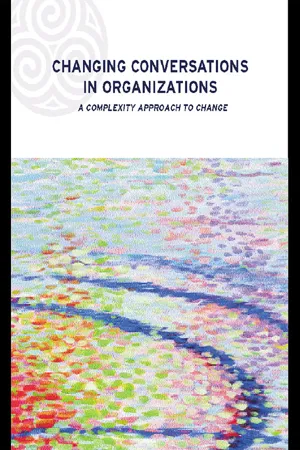
Drawing on the theoretical foundations laid out in earlier volumes of this series, this book describes an approach to organizational change and development that is informed by a complexity perspective. It clarifies the experience of being in the midst of change. Unlike many books that presume clarity of foresight or hindsight, the author focuses on the essential uncertainty of participating in evolving events as they happen and considers the creative possibilities of such participation.
Most methodologies for organizational change are firmly rooted in systems thinking, as are many approaches to process consultation and facilitation. This book questions the suggestion that we can choose and design new futures for our organizations in the way we often hope. Avoiding the widely favoured use of two by two matrices, idealized schemas and simplified typologies that characterize much of the management literature on change, this book encourages the reader to live in the immediate paradoxes and complexities of organizational life, where we must act with intention into the unknowable. The author uses detailed reflective narrative to evoke and elaborate on the experience of participating in the conversational processes of human organizing. It asserts that possibilities are perpetually sustained and changed by the conversational life of organizations.
This book will be valuable to consultants, managers and leaders, indeed all those who are dissatisfied with idealized models of change and are searching for ways to develop an effective change practice.
1 Changing conversations
What has ‘facilitation’ come to mean?
The legacy of process consultation and organization development
Conversing as organizing, organizing as conversing
The value of ‘just talking’
Glimpsing another way of working
A complexity approach to change
I began to ask myself what kind of work I was doing as an organizational consultant, when I found that from time to time I was being accused, albeit with curiosity, of not being a ‘proper’ consultant, or coach, or facilitator. Whether in relation to longer assignments or single encounters, the comments often seemed to be in response to what I was not doing. I did not write formal proposals for work. I did not prepare detailed designs for meetings, conferences, workshops. I did not develop detailed aims and objectives in advance. I did not clarify roles and expectations or agree ground rules at the start of working. I did not hold back my views or opinions. I did not develop clear action plans at the end of meetings. I did not capture outcomes. I failed to encourage ‘feedback’ or behavioural contracting between people. I did not ‘manage’ process.There seemed to be a lot of things that I did not do that most people had come to expect. At the same time, many managers seemed frustrated with the other forms of consulting or with the facilitation of some other meetings they had taken part in. They said approvingly that I was unlike most consultants they had worked with, although they were hard put to express more precisely what they valued about my contribution.
What has ‘facilitation’ come to mean?
In French or Italian, the word facile means ‘simple, easy, no fuss needed’, but in English it is not really a compliment, carrying a sense of something rendered too easy, almost glib. If someone accuses another of making a facile remark they might be suggesting that significant complexities are being underplayed. Maybe they also feel stung, possibly hurt, certainly irritated. So the implication is that the word ‘facile’ is used when someone is not altogether off track but has reduced or caricatured issues in some way that the accuser finds insensitive, even crass. For me, this sense of the word lurks around some kinds of facilitation intended in a positive sense to help complicated, difficult, conflictual situations of human engagement flow more easily and productively. So how have I developed this uneasy sense of some facilitation and process consultation as facile? Although I still call myself an organization development consultant, I am aware of how much the way I work has diverged from what this term has come to mean. This is not just in relation to fellow consulting professionals, but to large numbers of managers and executives who are asked to become enabling or facilitative leaders.
So my first aim in this chapter is to look at how approaches that emerged as a fresh impetus in organizations in the 1960s and 1970s may have congealed into habitual patterns of response. Yet I also want to keep in mind how the conversations that recreate these habitual patterns also have the potential for evolving novel forms of practice.
Recently I agreed at short notice to help a central marketing group in a large organization that I have been working with for some time. The members of the group were about to meet to discuss a new framework for their raison d’être that was being developed by two consultants from a well-known management consulting firm. I was asked to a meeting with the consultants and two senior members of the new team a few days before the strategic meeting of the whole group. The consultants had prepared a set of power-point slides that the manager of the team would be using to provide an introduction and overview of the proposed session. I was taken through the slides, one at a time:
Exercise 1: Expectations. Log on flip chart everyone’s expectations of the meeting. No right or wrong answers.
Exercise 2: Unspoken agendas. Bring out people’s issues, fears, obstacles to working as a team. Good to express unspoken feelings but needs to stay within certain productive boundaries.
Exercise 2: Unspoken agendas. Bring out people’s issues, fears, obstacles to working as a team. Good to express unspoken feelings but needs to stay within certain productive boundaries.
Team leader to communicate Long-Term Vision and high level objectives. Feedback from group about their roles, where can they add value, their deliverables. Team buy-in.
Exercise 3: Partner needs. List and rank in order of importance the primary needs of internal and external partners and customers.
Exercise 4: Brainstorming. Conduct brainstorming to identify initiatives that should be considered in first 18 months.
Exercise 5: Value. For each initiative identify primary points of value for our partners and customers.
Exercise 6: Prioritization. Prioritize initiatives by placing in quadrants of 2 by 2 matrix labelled Business Impact – High/low against Ease of Implementation – High/low. Select short list of initiatives with timings for implementation for next four quarters.
Exercise 7: Performance measures. Identify appropriate performance measures for planned initiatives.
Exercise 8: Value proposition. For each internal and external partner or customer, list points of value under Functional benefits (rational) and Emotional benefits.
Exercise 9: Fit. Explore how to work within SM and Group marketing to create synergy and leverage resources.
Exercise 10: Rules of engagement. Determine the rules that will create a positive and engaging work environment.
Review: Deliverables, actions and plans moving forward. Log unresolved issues and possible solutions with clear direction for follow-up.
It was clearly expected that I ‘facilitate’ the group as they worked through this agenda, with some fluidity, of course, around the exact order and timing of the exercises. Perhaps we would not need them all. As I listened, a feeling of dissonance was growing. What seemed strange to me was very familiar to the others. ‘Look,’ I said, ‘I just don’t work this way at all. I don’t really understand what you want me for. You’ve got a very clear structure for the meeting and two consultants to help the group work through this agenda, if that’s what everyone wants to do.’ ‘No, no,’ said the consultants, ‘our role is to help the group work with the business model, not to facilitate the meeting.’ The woman who had first asked me to join the meeting said, ‘Some of the discussion could be charged, that’s what we want you to handle.’
Silently I was already arguing about the whole rationale implicit so far. I did not voice this but turned to the team leader and asked in a conversational tone whether he could keep these slides as back up and start the meeting by talking with the group about how things stood so far, what was on his mind at this point, what he felt needed discussion at this meeting, and so on. The manager, replied that, certainly, he could do that. ‘Then couldn’t we just see how others responded and take things from there?’ I suggested.
There was a pause in which I felt I had said something naïve and, embarrassing and, indeed, in a way I had. By using the word ‘just’ I was in danger of implying that there was nothing to be understood in a suggestion that we ‘take things from there’. My aim in this book will be to draw attention to the complex social processes involved in ‘going on together from here’ and to talk about the ordinary artistry of our joint participation in these processes. In the pause I fancy we were all imagining the unknowable particulars of this future engagement, the proposed meeting, and what might flow from it. The question was, how would we approach this uncertainty?
The other team member came in: ‘This is the kind of structure we always use to ensure a productive meeting.’ ‘But look at this item,’ I said:‘ Unspoken agendas. Don’t you think there is something quite funny about having that as an agenda item?’ She looked a little offended for a moment, yet also seeing what I meant. ‘Yes, but that’s your job, to help get out the hidden agendas early so that they don’t get in the way of the meeting later on.’ I recognized this conundrum. We have all experienced the way that, as a meeting progresses we or others may express what we now assume we might usefully have expressed earlier, but didn’t. Surely we can get a grip on this problem. Now that we realize what it would have been useful to know earlier, can’t we ensure that next time we get everything out in the right order!
At that point I relaxed in my seat and again sought an everyday way of expressing myself:
What I’m trying to say is that I can see that this is a crucial meeting. There hasn’t been a central marketing group before, there must be a lot of pressure to succeed, people must be uncertain how best to take up their new responsibilities and how best to contribute to the business. You’ve put aside a couple of days for an in-depth discussion of the issues facing you and how you go forward. There’s been a lot of preparatory conversations and documentation that will feed into the meeting. I would be very happy to join you and help to find whatever form of conversation we need as things develop.
There was a palpable rise in temperature all round. ‘That’s exactly what we want,’ said the manager, looking pleased and relieved.
To me this example shows very clearly what has happened in the corporate world. Decades of a certain kind of business school education and writing; the rise and rise of expensive management consulting focused on packaging ‘best practice’ and promising to provide the expertise that will ‘deliver’ desired future success; the professionalization of all kinds of human communication into codified behavioural notions of ‘coaching’, ‘counselling’, ‘teamwork’ or ‘leading’ – all these have given us a curiously rational, instrumental approach to ourselves. In the short encounter above, we were moving between different ways of accounting for what goes on between us. The carefully structured agenda initially proposed was a highly systematic account of how we get to grips with ourselves and the world of human action as a logical ‘problem’ to be solved. It is hard to argue against any element of the proposed plan – it is perfectly logical, relentlessly so, I would say. Everyone knows that life isn’t quite like this, so implementing this idealized plan requires engaging someone who might be able to help the group navigate the murky shoals of ‘charged’ discussion so that it stays ‘on track’.
Yet, in the midst of a conversation that constructed how we would work together in a certain way, it was also possible for me to speak into another, more improvisatory way of approaching how we might go on together. We have much practical knowledge and skill relating to the everyday art of ‘going on together’, knowledge that we create and use from within the conduct of our communicative activity. People had a sense of what I meant because of our mutual ongoing experience of the disorderly way order arises and dissolves and reconfigures in human affairs, a process we are never on top of or ahead of despite our inescapable attempts to be so. It is as though our capacity for self-conscious reflection gives us delusions of omniscience and omnipotence. Our sophisticated capacity for observing our own participation tempts us to think we can grasp the whole picture and manage its dynamics to suit our well- or ill-meaning ends.
Most of what managers, leaders, consultants, and facilitators are asked to do is ‘to get ahead of the game’, ‘to be on top of the mess’, ‘to manage the process’, ‘to set the boundaries’, ‘to delve beneath the surface to change the deep structure’. It would seem that we want to think of ourselves anywhere other than where we are, in the flow of our live engagement, sustaining and transforming the patterning that simultaneously enables and constrains our movement into the future. Because we don’t seem to have a way to think and talk about what we are doing in this reciprocal engagement, we have become accustomed to a particular kind of systematic practice that is meant to help us do this. Here is another example.
Not long ago I was invited to join a kind of international think-tank sponsored in part by business, in part by policy units in government and in part by educational institutions. The project was envisioned to last over two years to explore and articulate approaches to the emerging complex issues of today’s world that might guide policy making. Some twenty-five people, academics, activists, scientists and psychologists among others, gathered for the first time in the evening for a three-day meeting. There was a brief welcome by the main business sponsor and the person leading the initiative. Then the facilitator stood up and introduced himself and explained the intended style and process of the next few days. He said that he considered that the role of a facilitator was to help what was trying to happen to happen and then get out of the way. Here is another interesting formulation of what it might mean to facilitate or enable. What did this turn out to mean in practice?
He pointed out the carefully designed setting that had been created for the meeting, including various technological aids that he suggested we would do well to familiarize ourselves with now so that we would be able to use them later. First he invited us to approach the terminals placed round the room and type in a comment about the start of the meeting – any comment would do – and then press the enter key. Immediately the screen would display all the other comments that had been entered so far and we could type in a response to any one and, by pressing the key, we could see all the responses. There was a noticeable reluctance to start this activity. Some people typed in a sentence or two, with others looking over their shoulders, but soon people drifted back to their seats.
The facilitator then suggested that we familiarize ourselves with another aid. He gave us all something akin to a mobile phone with a small keypad and told us it was a voting machine. He suggested that it would be very interesting to know about the connections between people in the group as we came together for the first time. A slide flashed up on the wall asking whether we already knew one, two, up to five or more than five people in the group. We were asked to press the appropriate key to indicate our choice of answer. Within a few seconds a bar chart of our responses appeared on the wall. The bar chart told us now that most people in the room knew two others before coming. But who knew who and how and what kind of bearing might that history have for us? At this point someone pointed out that the total number of responses on the chart did not match the total number present. Were some of the voting machines faulty or were some people not responding? We tried again with a similar result. The facilitator promised to check the machines. I imagined some feelings of disappointment as he continued as though what was happening was not what he had hoped might flow from these early activities.
There seemed to me to be a restlessness among those in the room. The odd thing was that the technological aids to our work were doing the opposite of aiding us. I am not making a point about technology as such, but about how the process of enabling was being approached. The machines proliferated messages and statistics in the midst of activities that did little to help us make meaningful connection. The computer screens had flashed up a few dozen messages in a way that confused the sense of who was responding to who about what. The complex temporal and spatial web of human responsive relating was addled so we were struggling with the creative process of constructing the possible significance of our presence here together.
An hour had passed before the facilitator suggested people introduce themselves to one another. He proposed a way we might do this as a start although we were free, of course, to choose any other way. I was struck by the sense that we needed a format for doing this to start us off, as though otherwise we might be at a loss how to begin to engage one another and it would be better to have something to fall back on.
The four corners of the room had been labelled with the four topics of the project and around each corner pieces of paper were stuck on the walls each carrying a few sentences. I realized by recognizing some of my own phrases that these were taken from material we had sent in before the meeting in response to a series of questions. The sentences were not attributed and I noticed that two remarks of mine that had followed one after the other had been pasted at different corners. Again I thought how odd this process was, distributing snippets disconnected from one another and from the author and from the question the author was responding to in the first place.
After introducing ourselves to one another we were asked to choose one of the corners of the room and to discuss our first thoughts with the group that convened there. Again it was assumed that the open space of exploring how we might begin together was just too anxiety-provoking or time-wasting to contemplate. A large board at each corner was marked out with an identical grid for us to fill in. The headings were prompts like: key issues under this topic, positive trends, negative evidence, aspirations for our work in this area, and so on. Again the facilitator assured us that this was just a starting point for the discussion and just a useful way of feeding back to the whole meeting. In the group I joined we ignored the board and then tried to fit our discussion to its ...
Table of contents
- Cover Page
- Title Page
- Copyright Page
- Series preface Complexity and Emergence in Organizations
- 1 Changing conversations
- 2 Making sense of gathering and gathering to make sense
- 3 The transformative activity of conversing
- 4 The politics of change
- 5 Organizational change as ensemble improvisation
- 6 The legacy of organization development
- 7 What’s the difference?other approaches to conversation,participation and organizational change
- Coda: how do organizations change?
- Appendix: a cast list for Ferrovia (in order of appearance)
- References
Trusted by 375,005 students
Access to over 1.5 million titles for a fair monthly price.
Study more efficiently using our study tools.
Frequently asked questions
Yes, you can cancel anytime from the Subscription tab in your account settings on the Perlego website. Your subscription will stay active until the end of your current billing period. Learn how to cancel your subscription
No, books cannot be downloaded as external files, such as PDFs, for use outside of Perlego. However, you can download books within the Perlego app for offline reading on mobile or tablet. Learn how to download books offline
Perlego offers two plans: Essential and Complete
- Essential is ideal for learners and professionals who enjoy exploring a wide range of subjects. Access the Essential Library with 800,000+ trusted titles and best-sellers across business, personal growth, and the humanities. Includes unlimited reading time and Standard Read Aloud voice.
- Complete: Perfect for advanced learners and researchers needing full, unrestricted access. Unlock 1.5M+ books across hundreds of subjects, including academic and specialized titles. The Complete Plan also includes advanced features like Premium Read Aloud and Research Assistant.
We are an online textbook subscription service, where you can get access to an entire online library for less than the price of a single book per month. With over 1.5 million books across 990+ topics, we’ve got you covered! Learn about our mission
Look out for the read-aloud symbol on your next book to see if you can listen to it. The read-aloud tool reads text aloud for you, highlighting the text as it is being read. You can pause it, speed it up and slow it down. Learn more about Read Aloud
Yes! You can use the Perlego app on both iOS and Android devices to read anytime, anywhere — even offline. Perfect for commutes or when you’re on the go.
Please note we cannot support devices running on iOS 13 and Android 7 or earlier. Learn more about using the app
Please note we cannot support devices running on iOS 13 and Android 7 or earlier. Learn more about using the app
Yes, you can access Changing Conversations in Organizations by Dr Patricia Shaw in PDF and/or ePUB format, as well as other popular books in Business & Business General. We have over 1.5 million books available in our catalogue for you to explore.