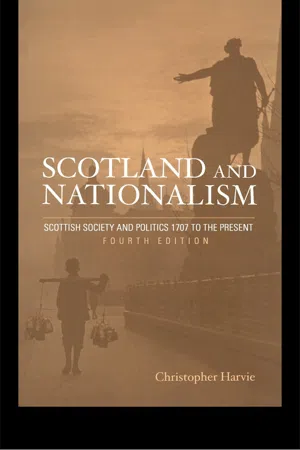
Scotland and Nationalism provides an authoritative survey of Scottish social and political history from 1707 to the present day. Focusing on political nationalism in Scotland, Christopher Harvie examines why this nationalism remained apparently in abeyance for two and a half centuries, and why it became so relevant in the second half of the twentieth century.
This fourth edition brings the story and historiography of Scottish society and politics up-to-date. Additions also include a brand new biographical index of key personalities, along with a glossary of nationalist groups.
eBook - ePub
Scotland and Nationalism
Scottish Society and Politics 1707 to the Present
- 288 pages
- English
- ePUB (mobile friendly)
- Available on iOS & Android
eBook - ePub
Scotland and Nationalism
Scottish Society and Politics 1707 to the Present
About this book
Information
Part I
1
THE BALLADS OF A NATION
Political nationalism, 1707–1945
Oldbuck: I’ll supply you with a subject—The battle between the Caledonians and the Romans—the Caledoniad; or, Invasion Repelled. Let that be the title—it will suit the present taste, and you may throw in a touch of the times.
Lovel: But the invasion of Agricola was not repelled.
Oldbuck: No; but you are a poet—free of the corporation, and as little bound to truth or probability as Virgil himself—You may defeat the Romans in spite of Tacitus.
Sir Walter Scott, The Antiquary (1816)
THE USES OF LIBERTY
In 2003 the London government decided on a form of ceremony for those adopting British nationality. A form of words would be spoken, before a flag, and the national anthem played. But which flag, and which national anthem? In Scotland the Union Jack and ‘God Save the Queen’ were out. But that left no fewer than four possible Scottish national anthems; Robert Burns’ ‘Scots Wha Hae’, ‘Scotland the Brave’, a blameless bit of rum-ti-tum concocted by the Glasgow journalist Cliff Hanley in the 1950s. ‘O Flower of Scotland’ by the folksinger Ronnie Anderson from 1967, was the great favourite of the Tartan Army until they worked out that its plangencies might actually be demoralising the Scotland team. Hamish Henderson’s ‘Freedom Come All Ye’ was right-on in its socialist sentiments, but were the Scots?
The tunes of glory were important. In 1704, on the eve of the Union, Andrew Fletcher of Saltoun, fighting for the doomed Scottish parliament, wrote that ‘if a man were permitted to make all the ballads, he need not care who should make the laws of a nation.’ Traditionally, nationalists have regarded Fletcher as the parent of Scottish democracy. The Saltire Society runs an annual Andrew Fletcher lecture; wreaths are laid at the family tomb in Saltoun kirkyard. Fletcher was a man of his unruly time, an angry patriot in the mould of Machiavellian civic humanism who wanted to revive Scotland by reinforcing serfdom. Yet he accurately predicted the way Scottish nationalism, on the margin of British and European politics, would survive.
Poetic tradition gave a logic of its own to Scottish development during the middle ages. Two national epics treated the War of Independence, 1296–1328, not as a chivalric episode but as a popular struggle which was also libertarian. Looming in the background was Calgacus of the Caledonii who had confronted the Agricoline legions at Mons Graupius in 81 with the unforgettable exit line: ‘You make a desert, and you call it peace!’ There was reality behind this, but also a slug of realism. Archaeologists have
recently shown that the Romans moved in a decade before Agricola, by doing deals with the locals, the Foederati or ‘Treaty Folk’ as they called them, who were apeing their forts and villas…
Such less-than-heroic diplomacy aside, how did the Scotlanders, composed far more than the English of a variety of races and affected by the cultural traditions of Roman and Christian Europe, Welsh, Irish, Saxons and Vikings, manage to evolve by the thirteenth century, in advance of England and France, the institutions of a national community? These were in the main aristocratic, derived from Anglo-Norman feudal practice, but their local identity was so secure that when the male royal line of Scotland expired in 1286, the Scots nobility (the greatest of whose members had large landholdings in England) thought that the further deal of joining England under a dual monarchy implied no major risk to it. Instead, the collapse of this scheme, English invasion, resistance by William Wallace and later Robert Bruce made patriots of the mass of the population.
In 1320, six years after the defeat of Edward II at Bannockburn, the Scots nobility, along with ‘the other barons and freeholders and the whole community of the realm of Scotland’, petitioned the Pope to recognise Scotland as independent and Robert the Bruce as king. The Declaration of Arbroath, ‘the most impressive manifesto of nationalism that medieval Europe produced’, culminated with the threat that if Robert backslided:
we would strive at once to drive him out as our enemy and a subverter of his own right and ours, and we would make some other man who was able to defend us our king; for, as long as a hundred of us remain alive, we will never on any conditions be subjected to the lordship of the English. For we fight not for glory, nor riches, nor honour, but for freedom alone, which no good man gives up except with his life.
‘Freedom from unfreedom’—or the ‘liberties’ of a privileged class? Initially, the second, and the magnates were to cause enough trouble afterwards, but enduringly the first. This reflected the experience of a war intense enough to have given most groups in society a stake in its outcome: a type of popular nationalism rare in Europe before the French Revolution.
After the Reformation of 1559–60, religion altered the matrices both of nationalism and of liberty. But the poets preserved and transmitted the memory of the war and its ideals: the praise of freedom in Archdeacon Barbour’s The Bruce in 1375:
A! fredome is a noble thing
Fredome mays man to haiff liking;
Fredome all solace to man giffis
He levys at es that frely levys.
was, a century later, joined by Blind Hary’s glorification of Bruce’s more obscure predecessor, William Wallace. Both epics were printed and reprinted from the sixteenth century onwards. The Wycliffe and later the King James Bible, a notable coup for Anglicisation, would be partly affected by this, and the dialectic then set up carried a powerful republican charge in the work of George Buchanan and Samuel Rutherford, their echoes carried through to the mobs which rioted against the Union in 1707 and against the Malt Tax in 1713, and which lynched Captain Porteous in 1736. They were picked up by the Jacobin Burns and condensed in 1793—after the execution of Louis XVI—into the powerful stanzas of ‘Bruce to his Troops on the eve of the Battle of Bannock-burn’:
Scots, wha hae wi’ Wallace bled,
Scots, wham Bruce has aften led;
Welcome to your glory bed,
Or to victorie.
Now’s the day, and now’s the hour,
See the front o’ battle lour;
See approach proud Edward’s power—
Chains and slaverie!
Wha for Scotland’s king and law
Freedom’s sword will strongly draw,
Free-man stand, or Free-man fa’,
Let him follow me!
Bannockburn, Arbroath and Wallace’s reputed birthplace at Elderslie remain places of Nationalist pilgrimage. Yet Burns’ attitude to Scottish nationalism was ambiguous. His poem is at no point anti-English, was first carried in a London radical paper, the Morning Chronicle, in 1794, and its radical Whig argument scarcely differed from that of ‘Rule Britannia’ by Burns’s hero, James Thomson of Ednam, written in 1740. In 1894 the Glasgow professor John Nichol, the friend of Kossuth and Mazzini, described him as writing the requiem of Lowland Scotland ‘as a distinct nationality’, while being the prophet of a new and universal democratic order. Burns’s poetry became part of the liberal radicalism—the German Freiligarth’s ‘Trotz Alledem’, sung by the crowds of 1848, is ‘A Man’s a Man for a’ that’. But, allied with industrialisation, mass-society overthrew much of Scottish political distinctiveness, and with it the basis for a nationalist movement. The internationalist, elitist Goethe, writing to Carlyle in 1828, was strongly conscious of Scottish identity; the Marxist Georg Lukacs, a century later, assimilated the country to ‘England’.
OUT OF SYNC
Elie Kedourie, a sceptic about nationalism, characterised it as amalgamating the politics of the French Revolution, vesting sovereignty in the people, and the philosophy of German idealism, ‘realising’ the individual will in the service of the state. Yet nationalism also drew on earlier tendencies. In the seventeenth and eighteenth centuries absolute rulers tried to crush aristocratic localism and provincial loyalties, dangerous centrifugal forces during the late middle ages and the wars of religion. Monarchs shaped future nations, when they suppressed the estates of the clergy, nobles and burgesses; conversely, where they failed, or compromised, a smaller-scale nationality could develop around what survived. Such institutional cultures marked what mid-nineteenth-century radicals, notably Marx and Engels, called the ‘historic’ nationalities. Through them, and in defiance of the conservative multinational empires, the Poles and the Hungarians evolved towards capitalism and democracy.
For the groups which failed to sustain such institutions, or had none to sustain, Marx and Engels had little time: ‘peoples without history’ were a threat to social progress:
There is no country in Europe that does not possess, in some remote corner, at least one remnant-people, left over from an earlier population, forced back and subjugated by the nation which later became the repository of historical development. These remnants of a nation, mercilessly crushed, as Hegel said, by the course of history, this ‘national refuse’, is always the fanatical representative of the counter-revolution and remains so until it is completely exterminated or de-nationalised, as its whole existence is in itself a protest against a great historical revolution.
Amongst Slavs, Basques and Bretons they numbered the Gaels, ‘supporters of the Stuarts from 1640 to 1745’. Scots as Scots appeared in their discussions only to show how they had eluded the great generalisations. The Lowlanders lacked the constitutional focus—or determination to secure it—of ‘historic nationality’; but despite the shared parliament and language, they were indelibly separate from the English. Forced when abroad to accept the shorthand of being part of ‘England’ rather than ‘Britain’—explaining the complex relationship and doing quick deals ruled one another out—the Scots had to remedy matters in domestic and cultural politics. ‘The preponderance of enjoyment lies on the more credulous side,’ the polymath Hugh Miller, a man of the Highland Line, wrote of the English, ‘I never yet encountered a better-pleased people… Unthinking, unsuspicious, blue-eyed, fair-complexioned, honest Saxons.’ For the Scots had made the conscious decision to supersede nationality by ideology.
From the standpoint of ‘British’ history, the Union of 1707 resembled contemporary continental developments: the suppression of a schismatic nobility in the interests of dynastic security. After it, in the words of Lord Dacre, ‘intelligent Scotchmen rejoiced in the removal of their national politics to London’ and got on with the real business of improving their country. Accurate enough about English attitudes, this is as misleading about Scotland as the nationalist myth of a representative assembly cut down in its prime. Although dominated by nobles and their factions, the Scottish parliament had since 1688 claimed a hitherto unprecedented national role. Its problem was twofold. First, it had to cope with economic disaster in the 1690s: two years of crop failure and famine, and the catastrophic colonial enterprise at Darien. Second, it was not indispensable. For a century and a half, it had had a rival—the Kirk.
CALVINISM IN ONE COUNTRY
In The Scot in History, the Scots-Jewish-American historian Wallace Notestein contended that ‘in explaining Scottish character nothing is more important than religion’. The country’s uniquely influential reformation of 1560 created a new politics and a new concept of freedom. The corruption of the Catholic Church, ‘devolved’ in the 1480s to a rapacious Scots court, coupled with a European diplomatic revolution which allied the great Catholic powers of Spain and France against Elizabeth’s England, made the Scots opt for drastic religious innovation, guaranteed by agreement with England. This brought to an end the French alliance which had endured since the War of Independence, and effectively foreshadowed the Union. The social gospel of Calvinism gradually overlaid the ideals of national independence and individual freedom which the ballads had celebrated.
A European crisis coincided with the weakening of central authority in a peripheral state; an émigré intelligentsia returned to impose its own ideology. Like the Russian Communists after 1917, the Scots Calvinists proclaimed a ‘positive’ liberty, achieved within society. This was not capricious—George Buchanan and Samuel Rutherford had a strong sense of contractual government—but neither was it conspicuously tolerant:
No man may be permitted to live as best pleaseth him within the Church of God; but every man must be constrained by fraternal admonition and correction to bestow his labours when of the Church they are required, to the edification of others (otherwise) discipline must proceed against them, provided that the civil magistrate concur with the judgement and election of the Church.
The claims of the Kirk were confirmed by the Revolution of 1688, not before the Calvinists had tried to impose their will on all the Stuart dominions. 1688 meant compromise—‘Calvinism in one country’—with religion allowed to prevail over a precocious political nationality, a victory confirmed in 1707. The writers and singers of the ballads didn’t just provide parallels with European nationalism: ‘Ossian’ MacPherson, Burns and Scott gave it much of its ideological pabulum. But at home, for the next two centuries, they were on their own. During the great age of European nationalism, Scottish religion took centre stage.
The ideology which triumphed in 1707 was not anti-Scottish. ‘Principled’ unionists like William Carstares, leader of the Kirk, and William Paterson, founder of the Bank of England and the Bank of Scotland, regarded parliament as only one of the national ‘estates’, and offered it up for the safety and effectiveness of the Kirk, the law and the educational system. As Sir Robert Rait and Professor A.V.Dicey wrote in their apologia Thoughts on the Union in 1920, one could be both a sincere nationalist and an advocate of the Union. Would any English government have tolerated a parliament open to Jacobite and French intrigue? Its suppression—say in 1745—would probably have doomed all the semi-independent Scots ‘estates’ of kirk, law and education.
Still, the Union was unpopular even among politicians favourable to the principle. They wanted a looser federation; instead they got only nominal representation at Westminster, through forty-five MPs, mainly government placemen. A more drastic integration might have brought a competent bureaucracy, but taking over English political traditions—party patronage and local initiative—paradoxically meant that Scottish local and church government could go its own way. In time of economic depression, ‘semi-independence’ seemed a poor substitute for a sovereign parliament, but it satisfied enough of the estates to inhibit any hostile alliances.
These would have been difficult anyway. The discontents of the two Scotlands were too distinctive: trade and religion in the Low-lands; clan consciousness (though actually little clan conflict) and subsistence for the third of the population which lived beyond the Highland line. The latter erupted periodically in Jacobite revolts, a doomed aristocratic localism. After the failure of the last of these in 1745–6, Lowland Scotland accelerated the ‘improvement’ which by 1800 brought it abreast of its southern neighbour in economic performance and ahead in enlightenment, accelerating the de-nationalisation that Cumberland’s guns began on Culloden Moor.
Aristocratic Scottish nationalism then vanished. The rather intellectualised efforts of the (thoroughly Hanoverian) literati in the 1760s—Adam Ferguson and his cronies of the ‘Poker Club’—to reanimate a Scottish militia on ‘Machiavellian’ lines foundered. 1745 was still too close. Protests against interference with Scots law in the 1780s made a national appeal, though they failed to gain the strength of the ‘Volunteers’ of Flood and Grattan in Ireland, and implicitly demanded political convergence with the south. By 1789 Jacobitism could be celebrated by a radical like Burns, because it was harmless. Thomas Paine mattered; Cardinal Henry Stuart, the last Pretender, did not.
The revolutionary French toyed with promoting Scots separatism, and some Scots radicals concurred, such as the laird of Huntershill, Thomas Muir, whom persecution drove to accept French aid, but on the whole reformers wanted to strengthen rather than to subvert the Union. The campaign of the Scottish ‘Friends of the People’, whose ‘British Convention’ was held in Edinburgh in November 1793, demonstrated close collaboration between Scottish and English radicals. This persisted when the Scots-Irish, Enlightenment-inspired, radicalism of the United Irishmen under Wolfe Toner, broke down catastrophically, with 30,000 dead, in 1798 (8,000 had died in 1745–6). In the reform agitation which succeeded the peace in 1815, there was certainly a nationalist element in the skirmish of the ‘Radical War’ of 1820, but English agitators like Cobbett and Cartwright were enthusiastically welcomed in Scotland, and the traditions of seventeenth-century English parliamentarianism were celebrated by the founding of Hampden Clubs. By the mid-nineteenth-century, Lowland Scotland had evolved a presbyterian democracy, an important centre of ‘Anglo-Saxonism’ with a markedly anti- Irish streak.
Whatever Scots radicals thought about the principle of the Union, they preferred alliance with Englishmen to persecution by their native judiciary. The bourgeoisie, which in Europe acted as the main sponsor of nationali...
Table of contents
- COVER PAGE
- TITLE PAGE
- COPYRIGHT PAGE
- ACKNOWLEDGEMENTS
- SCOTLAND AND NATIONALISM: AN INTRODUCTION TO THE FOURTH EDITION
- PART I
- PART II
- PART III
- CHRONOLOGY
- FURTHER READING
Trusted by 375,005 students
Access to over 1.5 million titles for a fair monthly price.
Study more efficiently using our study tools.
Frequently asked questions
Yes, you can cancel anytime from the Subscription tab in your account settings on the Perlego website. Your subscription will stay active until the end of your current billing period. Learn how to cancel your subscription
No, books cannot be downloaded as external files, such as PDFs, for use outside of Perlego. However, you can download books within the Perlego app for offline reading on mobile or tablet. Learn how to download books offline
We are an online textbook subscription service, where you can get access to an entire online library for less than the price of a single book per month. With over 1.5 million books across 990+ topics, we’ve got you covered! Learn about our mission
Look out for the read-aloud symbol on your next book to see if you can listen to it. The read-aloud tool reads text aloud for you, highlighting the text as it is being read. You can pause it, speed it up and slow it down. Learn more about Read Aloud
Yes! You can use the Perlego app on both iOS and Android devices to read anytime, anywhere — even offline. Perfect for commutes or when you’re on the go.
Please note we cannot support devices running on iOS 13 and Android 7 or earlier. Learn more about using the app
Please note we cannot support devices running on iOS 13 and Android 7 or earlier. Learn more about using the app
Yes, you can access Scotland and Nationalism by Christopher Harvie,Christopher T. Harvie in PDF and/or ePUB format, as well as other popular books in Politics & International Relations & British History. We have over 1.5 million books available in our catalogue for you to explore.