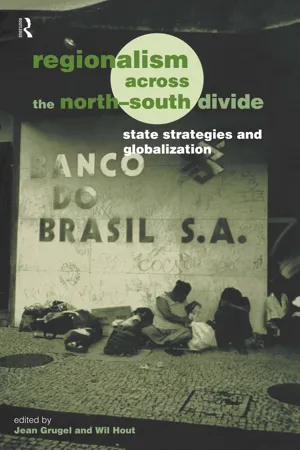
eBook - ePub
Regionalism across the North/South Divide
State Strategies and Globalization
- 208 pages
- English
- ePUB (mobile friendly)
- Available on iOS & Android
eBook - ePub
Regionalism across the North/South Divide
State Strategies and Globalization
About this book
In contrast to most studies of regionalism, Grugel and Hout focus on countries not currently at the core of the global economy, including Brazil and Mercosur, Chile, South East Asia, China, South Africa, the Maghreb, Turkey and Australia. What seems clear from this original analysis is that far from being peripheral, these countries are forming regional power blocs of their own, which could go on to hold the balance of power in the new world order.
Information
Theoretical framework
1
Regions, regionalism and the South
Jean Grugel and Wil Hout
This book examines the trend towards regionalism in the contemporary world order. Until quite recently, studies of regionalism tended to focus on developments in the industrialized areas and/or on the so-called Third World. However, the term ‘Third World’ has ceased to have much analytical significance and scholars have moved on to examining instead the political economy of an increasingly interconnected global order. As one leading scholar of international political economy has phrased it, a ‘main source of academic uncertainty and confusion…has been the collapse of the Third World coalition of less developed countries’ (Strange 1995:162). Consequently, the focus of regionalist studies must also change. The concept of the Third World, pictured as a group of countries sharing important developmental features and similar linkages with the international system, needs to be reconfigured on the basis of their links (or absence of) with the industrialized world.
At the same time, the nature of regionalism itself has changed dramatically. The form the ‘new regionalism’ assumes has tremendous implications for international relations and for development studies. This book makes its contribution to the understanding of new regionalism by analysing regionalist developments and projects in the South. It examines the emergence of regionalism at the North-South interface, the semi-periphery, and within three distinct regions which group together peripheral countries. It tries to make sense of what regionalism means for the South and thereby to contribute to a deeper understanding of international relations, the relationship between the processes of globalization, regionalization and regionalism, the place of the state in international exchanges and the possiblity of cooperation within the developing world.
Developments in the 1990s have meant that region-building projects, as well as sometimes grouping together countries of roughly similar levels of economic development, also emerged between countries from either side of the ‘North-South divide’. The form and content regionalism assumes in the South has undergone a radical transformation as economic and political elites, and in some cases sectors of civil society, responded to their changing position in the global order and to the weakening of state capacities in the South by seeking new partners outside the state. Contemporary regionalism in the developing world is therefore very different from regionalist attempts in the 1950s and 1960s, when it was overwhelmingly political both in its aspirations and its forms. In contrast to that earlier period, ‘new regionalism’ is principally a defensive response to the economic marginalization of much of the South in the 1980s, its political reconfiguration during the political and economic turmoil at the end of the Cold War, and a fear of, or reaction to, the trend towards a globalized economy. States are the main actors in new regionalist blocs, sometimes responding to demands generated within society, sometimes in response to external pressures, and sometimes as a result of a particular regionalist vision of relatively autonomous state elites.
The book is organized in three sections. Part I provides some background to the changing position in the global order of the South and examines the competing theoretical perspectives on regionalism. This introductory chapter seeks to clarify some of the organizing themes around which the later chapters are constructed. Broadly speaking these are: the impact of globalization on the South; our conceptualization of the South, which we divide into the semi-periphery and the periphery, inspired by a world-system analytical framework; the terms ‘region’, ‘regionalization’ and ‘regionalism’; and the term ‘state strategy’, which is used to explain certain regionalist trajectories. Part II looks at politics within some semi-peripheral states and the role they play in building new regions. Part III discusses regional associations within three developing areas, where the region is taking on a ‘middle position’ between the North and South.
Globalization and the South
Over the last decade, scholars of international relations, international political economy, North-South relations and development studies have noted a transformation of international economic relations taking place. The ‘stretching’ of social, political and economic activities across national frontiers and the ‘deepening’ of the density of patterns of global interconnectedness are generally referred to as globalization (McGrew 1997:7). It is unnecessary for our purposes to enter into the debate whether this constitutes a radical break with past forms of global interaction or merely the intensification of certain trends which have long been present within the global political economy. What is not in dispute is that the contemporary forms of economic interconnectedness impinge on the relationship between the state and capital. The global patterns of trade, investment and production, and hence the choices state elites can make and the range of developmental options available, are being reshaped by: the liberalization of financial markets; the spread of information services and the concomitant mobility of service industries; and the shift from a fordist to a post-fordist system of corporate and industrial organization, resulting in the desire of the producers to locate close to the suppliers and their customers.
Globalization theories, though they draw on a variety of different and sometimes contradictory theoretical perspectives, all start from an awareness that knowledge, production and even diplomacy are no longer the exclusive preserve of the inter-state system. The significance of this lies in the fact that, until recently, the state was seen as the only, or at least the key, political actor in the international system. Many authors now seem to agree that, whereas the state remains an important unit of analysis in the study of the international political economy, it no longer can be the sole unit. Apart from the state, so-called inter-governmental, non-governmental and transnational actors merit attention (Strange 1995:161). Within analyses which attempt to track the consequences of global structural changes, the tendency is to suggest that transnationalized production is leading to changes in the hierarchy of states and the dissolution of borders between states, in so far as they affect production, distribution and economic exchanges generally. New production techniques also contribute to the processes through which new cores and peripheries emerge which do not map directly onto the old state system. Cores and peripheries can now be regions within states or areas that cross state boundaries. Some scholars have mapped these new developments through identifying ‘growth triangles’, such as the SiJoRi triangle in South East Asia, which spans Singapore, Johore Province in Malaysia and the Riau Archipelago of Indonesia.
The tendency towards globalization is undermining the independent policy-making capacity of the state. But it does not affect the policy-making capacity of all states to the same extent. Globalization is an uneven process (Holm and Sørensen 1995:4–7). It is to be expected that ‘weak states’ (Migdal 1988) have less means to hold globalization at bay, whereas ‘strong states’ may be more able to mitigate the effects of globalization. We agree with Hurrell and Woods (1995:469) that
globalization will not lead to the progressive global enmeshment heralded by liberal analysts. Existing inequalities make it more likely that globalization will lead to an increasingly sharp division between ‘core’ states, which share in the values and benefits of a global world economy and polity, and ‘marginalized’ states, some of which are already branded ‘failed’ states.
Thus, it is to be expected that the impact of globalization is greater on less developed countries than on the developed ones. In fact, it has a number of extremely broad-ranging consequences for developing areas. First, it has introduced a strong element of competition between developing countries for investment, the more so as developing states have chosen (or, as some would argue, have been pushed) to adopt neo-liberal, market-friendly macroeconomic and external policies. The ‘competition state’, identified by Cerny (1990), emerges in developing countries as well as in industrialized ones. Second, globalization may lead to a recomposition of, and renegotiation between, the interests the state represents. Third, the new globalizing tendencies almost certainly add more actors to the policy process, and, it could be argued, increase the power of ‘external’ actors over state policy. Apart from the state itself, and local groups, pressure may be brought to bear from, inter alia, foreign firms, foreign states and multinational agencies. The result may be a reduction in the ‘autonomy’ of the state and the range of policy instruments it commands. To use Peter Evans’ (1995) term, the ‘embeddedness’ of the state may be reduced as a consequence of the increasing influence of external actors and this may result in a reduction of the developmental role the state is able to play. And fourth, the process of globalization brings into question the extent to which the rigid divisions between North and South, developed and underdeveloped, can be maintained in the face of an emerging global economy. It points to a separation within the South between those states which can adapt to the new global agenda and those which are unable to do so.
Globalization, therefore, would seem to presage a reconfiguration of the South, as the term was understood in the 1970s, and to pave the way for a reconstitution of a new international order in which some of the larger, more advanced states, the semi-periphery, those with an already established productive base, play a key role. According to Hettne (1995a), ‘a rather selective group of countries are going to make the transition’ to the new rules of the game. It is our contention that one way that semi-peripheral states try to make this transition, and thereby participate within the production structures of the global economy, is through adopting new forms of regional networks which bring in other states and which also lock in multinational producers within the alliance. Peripheral states may also try to participate in new regionalist associations as a way to avoid marginalization. Furthermore, it could be argued that, in an era of increasing globalization in which the international political economy is more dependent on government-firm and firm-firm diplomacy (Stopford and Strange 1991:19–23), the states in the South will experience a further erosion of their negotiating power vis-à-vis transnationally active firms. In this light, the contemporary resurgence of regionalism might be seen as a reaction to the reduced leverage of states in the South. It should also be noted that it is the transformation of the international political economy which has made this new form of regionalism an option, by making it also attractive to some developed states in ‘the North’.
The semi-periphery and the periphery
At the original European Consortium for Political Research (ECPR) workshop in 1995 from which this project emerged, a number of international relations and area studies experts posed the question of how the South is responding to the new global agenda of liberalized trade and globalized forms of production. The question was also raised whether the growing tendency towards globalization means that the state in developing countries has completely lost its power to shape national economic policies. While the answers seem to be complex, and to vary from country to country, and region to region, a common theme emerged for several of the states of the South, especially, though not exclusively, for the more industrialized ones: elites within some developing states and areas are trying to develop strategies for cooperation and integration and are seeking participation in some kind of new regional association or cooperation, with trade and investment links at its centre.
Clearly, then, in most developing countries at least, the state has some policy choices to make. To argue this is not to abandon the notions of inequality, stratification and subordination which are, in our view, at the heart of international exchanges and North-South relations. Rather we thought it important to probe how these regionalist strategies, which are seen as options for development, emerge in some Southern states and intersect with structured inequalities and historical patterns of subordination. We decided that it would make sense to focus more deeply on politics and development within some of these states in order to assess their potential as development strategies. In some cases, it made more sense to focus on the region, rather than the state, as the unit of analysis, and in these cases we tried to identify the inter-state and social alliances out of which regionalism is emerging.
Chapters 3 to 7 focus on the semi-periphery. It is important to note that we are using this term in a significantly looser way than its original formulation by Wallerstein (1974:350; 1979:23). In Wallerstein’s world-system theory, the capitalist world economy is composed of a dominant developed core, a subordinate poor periphery and a political and economic ‘buffer’, called the semi-periphery. He argues that an international division of labour has gradually developed in which some units have come to produce predominantly primary products (agricultural produce and raw materials) while others have been able to develop technologically more sophisticated production processes. Over the last few decades, a ‘new international division of labour’ has come into being in which the traditional dichotomy between primary production and manufacturing has become blurred and parts of typical core production processes have been transferred to peripheral and semi-peripheral areas. Post-fordist production techniques and the growing importance of knowledge over labour intensify the tendency towards an ever more spatially diffused production.
Wallerstein’s original analysis grew out of the study of the rise of the modern capitalist world economy during the ‘long sixteenth century’. The semi-periphery was seen as a ‘transmission belt’ through which flowed the surplus that was syphoned off from the periphery to the core. In this era, the world system was largely undifferentiated. Apart from the European core and semi-peripheral states, a large ‘external’ area existed, which was only gradually integrated into the world economy. However, as a result of the changes in global production techniques and the dispersal of knowledge, the boundaries within the world system are blurring. Empirical analyses of the world system and its hierarchy have showed that the expectation of a simple trichotomy is not borne out (for example, Smith and White 1992). At the same time, the size of the semi-periphery appears to be growing.
Chase-Dunn (1989:212) has attempted to overcome these problems by distinguishing analytically between two kinds of semi-peripheries: ‘those states in which there is a balanced mix of core and peripheral activities’ and ‘those areas or states in which there is a predominance of activities which are at intermediate levels with regard to the current world-system distribution of capital-intensive/labour-intensive production’. This is an acknowledgement of the need to encompass analytically the increasing differentiation in the global economy. Quantitative-empirical researchers, such as Smith and White (1992), have, on their part, made a further empirical distinction of the semi-periphery and the periphery into ‘strong’ and ‘weak’ parts. The ‘strong’ semi-periphery is made u...
Table of contents
- Cover
- Title
- Copyright
- Contents
- Series editor's preface
- Contributors
- Acknowledgements
- PART I Theoretical framework
- PART II State strategies and the semi-periphery
- PART III Reconfiguring regions
- PART IV Conclusion
- Bibliography
- Index
Trusted by 375,005 students
Access to over 1.5 million titles for a fair monthly price.
Study more efficiently using our study tools.
Frequently asked questions
Yes, you can cancel anytime from the Subscription tab in your account settings on the Perlego website. Your subscription will stay active until the end of your current billing period. Learn how to cancel your subscription
No, books cannot be downloaded as external files, such as PDFs, for use outside of Perlego. However, you can download books within the Perlego app for offline reading on mobile or tablet. Learn how to download books offline
Perlego offers two plans: Essential and Complete
- Essential is ideal for learners and professionals who enjoy exploring a wide range of subjects. Access the Essential Library with 800,000+ trusted titles and best-sellers across business, personal growth, and the humanities. Includes unlimited reading time and Standard Read Aloud voice.
- Complete: Perfect for advanced learners and researchers needing full, unrestricted access. Unlock 1.5M+ books across hundreds of subjects, including academic and specialized titles. The Complete Plan also includes advanced features like Premium Read Aloud and Research Assistant.
We are an online textbook subscription service, where you can get access to an entire online library for less than the price of a single book per month. With over 1.5 million books across 990+ topics, we’ve got you covered! Learn about our mission
Look out for the read-aloud symbol on your next book to see if you can listen to it. The read-aloud tool reads text aloud for you, highlighting the text as it is being read. You can pause it, speed it up and slow it down. Learn more about Read Aloud
Yes! You can use the Perlego app on both iOS and Android devices to read anytime, anywhere — even offline. Perfect for commutes or when you’re on the go.
Please note we cannot support devices running on iOS 13 and Android 7 or earlier. Learn more about using the app
Please note we cannot support devices running on iOS 13 and Android 7 or earlier. Learn more about using the app
Yes, you can access Regionalism across the North/South Divide by Jean Grugel, Wil Hout, Jean Grugel,Wil Hout in PDF and/or ePUB format, as well as other popular books in Politics & International Relations & Globalisation. We have over 1.5 million books available in our catalogue for you to explore.